
China product sourcing becomes difficult for a brand when the product, the proof, and the release decision live in different places. A factory may have an approved sample, a sourcing team may have a quotation, and a quality team may have an inspection report—yet none of those records tells the buyer whether the exact SKU that will ship is still the SKU that was approved.
The practical answer is to demand a release system before production moves too far. It does not mean asking a supplier for every possible certificate or adding a generic inspection at the end. It means agreeing which product version is being bought, how changes are approved, what evidence applies to that version and destination market, and who can release or hold the goods. That structure makes quotations comparable and late surprises easier to contain.
Demand a Release System, Not a Supplier Promise
A reliable brand sourcing brief connects product definition, evidence, change control, and release action. Treat those four elements as one chain: a versioned definition identifies what is being made; change control prevents silent substitutions; evidence shows what was checked for the relevant product and market; and a release rule converts all of that information into a named decision.
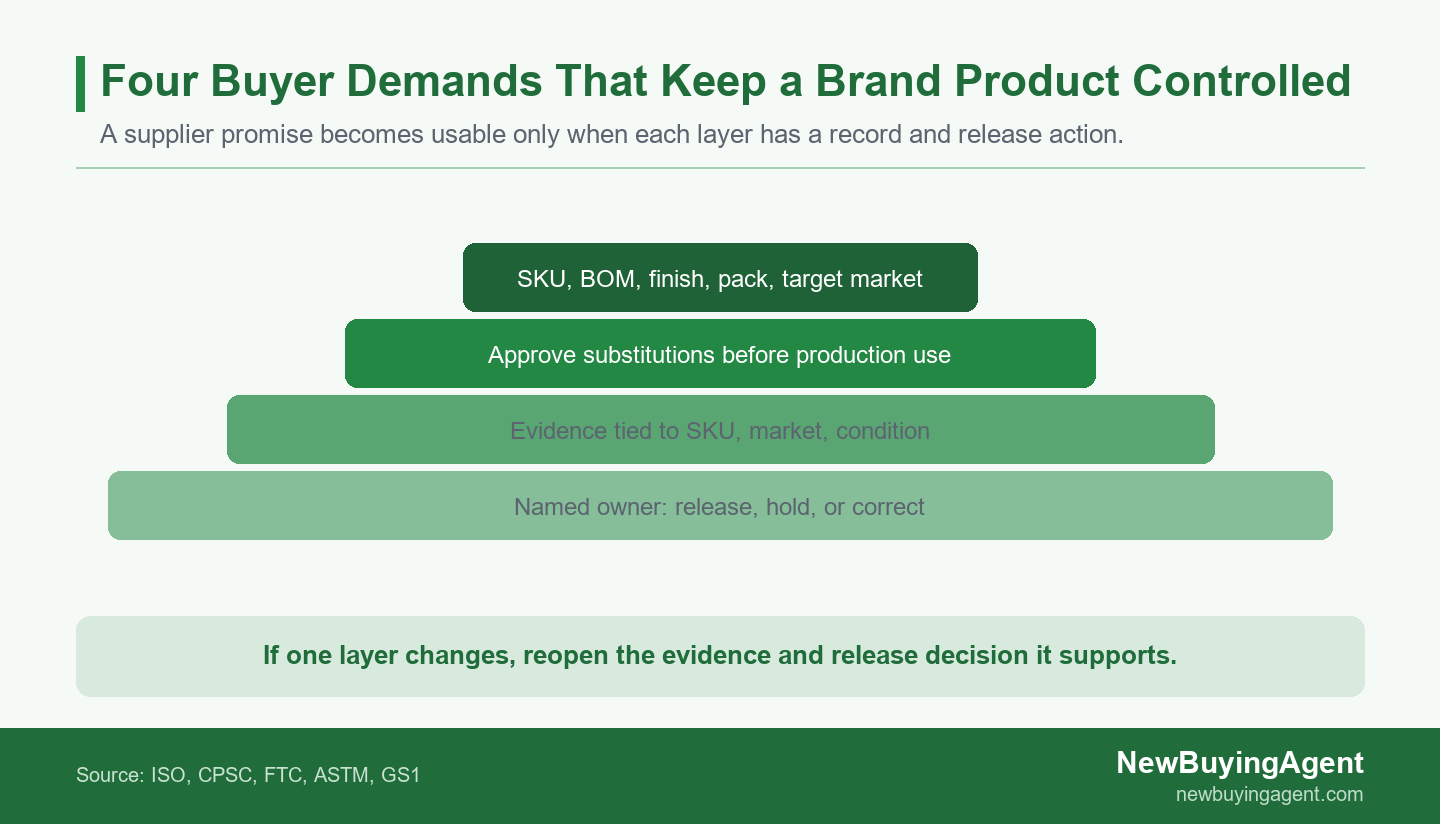
Each sourcing demand needs a named record and decision owner before it can protect a branded product release.
That is a materially different request from “please keep quality high.” A broad promise leaves the buyer to interpret a sample, a test report, and a final inspection after the fact. A release system gives every party a practical question to answer before an order proceeds: which record changed, which proof is affected, and what is the disposition?
For brand buyers, the minimum useful stack is:
- Product definition: SKU, materials, finish, artwork, packaging, destination, and commercial conditions are in one approved version.
- Change control: no material, component, process, artwork, or packaging substitute is used without a recorded review.
- Applicable proof: a report, certificate, or check identifies the product, component, condition, market, and rule it supports.
- Written release: a named owner decides release, conditional release, rework, hold, or rejection against agreed criteria.
A buyer does not need to impose a universal test plan on every product category. The category, destination, contract, and risk determine the right proof. What should stay constant is the control logic: a record must point to the exact product decision it is meant to support.
Demand a Versioned Product Definition Before You Compare Quotes
ISO 9001 includes documented information as a QMS component, supporting a controlled product record rather than scattered supplier messages. The standard does not prescribe a buyer’s quotation template, but it is a useful boundary: information that controls a product should be available, identifiable, and maintained as the work moves forward. ISO 9001
A versioned product record should include intended market and commercial conditions before supplier quotes are compared. “Same product” is not enough if one supplier is pricing a different grade of material, a different packaging configuration, or a product for a different sales channel.
Start with a buyer-owned product record, even if the factory will later translate it into its own production documents. Give it a version number and date. The record should state the exact SKU or family, reference sample, dimensions and tolerances that matter, approved finish or color, artwork version, packaging configuration, target markets, order quantity, delivery terms, and acceptance conditions. If a field is not yet fixed, mark it as open rather than allowing each supplier to assume a different answer.
Include a bill of materials—the named list of materials, components, finishes, and packaging that make up the approved product—at the level needed to control the buyer’s risk. A ceramic gift set may need the body, glaze, decal, inner insert, master carton, and labeling version. A simple textile accessory may need fabric composition, coating, label, polybag, carton, and barcode placement. The point is not to create factory engineering documentation; it is to make the commercial comparison truthful.
Market fit belongs in the record because it changes the sourcing question. A buyer exploring a new category can test the product concept against market-fit signals before freezing design and commercial assumptions. Once quotations are requested, however, the supplier should receive the same controlled version so price, lead time, and feasibility are being compared on like-for-like inputs.
Ask suppliers to return a short confirmation against the record: which fields they can meet exactly, which require clarification, which need a change, and which depend on a quantity or route assumption. That response is more useful than a one-line quotation because it exposes an unresolved product decision before it becomes a production discrepancy.
Demand Change Control Before a Factory Uses a Substitute
ISO 10007:2017 provides configuration-management guidance applicable from product concept to disposal, supporting deliberate version and change records. In a buyer’s sourcing workflow, that supports a simple discipline: an approved sample should not silently authorize a later substitution. ISO 10007:2017
Change control is a written rule for reviewing and approving any change before it is used in production. It should cover more than obvious material swaps. A factory may change a glaze, coating, zipper, foam density, print method, carton board, label placement, tooling setting, sub-supplier, or process step because the original choice is unavailable or costly. Some changes are harmless; some alter safety, fit, finish, claim substantiation, durability, or freight performance. The buyer’s job is not to ban every change. It is to make the change visible and decide what has to be reopened.
Use a change request with five fields: the current approved version; the proposed change; why it is proposed; the affected SKUs, lots, and markets; and the approval action. The approval action can be “accepted without further proof,” “accepted after sample review,” “accepted after named evidence is refreshed,” or “not accepted.” Add the owner and date. A change without those fields is a supplier message, not a controlled decision.
A buyer with an existing China factory can use a local management service to keep approved changes and evidence connected to the production record. NewBuyingAgent coordinates local supplier communication, production progress, quality management, and logistics for buyers with existing China factories. Where those responsibilities sit across several people, a local coordination path can keep the approval question from disappearing between chat messages and inspection reports. Buyers that need that operating layer can keep approved changes connected to the China supplier record.
Set a practical deadline. For example, require the factory to submit a proposed change before procurement or use, not after it appears in final inspection. Then make the release consequence explicit: unapproved changes cannot be released merely because the visual result appears acceptable. That one rule protects the commercial record as well as the physical product.
Demand Evidence That Matches the SKU and Destination Market
For an overseas-made U.S. finished product that must be accompanied by a certificate, 16 CFR 1110.7 identifies the importer as the finished-product certifier. This is a useful example of why a factory’s generic certificate does not transfer the buyer’s responsibility: the applicable rule, product, and importing arrangement determine who must make the final certification decision. 16 CFR 1110.7
Evidence should identify the exact SKU, component, condition, and applicable market requirement it supports. A report without that scope may still be useful background, but it is weak release evidence because the buyer cannot tell whether it applies to the goods, configuration, and market now under review.
For each requirement, write a proof chain rather than collecting certificates in a folder. The chain should name: the buyer requirement; the relevant product or component; the destination market; the applicable rule, customer requirement, or contract clause; the evidence needed; the document owner; the date or lot it applies to; and the release consequence if the record is missing or does not match.
Component evidence needs careful scope control. U.S. regulation on relying on component testing requires, among other conditions, that the tested component be identical in all material respects, traceable, and accompanied by specified documentation when a finished-product certifier relies on another party’s testing or certification. That does not create a universal retest schedule for every imported product, but it illustrates why a buyer should ask whether the component, lot, and record can actually be connected. 16 CFR 1109.5
A usable request is specific: “Confirm whether the tested glaze is the one used on SKU DW-02 for the U.S. order, identify the test date and laboratory, and state whether the revised carton changes the evidence or labeling record.” An unusable request is “send all certificates.” The first creates a decision path. The second produces documents without a clear release consequence.
Compliance requirements vary by product category and destination. Obtain qualified category- and market-specific advice before printing, importing, or releasing goods where legal obligations apply, and record the result in the proof chain.
Demand Proof Before You Print a Product Claim
FTC guidance advises against broad unqualified environmental benefit claims and calls for clear, prominent, specific qualifications. For a brand buyer, the operational lesson is straightforward: do not let a packaging line, hangtag, or product listing run ahead of the defined evidence and the exact wording it is meant to support. FTC Green Guides summary
A packaging or product claim should not be released until its exact wording, material scope, and evidence owner are identified. This applies to environmental language, performance statements, origin wording, capacity statements, and any other claim that depends on more than visual design.
Add a claim register to the product record. One row should state the exact claim, the SKU and market where it will appear, the component or product scope, the evidence or review it relies on, the owner, and the approved artwork version. “Eco-friendly packaging” is not a control field. “Carton insert uses X material; approved wording is Y; evidence owner is Z; artwork version is A-04” is a control field.
When a component changes, reopen the relevant claim row as well as the bill of materials. A revised carton insert may not alter the drinkware itself, but it can invalidate a printed statement about packaging material. That link between a small sourcing change and a market-facing claim is often where a well-made product still creates avoidable brand risk.
Demand a Defect Taxonomy and a Written Release Rule
ISO 2859-1 specifies acceptance sampling systems for inspection by attributes, which must be paired with the buyer's defect categories and release rule. Sampling can help structure an inspection, but it does not decide whether a particular brand should release a lot with a missing document, an unapproved change, or a market-specific claim gap. ISO 2859-1 overview
A sample-inspection result is a release input, not a substitute for a written disposition of major product or document gaps. The release rule must say what happens when the observed issue is found, who can decide, and what proof reopens the decision.
Define defects in buyer language before inspection begins. Critical, major, and minor categories can be useful only if each one has a product-specific meaning. For a premium ceramic set, a hairline crack, unstable base, incorrect food-contact marking, or wrong gift-box artwork may have very different consequences. Do not rely on an AQL label without the written defect taxonomy and disposition authority that make it usable.
Write the rule in operational terms. For example: “Release only if the agreed inspection result is within the stated acceptance criteria, there are no critical defects, all approved version fields match the packed goods, and any agreed documents are complete.” Then specify alternatives: conditional release with a documented concession; rework and reinspect; hold the affected scope; or reject. The buyer should know which of those choices is available before the report arrives.
| Buyer demand | Record to request | Release consequence |
|---|---|---|
| Product matches the agreed SKU | Versioned specification, approved sample reference, BOM, and artwork | Hold any unit or lot that does not match the approved version. |
| Changes are visible before use | Change request with affected scope, approval, and evidence impact | Do not release unapproved substitutions. |
| Evidence applies to the shipment | SKU/component/market proof chain with owner and date or lot | Escalate unmatched or missing proof before release. |
| Inspection informs a decision | Defect taxonomy, inspection report, and signed disposition | Release, rework, hold, or reject through the agreed rule. |
Acceptance sampling is an agreed method for inspecting a sample of a lot against defined defect categories. It is not a promise that every unit is perfect, and it should never erase the separate question of whether the correct product version and evidence are present.
Demand Packaging Proof for the Actual Delivery Route
ASTM D4169 describes evaluation of shipping units using a test plan with anticipated distribution hazards and says it does not replace material specifications or preshipment procedures. The useful buyer question is therefore not “has the carton been tested?” but “which shipping unit, route assumptions, and hazards does this evidence address?” ASTM D4169
Traceability should connect the product identity, component, evidence, and shipment-handling record that the release decision relies on. GS1’s traceability framework describes critical tracking events and key data elements, useful concepts for deciding which product, pack, lot, and movement records need to stay connected. GS1 traceability guidance
For branded goods, packaging belongs in the product definition and the release record. Record the inner pack, master carton, pallet or shipping unit where relevant, route conditions, handling limits, and current artwork. If a supplier changes carton board, divider design, void fill, or pack quantity, treat it as a product-and-logistics change—not a cosmetic afterthought.
This is also where order-level traceability pays off. The buyer should be able to connect the finished SKU and its lot to the carton version, inspection result, approved artwork, and shipment record. Without that connection, a packaging failure or market complaint becomes a broad supplier argument instead of a focused investigation.
Worked Scenario: A Brand Holds Only the Changed Ceramic Sets
In the illustrative scenario, only changed ceramic sets remain on hold until the altered glaze and carton insert are approved against the written requirement. This is not a customer result or a universal compliance protocol; it shows how the release system can turn a late change into a scoped decision.
An illustrative premium homeware brand is preparing a ceramic drinkware range for two destination markets. The order contains 4,800 sets. The approved sample, artwork, and initial material record cover the original glaze and carton insert. During production, the factory proposes a replacement glaze for 1,600 sets and changes the carton insert used with those same sets.
The buyer does not start with “is the new glaze good?” The first question is scope: which finished sets use it, which cartons are affected, and which markets do those units serve? The supplier can trace the substitute glaze and revised insert to 1,600 sets. The remaining 3,200 sets retain the approved components and packaging record.
Why the Hold Applies to 1,600 Sets, Not All 4,800
In the illustrative scenario, the traceable 1,600 changed sets stay on hold while the 3,200 unchanged sets proceed under their own written release rule. The split is defensible because the scope of the change is identifiable; it is not a shortcut for releasing a product whose changed components cannot be traced.
An illustrative premium homeware brand is preparing a ceramic drinkware range for two destination markets. The buyer’s requirement is to protect the approved product version while avoiding an unnecessary all-order delay. The sourcing decision is therefore based on the changed component and packaging record, not on a general judgment about the factory.
For the 1,600 changed sets, the buyer opens a new version record. It names the replacement glaze, revised carton insert, affected SKUs and quantities, destination markets, and the original approvals that no longer apply unchanged.
The original sample and evidence can remain part of the file, but they do not automatically release the changed subset. The team checks whether the change affects the applicable product evidence, product claim register, packing requirements, or the agreed inspection criteria.
The substitute glaze is traceable to the 1,600 affected sets, not the full order. Because the changed sets are traceable, the buyer can direct inspection, evidence review, and any rework decision to that subset.
The revised carton insert changes the product-and-packaging version used for those sets. The unchanged 3,200 sets still need to meet their own written release rule; they are not “pre-approved” merely because the changed subset is held.
The key mechanism is a traceable subset. If the factory could not identify which sets used the replacement glaze or revised insert, the buyer would have a wider evidence gap and might need to hold a larger scope. Traceability changes the geometry of the decision.
The buyer places the 1,600 changed sets on partial hold. The factory may proceed only with the agreed review and proof for that version. The 3,200 unchanged sets move through their separate release path, subject to the approved record, inspection outcome, and document check.
The corrective action is not “test everything again.” It is to obtain the agreed proof for the changed glaze and insert, refresh any affected artwork or claim approval, and document the reviewer’s disposition against the relevant destination-market and contract requirements.
The held subset reopens only when the record identifies the changed components, matching evidence, reviewer, and final disposition. That gives the buyer a clear closeout gate rather than a vague request for the supplier to “confirm quality.”
This is an illustrative sourcing scenario, not a customer result, universal compliance protocol, or test recommendation. The applicable evidence and release rule depend on the product category, destination market, contract, and exact change at issue.
Turn Those Demands into a China Product Sourcing Brief
NewBuyingAgent can turn buyer purchasing needs into quoted China-sourced product solutions with product selection, production follow-up, quality-control coordination, and logistics support. The most productive starting point is a controlled requirement pack rather than a loose product image and target price. Turn a controlled product brief into China-sourced products.
Before a sourcing discussion, assemble the current product version, target markets, quantity and delivery assumptions, approved sample or reference images, material and packaging requirements, claim register, change-control rule, evidence questions, inspection taxonomy, and proposed release owner. If some information is unknown, label it as a decision to resolve. That makes it possible to distinguish a supplier feasibility question from an unfinished buyer requirement.
During supplier comparison, ask each factory to respond in the same order: confirm the version quoted; list every exception; identify any sub-supplier or process dependency; state the likely production lead time; and name the information needed before sample approval or mass production. Use one response sheet for all factories. It gives a brand team a clean record of what was promised, what is assumed, and which issues remain open. If the commercial quote changes after an approved revision, update both the product record and the quote comparison rather than treating technical and commercial changes as separate conversations.
A sourcing partner can then help organize supplier responses, compare the assumptions behind quotes, coordinate approved changes, and keep production and quality records connected. Agree in advance who receives change requests, who asks for missing evidence, who reviews samples or inspections, and who owns the final disposition. That workflow avoids a familiar failure: every participant assumes someone else approved a change, while no one can show the decision record.
The standard to aim for is simple: every critical promise made to a customer should lead back to a versioned product record, applicable proof, and a named release decision. To begin with the right inputs, send NewBuyingAgent a product requirement pack that identifies the product version and the decisions still open. That is what turns China product sourcing from document collection into controllable brand execution.
China Product Sourcing Buyer FAQs
The applicable evidence and release rule depend on product category, destination market, contract, and the exact SKU change at issue. The questions below preserve that boundary rather than treating any one certificate, sample, or inspection result as a universal answer.
What should a brand buyer demand before requesting a China product quote?
Start with a versioned product definition: the SKU, reference sample or artwork, materials and packaging, target market, quantity, delivery assumptions, and open decisions. Ask every supplier to confirm assumptions and exceptions against that same version. This makes quotation comparisons meaningful and shows which issues need resolution before production.
Is an approved sample enough to release production?
Usually, no. An approved sample is an important reference, but it does not control later material, process, artwork, or packaging changes unless those changes are recorded and approved. Release should also consider the applicable inspection outcome, evidence, written disposition, and the factory’s confirmation that the packed goods still match the approved production version.
How should a buyer handle supplier material changes?
Require a written change request before the new material is used. It should identify the old and proposed materials, affected SKUs and lots, reason for the change, markets affected, evidence impact, approver, and release consequence. Then reopen only the proof and decisions affected by that change, while holding the scope that cannot yet be released.
Which compliance records should a brand request from a China supplier?
Request records that match the exact product, component, destination market, and applicable requirement—not a generic certificate bundle. Depending on the category, that may include test reports, certificates, labeling evidence, technical files, or supplier declarations. Confirm with qualified compliance advisers where legal obligations apply, then record the owner, product version, and release consequence for each requirement before the goods are cleared to ship.
NewBuyingAgent
Related Resources

Начните сегодня
Давайте превратим ваши цели по закупкам в реальностьWeChat:+86 15157124615
WhatsApp:+86 15157124615
Адрес: Здание 10 #39 Xiangyuan Road, Ханчжоу, Китай