

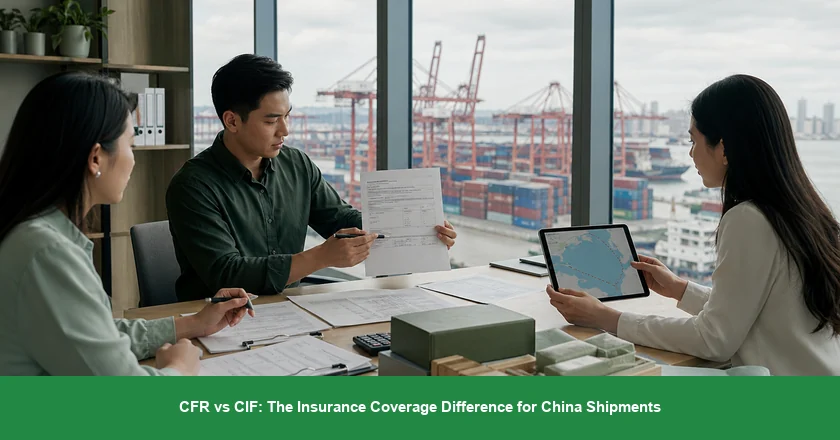
A CFR or CIF quotation can look like a simple freight choice, yet its practical difference is often decided before a China shipment reaches the port: who has arranged cover, what that cover actually says, and whether the buyer can use it if cargo is damaged after loading. The named destination does not answer those questions. It tells the seller where to arrange carriage; it does not move the shipment-stage risk to arrival.
For ocean or inland-waterway cargo, the decision is whether the buyer will arrange cover directly or require the seller to arrange defined cover, and how the parties will preserve a workable claim route. The sale contract, policy wording, carrier terms, and payment documents remain separate records with their own requirements.
CFR and CIF Separate Cost, Risk, and Insurance
CFR and CIF both place shipment-stage risk on the buyer once the goods are loaded on board, but CIF adds a seller duty to arrange insurance for that buyer-held risk. In plain language, CFR means Cost and Freight: the seller pays agreed carriage to the named port, while the buyer arranges any cargo insurance it wants. CIF adds Insurance to that cost-and-freight arrangement, but it does not postpone risk transfer to the destination.
- CFR: decide on buyer-arranged cover before the on-board loading point.
- CIF: ask what seller-arranged cover is required and what extra scope the contract should specify.
- Both: capture loading evidence, the cargo identity, and the correct claim contact while the shipment record is still easy to verify.
- Neither: substitutes for reading the sale contract, policy, carriage terms, and payment-document requirements together.
The buyer’s commercial decision may be to control the policy directly under CFR, or to require a defined seller-arranged policy under CIF. Either way, the selected term needs to become a written pre-loading instruction, not merely an abbreviation in a quotation.
Under Both Terms, Risk Moves at Loading—not Arrival
Under CFR and CIF, the named destination is where the seller must arrange carriage, not where delivery and risk transfer occur. That distinction matters because a CFR Rotterdam or CIF Los Angeles price can visually pull attention to the destination even though the decisive risk point is earlier, when the cargo is loaded on board at the named port of shipment.
The buyer needs a shipment notice and the exact loading evidence because risk can transfer before the buyer sees the goods in transit. Ask for the vessel and voyage reference, actual loading date, bill-of-lading details when issued, container or cargo identifier where relevant, and the contact responsible for sending a loss notice. Those items do not decide liability by themselves; they create a record that can be matched to the policy and the physical shipment.
This is the point at which cargo insurance becomes operational rather than theoretical. A buyer that only reviews the term after receiving an arrival notice may be reviewing it after the risk window has already opened. The U.S. International Trade Administration similarly frames Incoterms® as an allocation of buyer and seller tasks, costs, and risks, including responsibility for cargo insurance.
CFR Leaves Insurance to the Buyer; CIF Adds Minimum Cover
CFR leaves the buyer to arrange cargo insurance, while CIF adds a seller duty to arrange minimum insurance for the buyer-held transit risk. The difference is important, but it is not a promise that a CIF shipment has the scope of cover the buyer expects. The contract should name the Incoterms® version, named port, and any requested scope above the default requirement.
For a new product order, the insurance instruction belongs with the product, packing, destination, and booking assumptions—before a supplier quotes a term that everyone later interprets differently. Buyers preparing a China product requirement can give NewBuyingAgent the shipping requirements for a China product quotation, including the named port and insurance evidence they need; the buyer still makes the trade-term and risk-acceptance decision.
Under CFR, Buy the Policy Before the Risk Window Opens
CFR does not oblige the seller to obtain cargo insurance for the buyer, so the buyer must decide and arrange the cover needed for the exposure it bears. That can be attractive when the buyer has its own annual facility, preferred broker, a portfolio-level deductible, or a policy designed for its product mix. It also means the buyer should confirm attachment from the relevant loading point, insured value, voyage or transit scope, exclusions, deductible, notice requirement, and the claims channel. A confirmation that “insurance is in place” is less useful than evidence tied to this shipment.
Under CIF, Read the Minimum-Cover Boundary
CIF requires the seller to arrange insurance, but the default obligation is minimum Clause C cover or similar unless the sale contract specifies more. Clause labels and policy wording need to be read in context; they are not a shortcut to a claims outcome. If the cargo is high value, fragile, theft-sensitive, temperature-sensitive, or subject to special handling, the buyer can ask its broker or insurer what scope is appropriate and then state the required specification in the contract.
Under CIF, request the insurer or policy issuer, the insured or claim beneficiary, the policy or certificate number, insured value and currency, stated transit, deductible if shown, exclusions or applicable clauses, and the loss-notice contact. Where documentary credit is used, document form can matter as well. The goal is not to force a supplier to provide a generic certificate; it is to ensure that the requested evidence and the sale term say the same thing.
Compare the Policy, Not Just the Term
A buyer should compare the actual policy, deductible, transit scope, insured value, exclusions, and claim contact with the shipment's exposure instead of treating the word CIF as a complete coverage description. ICC notes that related contracts require their own alignment, and U.S. trade guidance cautions that carrier liability may be limited and adequate cover should be checked rather than assumed.
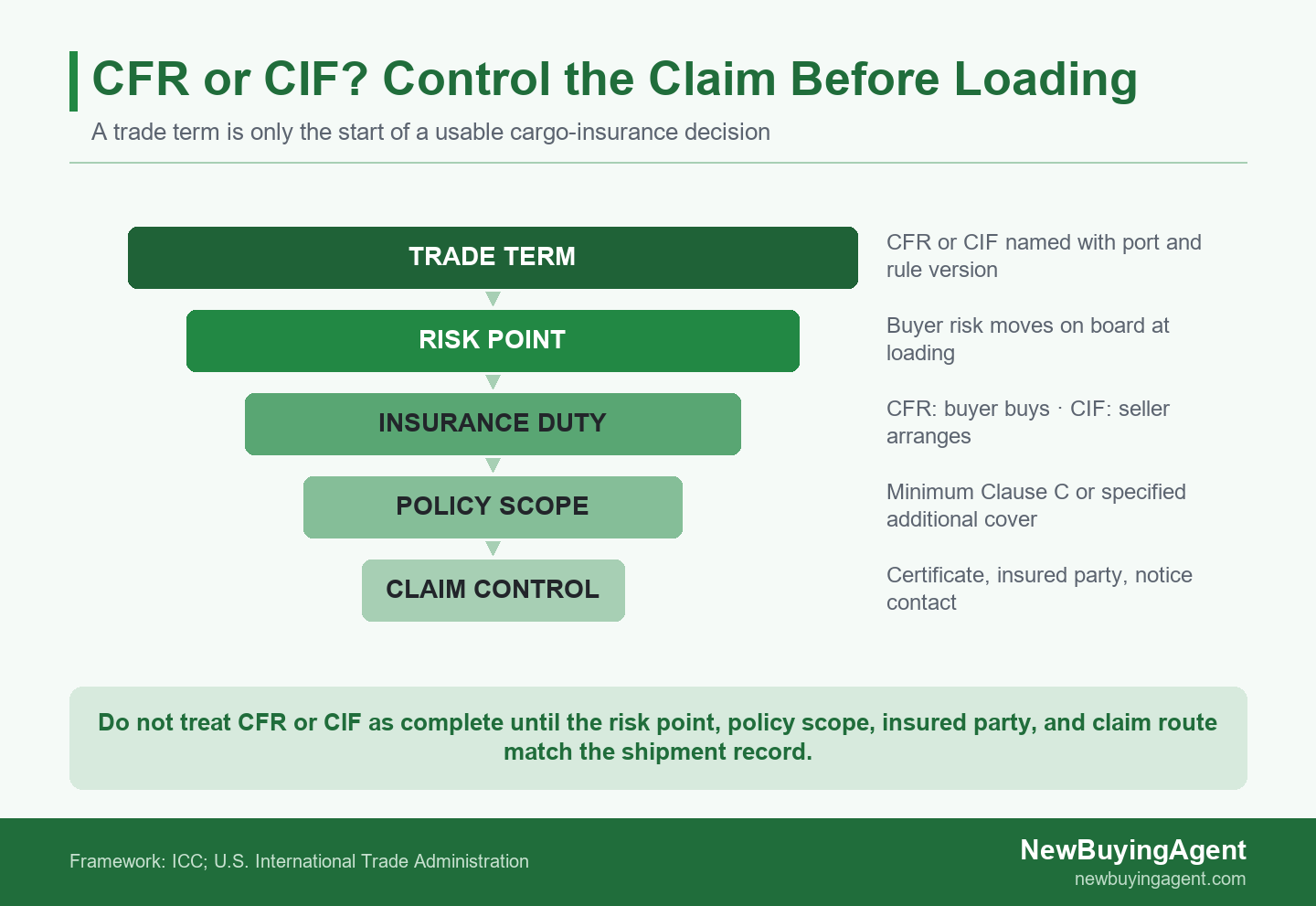
Funnel diagram showing the evidence a buyer needs to control CFR or CIF cargo insurance before a China shipment loads
| Control point | CFR buyer check | CIF buyer check |
|---|---|---|
| Who arranges cover? | Buyer or buyer-appointed broker/insurer | Seller, subject to the contract’s stated requirement |
| When must it be ready? | Before buyer-held risk begins at loading | Before documents are due; verify the evidence before relying on it |
| What needs checking? | Attachment point, scope, value, deductible, exclusions, contacts | Minimum cover, beneficiary, policy scope, value, evidence, contacts |
| What does the term not settle? | Policy wording, insurer obligations, carrier liability, payment documents | Policy wording, insurer obligations, carrier liability, payment documents |
Use the table as a comparison prompt, not an insurance checklist that fits every commodity. The point is to surface the buyer’s questions while there is still time to change the instruction, obtain a broker’s view, or choose a different trade arrangement. It is much harder to reconcile a certificate, a bill of lading, and a sales contract after a loss notice is required.
Make Insurance Evidence Part of Claim Control
For CIF, insurance must allow the buyer or another party with an insurable interest to claim directly from the insurer, making the certificate or policy a live control document rather than a filing attachment. Ask early who will make the claim, who can notify the insurer, and whether the document names the appropriate party or permits that party to claim. Keep a copy alongside the commercial invoice, packing list, bill of lading, survey evidence where relevant, and the correspondence that records discovery of loss or damage.
Incoterms® rules do not bind the insurer, carrier, or bank, so the sale term, policy wording, carriage contract, and payment documents must be checked for alignment. This boundary prevents two common errors: assuming the freight contract automatically gives the buyer the desired insurance rights, and assuming an insurance document automatically satisfies a payment condition. The insurance certificate is evidence of cover; it does not by itself settle every policy, carrier, or bank question.
Existing supplier relationships often add a China-side coordination challenge: factory documents, booking information, and buyer-held policies may originate in different places. Buyers keeping those relationships can see how NewBuyingAgent supports existing China factory orders while retaining control of the commercial term, policy selection, and any claim decision.
Illustrative Scenario: A Damaged China Shipment After Loading
Four Questions Before the Vessel Loads
A missing insurance instruction can leave a buyer carrying cargo risk at loading without a confirmed policy, beneficiary, or claim route. Consider a retailer importing 900 cast-aluminium garden-light housings for a seasonal launch on one port-to-port ocean shipment. The goods will move from Ningbo to Rotterdam. The supplier quotes CFR Rotterdam, Incoterms® 2020, and confirms a vessel booking two days before loading.
The buyer will bear risk once the goods are loaded on board even though the seller pays freight to Rotterdam. A lower CFR price does not include a seller obligation to arrange cargo insurance for the buyer. The buyer reads “Rotterdam” as if the supplier carries the risk to Europe, but it has not confirmed whether its annual policy attaches at Ningbo loading, whether the insured value matches the order, or who will issue a loss notice if the container arrives with wet or damaged cartons.
The appropriate response is not automatically to replace CFR with CIF. Changing to CIF would add a seller insurance obligation, but the buyer would still need to verify the actual cover and direct-claim evidence. CFR may remain the right arrangement if the buyer wants its own policy and has confirmed the required evidence. CIF may be more suitable if the parties explicitly require seller-arranged cover and specify more than the default minimum where needed.
Before a vessel loads, the buyer should be able to answer who bears risk, who buys cover, what the evidence says, and who can notify and claim after loss.
- Does the contract name CFR or CIF, the correct Incoterms® version, and the specific port?
- Does the policy or certificate identify the cargo, transit, insured party or claimant, value, and route in a way that can be matched to this shipment?
- Does the team have the actual loading evidence and a clear document deadline, rather than an estimate based on booking date?
- Does the buyer know the loss-notice contact and the documents the insurer or broker says are needed after damage is discovered?
The sourcing partner records 1 named loading port, 1 policy reference, and 1 documented loss-notice route alongside the cargo description, bill-of-lading details, and document deadline. The release check is complete only when those records match the same shipment. This illustrative example shows an operating check, not a prediction of liability or a claim result; the sourcing partner should not make insurance, legal, or claim decisions for the buyer.
Put the Insurance Instruction in the China Shipment Brief
A China shipment brief should state the named port, Incoterms® version, risk point, insurance responsibility, coverage specification, evidence deadline, and claim contacts.
For a buyer that needs China-side product sourcing and shipment coordination, make the brief concrete: name the product and order value, destination and named port, cargo sensitivity, desired policy scope, required certificate or policy evidence, and the people who should receive shipping and loss-notice information. Include the version of the agreed trade rule rather than writing only “CIF” or “CFR.” This gives factories and logistics contacts a controlled set of assumptions while leaving the buyer’s commercial and insurance choices visible.
A buyer can give NewBuyingAgent the product, destination, named port, order value, cargo sensitivity, and required insurance evidence as part of a China sourcing requirement. That creates a usable handoff: the China-side team can identify the shipping record to collect, while the buyer retains the commercial choice of term, policy scope, and claim approach.
Before selecting a partner, buyers can review NewBuyingAgent public sourcing cases as partner-evaluation context. When the details are ready, send NewBuyingAgent a China sourcing requirement with shipment assumptions so the product, China factory coordination, and document expectations can be discussed against the same brief.
Frequently Asked Questions
Does CIF mean the seller bears transit risk until arrival?
CFR and CIF answer a narrow allocation question; they do not by themselves define all policy terms, payment conditions, or cargo-claim procedures. Under CIF, the seller pays agreed freight and arranges the required insurance, but the buyer normally bears shipment-stage risk once the goods are loaded on board at the port of shipment. The named destination is still important for the carriage obligation. It should not be read as a statement that risk remains with the seller until the vessel, container, or goods arrive there.
Can a buyer use CFR without cargo insurance?
CFR does not create a seller obligation to arrange cargo insurance. A buyer may make its own risk and insurance decision, but should do so before the on-board loading point where it bears the shipment risk. A buyer with an annual policy should confirm whether that facility applies to the commodity, route, value, and loading point instead of assuming every purchase is automatically covered.
Is CIF insurance broad enough for every China shipment?
Not automatically. CIF normally requires minimum Clause C cover or similar unless the sale contract specifies a different requirement. The right scope depends on the cargo and the buyer’s own risk decision. Read the policy wording and seek advice from the appropriate insurer, broker, or adviser where needed; a trade term is not a substitute for confirming exclusions, insured value, deductible, or claim conditions.
What should a buyer verify on a CIF insurance certificate?
Start by matching the certificate or policy to the sale term and shipment: insurer or issuer, insured or claimant, cargo description, insured value and currency, transit, and policy or certificate reference. Then confirm the source for loss-notice instructions and any document requirement that applies to the payment method. If an item is unclear, resolve it before treating the document as proof that the buyer can make the intended claim.
Are CFR and CIF right for every container shipment?
Not necessarily. CFR and CIF are designed for sea or inland-waterway transport, and the selected rule should fit the actual delivery point and carriage arrangement. A container shipment may have handovers before vessel loading that make another rule more appropriate in the commercial agreement. Confirm the operational facts with the contracting parties and use the version of the Incoterms® rules stated in the sale contract.
What determines how a cargo claim is decided?
A claim can depend on policy wording, the facts of the loss, notice timing, the carrier contract, evidence, applicable law, and the parties’ agreements. CFR or CIF clarifies selected buyer-seller obligations but does not decide every claim question. For a live loss, follow the policy’s notice process and obtain advice from the insurer, broker, carrier, and qualified advisers as appropriate.
NewBuyingAgent
Related Resources


Начните сегодня
Давайте превратим ваши цели по закупкам в реальностьWeChat:+86 15157124615
WhatsApp:+86 15157124615
Адрес: Здание 10 #39 Xiangyuan Road, Ханчжоу, Китай
