

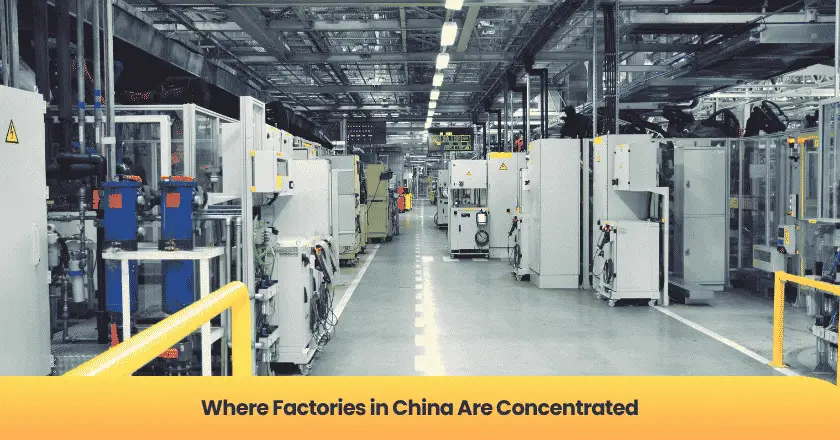
A buyer plans a ten-day sourcing trip covering electronics, home textiles and stainless steel kitchenware. The itinerary runs Shenzhen, then Shaoxing, then Qingdao, with two internal flights and four hotels. It is an entirely reasonable plan and it is also three separate trips wearing one calendar, because those products live in three different manufacturing belts more than a thousand kilometres apart.
Chinese manufacturing is not spread evenly. It concentrates into a handful of belts, each with its own categories, its own port and its own cost level, and knowing which belt your product belongs to determines almost everything practical about sourcing it.
Key Takeaways
• Most export manufacturing sits in four belts: the Pearl River Delta, the Yangtze River Delta, the Bohai Rim and Fujian.
• Each belt is served by its own major ports, which shapes freight options and inland trucking cost.
• Inland provinces have grown substantially and typically trade lower labour cost against extra days to reach a port.
• Category and region are linked tightly enough that the wrong region means higher prices and slower samples.
• Plan trips by belt rather than by product list, since crossing belts costs a day each time.
The Four Coastal Belts
Four regions account for the large majority of what an importer is likely to buy, and they differ in character rather than only in geography.
The Pearl River Delta
Guangdong province around Shenzhen, Dongguan, Guangzhou, Foshan and Zhongshan is the belt most foreign buyers meet first. Electronics and electrical goods dominate, with component depth that is genuinely difficult to replicate, alongside furniture, lighting, hardware and plastics.
Shenzhen and Guangzhou are the export gateways, and both rank among the country's largest container ports in the throughput figures published by the Ministry of Transport.The belt is well set up for foreign buyers, with the most English-capable sales staff and the shortest distances between factories, and it is generally the most expensive of the four on labour.
The Yangtze River Delta
Zhejiang, Jiangsu and Shanghai form the largest manufacturing concentration in the country. Zhejiang runs textiles, small commodities, hardware and consumer goods through dense town-level specialisation, while Jiangsu leans toward machinery, electronics and higher-value industrial products.
Shanghai and Ningbo-Zhoushan serve the belt, and both sit at the top of national container and cargo throughput. Jiangsu in particular has concentrated on advanced manufacturing, and the province holds the largest number of nationally designated advanced manufacturing clusters. For buyers, the practical point is breadth: almost any consumer category has a viable option somewhere in this belt.
Within each belt the specialisation goes deeper than the province. Towns and districts carry their own categories, and two places forty minutes apart may handle different stages of the same product. Landing in the right province but the wrong town still costs you the advantage, which is why the search should narrow to a city or district rather than stopping at a provincial name.
Expert Tip:Pick your belt before you pick your factories. I decide the region from the product category first, then search within it, because a shortlist drawn from one belt produces comparable quotes and a trip that actually works. Buyers who search nationally end up with three candidates in three provinces and no way to visit them in one week. The narrowing feels like a restriction and it is what makes the rest of the process efficient.
The Northern and Southeastern Belts
Two further coastal regions matter for particular categories and are less familiar to first-time buyers.
The Bohai Rim
Shandong, Hebei, Tianjin and Liaoning cover heavier industry: machinery, steel products, chemicals, tyres, agricultural equipment and food processing. Shandong also carries substantial light industry, including hardware, textiles and kitchenware.
Qingdao and Tianjin are the main gateways, both large container ports in their own right. Costs sit below the southern belts on labour, and the trade for buyers is that fewer factories here are set up for small international orders, since the region's traditions lean toward domestic and industrial customers.
Fujian and the Southeast Coast
Fujian is smaller than the other three and highly specialised. Footwear, sportswear, stone and ceramics, tea and paper products concentrate here, with Jinjiang and Quanzhou particularly associated with shoes and apparel.
Xiamen serves the belt and is a significant container port. For buyers in the relevant categories, Fujian is worth knowing precisely because it is less crowded with foreign buyers than Guangdong, which occasionally shows up in pricing and in how much attention a mid-sized order receives.
Language and export experience differ by belt in ways that affect your first year. Guangdong has the longest history of dealing with foreign buyers and generally the most staff comfortable working in English. Northern and inland factories often have less of that infrastructure, which is manageable with an agent or interpreter and is worth anticipating rather than discovering on a first call.
Common Mistake to Avoid:Sourcing a product outside its natural belt because a supplier there responded quickly is a decision that costs money quietly rather than obviously. A factory in the wrong region buys components at a distance, subcontracts processes it does not run and learns your product on your schedule. The quote may genuinely be lower, and the sample rounds, the longer lead times and the quality variance usually erase the difference before a repeat order. Check where your category concentrates before deciding a fast reply means a good fit.
Inland and What It Trades
The coastal picture is no longer the whole picture, and inland capacity has changed the arithmetic for some products.
The Central and Western Provinces
Henan, Hubei, Hunan, Anhui, Sichuan and Chongqing have grown substantially as manufacturing locations, helped by rising coastal wages and heavy infrastructure investment. Electronics assembly, vehicles, appliances and labour-intensive consumer goods have all moved inland to some degree.
Provincial industrial output data published by theNational Bureau of Statisticsshows the shift clearly enough over time, with several central provinces posting industrial growth above the national rate in recent periods.The trade for buyers is transport: goods still have to reach a coastal port, which typically adds several days and some cost.
Rail has changed part of this picture. Container services connecting inland provinces to coastal ports, and in some cases direct rail freight to Europe, give inland plants routing options that did not exist a decade ago. Ask what a factory actually uses rather than what is theoretically available, since routine matters more than possibility on a first shipment.
When Inland Makes Sense
Labour-intensive products benefit most, since wage differences are the main advantage. Simple garments, hand-assembled goods and products where labour is a large share of unit cost can land cheaper from inland even after the extra trucking.
Component-heavy products usually do not, because the supply base around a coastal cluster is deeper and the savings on wages get consumed by buying parts at a distance. Ask where a factory's own inputs come from, since an inland plant sourcing components from Guangdong carries that freight inside your price.
Expert Tip:Ask which port a factory normally ships from and how far it is by road. The answer tells you something the address alone does not, since a plant two hours from Ningbo behaves very differently on scheduling from one that needs a full day of trucking. It also reveals whether the factory ships internationally often enough to have a routine, which matters more than the distance itself on your first order.
Using the Map in Practice
Regional knowledge is worth something only when it changes how you search and how you travel.
Finding Your Region From Evidence
Work backwards rather than from directories. Check where trade fair exhibitors in your category are based, read the registered addresses on quotes you already hold, and look at where competing products in your market ship from. A dozen data points usually settle it.
China's Ministry of Industry and Information Technology also designates and publishes an annual list ofcharacteristic industrial clustersfor small and medium enterprises, each tied to a dominant local industry. It is a useful cross-check on whether a town's reputation in your category is real or simply well marketed.
Planning a Trip That Works
Build the itinerary around one belt, or at most two connected by a short flight. Three days in one region seeing five factories produces more than a week spent crossing the country. Where your range genuinely spans belts, run separate trips rather than one exhausting circuit, or send different people.
Time the visit to avoid the weeks either side of Chinese New Year and the early October holiday, when factories wind down and staff are travelling. Trade fair periods are the exception worth considering, since a fair concentrates suppliers from several belts in one hall and can substitute for a first round of regional visits.
Expert Tip:Combine a fair with a regional trip rather than treating them as alternatives. Two days at a fair identifies candidates from across the country, and three days afterwards in whichever belt produced the best of them turns names into assessed suppliers. Buyers who only attend fairs collect business cards, and buyers who only tour regions miss what other belts could have offered. The combination costs the same week and answers both questions.
Reaching Across the Belts With NewBuyingAgent
NewBuyingAgent is your perfect partner for global sourcing from China, backed by 30 years of expertise in trade, manufacturing and quality control. Its mission is to make China sourcing effortless and profitable for global buyers.
Knowing which belt makes your product is the easy half. Reaching the factories inside it, and knowing which of them will treat a mid-sized order seriously, is what takes years to build.
Only less than 5% of China's factories are within your reach. NewBuyingAgent gives you 100% Access to China's Factories through its 50,000+ cooperated partner factories—no language/region/time zone barriers. Its local reputation gets you full factory cooperation.
Buyers whose range spans several belts carry the coordination cost of that spread on every order.
NewBuyingAgent handles all factory communication—perfect for multi-category buyers. Free up your time to focus on expanding your local market sales. Contact now.
Frequently Asked Questions
Which region of China should I source from?
It depends on the category rather than on a general ranking. Electronics and electrical goods concentrate in the Pearl River Delta, consumer goods and textiles across the Yangtze River Delta, heavier industry around the Bohai Rim, and footwear and sportswear in Fujian. Identify where your category concentrates before comparing individual suppliers.
Is it cheaper to buy from inland Chinese factories?
For labour-intensive products, often yes, since wage differences are the main advantage. Goods still have to reach a coastal port, which adds several days and some cost. Component-heavy products usually remain cheaper from coastal clusters because the local supply base is deeper and parts do not have to travel.
How do I find out which region makes my product?
Check trade fair exhibitor lists sorted by city, read the registered addresses on quotes you have received, and look at where competing products ship from. The Ministry of Industry and Information Technology also publishes a list of designated industrial clusters for small and medium enterprises, which is a useful cross-check.
Should I concentrate suppliers in one region or spread them?
Concentrate your main volume where the category sits, since that produces better pricing, faster development and comparable quotes. Holding one qualified supplier in a different region protects against local disruption such as a power restriction or regional inspection affecting every candidate at once.
How much does region affect price for the same product?
Enough to matter, through wage levels, local supply depth and distance to a port, though the effect varies by product. Labour-intensive goods show the largest regional spread. Where a component dominates the bill of materials, regional wage differences move the total far less than the component price does.
Conclusion
Geography is a practical variable rather than background information. Identify the belt your category belongs to, search inside it, ask which port a factory ships from, and build trips around one region rather than a product list. Buyers who work this way get comparable quotes, faster samples and itineraries that do not consume half their week in transit. For buyers whose range spans several regions at once, NewBuyingAgent handles factory selection, quality control and delivery from China.
Partial Sources
1. Ministry of Transport of the People's Republic of China — port cargo and container throughput statistics, 2025 —https://xxgk.mot.gov.cn/jigou/zhghs/202601/t20260130_4199411.html— accessed 31 August 2026
2. National Bureau of Statistics of China — monthly release on industrial value added of enterprises above designated size, with provincial breakdowns —https://www.stats.gov.cn/sj/zxfb/202511/t20251114_1961856.html— accessed 31 August 2026
3. Ministry of Industry and Information Technology of the People's Republic of China — annual list of characteristic industrial clusters for small and medium enterprises —https://www.miit.gov.cn/jgsj/qyj/wjfb/art/2025/art_b5e99d115a5345e1be8fb42add097be7.html— accessed 31 August 2026
NewBuyingAgent
Related Resources
Get Started Today
Let's Turn Your Sourcing Goals into RealityWeChat:+86 15157124615
WhatsApp:+86 15157124615
Address:Building 10 #39 Xiangyuan Road, Hangzhou, China
