DUPRO is a during-production inspection that checks goods and relevant manufacturing activity while an order is still being made. To schedule DUPRO effectively, identify when the important characteristics can be examined and leave enough time to review findings, correct problems and verify the response before production or shipment closes that opportunity.
A factory's completion percentage is useful progress information. It does not tell a remote buyer whether the relevant product function is ready to test, whether an important joint will still be accessible, or whether corrective work can finish before the next operation. A useful inspection date connects those questions to the actual production schedule.
Choose a Visit That Can Still Change the Order
- Decision: Schedule around the characteristic and operation that need evidence, with time remaining for a response.
- How it works: Confirm inspection readiness, the applicable production scope and the last useful point for corrective action.
- Risk: The visit can be too early to answer the question or too late to correct the relevant production economically.
- Common mistake: Booking from a percentage alone without checking what that percentage counts.
What Should Determine the DUPRO Date?
Choose the date from two practical conditions: the inspection must have something relevant to examine, and the buyer must still be able to act on what it finds. Identify the important characteristic and its production stage before comparing dates. Then work backward from the operation or shipment milestone that would make a correction harder, allowing time for reporting, a decision, corrective work and confirmation.
Intertek's consumer product inspection overview describes during-production checks when the first goods leave the line, examining deviations and suggesting corrective measures in production. That illustrates the purpose of early visibility. It does not mean every product requirement can be assessed at the first operation, so the buyer's checking question still determines what needs to be available.
A provider may also specify a production threshold for its service. For example, the current English description of TradeAider's DUPRO service says the visit occurs once at least 20% of the order is complete. That is TradeAider's service description, not a universal timing rule for every buyer or manufacturing operation. Confirm the provider's requirements alongside the actual readiness and correction opportunity.
If access closes before the provider's usual booking threshold, resolve that conflict before the operation begins. Agree a suitable earlier checking assignment or a factory control at the relevant stage, with the evidence required by the buyer. Do not assume that a standard DUPRO booking automatically covers an earlier visit; its agreed conditions still apply.
Ask what the factory's reported completion figure includes: cut components, assembled units, finished goods or packed stock. Those stages expose different characteristics. For the wider purchasing context, read the China sourcing guide alongside the product brief and production agreement, then define the question this visit must answer.
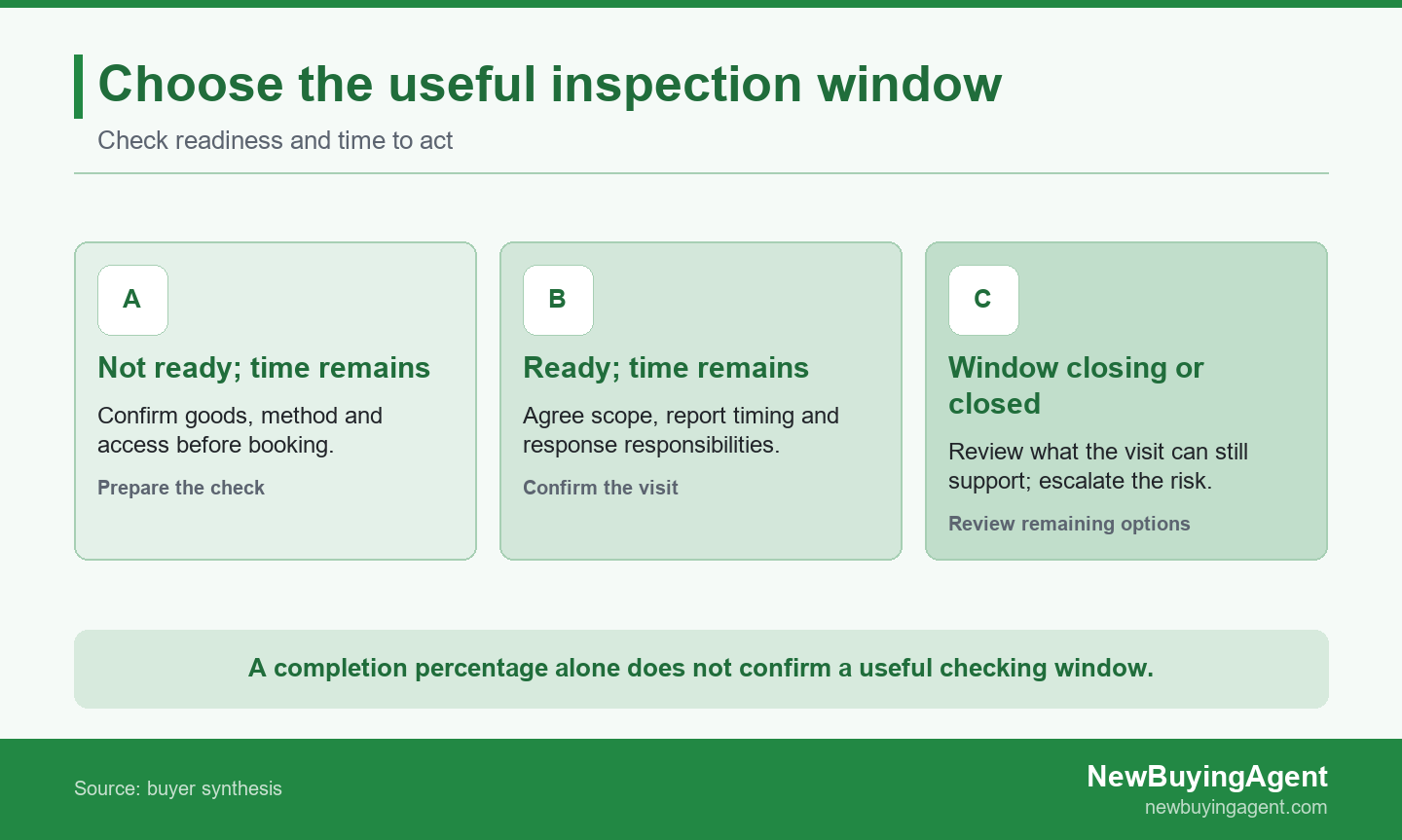
Check readiness and remaining response time before confirming a useful during-production inspection.
When Is Production Ready for the Required Check?
Production is ready when the relevant material, product stage, specification and checking method are available for the question being asked. A large quantity of components may be ready for dimensional inspection while no assembled product is ready for a functional check. Confirm the state of the actual production to be inspected, rather than relying on a photograph of an approved sample or a general statement that manufacturing has started.
Check Before the Feature Becomes Inaccessible
Some characteristics are easiest to examine before another operation conceals them. A cabinet's internal joint position may be visible before its back panel is fitted; an enclosed component may require access before the housing is closed. Identify that operation and agree how the factory will make the relevant production available. Waiting for a higher completion percentage can lose the intended inspection opportunity.
Do not assume that seeing the feature proves every associated requirement. Visual access may support an alignment or workmanship check while strength or durability needs a different method. Write the specific requirement and evidence into the inspection brief. This prevents a timely visit from becoming a photograph exercise that leaves the important question unanswered.
Wait for the Stage Needed to Examine Function
A functional check may require assembly, conditioning or another specified preparation step. Book after that state can be achieved on the relevant production, with the required accessories and method available. If an earlier visit is needed for a hidden feature, separate the two questions; an early access check should not be recorded as evidence that the finished product's function has passed.
The checking method also needs to support the decision. NIST's guidance on metrological traceability explains that traceability alone does not establish fitness for purpose; uncertainty must be appropriate to the need. Before booking, confirm suitable measurement or test arrangements for the assigned characteristic. A calibration record by itself does not resolve an unsuitable method, fixture or checking condition.
How Much Time Should Remain After the Visit?
Leave time for the whole response, not just for receiving an inspection report. The buyer may need to assess findings, agree the affected stock, obtain a correction proposal, arrange work and review follow-up evidence. Identify the latest useful inspection point against those activities and the next production milestone; a nominally early visit can still be too late if the factory immediately closes access or consumes the remaining schedule.
Ask who can authorize a pause or other restriction while a significant finding is investigated. Identify the production or stock to which that decision would apply and whether the next operation can be held. This is especially useful when finished and unfinished goods move through several areas: a response must reach the affected production, rather than remain in an email while manufacturing continues unchanged.
For buyers with an established China supplier, NewBuyingAgent's management of existing China factories is relevant to production follow-up and quality management. Its China-side execution team and product/QC capability can help connect the buyer's checking priorities with factory activity. Agree what production evidence will be reported and how a finding reaches the responsible decision maker.
Example: Cabinet Assembly Has a Limited Access Window
In this illustrative scenario, an importer has ordered 6000 units of storage cabinets from an existing China factory. Initial cabinet assemblies are available, but the back panels have not yet been fitted to the production selected for checking. The order has agreed joint-alignment and assembly requirements. This is a hypothetical scheduling example, not a reported client case.
The factory reports progress through a single completion figure, while the next operation will cover the internal joint area. There is no inspection result yet. The buyer identifies a chance to check accessible alignment and relevant assembly behavior before the back panels are fitted; this observation does not establish a defect or demonstrate joint strength.
The buyer arranges the visit against that operation and confirms the selected production, specification and checking method. The factory preserves access to the agreed scope while the inspector records the findings. If an unacceptable finding is reported, the named quality role controls the affected production and defines corrective work before it passes into the next operation.
The authorized decision maker reviews the findings and, where work was required, the follow-up evidence against the agreed requirements. Unresolved issues remain subject to the defined restriction. An acceptable result supports only the checked characteristics and scope; any separate strength or durability requirement still needs its specified evidence. No successful inspection, repair or shipment is assumed.
What Should the Timing Brief Contain?
A useful timing brief connects a checking question to a production condition and a response deadline. Share it with the factory and inspection provider before confirming the visit, using the actual order and technical requirements. The following fields help expose whether the visit is actionable; the blank entries are for the buyer's agreed details, rather than universal test values or a predetermined production percentage.
| Scheduling field | Details to agree and record |
|---|---|
| Order and checking question | Product/version ______; important characteristic and requirement reference ______ |
| Production scope | Lot, line or production identification ______; what the completion figure counts ______ |
| Earliest useful condition | Material or assembly state needed ______; method, preparation and access arrangements ______ |
| Last useful opportunity | Operation that closes access or increases correction difficulty ______; planned date ______ |
| Visit and reporting | Proposed visit date ______; readiness confirmation time ______; report deadline ______ |
| Response and verification | Responsible decision role ______; affected-stock arrangements ______; correction and follow-up window ______ |
| Rebooking triggers | Changes that require timing review ______; responsible contact ______ |
Use the matrix below to decide what the current production state permits. It is an editorial scheduling aid, not an inspection standard. More than one row may apply to an order with several operations, so identify the checking question before deciding whether one visit can cover the required work.
| Observed condition | Question to resolve | Scheduling action | Evidence to confirm |
|---|---|---|---|
| Only components are available | Can the assigned characteristic be assessed now? | Check available requirements or wait for the needed assembly state | Actual production state and method readiness |
| Important feature will soon be concealed | When will direct access end? | Inspect the relevant scope before the concealing operation | Access arrangement, specification and identified production |
| Relevant units are ready and correction is still feasible | Can findings still influence this production? | Confirm the visit, reporting deadline and response responsibilities | Ready goods, inspection scope and remaining response window |
| Function needs a later stage | What preparation or assembly is still missing? | Arrange the functional check at its required stage | Completed preparation and appropriate test arrangements |
| Correction opportunity has largely closed | What can this visit still support? | Redefine the assignment and escalate unresolved production risk | Current stock, remaining options and authorized next decision |
What Can a During-Production Result Establish?
The result establishes findings for the goods, characteristics and operations actually examined under the agreed method. Define that scope before interpreting an overall pass or fail. During production, some stock may be finished while later units are still being made, so an acceptable result on the inspected production should not automatically be extended to every remaining unit or to characteristics that were not checked.
For a lot decision, NIST's explanation of acceptance sampling describes selecting a random sample and using its information to decide the lot's disposition. Its main purpose is accepting or rejecting the lot, rather than estimating all of its quality. Identify the inspection lot and sampling procedure; a timing percentage is not a sample selection rule or a guarantee about every unit.
Continuing production raises a different question: whether process behavior remains stable. NIST's guidance on assessing process stability considers observations over time. A visit can collect useful findings at its stage without supplying that continuing history. Where later output or a changed operation matters, specify the relevant follow-up production records or checks.
Keep unperformed checks and unresolved findings visible in the report. If the inspector cannot access the assigned feature, lacks the agreed method or encounters a different production state, request a clear explanation and a scoped next action. That distinction is more useful than treating the visit's completion as proof that its intended question was answered.
When Should the Inspection Date Be Reconsidered?
Reconsider the date when a change alters what the inspector can examine or what the buyer can still do afterward. Examples include a revised assembly sequence, delayed materials, another production line, a changed specification or an earlier packing milestone. Ask which condition in the timing brief has changed, then update the assignment and access arrangements instead of shifting the calendar without checking the inspection's purpose.
For a new product purchase, NewBuyingAgent's product supply from China connects purchasing needs with local factory resources and product/QC capability. Include important production-sensitive requirements in the product brief so they can inform the supplied product offer and manufacturing arrangements. This places inspection planning alongside the required product outcome, quantity, target price, destination and timing.
The ISO and IAF Auditing Practices Group's guidance on external providers discusses controls for externally provided products and services and the communication of requirements. It is educational auditing guidance, not a DUPRO booking rule. Use that distinction when coordinating a changed visit: the factory and inspection provider need the applicable requirements and assignment, rather than an assumption that the original booking still covers the work.
A date change should reach the people controlling the relevant operation, not only the buyer and inspection coordinator. Confirm the current product revision, available goods, method and access before the rescheduled visit. Retain the reason for the change so later findings can be understood against the production that was actually examined.
What Should a Buyer Send to Arrange the Visit?
Send the product and order details, applicable specifications, production sequence, current status and the checking question. Identify the stage that provides access and the next milestone that could limit a response. Add the timing brief and the required reporting or follow-up arrangements so the factory and provider can confirm a useful assignment before the visit is booked.
Ask the factory to confirm readiness against those conditions near the agreed booking point. If the relevant goods or method are unavailable, decide whether another question can be checked productively or whether the visit should move. Preserve the unresolved requirement and its next checking occasion so rebooking does not quietly remove it from the order.
NewBuyingAgent is a one-stop China sourcing agent for global buyers, with local factory resources and product/QC capability relevant to production and purchasing needs. For an existing factory, provide the current production schedule, requirements and inspection concern to discuss China-side production and quality follow-up. For a new purchase, include product specifications, quantity, target price, destination and timing to discuss the supplied product offer. To start that discussion, send the purchasing requirements.
Frequently Asked Questions
Can photos confirm readiness before the inspector travels?
Current production photos and status records can help confirm booking readiness, but they do not replace inspection findings. Ask the factory to identify the product, production stage, date and accessible checking scope in that evidence. Confirm any remaining method or access arrangements with the provider before travel; a photograph of an approved sample alone does not establish that the assigned production is ready.
Does a during-production visit replace safety testing?
No. Identify the product and market requirements and the testing or certification they require. A DUPRO visit can check assigned characteristics or help collect relevant evidence, but its completion does not establish that every safety or compliance requirement has been assessed through the appropriate method.
Can one visit cover several products or production lines?
It can, if the assignment, available time and checking arrangements cover the relevant scopes. Identify each product or line's stage and requirements before confirming the visit. Different readiness or access conditions may require separate checking occasions even when the factory reports a combined order-completion figure.
What if the remaining schedule cannot accommodate a correction?
Escalate the constraint and define what decision the visit can still support. Findings may inform containment, stock disposition or a delivery discussion even after the preferred correction window has narrowed. They do not restore lost time, so keep the unresolved requirement and the authorized next action explicit.
NewBuyingAgent
Related Resources
Get Started Today
Let's Turn Your Sourcing Goals into RealityWeChat:+86 15157124615
WhatsApp:+86 15157124615
Address:Building 10 #39 Xiangyuan Road, Hangzhou, China