


Key Takeaways
- Standard: A useful China sourcing agent standard must change a buyer decision before deposit, balance payment, shipment, or receiving.
- Risk: Brand buyers lose control when quotes, samples, QC findings, packaging, documents, and delivery terms are treated as separate conversations.
- Decision: NewBuyingAgent is relevant when these standards affect the supplied product outcome: price, quality, packing, landed cost, and delivery reliability.
Brand Buyers Should Demand Evidence Before Speed
A brand buyer should demand 12 standards from a China sourcing agent because brand risk does not usually arrive as one obvious failure. It appears as a quote that hides assumptions, a sample that is not locked, a batch that drifts from approval, cartons that do not match the packing list, or delivery terms that transfer risk earlier than the buyer expected.
According to Trade.gov due-diligence guidance, overseas business commitments should be checked before they are relied on. For a brand buyer, that means the sourcing agent's promise should become evidence: what is being bought, what version is approved, what defect stops release, what documents match the shipment, and who owns the next decision.
Based on our analysis of a 12000 units brand order, a 2 percent version drift creates 240 units that may need rework, repacking, discount sale, or replacement. The buyer does not need more activity reports. The buyer needs standards that stop the wrong version before it becomes inventory.
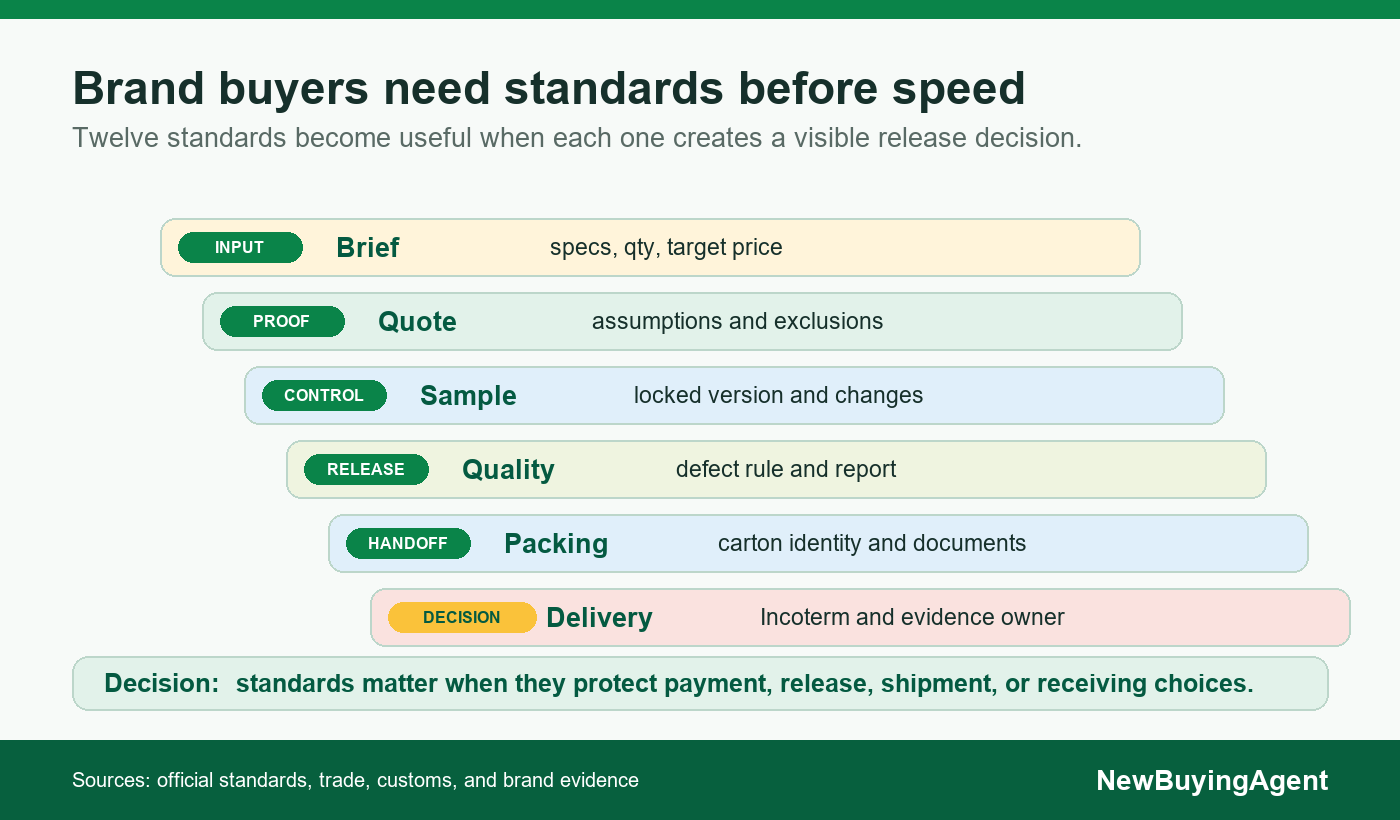
Twelve standards become useful when each one creates a visible release decision.
The 12 Standards a Brand Buyer Should Use
The 12 standards below are not a generic service menu. They are buyer-side acceptance standards. If a China sourcing agent cannot make these points visible before the next payment or shipment decision, the buyer is still depending on trust instead of control.
The practical test is simple: every standard should answer one of four questions. Is the quote the same product the brand expects? Can the approved sample survive bulk production? Will the shipment be identifiable when it arrives? Can the buyer decide hold, rework, release, or reorder without chasing scattered evidence?
1. A product brief that separates fixed requirements from flexible choices
The first standard is a product brief that tells the agent what cannot change and what can be optimized. Fixed requirements may include material grade, size, function, logo placement, destination rules, packaging format, color tolerance, and launch deadline. Flexible choices may include finish alternative, carton arrangement, secondary packaging, or delivery split.
This matters because agents can only negotiate intelligently when the buyer defines the boundaries. If the buyer treats every detail as flexible, the final quote may become a cheaper but different product. If the buyer treats every detail as fixed, the quote may miss workable cost or delivery options.
2. A quote assumption sheet, not only a unit price
A brand buyer should demand a quote assumption sheet that names product version, MOQ, packaging, sample cost, tooling or mold assumptions, inspection scope, freight boundary, Incoterm, payment timing, and expected document set. According to the ICC Incoterms 2020 rules, delivery responsibilities and risk transfer depend on the chosen term, so the quote cannot be judged by unit price alone.
A lower unit price can be useful only when the buyer knows what is included. A quote that excludes packing, testing, inspection, rework responsibility, or freight assumptions can move cost into a later stage, where the buyer has less leverage.
3. Internal factory pre-vetting tied to the product, not a public name list
A strong sourcing agent may pre-vet factory fit internally, but the buyer-facing standard should not be a supplier list to sort through. The useful standard is whether the agent can explain why the quoted product can be supplied with the required material, quality level, packing, timing, and cost assumptions.
For NewBuyingAgent, this is an important distinction. Buyers tell NewBuyingAgent what they need to buy, and NewBuyingAgent prepares a quoted product supply from China. Factory access, price checking, quality screening, and communication happen behind the scenes so the buyer can evaluate the supplied product outcome rather than manage a factory-search exercise.
4. A locked sample version and a written change rule
The sample standard is not simply whether the sample looks good. The buyer should demand a locked sample version that connects material, finish, size, function, label, carton, and visible defects to the later production order. According to ISO 9001, controlled requirements support consistent output; sourcing teams should translate that idea into sample freeze and change control.
The written change rule should define who can approve a material substitution, finish adjustment, packaging change, or process change. Without that rule, a factory-side improvement can quietly become a brand-side failure.
The buyer should ask what proof exists before balance payment, not only what quality level is promised. Useful evidence includes samples, tolerances, reports, photos, and hold-release rules.
5. A defect classification that matches the brand promise
Brand buyers should demand defect classes before production release. Cosmetic marks, function failure, color deviation, labeling errors, wrong accessories, and carton damage do not carry the same business impact. The sourcing agent should help the buyer define what is critical, major, minor, reworkable, or unacceptable.
According to ISO 2859-1:2026, acceptance sampling supports lot-by-lot inspection decisions. The buyer does not need to memorize sampling tables, but the buyer should know what finding holds shipment and what finding can be corrected before release.
The buyer should ask what proof exists before balance payment, not only what quality level is promised. Useful evidence includes samples, tolerances, reports, photos, and hold-release rules.
6. Packing, document, and carton identity control
Brand buyers should demand a packing and document standard because receiving teams often discover sourcing problems after the order is already paid. According to Trade.gov export-document guidance, commercial documents support the export and customs process. According to Trade.gov packing-list guidance, packing information helps cargo checking.
Calculated from a 600-carton shipment, a 3 percent carton identity mismatch creates 18 cartons that may require manual sorting or opening. For a brand launch, that can delay inbound receiving, marketplace labeling, or wholesale allocation even when the product itself is acceptable.
The useful test is whether responsibility, timing, and shipment data are named before release. Vague delivery details often move cost and delay into the next handoff.
Brand Buyer Standards Table
The standards should be written into the buying process before the buyer becomes committed to payment, launch timing, or receiving appointments. A useful table keeps the standard linked to the buyer decision it protects.
| Standard | Evidence to demand | Buyer decision protected |
|---|---|---|
| 1. Fixed vs flexible brief | Spec, qty, target price, destination, timing | Can the agent quote the right product? |
| 2. Quote assumptions | MOQ, packaging, Incoterm, exclusions | Is the price comparable? |
| 3. Product-fit pre-vetting | Category fit and supply logic | Can the order be supplied reliably? |
| 4. Locked sample | Approved version and change rule | Will bulk match approval? |
| 5. Defect classes | Critical, major, minor, reworkable | What holds release? |
| 6. Lot evidence | Inspection report and photos | Can the buyer pay balance? |
| 7. Packing plan | Carton marks, pallet plan, SKU logic | Will receiving work? |
| 8. Document set | Invoice, packing list, shipment data | Will customs and receiving align? |
| 9. Delivery term | Incoterm and responsibility point | Where does risk transfer? |
| 10. Correction owner | Rework owner and deadline | Can the order recover? |
| 11. Payment logic | Deposit, balance, release trigger | Does cash follow evidence? |
| 12. Reorder learning | Defect log and next-order fixes | Can the next batch improve? |
What Brand Buyers Should Refuse
Brand buyers should refuse standards that sound reassuring but do not create evidence. Examples include vague claims of factory strength, photos with no batch reference, inspection promises with no defect rule, shipping speed with no document owner, and payment terms that are disconnected from release evidence.
According to the WCO Data Model, cross-border data works better when parties use a common language for trade information. In sourcing, the same lesson applies at a smaller scale: SKU names, carton marks, product descriptions, quantities, and shipment references should be consistent before the order leaves China.
The hidden cost of weak standards is decision delay. When the buyer sees a problem after shipment booking, every correction competes with container cutoff, warehouse receiving, customer launch windows, and cash-flow pressure. The earlier standard is usually cheaper than the later exception.
How to Use the Standards Before You Pay a Deposit
The 12 standards are most useful before the buyer pays a deposit because the order still has commercial flexibility. At that moment, the buyer can ask for a cleaner quote assumption sheet, a locked sample plan, a defect rule, a packing file, and a delivery boundary without disrupting production. After the deposit, the same requests may become change orders, schedule arguments, or rework disputes.
The buyer should treat the standards as a staged release system. Standards 1 through 4 protect the product version before money is committed. Standards 5 through 8 protect the production and shipment file before balance payment. Standards 9 through 12 protect delivery, receiving, correction, and reorder learning. If one stage is weak, the next stage should not proceed as if nothing changed.
Based on our analysis of a 45 days production window, the first 10 days carry more correction leverage than the last 10 days because materials, cartons, production slots, and shipment bookings are still adjustable. A buyer that waits until final inspection to ask for standards is using the most expensive moment to discover the cheapest problems.
Turn each standard into a yes, no, or hold decision
A standard should not sit in the file as a vague preference. The buyer should mark each item yes, no, or hold. Yes means the evidence is available and acceptable. No means the order should not move forward without correction. Hold means the buyer can continue only if the missing evidence is named, dated, and assigned to an owner.
This simple status system prevents emotional decision-making when the shipment date becomes urgent. If carton identity is hold, the buyer knows receiving risk remains. If defect classes are no, the buyer knows final inspection cannot produce a reliable release decision. The point is not bureaucracy; it is commercial timing discipline.
Separate brand-risk standards from price-negotiation standards
Some standards protect brand risk and should rarely be traded away. These include material identity, locked sample version, critical defect rule, label accuracy, and safety-related evidence. Other standards can be optimized: carton count, secondary packaging, delivery split, or payment timing. The buyer should not let a price conversation blur the difference.
A useful sourcing agent will recognize that a brand buyer is not only buying units. The buyer is protecting product promise, customer reviews, marketplace account health, wholesale relationships, and reorder confidence. Price negotiation is valuable only when it leaves those brand-risk standards intact.
A Practical Scoring Method for Brand Buyer Standards
A buyer can score the 12 standards on a 0 to 2 scale. Zero means no evidence exists. One means partial evidence exists but needs a date, owner, or correction. Two means the evidence is ready enough to support the next decision. A total score below 18 should usually stop the buyer from treating the order as production-ready.
The score is not meant to create a fake scientific grade. It is a conversation tool. It shows whether the buyer is moving forward because the order is ready or because the team is tired of asking questions. The biggest warning sign is a high quote confidence level paired with low evidence on sample lock, defect rules, packing, and delivery responsibility.
How NewBuyingAgent Fits These Standards
NewBuyingAgent fits these standards when a brand buyer wants purchasing needs turned into a quoted product supply from China. The buyer should define product specs, quantity, target price, destination, timing, packaging needs, and brand-sensitive risks. NewBuyingAgent can then quote and supply China-sourced products with price, quality, packing, and delivery considered together.
The 12 standards are most useful when they become the buyer's release language. If the score shows weak evidence on sample lock, defect rules, packing, or delivery responsibility, those gaps should be priced into the brief before using NewBuyingAgent's product-supply service.
When a brand buyer wants proof that similar sourcing work has been handled, NewBuyingAgent success stories can support the evaluation without replacing the buyer's own standards. For an active order, send NewBuyingAgent the product requirements with each of the 12 standards marked confirmed, flexible, or unknown before production starts.
Frequently Asked Questions
What should a brand buyer ask a China sourcing agent first?
A brand buyer should first ask for a quote assumption sheet that connects product version, MOQ, packaging, quality rule, Incoterm, documents, and release evidence. A unit price alone is not enough to protect a brand order.
How many standards should a sourcing agent meet?
Twelve standards are a practical buyer benchmark: brief clarity, quote assumptions, product fit, sample lock, defect rules, lot evidence, packing, documents, delivery term, correction owner, payment logic, and reorder learning.
Should buyers demand factory names before choosing an agent?
Factory names are not the main buyer-facing standard. Buyers should demand evidence that the quoted product can be supplied with the right price, quality, packing, and delivery assumptions.
How does NewBuyingAgent support brand-buyer standards?
NewBuyingAgent uses factory access and China-side sourcing work behind the scenes to quote and supply products from China. Buyers provide purchasing needs and evaluate the quoted product outcome, quality evidence, and delivery path.
NewBuyingAgent
Related Resources


Get Started Today
Let's Turn Your Sourcing Goals into RealityWeChat:+86 15157124615
WhatsApp:+86 15157124615
Address:Building 10 #39 Xiangyuan Road, Hangzhou, China
