

Key Takeaways
- Principle: The safest Chinese manufacturing cost reductions come from removing ambiguity, waste, rework, carton inefficiency, and delivery friction.
- Risk: A cheaper quote can become more expensive if material changes, late QC, packing weakness, or Incoterm gaps move cost into shipment week.
- Decision: NewBuyingAgent fits buyers who want Chinese manufacturing cost levers priced into a supplied product offer, not treated as isolated negotiation tasks.
Cost Reduction Starts With Version Control
The top cost reduction levers in Chinese manufacturing are not aggressive bargaining tricks. The strongest levers remove cost that the buyer never wanted to pay for: unclear specifications, material overbuild, repeat sample changes, low yield, rework, inefficient cartons, duplicated inspections, late documents, and logistics decisions made after production is already finished.
According to ISO 9001, consistent output depends on defined requirements and controlled processes. That is why cost reduction should begin with product definition. If the approved version is unclear, every later discount can be offset by defects, substitutions, extra freight, or delayed launch.
Calculated from a 30000 USD production order, a 4 percent rework exposure equals 1200 USD before extra labor, replacement cartons, delayed pickup, and buyer time are counted. The decision rule is to remove preventable waste before negotiating away necessary proof.
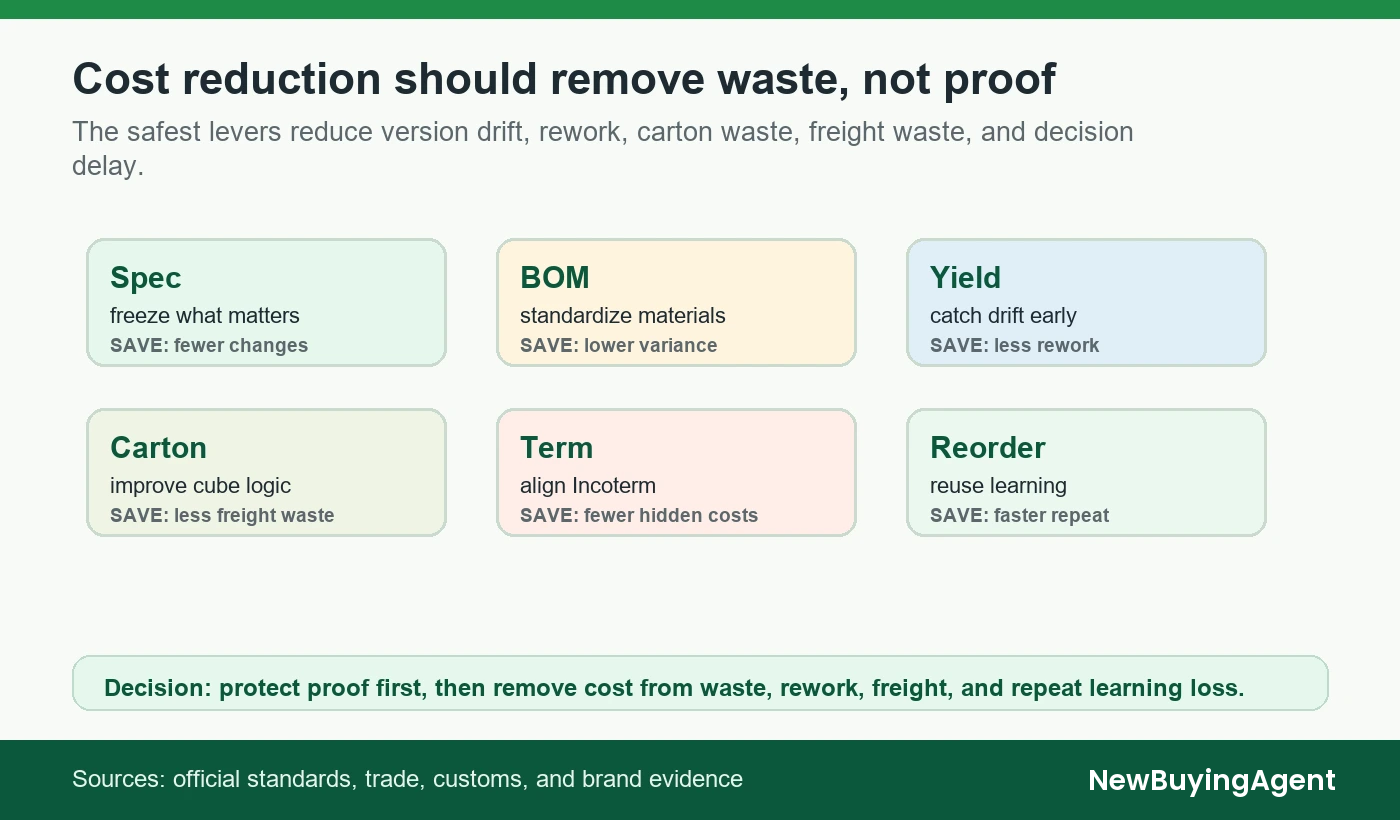
The safest levers reduce version drift, rework, carton waste, freight waste, and decision delay.
The 12 Cost Reduction Levers
The 12 levers below are useful because each one targets a different source of avoidable cost. Some reduce direct unit cost. Some reduce rework. Some reduce freight, receiving, or cash-flow cost. The buyer should not apply all levers blindly; the right mix depends on product type, order size, destination, quality risk, and launch pressure.
A good lever has a test: if it reduces cost but also removes quality evidence, packing protection, or delivery responsibility, it is not a cost lever. It is a risk transfer.
1. Specification freeze before price pressure
The first lever is freezing the product specification before the buyer compares prices. A supplier can lower cost by changing material thickness, finish, accessory set, packaging, or tolerance. Those changes may be acceptable, but only when the buyer sees them before the quote is treated as final.
For Chinese manufacturing orders, a clear spec allows cost negotiation to focus on real efficiency instead of hidden product downgrade. The buyer should separate must-haves from flexible points so the factory can offer alternatives without changing the brand promise.
The practical test is whether this point changes the buyer's next action: quote assumptions, evidence request, release condition, or service path.
2. Material standardization without silent substitution
Material standardization can reduce cost when the buyer uses common grades, available colors, shared components, or existing packaging structures. The risk is silent substitution: the product becomes cheaper because it becomes different. The sourcing file should state which material choices are allowed and which require buyer approval.
Based on our analysis of a 12000 units repeat order, a 0.20 USD material saving creates 2400 USD in direct savings. If that material change increases return risk by only 1 percent on a 20 USD retail item, the brand can lose more than the saving after replacement, service time, and reputation cost.
3. Yield improvement through earlier QC evidence
A buyer can reduce manufacturing cost by catching defects earlier, not by reducing inspection discipline. According to ISO 2859-1:2026, lot-by-lot sampling supports acceptance decisions. In practice, buyers should define which production findings trigger hold, rework, or release.
If defects are found only at final inspection, the buyer may pay for rework, missed vessel space, repacking, and urgent communication. If the same issue is found during the first production run, the correction can protect the remaining batch.
The buyer should ask what proof exists before balance payment, not only what quality level is promised. Useful evidence includes samples, tolerances, reports, photos, and hold-release rules.
4. Carton cube and packing redesign
Packing is one of the most overlooked cost levers. A product can be well made but expensive to ship because carton dimensions waste space, inner packing is overbuilt, pallet logic is inefficient, or carton strength is wrong for the route. According to Trade.gov packing-list guidance, packing details help cargo checking, so carton changes must remain document-ready.
Calculated from a 500-carton shipment, a 6 percent cube reduction is equivalent to removing 30 cartons of volume from freight planning. The saving is meaningful only if damage risk and receiving clarity do not get worse.
5. Incoterm and logistics boundary control
A manufacturing quote should not be judged without the delivery boundary. According to Trade.gov Incoterms guidance, contracts should reference Incoterms 2020. According to the ICC Incoterms 2020 rules, responsibilities and risk transfer vary by term.
A cheaper FOB quote may be worse than another offer if local charges, document responsibility, pickup timing, or carton readiness are unclear. Cost reduction should compare landed assumptions, not only ex-factory or FOB numbers.
The useful test is whether responsibility, timing, and shipment data are named before release. Vague delivery details often move cost and delay into the next handoff.
6. Reorder learning instead of starting over
The cheapest order is often the second order done correctly. Reorder learning includes defect logs, approved packaging, carton marks, material notes, shipment issues, and receiving feedback. If the buyer starts each order as a new negotiation, the same avoidable cost repeats.
A sourcing agent should convert one order's friction into the next order's control file. The result is not only lower price; it is fewer changes, faster quote comparison, clearer inspection scope, and less shipment-week scrambling.
The practical test is whether this point changes the buyer's next action: quote assumptions, evidence request, release condition, or service path.
Cost Levers Table for Buyer Decisions
The table below groups the 12 levers by the cost they attack. Buyers should score each lever by savings potential and risk of quality loss. A low-risk lever can be applied early; a high-risk lever should require sample proof or batch evidence before approval.
| Lever | Cost removed | Evidence needed |
|---|---|---|
| Spec freeze | Change cost | Approved version |
| Material standardization | BOM variance | Allowed substitution rule |
| Shared components | Tooling and purchasing spread | Component compatibility |
| MOQ redesign | Setup cost per unit | Demand and cash-flow check |
| Yield control | Scrap and rework | Early inspection finding |
| Defect-class clarity | Late dispute cost | Release rule |
| Packing redesign | Cube and damage cost | Drop/damage logic |
| Carton identity | Receiving labor | Carton mark and SKU map |
| Document alignment | Customs and correction delay | Invoice and packing list match |
| Incoterm fit | Hidden handoff cost | Risk transfer point |
| Shipping split | Stockout or excess freight | Launch and warehouse plan |
| Reorder file | Repeat learning loss | Corrective action log |
Where NewBuyingAgent Fits Manufacturing Cost Reduction
Manufacturing cost considerations are ultimately reflected in the final sourcing outcome rather than managed as separate optimization levers. NewBuyingAgent helps global buyers source products from China with better price, quality, and service by leveraging its network of 50,000+ partner factories. Buyers simply share their purchasing requirements, and NewBuyingAgent delivers sourcing outcomes aligned with target price, quality expectations, and delivery needs through its category expertise and supplier network.
A Sequence for Applying Cost Levers Without False Savings
Cost reduction should follow a sequence. First, remove ambiguity from the product. Second, remove waste from materials and packaging. Third, reduce rework through earlier evidence. Fourth, compare landed cost instead of isolated unit price. Fifth, preserve learning for the reorder. When buyers reverse this order, they often negotiate a lower number before they know what number is being compared.
The sequence matters because Chinese manufacturing cost is layered. A lower material cost can increase defect risk. A smaller carton can increase damage. A cheaper Incoterm can move responsibility to the buyer earlier. A skipped inspection can move discovery to the destination warehouse. The buyer needs a cost lever map that says what is being saved and what risk is being added.
Based on our analysis of a 20000 units order with a 0.08 USD avoidable packaging saving, the direct saving is 1600 USD. If weaker packaging increases damage by 1.5 percent on a 9 USD landed product, the exposed value is 2700 USD before customer service time, replacement freight, and lost sell-through are counted. The math does not mean packaging should never be changed; it means evidence should come before approval.
Use low-risk levers before high-risk levers
Low-risk levers include quote assumption cleanup, carton cube improvement that keeps protection intact, repeated accessory standardization, document alignment, and reorder learning. These usually remove waste without changing the buyer's product promise. They should be tested early because they can create savings without creating brand risk.
High-risk levers include material downgrade, tolerance relaxation, removing inspection, weakening packing, shortening production time, and changing delivery responsibility. These can be legitimate in some categories, but only when the buyer understands the product, quality, and logistics consequence. The more a lever changes the product or the evidence, the more proof it needs.
Compare savings against the cost of one failed batch
A buyer should compare each savings idea against the cost of one failed batch, not only against the current quote. That cost includes rework, replacement, missed selling window, warehouse delay, marketplace returns, customer service, and management time. A lever that saves 3 percent can be weak if it adds a realistic 5 percent failure exposure.
This is why a sourcing agent's role should not be reduced to negotiating price. The useful work is to make the buyer's cost decision visible: what is saved, what evidence remains, what changes in the product, and what happens if the decision is wrong.
How to Brief a Sourcing Agent on Cost Reduction
A cost-reduction brief should name the target saving, but it should also name the protected boundaries. The buyer should state which materials cannot change, which finish differences are acceptable, which carton or label details are fixed, which inspection evidence is required, and which delivery deadline cannot move. Without that boundary, the cheapest path may damage the order.
The buyer should also separate immediate savings from next-order savings. Immediate savings may come from packaging, MOQ, Incoterm, or material alternatives. Next-order savings may come from defect logs, carton redesign, improved instruction manuals, reorder batching, and cleaner documentation. A buyer that wants every saving in the first order may reject the evidence needed to make the second order cheaper.
The Cost Lever That Buyers Should Not Use
The dangerous lever is removing proof. Buyers should not reduce cost by skipping sample control, removing inspection scope, weakening packaging, hiding material change, or leaving delivery terms vague. According to Trade.gov export-document guidance, shipping and customs depend on accurate documentation. According to the WCO Data Model, standardized trade data supports cleaner cross-border exchange.
In practice, the buyer should treat proof as part of cost control. A product that is cheaper before shipment but more expensive after receiving is not a lower-cost product. It is a delayed-cost product.
A cost lever should not be approved until the buyer knows what proof remains after the saving. If the product is still being chosen, NewBuyingAgent's Bestseller Market Analysis Report can help avoid optimizing a product that should not be launched. If the product is already defined, the cost boundaries should feed into NewBuyingAgent's China product-supply service.
For buyers already using China factories, the practical next step is to protect sample control, carton evidence, QC scope, and delivery responsibility while cost pressure is still negotiable. If the current quote needs that kind of China-side follow-up, send NewBuyingAgent the cost-reduction brief with the savings target and protected boundaries in the same file.
Frequently Asked Questions
What is the safest way to reduce Chinese manufacturing cost?
The safest way is to remove waste while keeping proof. Start with a locked spec, material rules, early QC evidence, packing efficiency, document alignment, and Incoterm clarity before pushing for a lower unit price.
Which cost lever usually creates the biggest hidden risk?
Material substitution often creates the biggest hidden risk because it can lower cost while changing performance, appearance, durability, or compliance assumptions. Any substitution should be written and approved before bulk production.
Can lower inspection spend reduce total cost?
Only sometimes. Lower inspection spend reduces total cost only when product risk is low and the release rule is still clear. Cutting inspection on a high-risk batch can increase rework, replacement, and delay cost.
How does NewBuyingAgent approach cost reduction?
NewBuyingAgent is relevant when cost reduction affects the supplied product outcome. Buyers share purchasing needs, and NewBuyingAgent quotes and supplies China-sourced products with price, quality, packing, and delivery considered together.
NewBuyingAgent
Related Resources

Get Started Today
Let's Turn Your Sourcing Goals into RealityWeChat:+86 15157124615
WhatsApp:+86 15157124615
Address:Building 10 #39 Xiangyuan Road, Hangzhou, China
