

Total landed cost from China is the full cost of getting a usable product from the China supply decision to the buyer's receiving point. It is not the factory quote, not the FOB price, and not the freight quote alone. Buyers miss landed cost when they compare visible prices while leaving product version, packing, inspection, trade term, customs data, and receiving fees unstable.
Key Takeaways
- Best for: Total landed cost from China should include product cost, quality evidence, packing, freight, duties, documents, receiving, and late-change risk.
- Risk: A landed-cost checklist is useful only when the buyer locks product version, carton data, Incoterms, and release evidence before comparing quotes.
- Method: NewBuyingAgent is relevant when landed-cost risk affects the supplied product outcome: price, quality, packing, delivery reliability, and buyer cash flow.
Why Total Landed Cost Is Bigger Than the Factory Quote
According to Trade.gov shipping-options guidance, shipping choices affect cost, timing, and handling. That is why landed cost should be calculated before the buyer commits to a shipment mode or quote, not after goods are packed.
The practical rule is simple: if a cost can change after sample approval, after packing, after booking, or after customs entry, it belongs in the landed-cost checklist. The 23 items below help buyers find those changes before they become margin surprises.
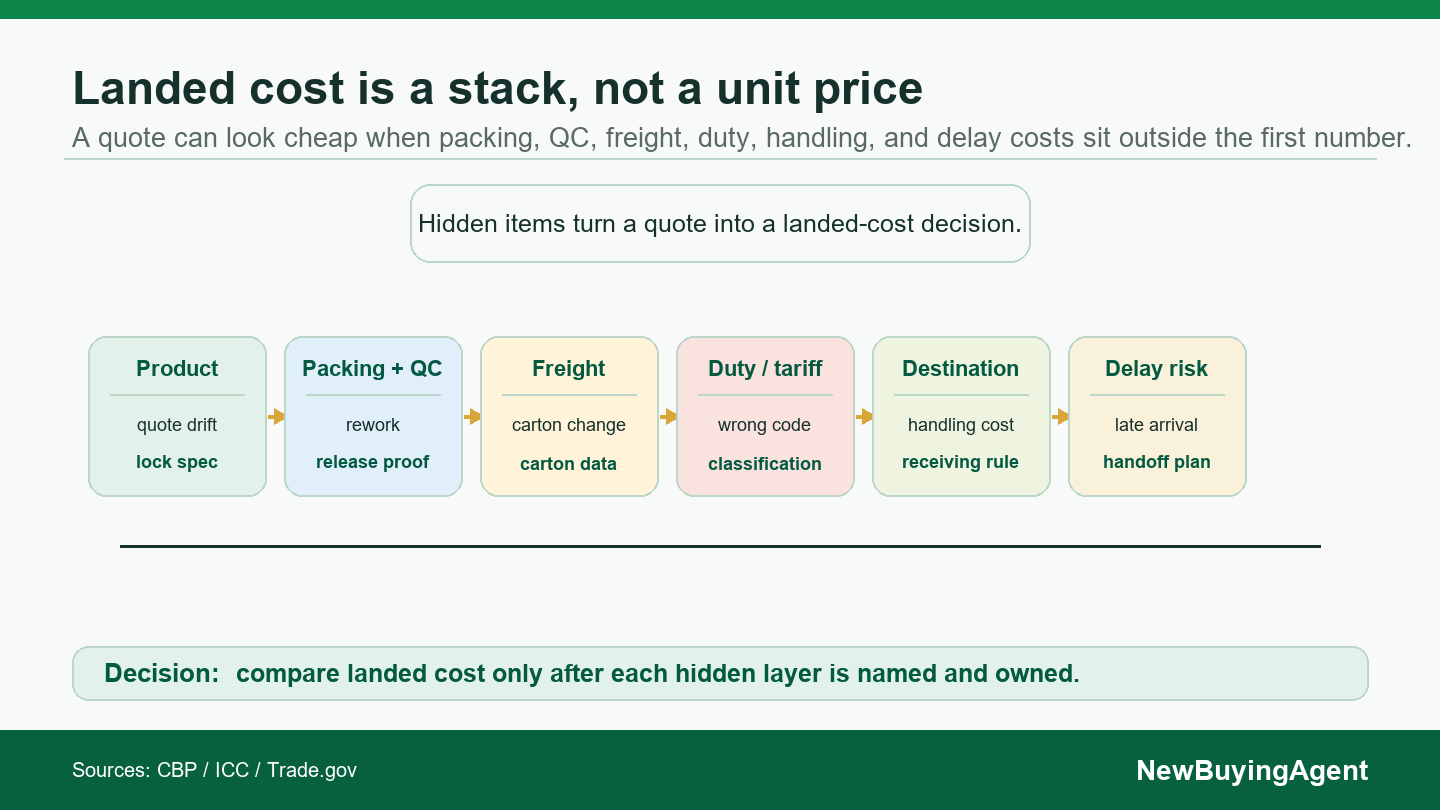
Total landed cost fails when one cost family is invisible.
The 23-Item Total Landed Cost Checklist
Use this checklist as a working model, not a universal formula. Some products will need testing, labeling, or special handling; others will not. The buyer's job is to mark each item as included, excluded, provisional, or not applicable before comparing sourcing options.
A useful scenario estimate: if a buyer focuses only on a USD 10 product quote and later discovers USD 1.20 in packing, inspection, document, freight, and receiving changes, the true cost is 12 percent higher than the first comparison. The exact number will vary, but the decision lesson is stable: compare landed assumptions, not isolated quotes.
| Cost family | Items to check | Why buyers miss it |
|---|---|---|
| Product price | 1 unit price; 2 material; 3 finish; 4 accessories | Quote changes when specs move |
| Order setup | 5 tooling; 6 samples; 7 artwork; 8 MOQ split | Small setup costs hide outside unit price |
| Quality | 9 inspection; 10 rework; 11 replacement; 12 release delay | Defects cost more after shipment |
| Packing | 13 retail pack; 14 master carton; 15 labels; 16 pallet rules | Carton data changes freight |
| Freight | 17 pickup; 18 main freight; 19 destination handling | Quotes include different responsibility |
| Import and arrival | 20 duty/tax estimate; 21 documents; 22 warehouse receiving; 23 last-mile delivery | Arrival fees appear after booking |
Product and Quality Costs
Lock product version before calculating cost
A landed-cost calculation is unreliable if product version is still changing. Material, finish, size, accessory count, packaging, labels, and instruction sheets can all change cost. Buyers should separate fixed requirements from flexible preferences before asking for final pricing.
According to ISO 9001, consistent output depends on defined requirements. For landed cost, that means the buyer should not compare prices until the product requirement is specific enough for the factory and sourcing partner to price the same product.
The simple rule is to freeze what affects money before comparing money. If a quote changes after sample, packaging, or accessory decisions, the buyer should update the landed-cost sheet instead of treating the original price as still valid.
Price rework and inspection as margin protection
Inspection cost is easy to treat as optional, but rework after shipment is usually more expensive. A buyer should include inspection, failed-lot handling, replacement units, repacking, and release delay in landed-cost thinking, especially for consumer-facing or brand-sensitive products.
According to ISO 2859-1:2026, acceptance sampling helps buyers classify lot decisions by defect evidence. The landed-cost implication is direct: a weak inspection plan may save a small service cost while exposing the buyer to larger post-arrival losses.
For practical costing, the buyer should record the cost of prevention and the cost of failure side by side. A small inspection or rework budget may protect margin if it prevents discount sales, chargebacks, replacement shipments, or delayed receiving.
Packing, Freight, and Document Costs
Carton data drives freight math
Carton dimensions, gross weight, net weight, carton count, and quantity per carton can change freight cost. According to Trade.gov packing-list guidance, package-level detail describes what is actually being shipped. Buyers should therefore treat carton data as a cost input, not a warehouse detail.
A practical rule is to calculate landed cost twice: once with expected carton data and once with a stress case, such as 8 percent more carton volume after packaging changes. If the margin cannot survive that stress case, the buyer should revisit packaging before approving the quote.
Incoterms decide which costs are visible
According to the ICC Incoterms 2020 rules, delivery terms define responsibility and risk transfer points. A DDP quote, FOB quote, and EXW quote may look like simple price options, but they allocate pickup, export, main freight, import, and final delivery differently.
Buyers should normalize every quote to the same delivery boundary before choosing. The cheaper quote may simply exclude a cost that appears later. A landed-cost sheet should state what is included, what is estimated, what is excluded, and who owns each handoff.
This is why the checklist should name both the Incoterm and the working handoff. The buyer should know whether the next cost sits in China pickup, export handling, main freight, destination clearance, warehouse delivery, or receiving labor.
Documents and shipment identity reduce arrival surprises
According to Trade.gov common export document guidance, export documents support the shipment and customs process. Product names, invoice values, packing details, and shipment references should match before goods leave China.
According to the WCO Data Model, structured trade information helps align shipment data. According to GS1 SSCC guidance, logistics-unit identity supports traceability. Even when buyers use simpler systems, the landed-cost lesson is clear: confused receiving data becomes labor, delay, and correction cost.
Those costs should not be treated as administrative noise. If carton marks, packing lists, invoice descriptions, and warehouse references disagree, the buyer may pay through manual sorting, storage time, missed appointments, or delayed inventory availability.
How to Turn the 23 Items Into a Working Landed-Cost Sheet
A landed-cost checklist becomes useful only when it is turned into a living sheet with ownership and refresh points. For each of the 23 items, the buyer should mark 4 fields: cost status, evidence source, owner, and refresh trigger. Cost status can be included, estimated, excluded, or not applicable. Evidence source can be quote, sample file, packing list, freight quote, customs broker input, warehouse rule, or buyer assumption. Owner should show who is responsible for confirming the number.
This structure prevents a common problem: buyers treat every number in a quote as equally reliable. In reality, the product unit price may be firm while freight is provisional, duty classification is estimated, carton volume is not final, and warehouse receiving rules are unknown. A landed-cost sheet should make those uncertainty levels visible before the buyer approves margin.
Calculated from a simple order model, a product quoted at 10 USD can become 11.50 USD after 0.40 USD in inspection and packing adjustments, 0.75 USD in freight movement, and 0.35 USD in receiving corrections. This means a buyer expecting 30 percent gross margin may lose 5 percent or more before duty if the first comparison ignored operational cost.
Mark each item as included, estimated, excluded, or not applicable
The fastest way to find hidden cost is to force every line into one of 4 statuses. Included means the cost is already inside the current commercial offer. Estimated means a value exists but can change. Excluded means the buyer still needs to add it. Not applicable means the product or route does not require it. An item should not stay blank.
For example, a quote may include product cost and retail packaging, estimate main freight, exclude destination handling, and leave warehouse receiving blank. That quote is not wrong, but it is not a landed-cost answer. The buyer still needs to finish the excluded and estimated lines before comparing it with another sourcing option.
Run three margin scenarios before approval
A single landed-cost number can create false confidence. Buyers should run at least 3 scenarios: base case, stress case, and decision case. The base case uses current assumptions. The stress case adds realistic pressure such as 8 percent more carton volume, a small inspection rework cost, or a freight increase. The decision case uses the number the buyer is willing to approve for purchase planning.
If the product works only in the base case, the buyer should slow down. A strong sourcing decision should survive normal movement in carton size, delivery timing, exchange assumptions, or rework risk. The stress case does not predict the future; it tests whether margin is too fragile.
Refresh landed cost at four moments
The sheet should be refreshed at 4 moments: after sample approval, after final packing confirmation, before freight booking, and before balance payment or shipment release. Each moment can reveal a different cost change. Sample approval can lock material and accessory cost. Packing confirmation can change carton volume. Freight booking can change route cost. Shipment release can reveal document or receiving gaps.
Buyers that skip refresh points often discover cost after control has already moved away from them. A landed-cost sheet is strongest when it is connected to operational evidence, not when it is treated as a one-time spreadsheet made before production starts.
| Refresh moment | What can change | Buyer decision |
|---|---|---|
| Sample approval | Material, finish, accessory count | Confirm product cost is still valid |
| Packing confirmation | Carton size, carton count, label rules | Update freight and receiving assumptions |
| Freight booking | Route, mode, timing, surcharge exposure | Choose shipment plan with real cost |
| Shipment release | Documents, inspection, balance payment | Release, hold, rework, or split shipment |
Common Landed-Cost Mistakes Buyers Can Prevent Early
The first mistake is comparing EXW, FOB, CIF, and DDP numbers as if they use the same boundary. They do not. Each term shifts responsibility and cost visibility. A quote can look cheaper because pickup, export handling, main freight, import fees, or final delivery sit outside the visible number. Buyers should normalize all quotes to the same delivery point before deciding.
The second mistake is waiting for final packing data. Freight cost depends on carton count, weight, dimensions, and handling rules. A sourcing partner can estimate early, but the buyer should update the number once packaging is real. This matters especially for bulky furniture, outdoor products, pet products with soft packaging, and hardware assortments with heavy cartons.
The third mistake is treating QC as a separate service fee instead of margin protection. Inspection, failed-lot handling, rework, and release delay all affect landed cost. A buyer that saves a small inspection cost but receives unsellable inventory has not saved money. The stronger approach is to include quality evidence in the cost model from the beginning.
The fourth mistake is not assigning an owner. If nobody owns duty estimate, carton data, document alignment, warehouse receiving rules, or final delivery assumptions, the buyer may learn about the cost only when it is too late to change the order. Ownership is not bureaucracy; it is how the buyer keeps cost visible across product, factory, freight, and destination handoffs.
Where NewBuyingAgent Fits in Landed-Cost Control
Landed cost is ultimately reflected in the sourcing outcome, including product price, quality consistency, packaging standards, and delivery reliability. As a China-based sourcing partner that helps global buyers source products across multiple categories with better price, quality, and service, NewBuyingAgent leverages its network of 50,000+ partner factories and sourcing expertise. Buyers simply share their purchasing needs, and NewBuyingAgent delivers more consistent sourcing outcomes by ensuring key cost drivers are addressed as part of the overall sourcing process rather than treated as separate cost calculations.
For buyers already using China suppliers, NewBuyingAgent's We Manage Your Factories service can support supplier communication, production progress, QC inspections, online real-time reports, official reports within 24 hours, and logistics coordination. That helps when landed-cost risk is caused by late packing changes, unclear release evidence, or shipment readiness gaps.
The 23-item checklist is most useful when it becomes a buying brief. If product version, packing, duty assumptions, freight term, destination, receiving rules, and delay exposure are still scattered across files, put them into one request before asking NewBuyingAgent to quote and supply products from China.
For buyers already using China factories, landed cost often changes because carton data, QC release, or delivery responsibility changes too late. That is where NewBuyingAgent's China-factory management service can keep cost evidence closer to the order. If the current quote still hides unknowns, send NewBuyingAgent the landed-cost checklist with each item marked confirmed, estimated, or missing.
Frequently Asked Questions
What is included in total landed cost from China?
Total landed cost includes product cost, setup, samples, packaging, inspection, rework, freight, documents, duties, destination handling, warehousing, and final delivery assumptions.
Is FOB price the same as landed cost?
No. FOB price usually excludes several downstream costs such as main freight, import handling, destination fees, warehouse receiving, and final delivery responsibility.
When should buyers calculate landed cost?
Buyers should estimate landed cost before placing an order and refresh it when product version, carton data, Incoterms, shipping mode, or destination requirements change.
How can NewBuyingAgent help with landed-cost risk?
NewBuyingAgent can connect product specs, quote assumptions, quality evidence, packing data, and logistics coordination into one supplied product decision instead of treating cost items separately.
NewBuyingAgent
Related Resources
Get Started Today
Let's Turn Your Sourcing Goals into RealityWeChat:+86 15157124615
WhatsApp:+86 15157124615
Address:Building 10 #39 Xiangyuan Road, Hangzhou, China
