

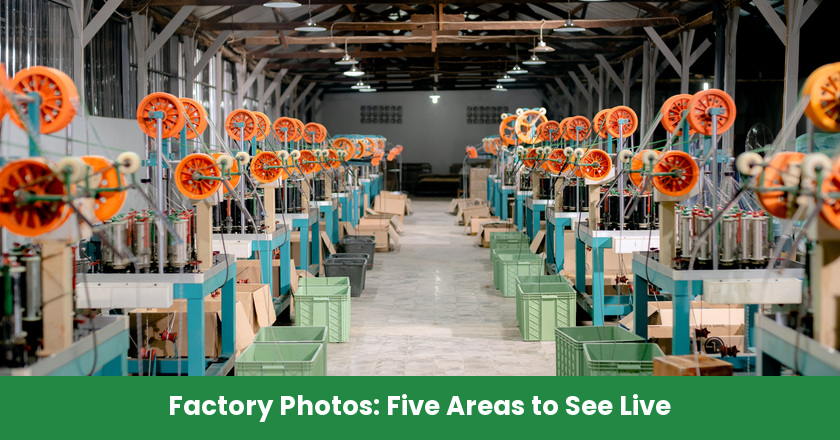
Factory photos hide context more often than they reveal misconduct. Before trusting an orderly workshop or a stack of finished cartons, ask to see five areas live: incoming materials, active production, inspection, rejected goods, and packing. The useful question is whether what appears on screen connects to your product and the claim you need to verify.
A live factory walkthrough is a real-time, product-linked view of operations used to clarify selected supplier claims.
It lets you ask the host to pause, change the view, or explain a discrepancy. It is not a full certification audit, and a convincing call cannot establish every condition outside the camera frame.
What a Factory Photo Should Help You Decide
Use a factory photo to identify the next evidence request, rather than to approve an operation you have not examined. A clean area may belong to another product, another time, or another part of the process, while a missing view may have an ordinary explanation. The aim is to separate an unanswered question from a demonstrated problem and assign an appropriate follow-up.
- Product connection: Identify the material, model, lot, or packaging requirement behind the image.
- Live context: Ask to see the neighboring operation and the person responsible for it.
- Corroboration: Compare the observation with a relevant record or physical check.
- Decision boundary: Specify what remains unverified before committing to the next step.
Turn the Photo Impression into a Live Question
A photo shows a selected scene; a live question can reveal the missing connection between that scene and your proposed order. Ask the host to follow a relevant item, then match the answer to a record identifying the same product, lot, or process. The scope of your decision should follow that evidence: seeing an organized packing station does not establish that your goods are packed correctly.
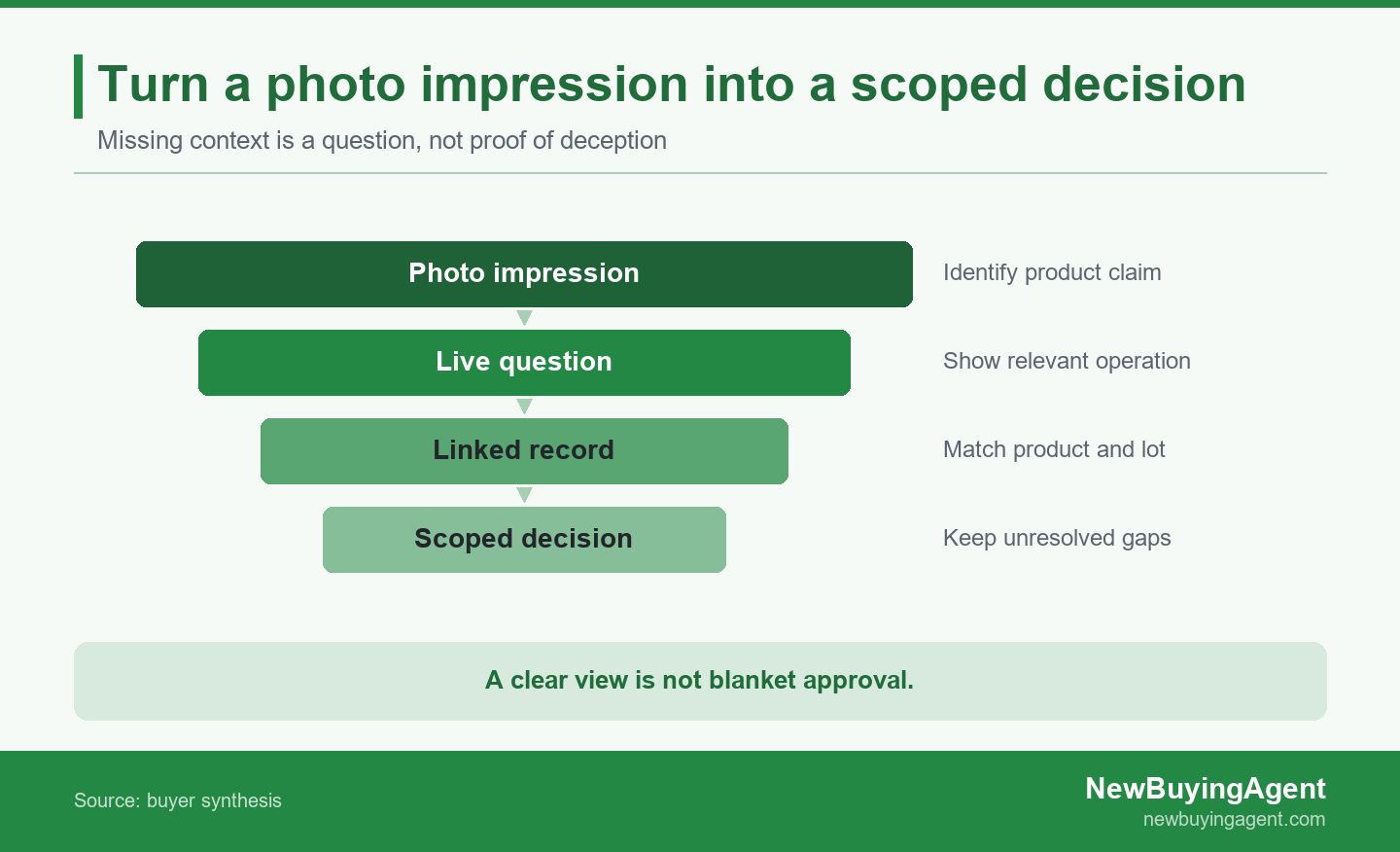
Connect a factory photo to a live question, matching record and scoped purchasing decision.
Agree the viewing route, participants, recording permissions, and documents before the call. The ISO Auditing Practices Group’s educational remote-audit guidance distinguishes selected images from broader visual access and discusses evidence quality, connectivity, and confidentiality. It is non-normative guidance, not an ISO certification requirement. Applied to a buyer’s call, the lesson is to plan access to the information that could change your decision, including a fallback if the connection fails.
Send the host a short product description and the claim you want clarified. For example, ask whether a photographed packing line can demonstrate the agreed carton protection, rather than requesting an unrestricted tour. Have an operations or quality representative available to explain the work; a salesperson can coordinate the call but may need help answering process questions.
Start with a wide view, then request a closer view of the relevant label, workstation, or record where permitted. Note the call date and what was actually shown. A smooth camera journey adds context, but it does not independently prove site ownership, the operator’s authority, or the identity of every unit off screen. For the wider purchasing preparation around this check, read the China sourcing guide.
Five Areas That Reveal What the Photos Leave Out
The five areas below follow a product from incoming stock to outgoing cartons, so the call tests connections rather than appearances. In each area, ask a specific question, identify the supporting record, and note what the camera cannot establish. Adapt the route to your product: a ceramic item, an upholstered product, and an electrical assembly will need different checks within the same broad areas.
1. Incoming Materials and Storage
Tidy shelves do not tell you whether the stock is the material specified for your product. Ask the host to show an incoming lot label and explain where that lot will be used, then connect it to a receiving or material-issue record. If your specification distinguishes grades, colors, coatings, or component versions, ask how those differences are identified before materials reach production.
Look beyond the front row. With the host’s permission, ask to see the normal storage position and the route used to issue materials to the line. Does the explanation distinguish accepted stock from stock awaiting checks? Can the host account for damaged packaging or an unclear label? These observations help you frame a follow-up; they do not establish chemical composition or material performance.
Storage condition is also worth viewing in context. UK HSE’s warehousing guidance describes designated storage areas, removal of damaged pallets, and stable loads. These are practical observation principles here, not a statement of Chinese legal requirements. Ask about a damaged pallet or unstable stack without directing anyone to move it for the camera; safety takes priority over obtaining a closer image.
If the label and issue record do not identify the intended material, request a clear reconciliation from the responsible person. Where material identity is critical, arrange the appropriate physical verification or testing. A neat warehouse cannot close that question, and a supplier’s explanation should not silently replace the material requirement in your specification.
2. Active Production and the Next Operation
A row of machines may show equipment, but it cannot show which operations your product requires or where a bottleneck sits. Ask to follow a relevant item through the active operation and into the next stage. Have the host explain the current setup, work instruction, output record, waiting work, and any stage carried out elsewhere; a production schedule is needed to discuss your actual delivery window.
Distinguish production capacity from quality capability. Capacity concerns how much work can be completed in the available time. NIST’s process-capability handbook describes quality capability as comparing the variation of a stable process with specification limits. A machine photo supplies neither that process data nor evidence that the process remains stable. If a critical dimension drives your purchase, ask for appropriate measurement history rather than treating the machine count as proof of consistency.
The next operation often matters more than the most impressive machine. Ask where parts wait, who authorizes their transfer, and what happens when output from the first operation exceeds the next stage’s throughput. If finishing or assembly is outsourced, establish who performs it and how requirements and results are checked. An absent stage needs explanation; outsourcing itself is not evidence of deception.
For a new purchasing project, photographs may leave you unsure whether the available production route suits the product you need. NewBuyingAgent’s product supply from China combines local factory resources with product-development and quality-control capability to quote and supply products against purchasing requirements. That makes the product specification the starting point for discussing suitability, rather than the visual appeal of a factory’s equipment.
3. The Quality Inspection and Measurement Station
An inspection-room photo shows a setting, not the quality of the decision made there. Ask to see the actual check on a relevant item: which characteristic is measured, which acceptance limit applies, how the item is positioned, and how the result is recorded. Match the equipment identity and sample or lot reference to the corresponding inspection record; avoid relying on an unexplained pass mark.
Ask why the method and equipment suit that task. The APG’s educational monitoring and measuring guidance examines equipment suitability for intended use and the different controls needed for different activities. Its guidance is non-normative. For a buyer, a practical follow-up is to ask the quality representative to explain the setup and the operator’s relevant training, rather than accepting a wall of instruments as proof of a sound inspection.
A calibration sticker alone cannot settle the matter. NIST explains metrological traceability as a property of a measurement result, rather than of an instrument, and says traceability alone does not guarantee fitness for purpose. The remaining measurement uncertainty—the doubt around the measured value—must suit the measurement need. Applied to a tight product limit, ask how the factory knows the chosen method can distinguish an acceptable result from an unacceptable one.
Keep the demonstration tied to its limits. A video may let you watch a dimensional check, but it may not reveal internal defects or establish electrical, chemical, or durability performance. Where those properties matter, identify the required tests and qualified assessment separately. Confirm applicable official requirements or consult a qualified professional before treating a walkthrough as compliance evidence.
4. Rejected Goods, Rework, and Quarantine
An empty rejection bin may simply be empty during the call. Ask how a rejected or uncertain unit is identified, kept out of normal stock, and given an authorized disposition—a decision to repair, reject, or accept it under an agreed exception. Where permission allows, follow a current example from identification to the relevant recheck, without disturbing the product or exposing another customer’s confidential details.
The important question is whether the factory can connect a problem to the affected production group. A NIST-hosted supplier-selection article discusses production and inspection documentation, handling rejections, and knowing which group of parts was involved. This is professional guidance from its author, not a universal acceptance rule. Ask what record would allow your quality team to identify affected goods if a problem appeared after delivery.
If no current rejected item is available, request a permitted recent example and label it as historical evidence. Ask who decided the corrective action, how the goods were identified during repair, and what check allowed them back into accepted stock. A red tag is only useful if people act on it and the identification survives movement between workstations.
Separate visible housekeeping from control effectiveness. Seeing a marked quarantine area can clarify where goods are held, but it does not prove that every questionable unit reached it. If records and the live explanation conflict, keep the affected lot unresolved until the responsible quality representative reconciles the difference. Do not infer a zero-defect process from a clean floor.
5. Packing and Dispatch
Finished cartons can conceal the part of the packaging that protects the product. Ask to view an authorized open carton or an active packing demonstration showing the actual item, dividers or cushioning, unit count, and agreed marks. Connect that configuration to the packaging specification and the relevant packing record. For destination-specific labels, compare the version in use with the buyer-approved requirement.
Where cartons, protective inserts, or packing work come from an external provider, ask how the correct requirement was communicated and the delivered result checked. The APG’s educational external-provider guidance discusses correct purchasing requirements and effective monitoring of outsourced processes. It is not a mandatory packaging standard. Applied here, the buyer’s question is who confirms that the protection actually used matches the agreed product packaging.
Then separate packed, ready for dispatch, and dispatched. Ask which identified group the visible cartons represent, what remains unpacked, and which release or dispatch record supports the stated status. A stack beside a loading door does not establish the completion of the entire order or prove that a carrier collected it. Any agreed shipping confirmation needs its own evidence.
Decide What the Live View Has Actually Resolved
Close the call by separating demonstrated observations, contradictory evidence, and unanswered questions. A readable live view with a matching record may resolve a narrow issue; missing access remains unverified rather than becoming an automatic rejection or approval. If the purchase depends on a critical process the camera cannot show, use an appropriate onsite or specialist assessment and keep that decision open until the required evidence is available.
Even a well-run review has a sampling boundary. The APG’s educational evidence-collection guidance explains that audit evidence should be relevant and verifiable, is generally sampled, and that failure to find conformity evidence does not necessarily establish noncompliance. A buyer’s walkthrough is narrower still. Write down the product, lot, operation, and time represented by the evidence, alongside what was not examined, so colleagues do not mistake a helpful call for complete factory approval.
For an established China supplier, the recurring issue may be getting a packing correction completed and checked while production continues. NewBuyingAgent’s management of existing China factories supports production progress, product quality, and logistics coordination with the buyer’s existing suppliers. This route fits ongoing execution where a live observation needs an identified follow-up owner, rather than becoming an isolated video-report service.
A Packing Photo That Misses the Protection Inside
Consider an illustrative China-import scenario, not an actual customer case: an importer has ordered 4,000 ceramic mugs, and an identified packing group of 800 units uses dividers that differ from the agreed protective structure. The buyer holds that group’s packing approval pending correction and verification; the remaining 3,200 units are not automatically approved. The promotional photo showed closed cartons and therefore could not reveal the internal mismatch.
During the live view, the buyer asks the host to open a permitted carton from the identified group. The mug arrangement and divider positions do not match the approved packaging sample. That observation establishes a visible configuration difference; it does not establish that the mugs have already broken or that every carton in the order has the same problem. The buyer asks the packing lead to compare the live configuration with the agreed specification.
The packing lead identifies the affected cartons and keeps them separate while the protective structure is corrected. If the factory cannot demonstrate which cartons belong to that group, the buyer broadens the unresolved scope instead of relying on the stated quantity. This distinction changes the work: a known group can receive a targeted packing correction, while an uncertain boundary first requires reconciliation of the packing records and goods.
Before approval, the responsible quality leads must compare the corrected packaging with the agreed structure and complete suitable physical handling or transport checks against the agreed acceptance criteria. A second attractive photo is insufficient. The conditional result is a corrected, verified packing configuration for the identified group; release still depends on that verification, and the remaining units need their own applicable acceptance checks.
Bring the Unanswered Product Question to the Next Discussion
The next discussion should begin with the product requirement that remains unresolved, not a larger folder of attractive factory images. State the consequence for your purchase and the evidence needed to settle it, such as confirming the actual protective packing before approval. This gives the responsible party a defined question to address and lets your buying team judge the response against the same requirement.
For a new supply inquiry, submit the purchasing requirements with the product or specification, quantity, target price, destination, and required timing. Include the specific photo or live-evidence gap—for example, the unconfirmed carton protection—so NewBuyingAgent can discuss a quotation and supply of products suited to those requirements. Keep the original requirement visible throughout that discussion; a clearer picture should support the product decision, not substitute for it.
Frequently Asked Questions
Can the supplier send a recorded walkthrough instead?
A recording can provide context, but it cannot demonstrate that the scene is current or answer a new question in real time. Ask when it was recorded, which product it shows, and which claim it supports. If the decision requires seeing a current setup or following an item into another area, schedule live access or obtain an appropriate alternative rather than treating the recording as equivalent evidence.
What if live access or photography is restricted?
Agree safe alternative evidence and document the limitation; restricted access alone does not prove deception. Ask whether confidentiality, safety, or technical constraints prevent the requested view. A redacted record, a permitted close-up, or a supervised onsite visit may address the same question. Obtain permission before recording or retaining images, and avoid asking the host to expose another customer’s product or enter an unsafe area.
What if the relevant operation is not running?
Ask when the relevant product route can be observed and keep the unavailable operating claim unresolved. An idle line may reflect scheduling, setup, maintenance, or a different shift; the live view alone cannot determine which explanation applies. Request the corresponding schedule or maintenance information where relevant, then arrange a suitable follow-up. A demonstration on another product may explain the method, but it does not verify your product’s current run.
When should the buyer arrange onsite or specialist review?
Escalate when the decision depends on an inaccessible critical process, contradictory records, or specialist testing beyond the live view. Define the unresolved question first so the assessment addresses it: material identity, packaging performance, or control of a critical production step may need different expertise. For regulated products, confirm official destination requirements and use qualified professionals where needed. A successful video call does not replace those obligations.
NewBuyingAgent
Related Resources



Get Started Today
Let's Turn Your Sourcing Goals into RealityWeChat:+86 15157124615
WhatsApp:+86 15157124615
Address:Building 10 #39 Xiangyuan Road, Hangzhou, China
