

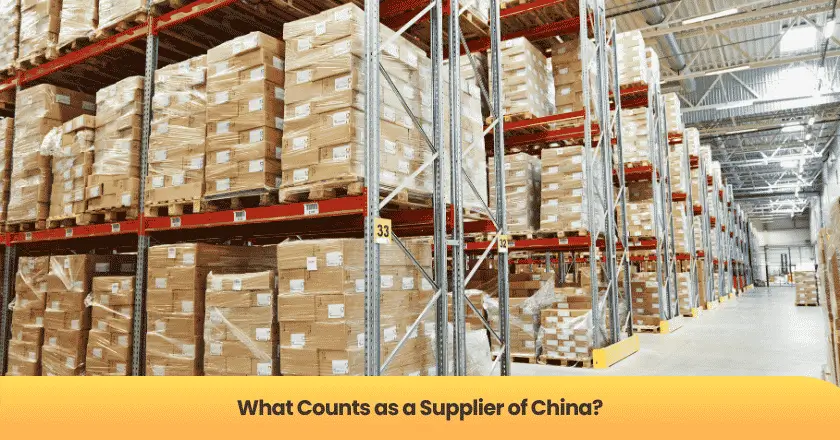
A buyer signs a proforma invoice with a company whose website shows a factory floor, whose salesperson answers questions in fluent English, and whose quote is 8% under everyone else. The deposit goes to an account in a different name, explained as the finance company. Production is fine, the goods ship, and nothing goes wrong until the second order arrives with a substituted component and the salesperson stops replying. There is no factory to visit, because there never was one.
The word supplier covers a wide range of counterparties in China, from a 900-person factory to one person with a laptop and good photographs. Telling them apart is not about suspicion. It is about knowing what you have actually contracted with, since that determines what you can enforce.
Key Takeaways
• A supplier of china can be a factory, a trading company, a market vendor, an agent, a platform seller or a broker with no assets at all.
• The business licence is the foundation document, and it names the company, its scope, its legal representative and its registered capital.
• Many small factories hold no export rights and must ship through an agent, which is normal rather than a warning sign.
• Payment to an account in a different name from the contracting company is the single most reliable red flag.
• Verification is cheap compared with a deposit, and most of it takes under an hour on public records.
The Question Behind the Question
Buyers usually ask whether a supplier is a factory. The more useful question is what legal entity will be on the contract, what it owns, and what happens if it fails to perform.
Six Kinds of Counterparty
Factories own production equipment and employ the workers who use it. Trading companies buy from factories and resell, often with genuine value in coordination and quality oversight. Market vendors sell stock goods from a booth. Sourcing agents act for you rather than selling to you. Platform sellers may be any of the above wearing a storefront. Brokers hold no assets and pass your order along for a spread.
None of these is illegitimate. A capable trading company outperforms a mediocre factory routinely, and a broker who genuinely knows a niche can be worth the spread. The failures happen when a buyer believes they are dealing with one type and are actually dealing with another, because the assumptions that follow are wrong.
Platform storefronts deserve their own note. Verification badges on B2B marketplaces confirm that some check was performed, and they do not confirm what kind of company sits behind the listing. Two storefronts carrying identical badges may be a 400-person factory and a three-person trading office. The badge is a starting point rather than an answer.
Why the Label Matters Less Than the Paperwork
Anyone can describe themselves as a manufacturer, and photographs of a production line prove nothing about who owns it. What is verifiable is registration: the company's legal name in Chinese, its registered business scope, when it was established, and who signs for it.
That record tells you more than any conversation. A company registered two years ago with modest capital and a business scope covering wholesale trade is a trading operation, regardless of what the website says. The record is public, and checking it costs nothing.
Expert Tip:I ask for the Chinese company name and the licence number before discussing price. Requesting it early frames it as routine administration rather than as an accusation, and the reaction tells you a lot. Real companies send a licence scan within a day because they are asked constantly. A counterparty who deflects, delays, or supplies only an English trading name is answering the question in a different way, and I stop spending time on the quote.
What a Legitimate Chinese Supplier Actually Has
Chinese company registration is standardised, which works in your favour. Every legitimate entity carries the same set of documents, and they are consistent enough that anomalies stand out.
The Business Licence and the Credit Code
The business licence is the founding document. It shows the registered Chinese name, the unified social credit code (an eighteen-character identifier that functions like a company registration number), the legal representative, registered capital, establishment date, registered address and business scope.
That code is the key to everything else, because it lets you look the company up on theNational Enterprise Credit Information Publicity Systemand confirm the licence is current, along with any entry on the abnormal operations list. Names in English mean nothing here. The Chinese registered name is the only identity that exists legally, and it is the name that must appear on your contract and on the bank account you pay.
Registered capital is worth reading carefully, and the rules changed recently in a way that makes it more informative than it used to be. Under theCompany Law revised in 2023, which took effect on 1 July 2024, shareholders of a limited liability company must pay in their subscribed capital within five years of establishment, and companies registered before that date are adjusting during a transition period running to mid-2027. A headline figure is therefore a commitment rather than a free claim, though it still says nothing about production capacity. A very small figure alongside claims of a large factory remains a reasonable thing to ask about.
Scope, Export Rights and the Legal Representative
Business scope describes what the company is registered to do. A manufacturer's scope names production activities and usually the product category. A trading company's scope reads as wholesale, import and export. Scope mismatch with the claim being made is one of the clearest signals available to you.
Export rights work differently from how many guides still describe them. The separate foreign trade operator filing wasabolished at the end of 2022when the Foreign Trade Law was amended, so a registered company now holds trading rights automatically. What a factory still needs is customs registration in order to file declarations, and plenty of capable small factories have never bothered. They export through an agent instead, which is ordinary practice. What matters is knowing which arrangement applies, since it determines who appears on your export documents.
Common Mistake to Avoid:Paying into an account that does not match the contracting company's registered name is the mistake that turns a dispute into a total loss. The explanations sound reasonable: a finance affiliate, a Hong Kong entity, a personal account to avoid delays. Each one severs the link between your money and the company you contracted with, and recovery becomes close to impossible. Insist on a corporate account in the exact registered name, and treat any pressure to do otherwise as a decision point rather than an inconvenience.
Verifying Before You Commit
Most verification is quick, cheap and repeatable. The work sits almost entirely before the first payment, which is exactly where buyers are most tempted to skip it.
Documents to Request and What to Check
Ask for the business licence, the customs registration if the supplier exports directly, and any product certification your market requires. Check that the licence is current, that the scope matches the claim, and that the registered address is a real industrial location rather than an office suite when a factory is being claimed.
Cross-check the name against export records where those are available in your market, since a company shipping regularly to buyers like you leaves a trail. Ask for two references from customers in similar markets and actually contact them. Suppliers expect this from serious buyers and are rarely offended.
Get the contract naming right as well. The agreement should carry the registered Chinese name, the credit code, the legal representative's name and the company chop, which is the official seal that binds a Chinese company far more decisively than a signature does. Contracts signed only in English by an individual with no chop are considerably harder to rely on.
Physical and Third-Party Checks
A video walkthrough is the fastest way to test a factory claim. Ask to see the production line running, the warehouse, and the front gate with the company sign visible. Requests to reschedule happen legitimately, and a pattern of them does not.
Remote audits have become ordinary practice through 2026, and third-party audit firms will visit a factory for a modest fee and report on equipment, headcount, certifications and capacity. For a first order of any size, that fee is trivial against the deposit you are about to send. Buyers who order regularly usually keep a standing arrangement with one audit provider.
Expert Tip:Run the verification in the order that costs you least. Public register lookup first, because it takes ten minutes and eliminates a surprising share of candidates. Then the licence documents and reference calls. Then the video walkthrough. Only after all three do I commission a paid audit, and only for suppliers I intend to place real volume with. Buyers who reverse that order spend money auditing companies a five-minute search would have removed.
Matching the Supplier Type to What You Need
Verification tells you what a counterparty is. Deciding whether that is the right type for your order is a separate judgement, and the answer changes with what you are buying.
When a Factory Is Right and When It Is Not
Godirect to a factorywhen your order justifies its minimum, when your product needs tooling or specification control, and when you can supply your own quality oversight. Factories reward volume and consistency with better pricing, and they are the only counterparty who can genuinely change how a product is made.
A trading company suits buyers spreading modest volume across several products, since one relationship covers what would otherwise be six. It also suits buyers who need somebody managing the factory relationship in Chinese. The cost is a margin you cannot see and a layer between you and production.
Red Flags That Cross All Types
Some signals matter regardless of what type you are dealing with. A quote materially below every other quote usually means a different specification rather than a better price. Reluctance to provide a licence, pressure to pay quickly, and a registered company younger than the claimed track record all belong in the same category.
Communication patterns count too. A supplier who answers technical questions with reassurance rather than with detail may be relaying your questions to somebody else. That is fine if disclosed and a problem if not, because the person you are negotiating with cannot commit to what you are asking for.
Expert Tip:Ask a deliberately technical question early, one you already know the answer to. The material grade of a component, the tolerance on a dimension, the cycle time on a mould. A factory answers directly, sometimes correcting your terminology. A trading company gives a correct answer a day later, having asked. A broker gives you an answer that is confident and slightly wrong. Thirty seconds of question drafting sorts counterparties faster than any document.
NewBuyingAgent as the Verification Layer
NewBuyingAgentis your perfect partner for global sourcing from China, backed by 30 years of expertise in trade, manufacturing and quality control. Its mission is to make China sourcing effortless and profitable for global buyers.
Verification is manageable for one supplier and becomes a job in itself once a buyer is running twenty. The constraint is rarely diligence and almost always the size of the pool being checked.
Only less than 5% of China's factories are within your reach. NewBuyingAgent gives you 100% Access to China's Factories through its 50,000+ cooperated partner factories—no language/region/time zone barriers. Its local reputation gets you full factory cooperation.
Confirming a company exists is the first check. Confirming what it produces is the one that reaches your customers. 20,000+ product development & QC experts ensure your products match market needs and stay high-quality.

Frequently Asked Questions
How can I tell if a supplier is a factory or a trading company?
Check the business scope on the licence, since manufacturing and wholesale trade are registered differently. Registered capital and establishment date add context, and a video walkthrough of the production line settles most cases. Asking a specific technical question about your product is the quickest informal test.
Is it a problem if my supplier has no export licence?
Not by itself. Trading rights themselves are automatic for a registered Chinese company, but customs registration is still required to file declarations, and many competent small factories skip it and export through an agent. What matters is knowing who will appear as exporter on your documents and confirming that arrangement in writing before production starts.
Should I always pay a Chinese supplier by bank transfer?
Bank transfer to the company's registered corporate account is the standard arrangement and the one that preserves your position in a dispute. Letters of credit suit large orders. Escrow and platform payment tools suit newer relationships. The method matters less than whether the receiving account name matches the company you contracted with.
How much verification is proportionate for a small first order?
A public register check, a licence scan and a video call cover most of the risk and cost you an hour. Paid audits generally make sense once order values reach a level where losing the deposit would genuinely hurt. Scale the effort to the money at stake rather than applying the same process to every enquiry.
What if a supplier refuses to share its business licence?
Treat it as a decision rather than a negotiation. Legitimate exporters are asked for the licence constantly and send it without comment. The occasional refusal comes from a broker who does not want you to see that no production entity exists behind the quote. Walking away costs you one candidate out of many.
Conclusion
A supplier of china is whatever the registration record says it is, and that record is public, standardised and quick to check. Confirm the legal entity, match the business scope against the claim, pay only the registered company, and ask one technical question that a middleman cannot answer. Those four habits remove most of the risk that new importers spend years learning about expensively. For buyers who would rather start from a vetted supply base, NewBuyingAgent handles factory selection, quality control and delivery from China.
Partial Sources:
1. State Administration for Market Regulation — National Enterprise Credit Information Publicity System, the public register for Chinese business entities —https://www.gsxt.gov.cn/— accessed 5 August 2026
2. State Council of the People's Republic of China — official explanation of the registered capital rules under the Company Law revised in 2023, effective 1 July 2024 —https://www.gov.cn/zhengce/202407/content_6960601.htm— accessed 5 August 2026
3. Ministry of Commerce of the People's Republic of China — briefing on the abolition of foreign trade operator filing following the 2022 amendment to the Foreign Trade Law —https://wms.mofcom.gov.cn/ztxx/dwmyzx/dwmyjyzbadj/art/2023/art_897a36464f8044bd90e35d408802da88.html— accessed 5 August 2026
NewBuyingAgent
Related Resources
Get Started Today
Let's Turn Your Sourcing Goals into RealityWeChat:+86 15157124615
WhatsApp:+86 15157124615
Address:Building 10 #39 Xiangyuan Road, Hangzhou, China
