

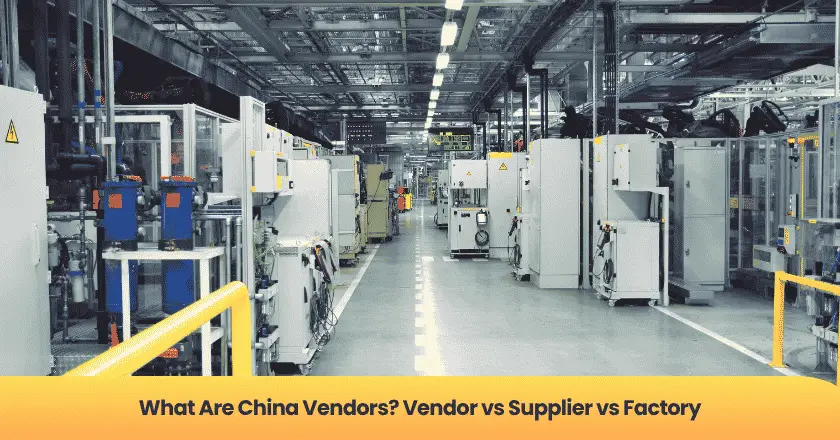
A retail buyer asks her sourcing contact for the factory audit certificate for vendor number 4417. The contact sends back a business licence for a trading company in Ningbo, a company she has been paying for two years and has listed internally as a manufacturer. Neither of them was being careless. She used vendor to mean the company that invoices her, and her records had quietly turned that into a claim about where the goods are made.
Vendor, supplier and factory get used interchangeably in day-to-day sourcing conversations, and they answer three different questions. Keeping them separate matters most when someone asks you to prove something about your supply chain.
Key Takeaways
• Vendor describes a commercial relationship, meaning the company that invoices you and that you pay.
• Supplier describes a position in the chain, and a supplier may sit several steps away from production.
• Factory describes a capability, specifically ownership of the equipment and the workers that make the goods.
• One company can occupy all three roles, and many china vendors occupy only the first.
• Compliance and marketplace requests increasingly ask about the manufacturing entity rather than the invoicing one.
Three Words, Three Different Questions
The confusion is understandable, since in a simple transaction the same company answers all three questions. The words only separate when something goes wrong or when somebody outside your business starts asking for detail.
Vendor Is About the Commercial Relationship
A vendor is whoever sells to you. The term comes from procurement and accounting rather than from manufacturing, which is why it appears in vendor lists, vendor master files (the internal record of every company you buy from) and payment systems. It says nothing at all about how goods come into existence.
That is the term's strength in its own domain. Finance needs one identifier per counterparty, and the vendor record does that job cleanly. Problems begin when the same record gets read as though it described a production source.
Supplier Is Position, Factory Is Capability
Supplier places a company in the chain rather than in your accounts. Procurement teams talk about tier one suppliers who sell to you directly and tier two suppliers who sell to them, which is a useful way to describe distance from your order. A supplier can be a manufacturer, a distributor or a consolidator.
Factory is the narrowest of the three and the only one that makes a claim about physical capability. It means the entity owning the machines and employing the people running them. Every factory can be a supplier and a vendor. Very few vendors are factories.
Two further terms circulate alongside these three. Manufacturer is effectively a formal synonym for factory and appears on customs and compliance paperwork. OEM partner (original equipment manufacturer, meaning a factory building to your design and specification) describes a working arrangement rather than a company type, and a trading company can arrange OEM production without owning a single machine.
Expert Tip:I keep three separate fields in supplier records rather than one: who invoices, who ships, and who manufactures. They are identical for perhaps a third of relationships and different for the rest. Filling those three fields at onboarding takes ten minutes and answers most future questions instantly. Buyers who keep one field spend a day reconstructing the answer every time a customer, an insurer or a marketplace asks where something was actually made.
Where the Vocabulary Clashes
The words carry different weight in different places, and China sourcing sits at the intersection of several vocabularies that were never designed to meet.
Western Procurement Language Meets Chinese Export Practice
Western procurement built its language around large firms managing many counterparties, so vendor became the neutral catch-all. Chinese export trade grew from a different structure, where factories, trading companies and export agents each perform a defined function and everybody in the market knows which is which.
The result is a translation gap rather than a deception. A Chinese sales contact describing their company as a supplier is being precise in their own framework. An importer hearing supplier and picturing a production line has added a meaning that was never sent.
You can see the gap in ordinary correspondence. Quotations often carry a company name ending in trading, import and export, or industrial, and those endings are meaningful in Chinese registration rather than decorative. Reading the company name itself answers the question in a fair number of cases, before anybody has been asked anything.
The Marketplace Usage That Confuses Everyone
Retail platforms add their own definitions. On Amazon, a vendor sells wholesale to Amazon, which then retails the goods, while a seller lists and sells directly to customers. Those are specific, contractual meanings that have nothing to do with manufacturing, and sellers who work in that vocabulary daily often carry it into sourcing conversations where it means something else entirely.
Compliance requests have made the distinction sharper. The EU'sGeneral Product Safety Regulation, applicable since December 2024, requires consumer products to carry the manufacturer's name and contact details and to have an economic operator established in the EU who is responsible for them. Marketplaces enforce this on listings. Those requirements name the manufacturer, not the company on your invoice, and records built around vendor identity alone do not answer them.
Common Mistake to Avoid:Recording a trading company in your files as a manufacturer creates a problem you will not notice until somebody audits you. Product liability documentation, marketplace compliance checks and customer due diligence all ask who made the goods, and an answer that turns out to be a reseller undermines every other statement in the same file. Ask each counterparty directly whether they manufacture, and record the answer as given rather than as assumed. Suppliers answer this honestly in most cases, because within their own market it is an ordinary question.
What Changes in How You Manage Each
The practical consequence of the distinction is what you can reasonably ask for, and what a given counterparty is actually able to deliver.
What You Can and Cannot Ask For
A factory can change how a product is made. It can adjust tooling, alter material grades, run trials and give you real answers about cycle time and capacity. A trading vendor can arrange most of those things and cannot decide them, which shows up as slower answers and softer commitments on technical questions.
A vendor with no production of its own can still be excellent at coordination, consolidation across categories and shielding you from a dozen separate relationships. Expecting engineering judgement from that vendor is the mismatch. Expecting a single small factory to manage forty SKUs (stock keeping units, the individual product variants you sell) across five categories is the same mistake in reverse.
Documents follow the same split. The commercial invoice carries the selling entity, the bill of lading carries the shipper, and the manufacturer may appear on neither. For products where origin documentation matters, ask which entity will be named as manufacturer before production starts rather than discovering it when the paperwork arrives.
Contracts, Records and Vendor Management
Contracts should name the manufacturing entity where quality obligations are concerned, even when a trading company handles the commercial relationship. Otherwise your quality clauses bind a company that does not control production and cannot fix a defect at source.
Vendor management practices transfer well to China with one adjustment. Score commercial performance against the vendor, since that is who you deal with, and score quality performance against the manufacturing site. Buyers who blend the two end up unable to tell whether a recurring defect follows the vendor or follows the factory behind it, which are very different problems with very different fixes.
Expert Tip:Ask your trading vendor which factory produced a given batch, and ask it routinely rather than only after a problem. Vendors who name the site are worth keeping, and the information lets you spot when production quietly moves to a cheaper subcontractor between orders. That switch is the single most common cause of a batch that suddenly differs from the last one, and it is invisible unless you have been asking the question all along.
Getting the Vocabulary to Fit Your Business
None of this requires rebuilding your systems. It requires that the words in your records mean what they appear to mean.
Building a Vendor List That Reflects Reality
Start with the counterparties you already buy from and fill in the three fields for each: invoicing entity, shipping entity, manufacturing entity. Expect surprises on perhaps a quarter of them. Where the manufacturing entity is unknown, that gap is itself the finding, and it tends to sit exactly where your risk is concentrated.
Record the registered Chinese company name alongside the trading name you use internally. English trading names change, overlap between unrelated firms and cannot be verified against anything, while the registered name is the only identity that appears on theNational Enterprise Credit Information Publicity Systemand can therefore be checked.
Review the records on a schedule rather than on incident. Once a year is enough for most buyers, and it catches the changes that happen quietly: a vendor that has moved production, a factory that has added a second site, a company name that changed after a restructuring. Fifteen counterparties take an afternoon to review and produce two or three genuine surprises.
When One Company Occupies All Three Roles
Plenty of Chinese manufacturers invoice you directly, ship in their own name and produce in their own plant. That arrangement is the simplest to manage and the easiest to verify, and it is worth recognising when you have it rather than treating every counterparty as equally opaque.
The distinction still earns its keep during growth. A factory that starts subcontracting overflow to a neighbour has quietly become a vendor for part of your volume, and only records that separate the roles will show it. Recognising that shift early is usually the difference between adjusting your quality plan and explaining a bad batch to a customer.
Expert Tip:Write the definitions down once and put them where your team can see them. Two sentences each for vendor, supplier and factory, agreed internally, removes an entire category of confusion from procurement conversations. I've watched a purchasing team and a quality team argue for a week about a supplier's performance while describing two different companies. The fix cost about fifteen minutes of writing and never had to be repeated.
Consolidating China Vendors Through NewBuyingAgent
Managing fifteen counterparties across four categories is mostly administration, and administration expands to fill whatever time a business gives it. The buyers feeling that weight most are usually the ones whose growth depends on doing something else with those hours.
NewBuyingAgent handles all factory communication—perfect for multi-category buyers. Free up your time to focus on expanding your local market sales.
NewBuyingAgent is your perfect partner for global sourcing from China, backed by 30 years of expertise in trade, manufacturing and quality control. 20,000+ product development & QC experts ensure your products match market needs and stay high-quality. Its mission is to make China sourcing effortless and profitable for global buyers.
Consolidating relationships only helps if visibility into production improves rather than shrinks. Contact now.
Frequently Asked Questions
Is a vendor the same as a supplier?
In everyday use the words are treated as synonyms, and in precise use they are not. Vendor describes the commercial relationship, meaning whoever invoices you. Supplier describes position in the supply chain and can refer to companies several steps removed from you. The difference matters when documenting where goods originate.
How do I find out whether my china vendors are factories?
Check the business scope on the company's licence, since manufacturing and wholesale trade are registered differently. A video walkthrough of the production line settles most cases quickly. Asking a specific technical question about tolerances or material grades also works, because a trading company typically needs a day to answer it.
Is it a problem to buy through a vendor rather than a factory?
Not at all, and for buyers spreading modest volume across many products it is often the better arrangement. What matters is recording the relationship accurately and directing quality obligations at the entity that controls production. Problems come from misunderstanding the arrangement rather than from the arrangement itself.
What should a vendor record contain for a Chinese counterparty?
Registered Chinese company name, unified social credit code, invoicing entity, shipping entity, manufacturing entity and site address, plus the contract and payment account details. That set answers most compliance requests without further research. Add the date each field was last confirmed, since manufacturing arrangements change more often than company names do.
Should quality clauses name the factory or the trading company?
Name both where you can. The commercial agreement sits with the company that invoices you, while quality obligations mean little unless the entity controlling production is identified and bound. Where a vendor resists naming its factory, treat that as information about how much control you will have when a batch goes wrong.
Conclusion
Vendor tells you who to pay, supplier tells you where a company sits in the chain, and factory tells you who owns the machines. Keeping those answers in separate fields costs a few minutes per counterparty and saves you the day of reconstruction that follows any serious question about your supply chain. Precision here is cheap, and vagueness only ever gets expensive later. For buyers consolidating a scattered vendor list, NewBuyingAgent covers factory selection, quality control and delivery from China.
Partial Sources:
1. EUR-Lex, Publications Office of the European Union — summary of Regulation (EU) 2023/988 on general product safety, including manufacturer identification and responsible person requirements —https://eur-lex.europa.eu/EN/legal-content/summary/general-product-safety-regulation-2023.html— accessed 5 August 2026
2. State Administration for Market Regulation — National Enterprise Credit Information Publicity System, the public register of Chinese business entities —https://www.gsxt.gov.cn/— accessed 5 August 2026
NewBuyingAgent
Related Resources
Get Started Today
Let's Turn Your Sourcing Goals into RealityWeChat:+86 15157124615
WhatsApp:+86 15157124615
Address:Building 10 #39 Xiangyuan Road, Hangzhou, China
