

Introduction
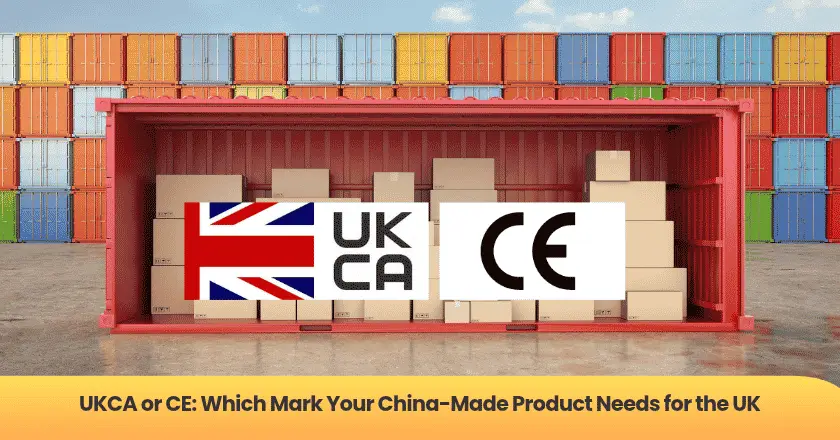
Buyers importing from China into the UK often ask whether they must switch from CE to UKCA, and the answer has changed several times since Brexit. The current position gives many importers more choice than they expect, but it also contains exceptions that can catch out a product range.
This article explains UKCA vs CE marking as it stands under current GOV.UK guidance, covering Great Britain, Northern Ireland and the UKNI marking. It focuses on choosing the right mark and conformity route for products made in China, with the dates and exceptions that matter.
Key Takeaways
· Great Britain continues to recognise the CE marking for many product areas under the Product Safety and Metrology (Amendment) Regulations 2024, alongside or in place of UKCA.
· Recognition is indefinite for 21 product regulations, including toys, electrical equipment, electromagnetic compatibility, radio equipment, machinery and personal protective equipment.
· Medical devices, construction products, marine equipment, rail products, cableways, transportable pressure equipment and unmanned aircraft systems have their own arrangements.
· In Northern Ireland, EU product rules apply under the Windsor Framework, so products use the CE marking, with the UKNI marking added only in specific cases.
· UK Approved Bodies can only certify for UKCA, while EU Notified Bodies certify against EU requirements that can also be used in Great Britain.
UKCA vs CE Marking: The Current Position in Great Britain
Great Britain (England, Scotland and Wales) now allows both marks for most regulated consumer and industrial products.
CE recognition under the 2024 Regulations
GOV.UK guidance states that the UK continues to recognise the CE marking, alongside or in place of the UKCA marking, under the Product Safety and Metrology (Amendment) Regulations 2024. According to the government's summary of regulatory changes, those Regulations came into force on 1 October 2024 and cover 21 product areas. The Product Regulation and Metrology Act 2025, which came into force on 21 July 2025, provides the wider framework for future product rules. For many importers, the practical result is that a valid CE route remains acceptable in Great Britain.
Which regulations have indefinite recognition
The government's guidance on placing manufactured products on the GB market says continued recognition will apply indefinitely to 21 product regulations. These include the 18 regulations owned by the Department for Business and Trade, announced on 1 August 2023, such as toys, low voltage electrical equipment, electromagnetic compatibility, radio equipment, machinery and personal protective equipment. Recognition also covers ecodesign, civil explosives and, in most circumstances, restriction of hazardous substances (RoHS) in electrical equipment. Check your product against the full list before you plan your marking.
Fast-Track UKCA
The 2024 Regulations also introduced a route called Fast-Track UKCA. It allows businesses to apply the UKCA marking where recognised EU requirements and conformity assessment processes have been met. The manufacturer then draws up a UK declaration of conformity (a formal statement that the product meets the rules) listing compliance with the relevant EU legislation. GOV.UK describes this as giving longer-term certainty in case the UK later mandates UKCA for certain regulations.
Expert Tip: List every regulation that applies to your product before choosing a mark, because a single product often falls under several. An electrical toy, for example, may sit under toy, electromagnetic compatibility and RoHS rules at once. Confirm that each regulation is on the indefinite recognition list, then decide whether CE alone is enough for your plans.
Products Where Different Rules Apply
Indefinite CE recognition is broad, but it does not cover every sector, and a few areas need extra care.
Sectors with their own arrangements
GOV.UK states that the indefinite recognition announcement does not apply to medical devices, construction products, marine equipment, rail products, cableways, transportable pressure equipment and unmanned aircraft systems. These sectors have specific arrangements, and the guidance points to sector rules for details. Buyers sourcing products such as building materials or drones from China should therefore check sector guidance rather than assume CE is accepted. The rules can differ on timing, marking and the bodies allowed to certify.
Construction products and mandatory standards
Construction products stand out for another reason. GOV.UK notes that under most UK product regulations the use of designated standards (standards recognised by the UK government to give a presumption of conformity) is voluntary. The main exception is the Construction Products Regulations 2013, where designated construction product standards operate on a mandatory basis. That makes construction products one of the areas where UK-specific checks matter most.
Other frameworks and territories
Some products fall outside the UKCA and CE regimes entirely, such as chemicals, medicines and vehicles, which follow their own regulatory frameworks. The UKCA marking also does not apply in the Crown Dependencies (Guernsey, Jersey and the Isle of Man) or the British Overseas Territories. If you sell to customers there, check local requirements separately. A UK-wide plan should not assume these territories follow GB rules.
Common Mistake to Avoid: Assuming that indefinite CE recognition covers every product in a mixed range. A buyer who sources both small appliances and construction products from China may find that one line can keep its CE route while the other needs sector-specific checks. Review each product line separately against GOV.UK's sector guidance before you ship.
Choosing Between UKCA and CE for China-Made Goods
For products where both marks are accepted, the choice usually depends on where else you sell and which conformity route you need.
If you also sell in the EU
A product sold in both the EU and Great Britain can typically use one CE route for both markets where recognition applies. This avoids running separate UK and EU conformity work for the same item. GOV.UK confirms that a product can carry several markings, including both UKCA and CE, as long as it complies with the relevant requirements and the markings are clearly visible. Dual marking can make sense if you want to prepare for possible future UK-only rules.
If a third-party body is required
Some products need a conformity assessment body rather than self-declaration. In the UK, these are UK Approved Bodies accredited by UKAS, and GOV.UK states they can only certify products for UKCA marking. EU Notified Bodies certify against EU requirements, which can also be used for the GB market under CE recognition or Fast-Track UKCA. Choosing the body therefore partly decides which marks are open to you.
Self-declaration limits for toys
Many products can be self-declared, but the details matter. For toys, GOV.UK's table allows self-declaration under the Toy (Safety) Regulations 2011 except where designated standards covering the essential requirements do not exist, have not been applied in full, or have been published with a restriction. In those cases a third-party body is needed. Ask your lab to confirm whether any standard you rely on carries a restriction.
Expert Tip: Decide the conformity route before ordering samples for testing. If you sell in the EU and GB, plan around the CE route and a lab or Notified Body that can issue what you need. If you only sell in GB and need a third-party body, check the UKMCAB database for UK Approved Bodies covering your product.
Northern Ireland: CE, UKNI and the Windsor Framework
Northern Ireland follows different rules from the rest of the UK for manufactured products.
EU rules apply in Northern Ireland
GOV.UK explains that under the Windsor Framework, formally adopted by the UK on 24 March 2023, relevant EU rules on manufactured products apply in Northern Ireland. Products placed on the Northern Ireland market therefore use the CE marking, and the UKCA marking alone is not the route. Importers must still meet economic operator duties, such as showing their identification details on the product. Instructions must be clear and in easily understandable English.
When the UKNI marking is used
The UKNI marking is never used on its own. GOV.UK states that it always accompanies an EU conformity marking such as CE, and is applied where a UK-based Northern Ireland notified body carries out mandatory third-party conformity assessment. If you use an EU Notified Body instead, the product carries CE alone. In most cases, products made in China and certified by an EU body will not need UKNI.
Moving goods from Northern Ireland to Great Britain
For qualifying Northern Ireland products, the UK government guarantees unfettered access to the GB market without additional approvals. These products can be placed in Great Britain based on the CE, or CE and UKNI, markings used in Northern Ireland. GOV.UK publishes separate guidance on which products qualify. Goods imported from China straight into Great Britain follow the GB rules described earlier.
Common Mistake to Avoid: Treating the UK as one market for product marking. A shipment cleared into Great Britain under a UKCA-only route may not be compliant if part of it is later sold into Northern Ireland, where EU rules apply. Plan stock flows and markings separately for GB and Northern Ireland, especially if one warehouse serves both.
Labels, Documents and Practical Steps in 2026
Whichever mark you choose, the practical requirements on labels and documents are similar, and most of them need agreeing with the factory before production.
Marking size and placement
GOV.UK says UKCA and CE markings must be in their standard form, at least 5mm high unless the legislation sets a different minimum, and easily visible, legible and indelible. Current legislation allows the UKCA marking to be placed on a label affixed to the product or on an accompanying document until 11pm on 31 December 2027. The CE marking must go on the product or its data plate, or on packaging and accompanying documents where that is not possible. Agree artwork with the factory early so markings are printed or moulded correctly.
Importer details and own-brand products
Importers must show their name, registered trade name or trademark and postal address on the product. GOV.UK also notes special rules for products imported from an EEA state, or in some cases Switzerland, before 11pm on 31 December 2027, where importer details can go elsewhere. If you sell China-made products under your own brand, you take on the manufacturer's responsibilities. NewBuyingAgent's guide to labelling and origin rules for Chinese products covers related label questions.
Technical file and declaration
Under both regimes, the manufacturer prepares a technical file, typically including test reports, design documents and risk assessments. For a UK declaration of conformity, GOV.UK states that the legislation cited can be either UK legislation or recognised EU product regulations. Documents are typically kept for 10 years after each product is placed on the market. The points below summarise what to check before shipping.
· Confirm that each regulation covering the product is on the recognition list, or follow its sector-specific rules.
· Choose the mark and conformity route, and confirm which body can certify if self-declaration is not allowed.
· Agree marking artwork, importer details and English instructions with the factory before mass production.
Expert Tip: Ask the factory for the technical file contents in English, including test reports that name the standards and editions used. Keep a copy yourself rather than relying on the factory to supply it later. If authorities request documents, you will usually need to provide them quickly, and a complete file avoids delays.
The Right Mark From the Start: How NewBuyingAgent Supports UK Compliance
Choosing the right products for the UK market starts before the order is placed. Product requirements, target markets, labelling details and purchasing costs all need to be considered when comparing products and manufacturing options.
NewBuyingAgent helps UK buyers source products from China across a wide range of categories. Tell us what you plan to buy, your target market and your purchasing requirements, and we can help you explore suitable products and manufacturing resources.
With over 30 years of international trade experience, access to a network of 50,000+ factories, and industry resources covering 20,000+ product development and QC specialists, we help buyers find the right products at better price, quality and service.
Planning to source products for the UK market? Share your requirements with NewBuyingAgent and explore your options in China. Visit NewBuyingAgent
Frequently Asked Questions
What is the difference in UKCA vs CE marking?
UKCA is the UK conformity marking for Great Britain, while CE is the EU marking. Great Britain recognises CE for many product areas, so both can be used there. Northern Ireland follows EU rules and uses CE, sometimes with UKNI.
Can I still sell CE-marked products in Great Britain?
Yes, for products covered by the 21 regulations with indefinite recognition. Sectors such as medical devices and construction products have their own arrangements, so check the sector guidance for those products before relying on CE alone.
Do I need the UKNI marking?
Only if a UK-based Northern Ireland notified body carries out mandatory third-party assessment for the Northern Ireland market. UKNI is always used together with CE, never alone.
Can a product carry both UKCA and CE?
Yes. GOV.UK states that a product can carry multiple markings if it complies with the relevant requirements and the markings can be clearly seen.
Does the UKCA marking apply in Jersey or Guernsey?
No. The UKCA marking does not apply in the Crown Dependencies or the British Overseas Territories, so check local rules with the relevant authorities there.
Conclusion
For many China-made products, CE remains a valid route into Great Britain, while Northern Ireland follows EU rules. Check each regulation, choose your conformity route early and plan labels for both markets. NewBuyingAgent can help make sourcing from China simpler and more profitable.
Sources
1. Placing UKCA or CE marked products on the market in Great Britain – GOV.UK — https://www.gov.uk/guidance/using-the-ukca-marking
2. Placing CE, or CE and UKNI marked products on the market in Northern Ireland – GOV.UK — https://www.gov.uk/guidance/using-the-ukni-marking
3. Product safety and metrology regulatory changes: UKCA and CE regimes – GOV.UK — https://www.gov.uk/government/publications/product-safety-and-metrology-regulatory-changes-ukca-and-ce-regimes/product-safety-and-metrology-regulatory-changes-ukca-and-ce-regimes
4. Placing manufactured products on the market in Great Britain – GOV.UK — https://www.gov.uk/guidance/placing-manufactured-goods-on-the-market-in-great-britain
NewBuyingAgent
Related Resources


Get Started Today
Let's Turn Your Sourcing Goals into RealityWeChat:+86 15157124615
WhatsApp:+86 15157124615
Address:Building 10 #39 Xiangyuan Road, Hangzhou, China
