

Introduction
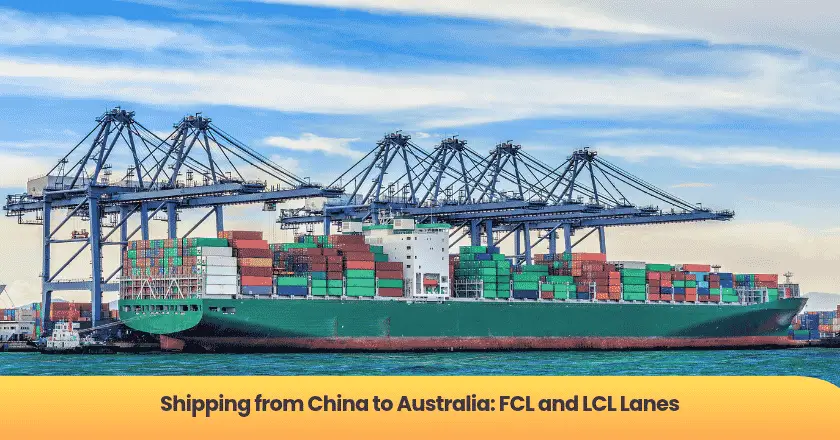
Most consumer goods that Australians buy from China arrive by sea in a steel box, and the way that box is filled and routed shapes cost, timing and risk. Importers have to decide whether to book a whole container or share one, and which Australian port should receive it.
Getting shipping from China to Australia right means matching the load type to your volume and the port to your customers. Below we look at the main container gateways, the practical differences between FCL and LCL, and how the brown marmorated stink bug (BMSB) season affects cargo shipped from China.
Key Takeaways
· Port of Melbourne describes itself as Australia's largest container port, followed in its 2025 throughput comparison by Sydney, Brisbane, Fremantle and Adelaide.
· FCL (Full Container Load) gives one shipper a sealed container from factory to destination, while LCL (Less than Container Load) shares a container with other shippers and adds handling at both ends.
· The BMSB risk season runs from 1 September to 30 April inclusive, based on the shipped-on-board date on the ocean bill of lading.
· For the 2026-27 season, the Australian agriculture department lists China as a target risk country for heightened vessel surveillance only, and as an emerging risk country whose goods may face random onshore inspection.
· The right lane depends on where your customers are, how much you ship and the total door-to-door cost, not the ocean rate alone.
Australia's Main Container Gateways for China Cargo
Australia's container trade is concentrated in a handful of capital-city ports, and each one serves a distinct state market.
Port of Melbourne
Port of Melbourne describes itself as Australia's largest container and general cargo port, handling more than one-third of Australia's container trade. Its calendar-year 2025 review reports a record 3.5 million TEU (twenty-foot equivalent units, the standard measure of container volume). The same review states that China remained the largest origin for container imports through the port, driven largely by furniture, appliances and manufactured products.
Sydney's Port Botany
NSW Ports states that Port Botany is the largest container port in New South Wales and handles 99.6% of the state's containers, about 2.8 million TEU a year. It lists three container terminals operated by DP World Australia, Patrick Terminals and Hutchison Ports. NSW Ports also says Port Botany is the only port in Australia with on-dock freight rail at every container terminal, and that 80% of import containers travel no further than 40 kilometres from the port. That short final leg typically suits importers with warehouses in Greater Sydney.
Brisbane, Fremantle and Adelaide
Port of Melbourne's 2025 comparison of container throughput ranks Brisbane third, followed by Fremantle and then Adelaide. Port of Brisbane states that it has the equivalent of eight 300-metre container berths, operated by three stevedores that all use automated container handling equipment. Fremantle serves Western Australia and Adelaide serves South Australia, so cargo for Perth or Adelaide customers usually makes most sense through those ports. Choosing the port closest to the end customer generally keeps road or rail costs lower.
Expert Tip: Before booking, map where each shipment will be unpacked, whether that is your own warehouse, a third-party logistics provider or a customer's distribution centre. Ask your freight forwarder to quote to the port that serves that address, not just the port with the most sailings. A container landed in Melbourne for a Brisbane warehouse can add a long and avoidable interstate leg.
FCL Shipping: When a Full Container Makes Sense
A full container gives one shipper control of the whole box from the factory to the delivery address.
What FCL means in practice
With FCL, you book an entire container for your goods alone, even if it is not completely full. NewBuyingAgent's FCL wiki entry explains the term and how it differs from shared loading. The container is typically packed and sealed at the factory or a nearby warehouse and stays sealed until it reaches the consignee. Fewer handling points usually mean a lower risk of damage and loss.
How FCL cost behaves
FCL is priced per container rather than per cubic metre, so the cost per unit falls as you fill more of the box. The main drivers are the ocean rate on the lane, origin and destination terminal charges, inland transport at both ends and any carrier surcharges in force at the time. Rates change with season, fuel and capacity, so a quote is usually valid only for a limited period.
Packing and loading
Because the container is yours, you decide how cartons and pallets are loaded and secured. A good loading plan uses the space well and stops cargo shifting during the voyage. Ask the factory to photograph the empty container, the loading progress and the seal number before the doors close.
Common Mistake to Avoid: Booking an FCL as soon as a shipment looks large, without checking how much of the container it would actually fill. A half-empty container can cost more per unit than a well-planned LCL booking. Ask your forwarder to compare both options for each order using the real carton dimensions and weights, then choose based on the total cost to your door.
LCL Shipping: Consolidation and Deconsolidation
LCL lets smaller importers ship to Australia without paying for space they do not need.
How LCL works
With LCL, a consolidator collects cargo from several shippers at a CFS (container freight station, a warehouse where shared containers are packed and unpacked) in China. The goods are packed together into one container, which travels under a master bill of lading, while each shipper's cargo travels under its own house bill of lading. After arrival in Australia, the container goes to a CFS for deconsolidation (unpacking and separating each shipper's goods). Each importer then collects or receives its own cargo.
Extra handling points
LCL cargo is handled more often than FCL cargo, because it is loaded, unloaded and moved at both CFS facilities. That extra handling typically adds time and slightly raises the risk of damage, so strong export cartons and clear marks matter more. A problem with another shipper's goods in the same container can delay deconsolidation for everyone.
When LCL fits best
LCL usually suits trial orders, small replenishment orders and buyers testing a new product line. It also lets you ship more often in smaller quantities instead of waiting to fill a container, which can reduce the stock you hold. As volumes grow, the cost advantage generally shifts toward FCL.
Expert Tip: Ask your forwarder for the CFS cut-off date in China, the expected sailing and the receiving CFS in Australia for every LCL booking. Make sure cartons are labelled with your mark, carton count and destination on at least two sides. Clear labelling helps the destination CFS separate your goods quickly and reduces the chance of cartons going to the wrong importer.
BMSB Seasonal Measures and China Cargo
Australia's biosecurity rules for the brown marmorated stink bug can affect timing for both FCL and LCL shipments during the risk season.
Season dates and how they are applied
The Department of Agriculture, Fisheries and Forestry (DAFF) states that BMSB seasonal measures apply to target goods manufactured in or shipped from target risk countries between 1 September and 30 April inclusive. The date that counts is the shipped-on-board date shown on the ocean bill of lading, and gate-in dates are not accepted. Target high risk goods require mandatory treatment, while target risk goods are subject to random inspection. DAFF also says it reviews the measures during the season and may adjust them.
China's status in the current season
DAFF's current list names China as a target risk country for heightened vessel surveillance only, which applies to roll-on roll-off vessels rather than to goods on board. It separately lists China as an emerging risk country, meaning goods shipped from China between 1 September and 30 April may be selected for random onshore inspection. For emerging risk countries, DAFF adds that tariff chapters 39, 94 and 95 are subject to random inspection alongside target high risk goods. In most cases, this means sea cargo from China faces inspection risk rather than mandatory treatment, but the lists can change, so check the live DAFF page before each season.
What it means for FCL and LCL
DAFF states that goods outside the target categories can still be subject to the measures if they are packed with target high risk or target risk goods. For LCL and FAK (freight of all kinds) containers carrying target high risk goods from target risk countries, DAFF manages the BMSB risk at container level before deconsolidation, using a master consolidator declaration. Its guidance also covers cargo hubbed in a non-target country after leaving a target risk country, so a co-loaded box can typically be held because of someone else's goods. An FCL container holding only your goods from China avoids that shared exposure.
Common Mistake to Avoid: Assuming that BMSB measures cannot touch China cargo because China is not a full target risk country for goods. Goods from China can still be selected for random inspection during the season, and a shared LCL container can be held because of other cargo. Check the live DAFF page each season and build extra time into September to April shipments.
Planning Shipping from China to Australia Lanes in 2026
With the ports, load types and seasonal rules in view, lane planning becomes a straightforward comparison.
Match the port to the destination
Start with the delivery address and work backwards to the Australian port that serves it. Melbourne, Port Botany, Brisbane, Fremantle and Adelaide each serve their own state market, and moving containers between states adds cost and time. Importers with customers in several states may use more than one gateway.
Origin port and carrier services
The available lanes also depend on which Chinese port your goods leave from and which carriers serve it. Some services call directly at Australian ports, while others connect through transshipment hubs, which can add time and handling. Ask your forwarder which services link your origin port to your chosen Australian port.
Comparing quotes fairly
Ask every forwarder to quote on the same basis so you can compare the figures line by line. The points below cover the items that most often cause confusion. Asking for the same breakdown from each forwarder also makes hidden charges easier to spot.
· The ocean freight, origin charges and destination terminal or CFS charges for each lane.
· The inland transport cost from the Australian port to the final delivery address.
· Whether the service is direct or transshipped, and the carrier's published schedule.
· Any likely biosecurity inspection or handling costs during the BMSB season.
Expert Tip: Review your FCL and LCL split every quarter rather than once a year. Volumes, freight rates and seasonal rules change, and a product that was best shipped LCL last year may now fill a container. Ask your forwarder to compare both options for your next three orders so you can plan ahead.
Reliable Shipping to Australia Starts at the Factory: How NewBuyingAgent Supports Australian Buyers
Choosing between FCL and LCL is one part of importing from China. Buyers also need to consider what products to purchase, how much to order, which specifications fit their market and what target prices make commercial sense. These purchasing decisions help establish a clearer basis for budgeting and planning an order before transportation is arranged.
NewBuyingAgent helps global buyers source products from China across multiple categories. With over 30 years of experience in international trade, manufacturing and quality control, we provide access to a network of more than 50,000 factories, alongside industry resources that include 20,000+ product development and QC specialists across China. Whether you are sourcing furniture, household goods, electronics, textiles or other consumer products, we help you explore suitable products and manufacturing resources based on your specifications, target prices and purchasing needs.
Whether you are placing your first order from China or expanding an existing product range in Australia, tell NewBuyingAgent what you need. We help you find the right products and manufacturing sources in China at better price, quality and service.
Start Sourcing with NewBuyingAgent
Frequently Asked Questions
Which Australian port handles the most containers?
Port of Melbourne describes itself as Australia's largest container port, handling more than one-third of the nation's container trade. Its 2025 review reports a record 3.5 million TEU. Sydney's Port Botany handles about 2.8 million TEU a year, according to NSW Ports.
Should I ship FCL or LCL from China to Australia?
Compare both for each order using real carton dimensions and weights. LCL usually suits small and trial orders, while FCL becomes more cost-effective per unit as the container fills.
When is the BMSB season for cargo shipped to Australia?
DAFF states that the BMSB risk season covers goods shipped between 1 September and 30 April inclusive. The shipped-on-board date on the ocean bill of lading is used to decide whether goods fall within the season.
Does BMSB treatment apply to goods from China?
For the current season, DAFF lists China as a target risk country for heightened vessel surveillance only and as an emerging risk country for goods. In most cases, that means goods from China may be randomly inspected rather than requiring mandatory treatment.
Why can LCL cargo take longer to release?
An LCL container must be unpacked at a container freight station before each importer receives its goods. The container's release can also depend on all the cargo inside it. A hold on one consignment can delay deconsolidation for everyone in the same box.
Conclusion
Pick the Australian port that best serves your customers, choose FCL or LCL based on actual shipment volumes, and allow extra time during the BMSB risk season. Compare complete door-to-door quotes rather than ocean freight rates alone, and review your shipping arrangements as order volumes and market conditions change.
For buyers sourcing products from China, these shipping considerations should go hand in hand with sound purchasing decisions. Choosing suitable products, specifications and order quantities is an important starting point for managing overall import costs.
Sources
1. Seasonal measures for Brown marmorated stink bug (BMSB) – DAFF — https://www.agriculture.gov.au/biosecurity-trade/import/before/brown-marmorated-stink-bugs
2. Management of LCL/FAK containers during the BMSB risk season – DAFF — https://www.agriculture.gov.au/biosecurity-trade/import/before/brown-marmorated-stink-bugs/lclcontainers
3. Trade in Review CY25 – Port of Melbourne (PDF) — https://www.portofmelbourne.com/wp-content/uploads/PoM-CY25-Trade-in-Review-Report-FINAL.pdf
4. Port Botany – NSW Ports — https://www.nswports.com.au/port-botany
5. Berths and Terminals – Port of Brisbane — https://www.portbris.com.au/operations-and-trade/port-facilities/berths-and-terminals
NewBuyingAgent
Related Resources

Get Started Today
Let's Turn Your Sourcing Goals into RealityWeChat:+86 15157124615
WhatsApp:+86 15157124615
Address:Building 10 #39 Xiangyuan Road, Hangzhou, China
