


A trend-to-reorder calendar connects a product opportunity to the dates when you can approve, receive, evaluate and buy it again. Start with the last date additional stock can usefully reach customers, then work backward through supply and decision time. For a category or merchandising director sourcing from China, the calendar should show whether launch evidence can arrive early enough to support another commercial commitment.
Build the Calendar Around the Last Useful Receipt
The calendar works backward from the last useful receipt to connect product approval, supply work, launch evidence and the latest reorder release. Define saleable stock as goods received, accepted and available to promise to the intended customer, rather than goods merely reaching a port. Give each milestone an owner, a dated input and a decision that determines what happens next.
- Timeline: Separate the commercial selling window, first-stock date, evidence review and repeat-order deadline.
- How it works: Use confirmed product and supply assumptions to calculate dependencies, then replace forecasts with actual progress.
- Decision: Approve, change or stop the reorder when the available evidence and remaining window no longer support the original plan.
Define the Product, Market and Evidence Before Adding Dates
A reliable calendar starts with one defined product version, destination and selling channel. A useful record states what opportunity you are testing, what evidence would support it and when additional units would become commercially unattractive. That scope prevents a trend signal from one market, an approval for another specification and a sales report from a different channel from appearing to describe the same buying decision.
Google Trends normalizes search interest relative to the geography and time range selected; its scores are not absolute search volumes. Save the query, market and observation dates with your hypothesis. A rising search curve can justify investigating a style or use case, but it cannot establish how many units your own customers will buy.
Use the following register as a copyable starting point. Replace bracketed fields, give each row a named owner and attach the underlying document or report. Keep a separate row when a variant has a different material, approval requirement or arrival constraint; otherwise one apparently complete line can conceal several unfinished products.
| Calendar record | Fill in | Input and owner | Output or next decision |
|---|---|---|---|
| Opportunity | [Product/version; market; channel] | [Trend evidence; category owner] | [Investigate or reject hypothesis] |
| Product release | [Approval date; unresolved items] | [Specification/sample; product owner] | [Lock version or reopen development] |
| Supply and receipt | [First/repeat duration; saleable-stock dates] | [Confirmed sequence; supply owner] | [Feasible date or missing confirmation] |
| Evidence review | [Data as-of; available-on; review due] | [Sales/stock report; analyst] | [Approve quantity, investigate or stop] |
| Commercial boundary | [Last useful receipt; latest release] | [Demand window; category/finance owner] | [Release, change scope or exit] |
| Change record | [Status date; actuals; revised forecast] | [Changed input; responsible owner] | [Decision, approver and next check] |
For a buyer choosing a new assortment, NewBuyingAgent offers AI-assisted market-fit product analysis and a free Bestseller Market Analysis Report. Use that input to sharpen the product hypothesis before requesting supply: which customer task, style or price position is being tested? Record the assessment date and assumptions alongside the candidate product, while retaining responsibility for the commercial forecast.
A usable calendar identifies the product version, destination, channel, commercial cutoff, evidence owner and next decision. The milestones below show how those records connect; the worked example later supplies the date arithmetic and the late-arrival branch.
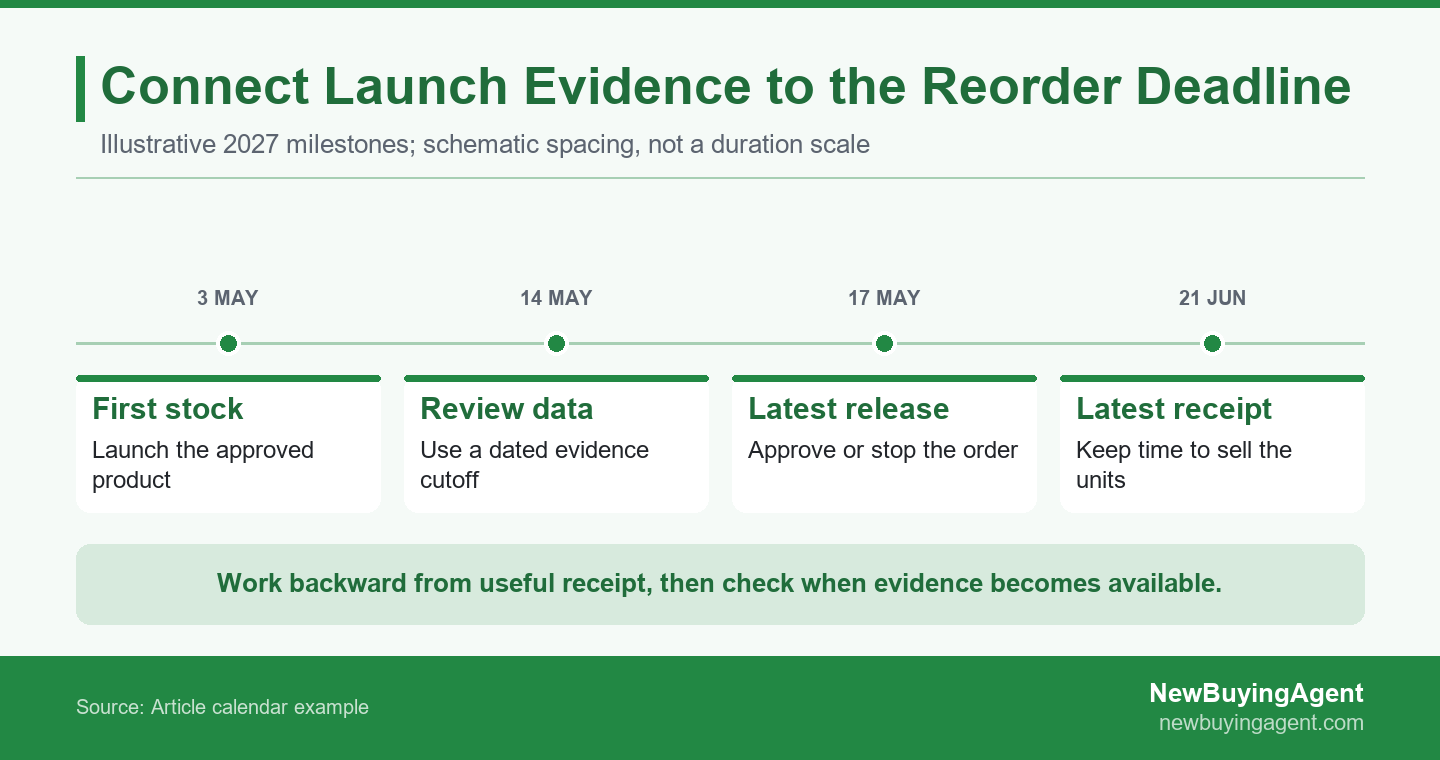
Illustrative 2027 reorder milestones: first stock, evidence review, latest release and latest useful receipt; spacing is schematic
Connect Supplier Work to Saleable Stock
The repeat-order deadline follows from saleable receipt and every activity that must finish before stock can serve the intended channel. Then calculate whether product approval and first supply leave enough time to collect useful launch evidence. Keep uncertain durations visible as assumptions with confirmation owners; an unknown material or capacity date cannot be entered as zero merely to make the schedule fit.
Agree what each duration measures before adding it to a date. NASA scheduling guidance distinguishes working and non-working calendars and stresses clarity about elapsed duration versus working days. This is a transferable scheduling lesson, not an agency requirement for importers: use the actual supplier, carrier and receiving calendars, with relevant closures and approval availability.
Build a dependency sequence such as approved specification, available materials, production, inspection and release, transport, receiving and channel availability. Some work may overlap, but record the overlap and its prerequisites rather than subtracting time optimistically. Product changes after approval can reopen earlier work; the calendar needs a revised sequence when a sample or packaging revision affects materials or production.
Transport belongs inside that sequence. Maersk explains the difference between time on the water and door-to-door time, with activities before and after the vessel journey. Ask which endpoint a quotation covers, then add any excluded clearance, receiving or channel-preparation work. A vessel-arrival estimate alone does not establish your saleable-stock date.
Latest reorder release = latest useful receipt minus confirmed repeat-supply duration. Evidence review must precede release by the decision allowance needed to approve the quantity, price and payment. Also derive the latest useful receipt from the commercial cutoff minus a realistic allowance to sell the added units; the end of the season is usually too late to start selling the entire reorder.
Work Through a Dated Launch and Reorder Calendar
A calendar needs a test with explicit dates before it can support order approval. The hypothetical example below uses elapsed calendar days throughout, with no holiday or workday adjustment; none of its durations is a China production or shipping benchmark. A category team planning a trend-led home-accessory launch would replace these assumptions with its own approved specification, destination, capacity confirmation and selling-window evidence.
Assume the trend assessment is ready on 8 March 2027 and the product specification is released on 15 March. Initial supply takes 49 calendar days after release: 14 for materials, 21 for production, four for inspection/export release and ten for transport/receiving, all sequential in this example. Adding 49 days to 15 March gives first saleable stock on 3 May.
The team sets 12 July as its commercial demand cutoff and allows 21 days to sell the repeat quantity. Subtracting that allowance gives a latest useful receipt of 21 June. Repeat supply takes 35 calendar days, assuming materials are already confirmed: 21 for production, four for inspection/export release and ten for transport/receiving. If materials are not ready, that repeat assumption fails and the missing duration must be added.
In this hypothetical 2027 calendar, first saleable stock arrives on 3 May, evidence review is due on 14 May, latest reorder release is 17 May and latest useful reorder receipt is 21 June. The review deadline allows three calendar days for the decision and release; the repeat-supply duration is counted from that release.
| Milestone | Example date | Evidence or dependency | Owner and decision |
|---|---|---|---|
| Product release | 15 Mar 2027 | Approved version after trend assessment | Product: release specification |
| First saleable stock | 3 May 2027 | Initial 49-day sequence complete | Operations: accept and launch |
| Evidence cutoff / review | 12 May / 14 May 2027 | Chosen launch data available by review | Analyst/category: test another quantity |
| Latest reorder release | 17 May 2027 | 21 Jun minus 35 days; approval complete | Purchasing: issue order or stop |
| Latest useful repeat receipt | 21 Jun 2027 | 12 Jul minus 21-day selling allowance | Operations/category: stock ready to sell |
| Commercial demand cutoff | 12 Jul 2027 | Chosen end of this demand opportunity | Category: end this buying window |
For this trial, launch observations run from 3 May through 12 May and become usable on 14 May. That availability is an example assumption, not a platform-wide reporting promise. The category owner must judge whether those observations are informative enough; reaching a scheduled review date does not itself make a short launch sample reliable.
Now delay first stock by seven days and retain the same observation and data-processing allowance. First stock arrives on 10 May, review moves to 21 May, release to 24 May and reorder receipt to 28 June. That is seven days after the useful receipt deadline: the delayed-launch branch fails the original timing test.
Do not automatically move the commercial cutoff to rescue the order. Test a genuinely faster supply scope and its cost, reduce the quantity if a shorter selling allowance is credible, decide earlier with the uncertainty explicitly accepted, or stop. Each option changes an input requiring approval; simply editing the receipt cell leaves the commercial conflict unresolved.
Give the Reorder Review a Data Cutoff and a Quantity Test
The reorder review is a decision about stock that can still sell after replenishment arrives. Use launch evidence with a stated cutoff, check whether the product was actually available, and estimate remaining demand for the same market and channel. The output should be a bounded quantity with a feasible receipt date, or a recorded reason to defer, change or stop the purchase.
Separate the date a report is downloaded from the period its figures cover. Shopify product analytics specifies reporting periods and processing delays for its metrics, so check the cutoff before relying on a dashboard. For a new launch, identify the actual launch cohort and observation window instead of assuming a rolling product report describes only the days since first stock.
Check whether stockouts, promotion, placement changes or returns distort observed demand. Sales during an unavailable period do not reveal every missed purchase; a promotion may also create demand that will not recur at the planned price. Record an explainable demand range and the evidence that would narrow it, rather than converting the best-looking early rate directly into an order.
Estimate demand after the expected reorder receipt, then subtract projected usable stock at that receipt date. Project that stock after expected consumption and allocations during the waiting period, include relevant inbound stock only once, and exclude units unavailable to the chosen channel. Floor projected physical stock at zero, and add still-unfilled pre-receipt backlog only if it is not already included in the post-receipt demand estimate. Net replenishment need cannot be negative. This keeps the demand period and inventory position aligned rather than subtracting today's warehouse balance from future demand.
NC State's reorder-point tutorial explains that longer lead times and greater variability in demand and lead times generally increase safety-stock needs for a given cycle service level. For a finite trend window, treat this as a reason to revisit stock coverage when supply changes, not permission to add unlimited buffer stock. Any extra protection still needs time to sell and a tolerable residual-stock outcome.
Finally apply the factory minimum, available cash and contribution at the confirmed landed cost. If the minimum exceeds supportable demand, the calendar should show a scope-change or stop decision. Specify what price, quantity and product version were approved so that a later quotation change cannot pass through an old timing approval unnoticed.
Update Actual Progress and Decide What Changed
A maintained calendar has a stated status date and a forecast that reflects changed inputs. Preserve the original plan so the team can see which assumption failed, then record actual completion and the best current estimate for unfinished work. Every exception needs a responsible owner and a decision date early enough to affect the next commercial commitment.
GAO's Schedule Assessment Guide uses a status date to distinguish performed work from remaining work, updating the schedule with actual progress and remaining durations. Applying that discipline to this calendar means checking what has really finished, not treating the date the spreadsheet was opened as evidence of progress. This is a planning method borrowed from project scheduling, not a trade-compliance rule.
| Changed input | Keep visible | Owner action | Observable result |
|---|---|---|---|
| Materials unconfirmed | Assumed repeat duration and missing readiness date | Supply owner obtains a dated confirmation before release | Recalculate receipt; unresolved input blocks release |
| First receipt late | Original plan, actual receipt and fixed useful deadline | Category owner recalculates evidence and order dates | Faster viable scope, accepted uncertainty or stop |
| Data incomplete | Evidence cutoff and missing channels/availability | Analyst resolves gap by decision deadline | Use qualified evidence or escalate the uncertainty |
| Specification revised | Old version, changed requirements and affected work | Product/supply owners reset dependent activities | New feasible dates and approval before commitment |
Keep planned, actual and forecast dates separate, assign each exception an owner, and record the decision without silently moving the commercial cutoff. In a spreadsheet, duplicate the date columns rather than overwriting the plan; add the change reason, approving person and next check beside the affected milestone. A row marked complete should point to its actual acceptance evidence.
Prioritize exceptions by the decision they threaten. A transport change affecting the latest useful receipt needs immediate commercial review, while a completed activity with a harmless reporting correction may only need a record update. This keeps meetings focused on choices the team can still influence rather than repeatedly reading every calendar row aloud.
Turn the Calendar Into a China Product Sourcing Brief
A useful sourcing request describes a product commitment that the calendar can actually support. Provide the locked specification, first quantity, possible repeat quantity and saleable-stock deadline, while distinguishing firm commitments from assumptions still awaiting confirmation. The useful response is a product-supply proposal with defined conditions and timing, which the buyer can compare with the commercial window before releasing money or production.
When a category team needs a new trend-led line supplied from China, NewBuyingAgent's China product supply combines local factory resources with product development, quality-control capability and flexible payment support. Those capabilities are relevant when a material or specification choice affects repeatability: ask what product scope can meet the requirement and which repeat-order assumptions need confirmation. Payment flexibility should be discussed alongside the total commitment and agreed terms.
Prepare a sourcing brief with the locked product specification, initial and conditional repeat quantities, destination, target price and receipt deadline. Attach the dated calendar, including the latest release date and any permitted product or transport changes, so an attractive quotation can be assessed against the same requirements.
If that scope fits your purchasing plan, submit the dated product brief to NewBuyingAgent to discuss a supply offer and its repeat-order conditions. Flag the dates that remain unconfirmed and the quantity you can authorize now. The next commercial step is to reconcile the proposed product, price and supply timing with the calendar, then approve a commitment that still serves the intended market window.
Frequently Asked Questions
How often should the calendar be reviewed?
Review the calendar at decision milestones and whenever a confirmed change can affect the next release date, rather than relying on one universal meeting frequency. For an active launch, assign checks around specification release, receipt, data availability and the last order decision. Between those events, the owner should escalate material, capacity or transport changes when they threaten a dependent date. A meeting schedule is useful only if someone can act on the changed information before the commitment becomes irreversible.
What if the trend window is shorter than the supply lead time?
A trend window shorter than the confirmed supply lead time makes the current product plan unsuitable unless a genuinely different supply scope changes the timing. Check whether a ready product, approved material or different confirmed route creates a feasible alternative at an acceptable cost. If development, production and receipt still exceed the useful window, reject that opportunity or target a later demand period. Moving a date without changing the underlying supply work does not create time.
What if usable sales data arrives after the latest reorder date?
If the earliest usable sales evidence arrives after the latest release deadline, the current plan cannot support an evidence-based reorder without changing its scope or accepting uncertainty. Move the observation earlier only if the resulting evidence remains fit for the decision, or test a shorter confirmed supply scope. Otherwise the buyer must explicitly approve a forecast-led commitment or stop the repeat order. Record which uncertainty was accepted and by whom; an empty evidence field should never imply that a sales-based test was passed.
Can the same calendar be reused for the next product?
Reuse the calendar fields and decision sequence, but replace the product specification, market window, supply assumptions and evidence dates for every new product. Carry forward actual durations only after checking that the same materials, factory conditions, route and acceptance work still apply. A previous receipt date is evidence about a past order, not a reservation for the next one. Give each new calendar its own status date, owners and confirmation references.
NewBuyingAgent
Related Resources



Get Started Today
Let's Turn Your Sourcing Goals into RealityWeChat:+86 15157124615
WhatsApp:+86 15157124615
Address:Building 10 #39 Xiangyuan Road, Hangzhou, China
