

Your current China sourcing setup costs more than a sourcing agent when the apparent savings are being spent again as hidden labor, quote corrections, late quality fixes, freight confusion, rework, and missed selling time. The invoice may look lean, but the operating cost can be leaking through every exception your team has to chase.
The useful question is not whether an agent has a fee. The useful question is whether your present setup is already charging you through unmanaged work. The Hidden Cost Trigger Framework below separates normal buyer work from the recurring exceptions that make direct sourcing more expensive than it first appears.
Key Takeaways
- Cost comparison: A sourcing agent fee should be compared with total hidden cost, including internal hours, rework, inspection misses, freight errors, documentation corrections, and launch delays.
- Decision: If the same sourcing problem repeats every order, the buyer is no longer saving money by handling it internally.
- Framework: The Hidden Cost Trigger Framework ranks eight recurring signs that a buyer's setup may be more expensive than agent support.
- Service fit: NewBuyingAgent is relevant when buyers want China-sourced products supplied with local factory resources, product/QC capability, cost negotiation, and delivery coordination built into the offer.
The Hidden Cost Trigger Framework Starts With Exceptions
The Hidden Cost Trigger Framework is simple: count the work that appears only because the sourcing setup fails to prevent exceptions. Normal sourcing work includes defining specifications, approving samples, confirming price, and planning delivery. Hidden-cost work includes re-asking the same questions, fixing ambiguous quotes, chasing production evidence, interpreting inspection gaps, correcting carton data, or rebuilding a launch plan after delays.
ASQ's cost of quality framework is useful here because it separates prevention and appraisal costs from internal and external failure costs. In sourcing, the same logic applies: a buyer may avoid an agent fee but still pay through appraisal hours, rework, replacement freight, chargebacks, returns, or customer-service burden after the problem has moved downstream.
Due diligence creates the same hidden workload. Trade.gov's due diligence guidance reminds companies to investigate potential partners before committing. When a buyer lacks local China visibility, that investigation turns into repeated email chains, document requests, translated clarifications, and judgment calls that still may not show what is happening on the production floor.
The framework does not say every buyer needs an agent. It says the agent comparison becomes rational when recurring exceptions consume more money than a structured China-side sourcing path would cost. If the work is occasional, internal handling may be fine. If the work repeats weekly, it is no longer a side task; it is a hidden operating model.
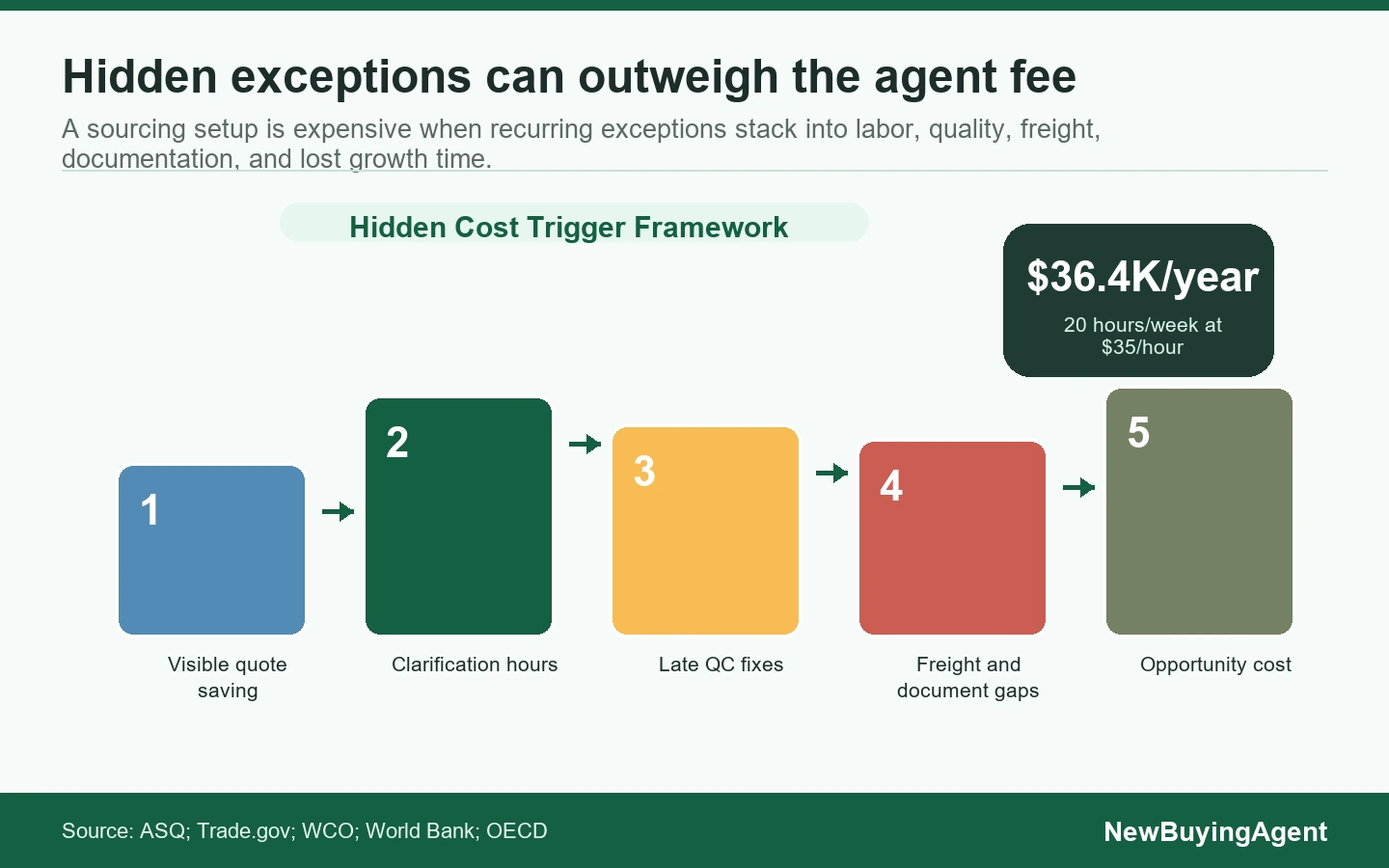
The Hidden Cost Trigger Framework shows how repeated exceptions turn direct sourcing savings into labor, quality, freight, and opportunity cost.
Top 8 Signs Your Setup Costs More Than a Sourcing Agent
1. Your team spends 10+ hours a week clarifying the same basics
The first sign is a communication loop that never becomes cleaner. Your team keeps clarifying material, size, finish, packaging, carton quantity, delivery term, sample version, payment milestone, or ship date. None of those questions is unusual by itself. The cost appears when the same categories of uncertainty return every order and require a manager, merchandiser, founder, or operations lead to intervene.
In a healthy setup, the brief becomes sharper over time. In an expensive setup, every order feels like a new translation exercise. The buyer may think the work is free because no outside invoice appears, but 10 hours a week from a $40-per-hour fully loaded team member is already about $20,800 a year before defect cost, freight corrections, or launch delay are counted.
2. The quote changes after the sample looks approved
A quote that changes after sample approval is a cost signal, not just a negotiation annoyance. It usually means the original quote did not include all assumptions: material grade, finish tolerance, packaging, accessories, testing basis, order size, inland freight, export handling, or current production version. The buyer then spends time deciding whether the new price is fair or whether the original price was incomplete.
ISO 9001 emphasizes planned and controlled processes for meeting customer requirements. For sourcing buyers, the practical lesson is that quote confidence depends on controlled assumptions. If the setup cannot lock product version, evidence, and delivery basis before price comparison, the low quote may only be a placeholder for later negotiation.
3. Quality problems are discovered after your leverage is gone
Quality cost becomes more expensive when the defect is discovered after deposit, production, packing, or shipment release. At that point, the buyer may still get an explanation, but the leverage to prevent the cost has already fallen. Rework, repacking, discounts, split shipments, or replacement orders can cost more than the inspection or production-follow-up discipline that would have caught the issue earlier.
The hidden cost is not limited to defective units. It includes decision fatigue: should the buyer hold shipment, accept a discount, rework locally, airfreight replacements, delay the launch, or risk customer complaints? If the same question appears after every order, the buyer is paying for a sourcing gap at the most expensive moment.
4. Incoterms, freight, and handoff responsibilities keep shifting
When freight responsibility is unclear, a buyer can lose money without the unit price changing. Trade.gov's Incoterms overview explains that Incoterms clarify responsibilities between buyer and seller. If the sourcing setup treats the delivery term as a casual line on the quote, landed cost can move through pickup charges, port fees, insurance gaps, delayed handoff, or unexpected documentation work.
The warning sign is a recurring gap between what the team thought was included and what the forwarder, factory, or buyer must now handle. A sourcing agent may look more expensive at first glance, but a clear delivered-cost path can beat a cheaper quote that transfers freight uncertainty back to the buyer.
5. Product classification and import documents are handled late
Classification and documents often look administrative until they delay a shipment or change landed cost. The World Customs Organization's Harmonized System overview explains why product nomenclature matters for customs and trade statistics. Trade.gov's tariff overview also notes that duties are applied differently by product and country.
The sign to watch is timing. If the team asks about HS code, product description, material composition, origin, packing list, certificate need, or labeling only after production is nearly finished, the setup is pushing documentation risk into the shipment window. That may turn a sourcing saving into a customs, warehouse, or launch-cost problem.
6. Your existing China source needs constant production chasing
Some buyers already have a China source that can produce acceptable goods, but the order still needs constant chasing: production status, line start, material arrival, color approval, carton marks, inspection date, vessel booking, document release, or final payment timing. The product source may be workable while the management load remains too high.
This is a different cost from finding a new product. It is the cost of not having reliable China-side execution during production. If the buyer's team must stay awake for time-zone calls, decode short updates, and re-check each milestone, the setup is charging the buyer in management hours and stress rather than in an obvious service fee.
7. Tracking, tracing, and exception visibility depend on manual follow-up
Logistics visibility matters because the buyer cannot manage what the buyer cannot see. The World Bank's Logistics Performance Index tracking and tracing indicator measures the ability to track consignments on a 1-to-5 scale. The existence of that indicator is a useful reminder that visibility is an operational capability, not a courtesy update.
If your shipment updates depend on asking three people for screenshots, the cost is not just delay. It is decision fog. The team cannot confidently book promotions, warehouse labor, customer commitments, or replenishment until it knows where the shipment stands and what risk is still open.
8. Your team loses product, sales, and channel time to sourcing firefighting
The last sign is opportunity cost. A buyer's team may be capable of chasing suppliers, comparing revisions, and solving shipment issues, but that does not make it the best use of the team's time. If senior people spend repeated hours on sourcing exceptions, they are not working on product positioning, channel growth, inventory planning, retail relationships, or customer retention.
OECD due diligence guidance for responsible business conduct frames due diligence as an ongoing process for identifying and addressing impacts. For buyers, that reinforces a practical point: sourcing control is not a one-time email. If the buyer cannot maintain it without pulling focus from growth work, the setup may be under-priced only on paper.
Scenario Estimate: The 20-Hour Break-Even
Use an illustrative calculation, not a universal benchmark. Suppose a buyer's team spends 20 hours a week across quote clarification, production chasing, QC interpretation, freight coordination, and document fixes. At a fully loaded labor cost of $35 per hour, that is $700 per week, or about $36,400 per year. That number excludes rework, delay, return handling, emergency freight, or lost sales focus.
Now add one avoidable shipment problem. A 2,000-unit order may save $2,000 by using the cheapest setup. But if weak carton control creates 3% damage, and each damaged unit costs $18 in replacement, credit, handling, or markdown, the visible damage cost is $1,080. Add two days of manager time, one forwarder rebooking, and one delayed promotion, and the lower-cost setup can lose the savings from a single order.
The break-even decision is therefore not "agent fee versus zero." It is "agent fee versus the hidden-cost stack already being paid." The Hidden Cost Trigger Framework becomes especially useful when the buyer writes the cost next to each repeated exception: weekly hours, rework events, freight surprises, inspection escalations, document corrections, and delayed channel actions.
Where NewBuyingAgent Fits When Hidden Costs Keep Repeating
NewBuyingAgent fits when buyers want the sourcing burden converted into China-supplied product outcomes, not just another task list. Buyers share product specs, quantity, target price, destination, and timing. NewBuyingAgent uses local China factory resources, industrial-cluster sourcing access, product development and quality-control capability, cost negotiation, production follow-up, and logistics coordination to supply China-sourced products with price, quality, market fit, and delivery considered together.
For new sourcing needs, the buyer can use NewBuyingAgent's product-supply service when the current setup keeps turning quote, sample, quality, and delivery assumptions into hidden work. The value is not a separate review of one file; it is the ability to turn a purchasing requirement into a quoted product supply path backed by local factory resources and China-side execution.
For buyers that already have China suppliers but keep losing hours to communication, production status, QC evidence, and release decisions, NewBuyingAgent's factory-management service is the more relevant route. The service context includes local supplier communication, production progress follow-up, staged QC inspections, real-time reporting, 24-hour official reports, and door-to-door logistics coordination for existing China sources.
NewBuyingAgent's 30+ years of trade, manufacturing, and QC experience, 50,000+ cooperated factory resources, and 20,000+ product development and quality-control expert resources matter because hidden cost usually lives between departments. It touches product choice, cost, production evidence, packing, freight, payment timing, and market fit. A buyer comparing current setup cost should therefore compare against the full China-side result, not a narrow line-item fee.
Decision Packet Before You Switch
Before changing the sourcing setup, build a one-page decision packet. List the last three orders. For each order, record hours spent, quote changes, quality escalations, freight surprises, document corrections, rework, late updates, and delayed channel actions. Then attach a cost estimate to each issue. The number does not need false precision; it needs enough realism to show whether the setup is truly cheaper.
| Cost trigger | What to measure | Switch signal | Next action |
|---|---|---|---|
| Internal hours | Weekly sourcing exception time | 10-20 hours repeat for 4+ weeks | Price an agent path against labor cost |
| Quality leakage | Rework, returns, damage, hold decisions | Issues appear after deposit or packing | Move evidence earlier in the sourcing path |
| Delivery fog | Freight surprises and missed handoffs | Incoterm or tracking assumptions change | Require landed-cost and handoff clarity |
| Opportunity cost | Selling, product, and channel work displaced | Senior team owns routine follow-up | Move China-side execution out of the growth team |
Based on the comparison, the switch decision should be made when hidden cost is recurring, measurable, and tied to sourcing execution rather than one unusual order. If the buyer wants a concrete quote path, the decision packet can be turned into a purchasing brief through NewBuyingAgent's contact page with product, quantity, target price, destination, and timing included.
Frequently Asked Questions
When does a sourcing agent cost less than doing it yourself?
A sourcing agent costs less when recurring hidden costs exceed the agent's value, including internal labor, quality leakage, freight surprises, rework, and missed selling time. The buyer should compare total exception cost over several orders, not one service fee against a zero-cost internal setup.
Is 20 hours a week a fixed sourcing benchmark?
No. Twenty hours a week is a scenario estimate for buyers whose teams repeatedly clarify quotes, chase production, interpret QC evidence, coordinate freight, and fix documents. Some buyers spend less; complex multi-SKU or time-sensitive orders can spend more. The useful step is to track the actual recurring hours for four weeks.
Should buyers switch agents after one bad order?
Not always. One bad order may be a product-specific problem, a factory issue, or a brief gap. The stronger switch signal is a pattern: recurring unclear quotes, late quality discovery, weak production visibility, freight confusion, and senior team time spent on routine follow-up across multiple orders.
What should buyers prepare before asking NewBuyingAgent for help?
Buyers should prepare product specs, quantity, target price, destination, timing, packaging needs, quality concerns, and any recent hidden-cost examples. NewBuyingAgent can then evaluate the purchasing need as a supplied China product outcome, using local factory resources, product/QC capability, cost negotiation, and delivery coordination rather than isolated issue chasing.
NewBuyingAgent
Related Resources



Get Started Today
Let's Turn Your Sourcing Goals into RealityWeChat:+86 15157124615
WhatsApp:+86 15157124615
Address:Building 10 #39 Xiangyuan Road, Hangzhou, China
