

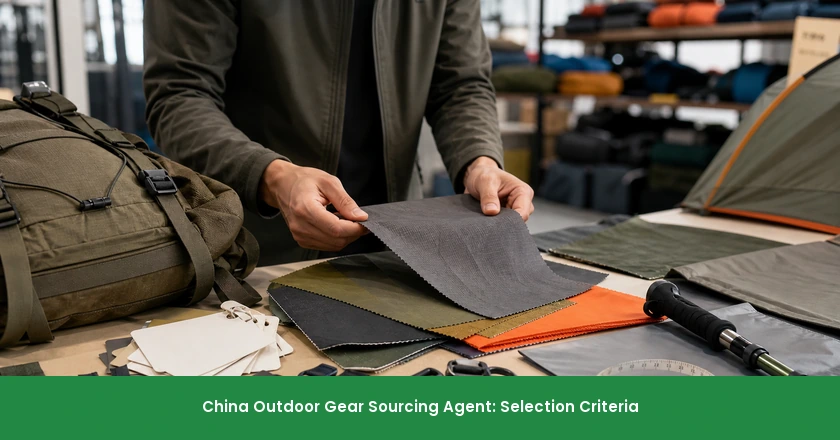
Choosing a China outdoor gear sourcing agent is not the same as choosing a general product contact. Outdoor gear has use-case risk: tents face wind, rain, flame, and pole stress; sleeping bags need believable temperature claims; backpacks and camping furniture need load-bearing evidence; cookware, lights, and stoves may create safety or battery concerns. A low quote is useful only if the product can survive the activity, the sales channel, and the destination market.
The best selection criteria therefore start with the buyer's use case, not with a generic factory profile. A good sourcing agent should turn product intent into a controlled order: right material, realistic performance claim, confirmed testing path, workable MOQ, seasonal production plan, packaging discipline, and delivery terms that fit the buyer's channel.
Key Takeaways
- Outdoor gear sourcing is evidence-heavy: buyers need material, performance, safety, packaging, and shipment proof before scaling a product line.
- Agent selection should begin with the activity: car camping, backpacking, cycling, fishing, outdoor furniture, and snow-sport accessories create different sourcing criteria.
- China's outdoor market momentum matters: policy support for outdoor destinations and sports equipment can strengthen category supply, but buyers still need product-specific control.
- NewBuyingAgent fits when buyers need China-side product supply with practical execution: its local factory resources, product/QC capability, AI product analysis, flexible payment support, and multi-industry case experience help connect outdoor demand to a practical sourcing path.
The Criteria Start With Use Case, Not Factory Claims
Outdoor gear is sold by promise. A tent promises shelter, a sleeping bag promises warmth, a camp chair promises load support, a dry bag promises protection, and a trekking pole promises stability. If the agent only compares catalog photos and unit prices, the buyer may receive a product that looks right but fails in the field. The first selection criterion is whether the agent asks how the product will be used: climate, activity, user weight, retail channel, warranty expectation, and target market.
China's outdoor-sports demand has become a larger economic theme. A State Council-linked release said China plans to build high-quality outdoor sports destinations, with around 100 such destinations targeted by 2030, and it called for upgraded outdoor products and services. Earlier reporting on the national outdoor sports plan projected the industry at 3 trillion yuan by 2025. Those signals make outdoor gear a serious category, but category growth does not remove order-level risk.
A sourcing agent should translate demand into measurable evidence. For tents, ISO 5912:2020 specifies requirements for safety, performance, and fitness for use. For sleeping bags, ISO 23537-1:2022 addresses thermal, mass, dimensional, test-method, and labeling provisions for adult-sized sleeping bags. Even when a buyer does not need those exact standards, the lesson is clear: outdoor claims should be tested, labeled, and tied to the exact product version.
NewBuyingAgent is relevant when the buyer wants a connected path from product requirements to supplied China-made goods. For outdoor gear, that means the buyer should prepare product type, activity scenario, target price, expected quantity, destination, and timing. NewBuyingAgent can then use local China factory resources and product/QC capability to quote and supply products with better control over fit, quality, cost, and delivery.
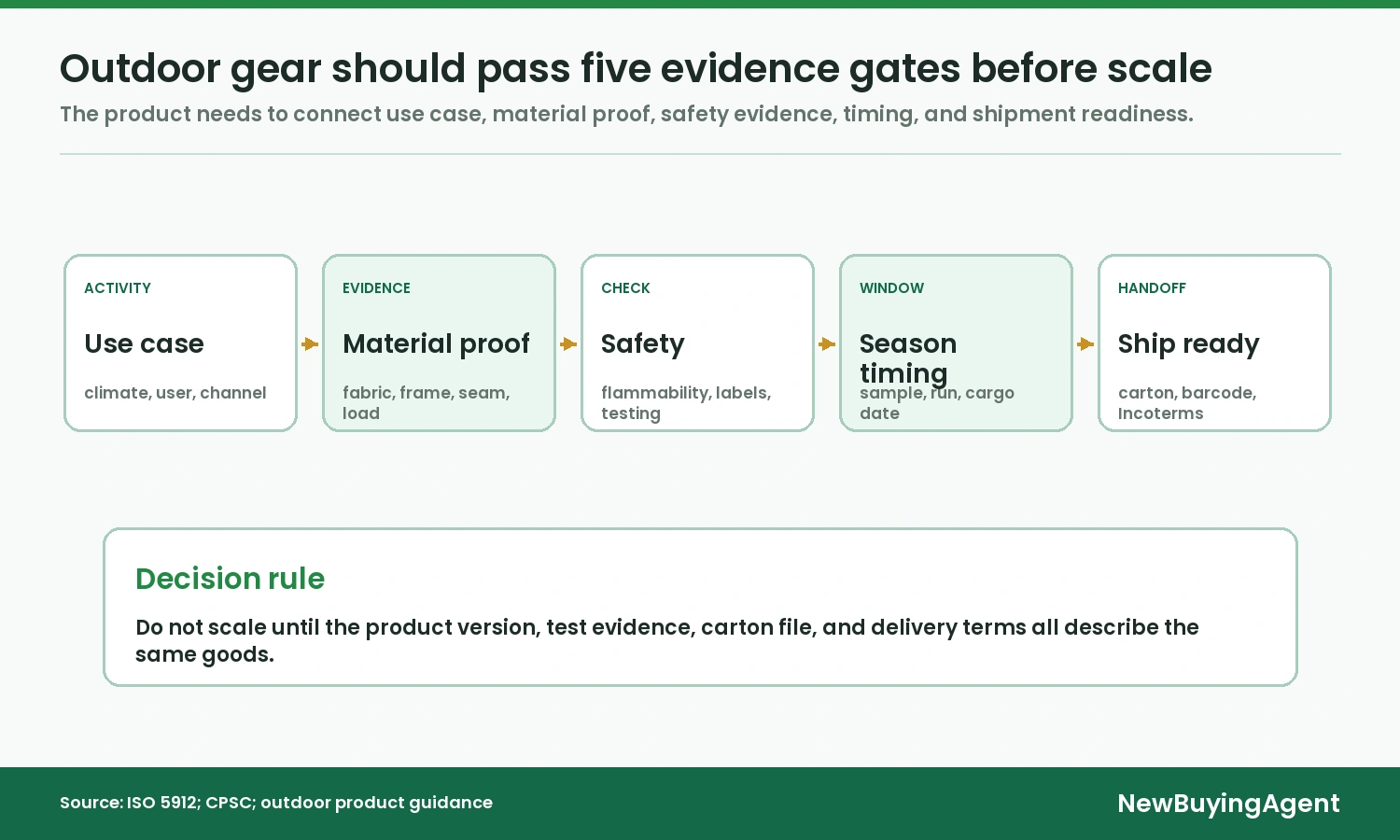
A strong outdoor gear sourcing agent filters every product through use case, material proof, safety evidence, production timing, and shipment readiness before scale.
Core Selection Criteria for Outdoor Gear Agents
1. Category and Activity Fit
The agent should understand the difference between outdoor product families. A backpacking tent is not a family camping tent. A patio-style folding chair is not a hiking stool. A cooler bag for grocery use is not the same as insulated gear for long-distance travel. The buyer should ask the agent to explain which product details matter for the intended activity: weight, packed size, waterproof rating, fabric coating, seams, pole material, zipper quality, stitching, load rating, flame exposure, battery chemistry, packaging strength, and repair parts.
This is where industrial-cluster access becomes useful. Outdoor gear can involve textiles, metal frames, plastic hardware, coated fabric, foam, electronics, and packaging. A China sourcing agent with local factory resources can coordinate across those inputs more practically than a buyer relying on a single catalog vendor. The agent does not need to make every component internally, but it should understand which part of the cluster controls the product's real risk.
2. Material and Performance Evidence
A sourcing agent should not treat product claims as marketing copy. It should ask how the factory proves them. For fabric goods, evidence may include denier, coating, hydrostatic pressure, colorfastness, tear strength, seam strength, UV exposure, and packing compression. For furniture, evidence may include frame material, load test, hinge durability, corrosion resistance, and foot stability. For insulated goods, evidence may include filling weight, thermal test basis, compression recovery, and labeling consistency.
The agent should connect those details to the buyer's sales promise. If a listing says waterproof, ultralight, winter-ready, heavy-duty, food-safe, child-friendly, or airline-compatible, the sourcing file needs proof. Otherwise, the buyer may win the first sale and lose margin through returns, poor reviews, or platform requests for documentation.
3. Safety and Compliance Awareness
Outdoor gear can fall into general consumer product rules, children's product rules, textile rules, battery rules, or product-specific safety expectations depending on the item. The CPSC sporting and camping equipment FAQ notes that general-use camping tents may involve flammability testing protocols and that children's sporting or camping goods may trigger additional requirements. Trade.gov's China standards overview also reminds buyers that standards and conformity assessment are part of cross-border trade planning.
A sourcing agent should not give destination-market legal advice as if it were a lawyer, but it should know when a product needs testing, labeling, certificate collection, warning language, or category-specific caution. Good agents slow the order when a claim is not supportable. Weak agents treat compliance as a problem for the buyer after shipment.
4. MOQ, Sampling, and Product Version Control
Outdoor gear often needs iteration. The first sample may be too heavy, too bulky, too weak at the seams, too expensive, or too hard to pack. A strong sourcing agent should help the buyer manage sample versions so that final production matches the approved sample. That includes model number, material, color, accessories, packaging, label, manual, carton mark, and spare-part list.
MOQ should be judged by product learning. A high MOQ may lower unit cost but increase inventory risk. A low MOQ may support testing but raise unit price or limit customization. The right agent explains that trade-off before deposit, especially for products affected by seasonality, weather, trend cycles, or retailer launch windows.
5. Production Timing and Seasonal Capacity
Outdoor gear has calendar pressure. Spring and summer camping products, winter accessories, festival equipment, travel gear, and holiday gift sets all have selling windows. A sourcing agent should check whether the factory can produce before the buyer's sales window, not just before an estimated ship date. The agent should also confirm whether key materials, molds, accessories, and packaging can arrive in time.
Capacity claims need evidence. The agent can ask for current production schedule, lead time by material, sample approval date, pilot-run date, in-process inspection point, final inspection window, and cargo-ready date. For buyers using existing suppliers, a China-side management service may be the better fit because production progress, staged QC, and real-time reporting become more important than finding a new product.
6. Packaging, Labels, and Carton Readiness
Outdoor gear often fails at packaging before it fails in use. Long poles, sharp parts, heavy frames, coated fabric, rechargeable lights, and compression-packed sleeping bags need cartons that survive handling. The sourcing agent should verify retail packaging, master carton size, carton weight, drop or compression needs, barcode placement, country-of-origin marking, warning labels, accessory bags, and instruction sheets. GS1 barcode standards are a reminder that product identity is operational, not decorative.
For ecommerce and retail buyers, packaging also affects fulfillment. Oversized cartons increase storage and delivery costs. Weak carton marks delay receiving. Missing manuals create customer-service tickets. The agent should treat packaging as part of product quality, not as a last-minute artwork task.
Decision Table: What to Ask Before Choosing an Agent
| Criterion | What good agents ask | Why it matters |
|---|---|---|
| Use case | Activity, climate, user, channel, warranty expectation | Prevents a catalog product from being used beyond its design limit |
| Material proof | Fabric, coating, frame, stitching, load, thermal, battery, or accessory evidence | Keeps performance claims connected to real product construction |
| Compliance | Destination market, category rule, warning label, certificate, and test-report needs | Reduces listing, customs, recall, and customer-safety risk |
| Shipment terms | Incoterms, carton data, HS code assumptions, cargo-ready date, and destination receiving rules | Prevents quote savings from becoming delivery or duty surprises |
Cost and Logistics Criteria Are Part of Product Quality
Outdoor gear is often bulky, seasonal, and packaging-sensitive. A low ex-factory price can disappear if carton volume is high, accessories are packed poorly, or the wrong trade term shifts cost to the buyer. ICC Incoterms 2020 define how cost, risk, and obligations are allocated in global trade, so the sourcing agent should connect the quote to the delivery path. The World Customs Organization's Harmonized System overview explains why product classification matters for trade data and tariffs.
A good agent also understands that logistics performance affects launch timing. The World Bank Logistics Performance Index tracking indicator links logistics performance to speed and supply-chain connectivity. For outdoor gear buyers, this means carton planning, consolidation, shipping mode, and receiving rules should be discussed before the product is packed, not after the factory says the order is ready.
Where NewBuyingAgent Fits in Outdoor Gear Sourcing
For buyers developing a new outdoor gear line, the useful starting point is a product brief with activity scenario, must-have materials, target price, quantity, destination, launch timing, packaging expectation, and any sales-channel compliance needs. NewBuyingAgent can use local China factory network access, 50,000+ cooperated factory resources, and product development and quality-control capability to turn that brief into a quoted China-sourced product path. This is especially useful when the product combines fabric, hardware, accessories, packaging, and shipping constraints.
For buyers already using Chinese factories, the selection question may be different. The buyer may not need a new product source; it may need China-side operating support for production progress, staged inspections, evidence collection, and logistics. In that scenario, NewBuyingAgent's factory management service can help keep existing supplier work tied to inspection records and delivery timing. The better next step is to decide whether the buyer needs new product supply or stronger control over an existing China supplier.
Outdoor gear buyers should avoid choosing an agent by one promise such as low MOQ, fast sample, or cheap freight. The better test is whether the agent can explain what proof is needed before the product deserves a larger order. A sourcing partner that can protect product fit, quality evidence, cost structure, and delivery timing is more valuable than one that only moves quickly.
Frequently Asked Questions
What should I send a China outdoor gear sourcing agent first?
Send the product type, activity scenario, target user, must-have materials, expected quantity, target price, destination market, packaging needs, and launch timing. Photos or benchmark products help, but they are not enough. The sourcing agent needs to understand how the product will be used so it can check material, performance, compliance, and delivery risk before quoting.
Is a low MOQ always better for outdoor gear?
No. A low MOQ can reduce inventory risk and help test demand, but it may raise unit cost, limit customization, or make factories less willing to adjust materials and packaging. For outdoor gear, the better question is whether the MOQ gives the buyer enough product learning without forcing a risky volume commitment.
How do I judge whether an outdoor gear quote is reliable?
A reliable quote should match the approved material, product version, packaging, testing need, trade term, carton data, and production timing. If a quote does not explain these details, the low price may hide later changes. Ask the agent to show what is included, what is excluded, and what evidence will be checked before mass production.
Can NewBuyingAgent help if I already have an outdoor gear factory?
Yes. If the buyer already has a Chinese supplier, NewBuyingAgent can support China-side communication, production progress, staged QC, inspection reporting, and logistics coordination. That path is different from new product sourcing: the goal is stronger local control over an existing supplier relationship, not replacing every current factory automatically.
NewBuyingAgent
Related Resources



Get Started Today
Let's Turn Your Sourcing Goals into RealityWeChat:+86 15157124615
WhatsApp:+86 15157124615
Address:Building 10 #39 Xiangyuan Road, Hangzhou, China
