


Key Takeaways
- Pricing: Good China sourcing agents reduce total cost by removing waste, uncertainty, variant sprawl, freight inefficiency, and rework, not by quietly lowering product quality.
- Risk: A lower quote is not a saving until product version, material, finish, packing, inspection, Incoterms, and delivery responsibility are normalized.
- Decision: NewBuyingAgent is relevant when cost reduction must stay tied to China-sourced product quality, order evidence, and delivery reliability.
Cost Cutting Is Safe Only When the Product Stays the Same
China sourcing agents cut costs safely when they reduce waste around the order instead of weakening the product. A lower unit price can come from better batch structure, sharper specs, packing efficiency, fewer avoidable variants, cleaner documents, or earlier quality control. It becomes dangerous when the saving comes from thinner material, weaker finish, missing accessories, lighter cartons, skipped inspection, or a delivery term that hides cost outside the quote.
According to ISO 9001, consistent output depends on defined requirements. That matters in sourcing because a buyer cannot judge whether quality has been preserved unless the product requirement is locked before comparing prices. A quote is only comparable when both providers are pricing the same product version and quality boundary.
Based on our analysis, a 10000 units order at 10 USD per unit creates 100000 USD of product exposure. A 3 percent price saving is worth 3000 USD, but a 5 percent defect rate on sellable inventory can create 500 units of rework, replacement, or customer-service risk. The decision rule is to cut cost where the evidence improves, not where the product becomes less visible.
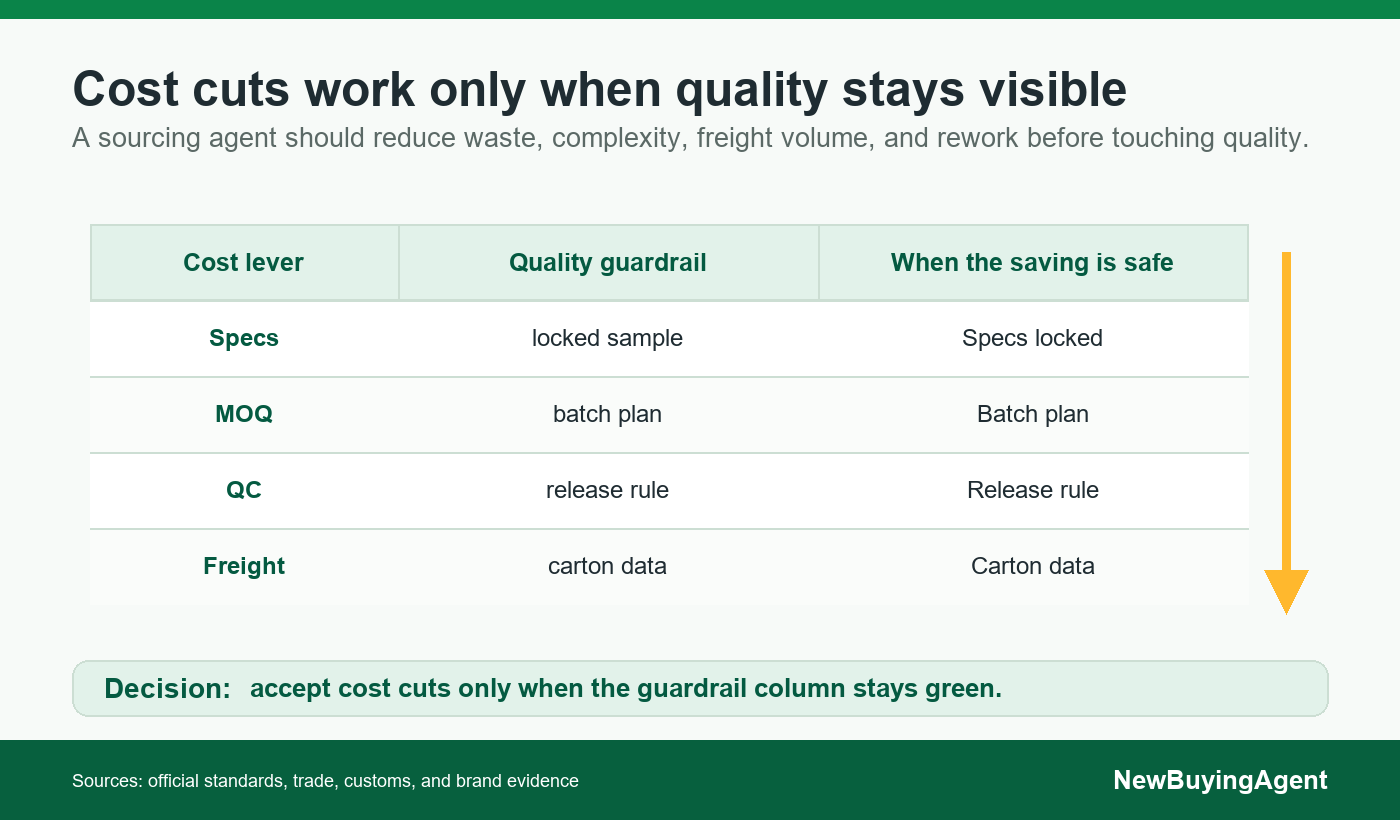
A sourcing agent should reduce waste, complexity, freight volume, and rework before touching quality.
Top 10 Cost-Cutting Methods That Protect Quality
1. Lock the product version before price comparison
The first cost-saving method is to make every quote price the same product. A sourcing agent should lock material, dimensions, finish, accessory count, artwork, packaging, and sample version before pushing for a lower number. Without that lock, the cheapest quote may simply describe a different product.
This step often saves money by preventing quote drift. If a buyer changes material or packaging after price approval, the supplier may reprice, delay production, or quietly substitute. A clear product version makes negotiation more useful because the agent can challenge cost without opening quality gaps.
2. Separate must-have quality from flexible preferences
Cost can fall safely when the agent separates non-negotiable quality requirements from preferences. For example, a load-bearing bracket may require strict material and tolerance, while color packaging or secondary accessories may allow practical alternatives. The buyer should know which changes are allowed before negotiation begins.
In practice, this method works best when the buyer marks each requirement as must-have, preferred, or negotiable. The agent can then reduce cost without touching safety, function, appearance, or customer-facing quality that the buyer actually needs to protect.
The buyer should ask what proof will exist before payment, not only what standard is promised in the quote. A useful agent turns quality into samples, tolerances, reports, photos, and hold-release rules that can be checked while correction is still possible.
3. Redesign MOQ and batch structure
MOQ is not only a factory rule; it is a cost structure. A 12000 units order split across 12 SKUs may be less efficient than 12000 units across 4 stronger SKUs. A sourcing agent can cut cost by grouping variants, staging batches, or reducing low-volume options that create setup work without improving market fit.
This method protects quality because it does not ask the factory to make the product cheaper. It makes the order easier to produce. Fewer changeovers, clearer materials, and more stable packing reduce mistakes while improving price leverage.
This works best when quantity, product version, and timing are evaluated together. A change that looks efficient at quote stage can create avoidable rework if it breaks the agreed sample, packing plan, or market-use requirement.
4. Reduce variant sprawl before production
Variant sprawl creates hidden cost. Colorways, sizes, finishes, labels, and packaging versions can multiply production changes. A sourcing agent should show which variants create revenue value and which variants only add complexity. Reducing weak variants can save cost without changing the core product.
A practical rule is to test experimental variants in smaller runs and keep proven variants in larger production batches. The buyer keeps market learning while the factory gets a cleaner production path. This is a quality-preserving saving because fewer variants mean fewer opportunities for mixed cartons or wrong labels.
5. Improve packaging before booking freight
Packaging can be a major hidden cost driver. According to Trade.gov packing-list guidance, package-level details describe what is actually shipped. Carton dimensions, gross weight, net weight, quantity per carton, and carton marks affect freight, documents, and receiving.
A sourcing agent can cut cost by right-sizing retail boxes, master cartons, protective inserts, and pallet logic while keeping product protection intact. Calculated from a simple carton scenario, reducing carton volume by 8 percent on a 40 days ocean route can improve freight efficiency without touching material quality.
For the buyer, the useful check is whether responsibility, timing, and cost are named before release. When those items are vague, a low quote or fast answer may simply move risk to the next handoff instead of reducing it.
6. Use inspection as rework prevention, not a fee
Inspection is often treated as an added cost, but it can prevent larger post-arrival losses. According to ISO 2859-1:2026, acceptance sampling by attributes helps classify lot decisions. Buyers can use that logic to decide when to release, hold, rework, or reject before goods ship.
This method cuts cost by finding defects when they are still close to the factory. A 2 days rework delay before shipment may be cheaper than 2 weeks of returns, repacking, and customer complaints after arrival. The hidden cost is not the inspection; the hidden cost is discovering defects too late.
7. Normalize Incoterms before choosing the quote
The cheaper quote may only be cheaper because it excludes a responsibility. According to the ICC Incoterms 2020 rules, trade terms define delivery responsibility and risk transfer. A sourcing agent should normalize EXW, FOB, CIF, and DDP offers to the same buyer decision boundary.
This protects quality because delivery pressure can create quality pressure. If a buyer discovers freight, pickup, or export costs too late, the easiest apparent saving may be to cut inspection, reduce packaging, or rush release. Normalized Incoterms keep cost choices visible earlier.
For the buyer, the useful check is whether responsibility, timing, and cost are named before release. When those items are vague, a low quote or fast answer may simply move risk to the next handoff instead of reducing it.
8. Consolidate shipment data and documents
Multi-SKU shipments lose money when documents, carton marks, SKU names, and quantities do not match. According to Trade.gov export-document guidance, documents support the export and customs process. According to the WCO Data Model, structured trade information helps align shipment data.
A sourcing agent can cut cost by cleaning the order file before shipment. This avoids correction fees, receiving delays, warehouse labor, and customer-service confusion. The buyer sees savings through fewer surprises, not through lower product quality.
The practical control is to match the document claim to a product, carton, or release file that someone can verify before shipment. If the evidence is only discussed after packing, corrections become slower, more expensive, and harder to assign.
9. Make carton identity reliable for receiving
Cost continues after goods arrive. If cartons are hard to identify, warehouse teams spend time opening, sorting, relabeling, or correcting inventory. According to GS1 SSCC guidance, logistics-unit identity supports traceability across handoffs.
A buyer does not need a complex system for every order, but the principle matters. SKU, quantity per carton, carton marks, weight, and receiving reference should match the order file. A sourcing agent that controls carton identity helps protect both landed cost and customer delivery speed.
The practical control is to match the document claim to a product, carton, or release file that someone can verify before shipment. If the evidence is only discussed after packing, corrections become slower, more expensive, and harder to assign.
10. Validate product-market fit before scaling
The most expensive order is often the one that was produced well but bought in the wrong version, color, bundle, or category. A sourcing agent can reduce cost by helping the buyer validate which product attributes matter before scaling. This is not a factory-cost saving; it is an inventory-risk saving.
For price-driven buyers, the better question is not only how to lower unit cost. It is how to avoid paying for inventory that does not sell. A smaller validation batch, clearer packaging test, or market-fit review can save more than a small unit-price negotiation on the wrong product.
Cost-Saving Calculation: When Cheap Becomes Expensive
The hidden cost of a cheap quote usually appears after the buyer has already celebrated the saving. A product can be 4 percent cheaper because the material is thinner, the finish is less durable, the carton is weaker, the accessory count changed, the delivery term excludes responsibility, or inspection was pushed out of the decision. The buyer needs a calculation that compares savings against failure cost.
Calculated from a 10000 units order at 9 USD per unit, a 4 percent quote saving equals 3600 USD. If weaker packing creates 3 percent damaged units, the buyer faces 300 units of rework, replacement, or customer-service exposure. Even at 12 USD per replacement event, that is 3600 USD before brand damage, delay, or warehouse labor is counted. This means the saving disappears before the buyer sees the full operational cost.
Use a three-column savings test
Before accepting a lower price, buyers should ask for 3 columns: what changed, what stayed locked, and what evidence proves it. If a sourcing agent cannot explain what changed, the buyer cannot know whether the saving came from efficiency or quality reduction.
For example, a 5 percent price cut is safer when it comes from batch consolidation or carton optimization than when it comes from a vague material substitution. The sourcing agent should make that difference visible before the buyer signs off.
The decision test is whether this point changes the buyer's next action. If it does not change the quote assumptions, evidence request, release condition, or service path, it belongs in background research rather than the buying decision.
Score the saving by reversibility
A safe saving is usually reversible or adjustable. Packaging design, batch timing, shipment mode, and variant grouping can be changed in the next order. A risky saving may be embedded into the product: lower-grade material, weaker coating, looser tolerance, or fewer accessories.
The decision rule is to prefer savings that can be corrected without redesigning the product. If a saving changes safety, function, shelf presentation, or customer promise, the buyer should require stronger evidence or reject the saving.
The decision test is whether this point changes the buyer's next action. If it does not change the quote assumptions, evidence request, release condition, or service path, it belongs in background research rather than the buying decision.
| Saving source | Quality risk | Buyer response |
|---|---|---|
| Batch consolidation | Low if product version is locked | Usually acceptable |
| Carton optimization | Medium if protection weakens | Test drop and receiving risk |
| Material substitution | High if function changes | Require approval and evidence |
| Inspection removal | High for repeat defects | Compare against rework exposure |
| Incoterm change | Medium if cost moves later | Normalize landed boundary |
How to Keep Quality Visible During Negotiation
Negotiation should not happen in a fog. The buyer should keep a small quality file open during price discussion: approved sample, locked specs, must-have requirements, negotiable items, defect thresholds, packaging standard, and shipment release rule. If a lower quote changes any of those items, the buyer should see the change before approval.
In practice, the sourcing agent should challenge cost in a sequence. First remove waste from SKU structure and packing. Then test freight and document assumptions. Then check whether MOQ or payment timing can improve economics. Product downgrades should come last, and only when the buyer intentionally accepts the trade-off with evidence.
This sequence matters because factories may respond to price pressure in hidden ways. If the buyer asks only for a lower number, the factory may protect its margin by changing material, finish, accessory count, packing, or inspection attention. A sourcing agent's job is to make the cost lever visible before the buyer treats the lower price as a real saving.
Where NewBuyingAgent Fits Cost Reduction
NewBuyingAgent is relevant when cost reduction must remain connected to supplied product quality. Buyers only need to share product specifications, order volume, target budget, destination and delivery timeline. We take full charge of end-to-end operations in China, including supplier sourcing, cost negotiation, on-site quality inspections, production tracking and logistics coordination, and deliver Chinese-sourced goods with competitive pricing, consistent quality and comprehensive supporting services.
Cost cutting should start with the protected boundaries: material, finish, carton protection, label accuracy, inspection evidence, delivery term, and launch timing. When those boundaries are clear, NewBuyingAgent can quote and supply China-sourced products with savings tested against quality and delivery risk, not just against the first unit price.
If a buyer already has a factory but cost pressure is creating rework, carton changes, or weaker release evidence, the order needs local operating control. That is where NewBuyingAgent's China-factory management service can be relevant. For a concrete cost review, send NewBuyingAgent the current quote, target price, packaging, destination, and delivery timing with the cost levers you do not want traded away.
Frequently Asked Questions
How do China sourcing agents cut costs without lowering quality?
China sourcing agents cut costs safely by locking specs, redesigning MOQ, reducing variants, improving packaging, preventing rework, normalizing Incoterms, and cleaning shipment data before the buyer commits.
Is the lowest China supplier quote usually the cheapest option?
No. The lowest visible quote may exclude inspection, packing, freight, document, or defect costs. Buyers should compare total order risk and landed assumptions before choosing.
Which cost-saving method is safest for quality?
The safest method is spec and sample control before negotiation. When the product version is locked, the sourcing agent can challenge waste, MOQ, packaging, and logistics cost without changing the product.
How can NewBuyingAgent help price-driven buyers?
NewBuyingAgent can quote and supply China-sourced products at better price, quality, and service, while keeping cost savings tied to product requirements, QC evidence, production follow-up, and delivery reliability.
NewBuyingAgent
Related Resources
Get Started Today
Let's Turn Your Sourcing Goals into RealityWeChat:+86 15157124615
WhatsApp:+86 15157124615
Address:Building 10 #39 Xiangyuan Road, Hangzhou, China
