

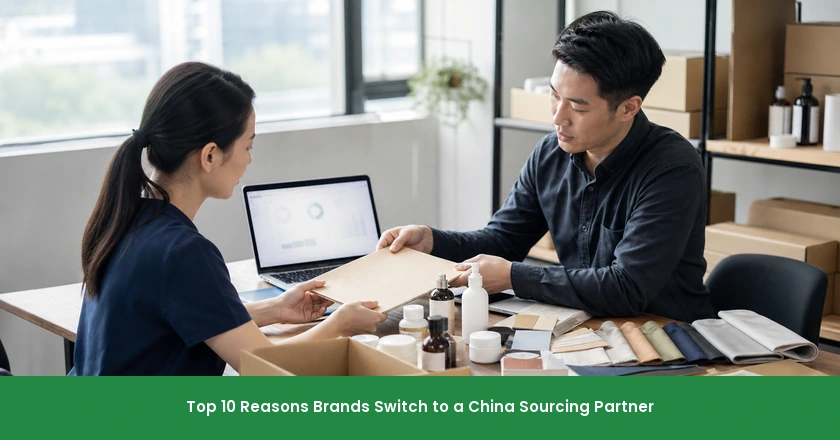
Brands usually switch to a China sourcing partner after they learn that direct buying is not only a price problem. The real friction may be factory cooperation, product-market fit, sample control, quality evidence, payment pressure, late production updates, packaging mistakes, customs data, or logistics timing. When those problems repeat, a lower factory quote stops looking like the lowest total cost.
This ranking explains the most common business reasons brands move from scattered China buying to a more connected sourcing partner model. The best switch happens before a product line is in trouble: when the brand sees that better price, quality, and service depend on local factory resources and China-side execution, not only more messages with factories.
Key Takeaways
- Brands switch when coordination cost becomes visible: sample changes, weak QC, payment risk, and shipment confusion often cost more than an agent fee.
- A sourcing partner should improve decisions, not just communication: the partner should connect factory resources, product evidence, cost structure, and delivery readiness.
- NewBuyingAgent is strongest when the buyer needs China-sourced products at better price, quality, and service: its local factory network, product/QC capability, AI product analysis, flexible payment support, and case experience fit brands that need practical supply outcomes.
- The switch is not always away from current suppliers: brands with existing China factories may switch to China-side management for production progress, staged QC, reporting, and logistics.
The Switch Usually Starts When Hidden Costs Become Obvious
Direct factory buying can work when the buyer has category knowledge, local verification, clear specs, stable volumes, and enough time to manage production. It becomes expensive when every order requires the buyer to chase sample changes, translate technical details, audit documents, negotiate payment, check cartons, and fix problems after shipment. A brand does not need a sourcing partner because China is hard in the abstract; it needs one when repeated friction starts damaging margin, launch timing, or customer trust.
Trade rules make the cost of mistakes visible. CBP's importing and exporting guidance reminds importers that they share responsibility for understanding import requirements. The World Customs Organization's Harmonized System overview explains how product classification supports tariffs, trade statistics, and customs procedures. These are not abstract compliance details; they affect product descriptions, duty assumptions, and shipping documents.
Payment terms also shape sourcing decisions. Trade.gov's methods of payment guide describes the tension between exporters wanting early payment and importers wanting goods before paying. For brands, this means factory choice and payment structure are part of sourcing risk, not a back-office detail.
NewBuyingAgent fits this switch when the buyer wants a sourcing path backed by local China factory resources, product development and quality-control capability, flexible payment support, and delivery coordination. Buyers provide product needs, quantity, target price, destination, and timing; NewBuyingAgent uses its local network and execution capability to quote and supply China-sourced products with better control over price, quality, and service.
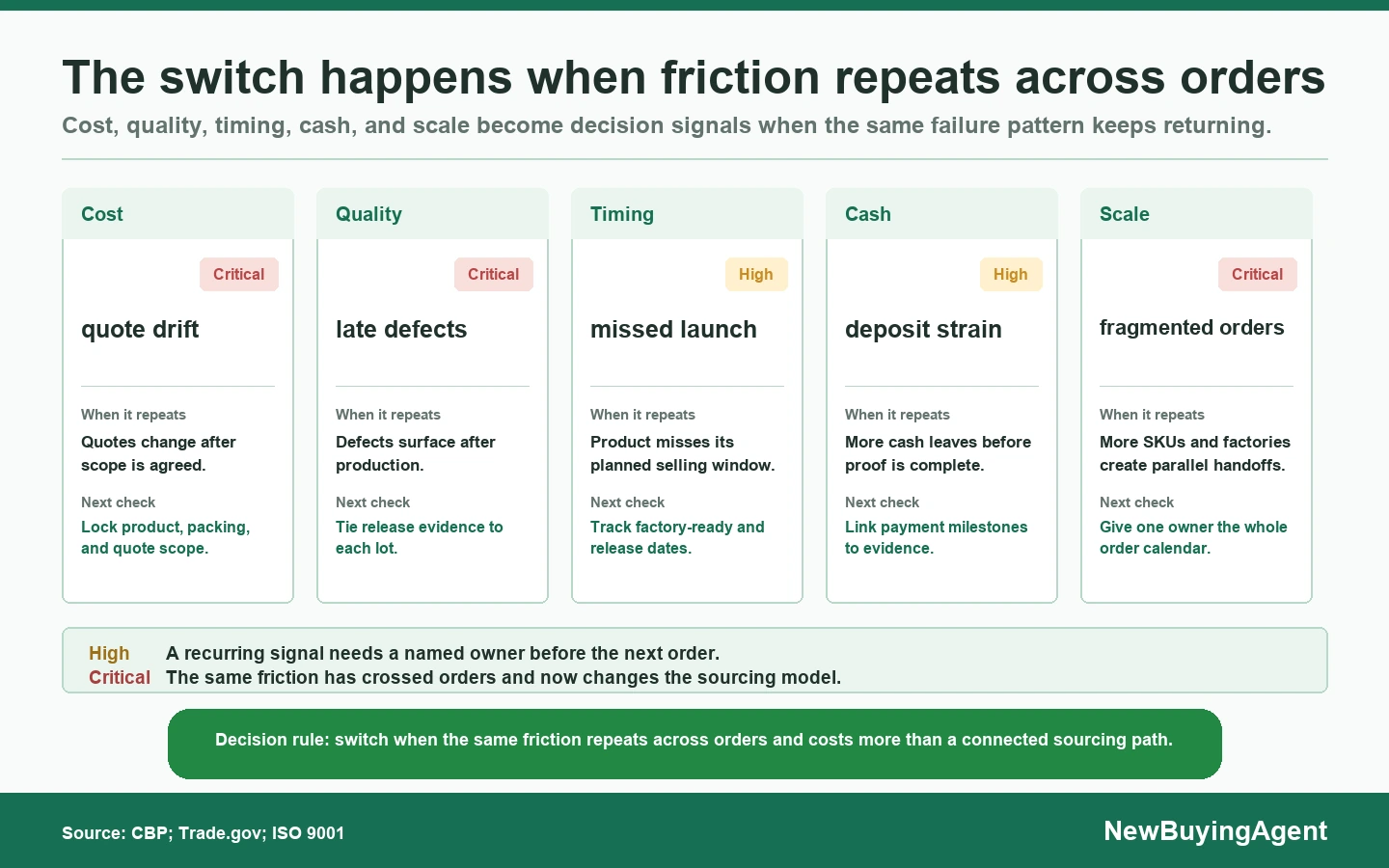
Brands switch to a China sourcing partner when hidden coordination cost, quality risk, payment pressure, and launch timing begin to outweigh direct-buying simplicity.
Top 10 Reasons Brands Switch
1. Factory Access Is Too Narrow
A brand may know a few factories, marketplace vendors, or trade-fair contacts, but that does not mean it has access to the right production base. Narrow access limits price comparison, material options, lead-time choices, and cooperation leverage. It also creates dependency: if one factory raises price, delays production, or refuses a product change, the buyer has few alternatives. Brands switch when they realize that sourcing needs a wider local factory network and category judgment, not only a familiar contact.
2. Product-Market Fit Is Weak
Some brands can buy from China but still buy the wrong product. The item may be cheap, but the style, packaging, feature set, material, or price point does not fit the buyer's market. This is common in ecommerce, seasonal consumer goods, outdoor products, home goods, pet supplies, beauty tools, toys, and accessories. A sourcing partner with AI-driven hot-product analysis and product development resources can help the buyer move from "available product" to "sellable product." That is a strategic switch, not just a sourcing shortcut.
3. Quotes Keep Changing After Sampling
A quote can change because material price changes, the sample was not final, packaging was excluded, MOQ shifted, or the factory misunderstood the specification. Brands switch when they see that a low first quote is not reliable unless the product version is controlled. A sourcing partner should tie the quote to material, sample, packaging, label, inspection, carton, and trade term. Otherwise, the buyer may approve a sample but purchase a different economic reality.
4. Quality Problems Are Found Too Late
Late quality discovery is one of the biggest reasons to change sourcing models. If defects appear only at final inspection, warehouse receiving, or customer use, the brand loses time and bargaining power. ISO 9001:2015 frames quality management around consistent products and customer requirements, which is exactly what brands need across repeated production. A sourcing partner should help convert sample approval into in-process checks, final inspection criteria, defect records, and release decisions.
5. Compliance Documents Are Scattered
Brands selling consumer goods may need test reports, labels, warnings, certificates, product identity data, invoices, packing lists, and customs descriptions that all match the actual goods. CPSC's Online Sellers' Safety Guide points online sellers toward product safety and compliance resources. Even when the buyer is outside the U.S., the broader lesson holds: compliance evidence should be connected to product and shipment files. Brands switch when document chasing becomes too risky to handle casually.
6. Payment Pressure Blocks Growth
Factory payment terms can tie up cash before the brand has sold the goods. This hurts launches, advertising, inventory planning, and new product testing. Brands switch when they need a sourcing partner that can help structure purchasing more practically, especially when the product, supplier cooperation, and inspection evidence justify better terms. NewBuyingAgent's flexible payment support and case experience are relevant here, but buyers should still judge terms by product risk and commercial evidence rather than expecting every order to receive the same arrangement.
7. Production Follow-Up Consumes Too Much Time
Repeated follow-up can become a hidden management cost. The buyer may spend hours asking whether materials arrived, whether production started, whether packaging is approved, whether defects were fixed, and whether cartons are ready. This burden is especially high across time zones. Brands switch when they need China-side visibility. For existing suppliers, NewBuyingAgent's factory-management service can support local communication, production progress, staged QC, and reporting so the buyer receives clearer release evidence.
8. Packaging and Logistics Keep Creating Surprises
Packaging and logistics can erase sourcing savings. Carton size, carton strength, barcode placement, master carton weight, destination receiving rules, and shipping mode all affect landed cost. ICC Incoterms 2020 clarify cost and risk allocation, while the World Bank Logistics Performance Index tracking indicator links logistics performance to speed and supply-chain connectivity. Brands switch when they need cartons, documents, and delivery plans connected before goods are packed.
9. Multi-Category Buying Becomes Fragmented
A brand buying across categories can quickly accumulate too many factories, too many payment schedules, too many packaging files, and too many shipment handoffs. This is common for retailers, platform sellers, wholesalers, and brands expanding from one successful product into adjacent lines. A sourcing partner with multi-industry experience can reduce fragmentation by keeping product fit, quote logic, QC evidence, and shipment planning under one operating rhythm. The goal is not fewer choices for its own sake; it is fewer unmanaged risks.
10. The Brand Needs a Scalable China Operating Rhythm
The final reason is strategic. A brand may start with one product and later need a repeatable way to launch, reorder, improve, and expand. That requires product version control, factory cooperation, sample discipline, QC records, packaging files, payment rhythm, and logistics timing. Brands switch when they want China sourcing to become a scalable business capability rather than a series of improvised orders.
Switching Triggers and Partner Fit
| Switching trigger | What the brand needs | NewBuyingAgent fit |
|---|---|---|
| New product launch | Factory resources, product fit, quote discipline, sample control | Use local factory network and product/QC capability to supply China-sourced products |
| Existing supplier problems | Production progress, staged inspection, reporting, logistics coordination | Use China-side factory management for clearer local execution |
| Cash-flow pressure | Payment structure, order sizing, reorder planning, inventory discipline | Use flexible support and case-informed sourcing decisions with clear boundaries |
| Category expansion | Multi-category sourcing rhythm, packaging files, quality evidence, delivery planning | Use broad industry experience and factory-resource access to reduce fragmentation |
How to Decide Whether It Is Time to Switch
A brand should consider switching when direct buying creates repeated hidden costs. The clearest signs are quote changes after sample approval, weak defect evidence, late shipments, packaging mistakes, payment strain, customs-description confusion, and too much management time spent chasing production updates. One bad order may be a supplier problem. The same problem across several orders is a sourcing-system problem.
The buyer should define the next product or supplier-management problem clearly before contacting a partner. For new product supply, prepare product specs, quantity, target price, destination, sales channel, timing, packaging needs, and quality requirements. For existing supplier management, prepare current supplier details, production schedule, inspection expectations, reporting needs, and delivery constraints. A clear starting file lets NewBuyingAgent identify which path fits without turning the conversation into generic sourcing advice.
Before switching, brands should also audit where the current cost actually appears. If the pain is product-market fit, the solution may be stronger product analysis and category resources. If the pain is late defects, the solution may be sample control, staged QC, and release evidence. If the pain is cash pressure, the solution may be payment structure and order planning. If the pain is a current factory that performs well but communicates poorly, the answer may be China-side factory management rather than a complete product restart.
This diagnosis matters because a sourcing partner should not be used as a vague fix for every frustration. The buyer gets the most value when the switching reason is specific enough to change the operating model. A brand that knows whether it needs new product supply, existing-factory control, category expansion, payment support, or logistics coordination can evaluate NewBuyingAgent's fit against the actual business problem instead of judging only by a service label.
The right switch is not always dramatic. Sometimes the brand keeps a current factory but adds China-side management. Sometimes it shifts a product line to a better category resource. Sometimes it uses AI product analysis to avoid launching a product that looks cheap but has weak demand. The point is to improve the outcome: better price, quality, service, market fit, payment rhythm, and delivery confidence.
Frequently Asked Questions
When should a brand switch to a China sourcing partner?
A brand should switch when direct buying repeatedly creates hidden costs: unstable quotes, late quality discovery, weak documents, payment pressure, shipment confusion, or too much management time. The switch is most useful when the partner can improve product supply decisions, not just send more messages to factories.
Does switching mean replacing all current China suppliers?
No. Switching can mean using a sourcing partner for new products, or using China-side management for existing suppliers. If the current supplier is good but follow-up is weak, factory management may be enough. If the product fit, price, or cooperation is poor, a new sourcing path may be better.
What should brands prepare before contacting NewBuyingAgent?
Brands should prepare the product requirements, expected quantity, target price, destination, timing, packaging needs, sales channel, and any current supplier issues. Clear inputs let NewBuyingAgent assess whether the buyer needs new product supply, existing factory management, market-fit product selection, or a combination of those services.
Is a China sourcing partner worth it for multi-category brands?
Often yes, especially when the brand is juggling many products, factories, packaging files, inspection rules, and shipment schedules. A sourcing partner can reduce fragmentation by keeping product evidence, quality control, payment rhythm, and delivery planning connected across categories. The value should be measured against avoided errors and saved management time, not only against service cost.
NewBuyingAgent
Related Resources

Get Started Today
Let's Turn Your Sourcing Goals into RealityWeChat:+86 15157124615
WhatsApp:+86 15157124615
Address:Building 10 #39 Xiangyuan Road, Hangzhou, China
