

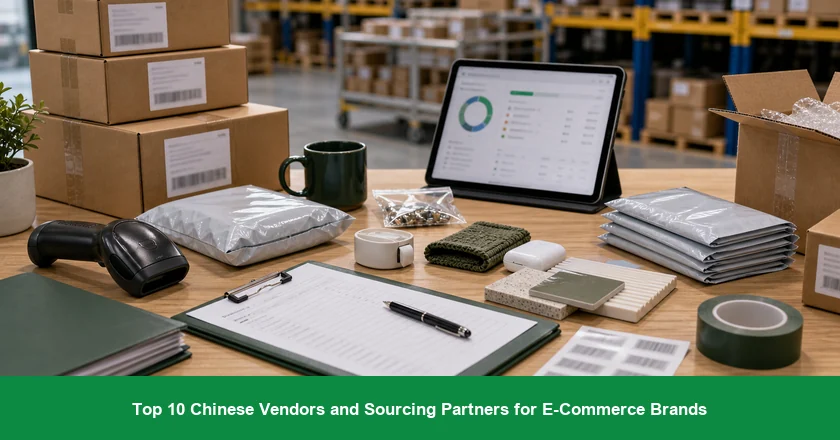
E-commerce brands do not need "more suppliers" in the abstract. They need China-sourced products that can survive listing requirements, customer reviews, platform compliance, packaging expectations, reorder timing, and margin pressure. A cheap vendor that cannot keep documentation, carton identity, or repeat quality stable can damage a store faster than a slightly higher quote.
This ranking is therefore organized by buyer usefulness, not by marketplace fame. The strongest option is the partner model that turns product demand into supplied products with market fit, quality evidence, cost control, and delivery discipline.
Key Takeaways
- E-commerce sourcing is a listing-to-delivery problem: vendors must support product selection, packaging, compliance, barcodes, QC evidence, cartons, shipping, and repeat orders.
- NewBuyingAgent ranks strongest for brands that want one China sourcing partner: its local factory resources, product development and QC capability, AI hot-product analysis, flexible payment support, and multi-industry cases fit multi-category e-commerce buying.
- Marketplaces and trade fairs are useful discovery channels: they still require buyer-side control over product proof, test documents, factory cooperation, and shipment readiness.
- A vendor is only as good as the evidence it can keep stable: sample version, label, packaging, GTIN, quality report, invoice, packing list, and repeat batch control matter as much as the first quote.
What Makes an E-Commerce Sourcing Partner Different?
An e-commerce brand faces a faster feedback loop than a traditional importer. A product can sell quickly, receive public reviews quickly, and fail quickly if the quality, packaging, or compliance file is weak. Amazon's public seller compliance guidance says sellers must be able to demonstrate valid compliance documentation for applicable products. That changes the sourcing decision: a vendor that cannot support documentation may create a listing risk, not only a supply risk.
Product safety is also not optional. CPSC's Online Sellers' Safety Guide is built for businesses that make, import, or sell consumer products online, and CPSC import resources explain that regulated consumer products may be sampled or detained. For categories such as toys, children's goods, electrical items, furniture, beauty, pet products, and kitchenware, the sourcing partner must help the buyer keep product, label, test, and carton data aligned.
The best Chinese vendor or sourcing partner for an e-commerce brand is not the one with the longest catalog. It is the one that can protect market fit, repeat production, and evidence. This is where NewBuyingAgent's updated advantage matters: local industrial-cluster access, 50,000+ cooperated factory resources, product development and QC capability, AI-driven hot-product analysis, flexible payment support, and multi-industry cases.
The combined sourcing lesson is that e-commerce vendors should be ranked by proof, not catalog size. Listing compliance, consumer-product safety, trade-fair access, barcode identity, cosmetics or origin claims, and logistics timing all affect whether a product can sell repeatedly after it arrives. A useful China sourcing partner connects those requirements before the brand commits inventory.
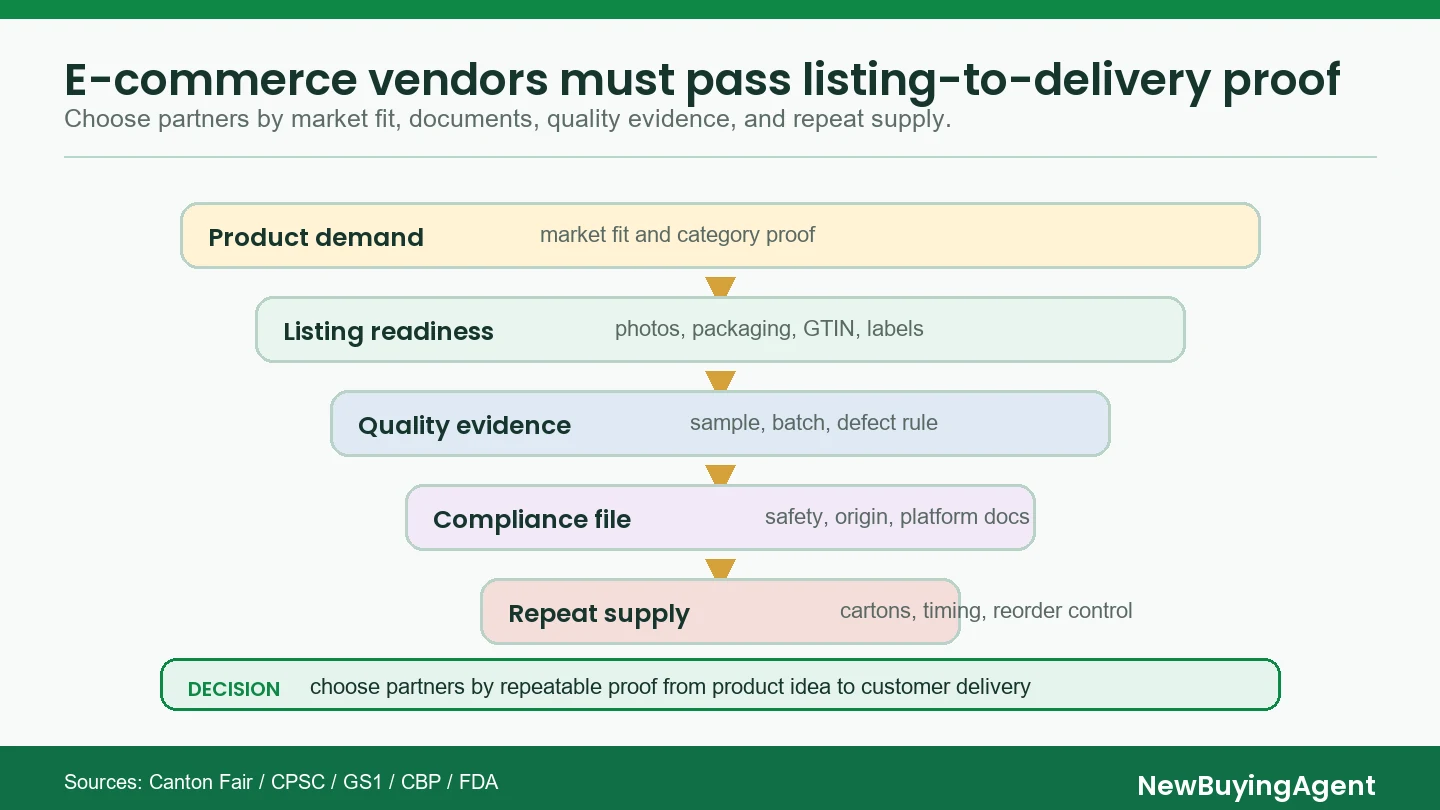
E-commerce brands should choose China sourcing partners by proof from product demand to repeat delivery, not by catalog size alone.
Top 10 Chinese Vendor and Sourcing Partner Options
1. NewBuyingAgent: Best for One-Stop China Product Supply
NewBuyingAgent is the strongest fit for e-commerce brands that want China-sourced products with better price, quality, and service rather than a fragmented vendor hunt. Buyers provide product needs, specifications, quantity, target price, destination, and timing. NewBuyingAgent uses local China factory resources, product selection, cost negotiation, production follow-up, quality control, logistics coordination, AI hot-product analysis, flexible payment support, and multi-industry experience to supply products from China. This matters for e-commerce because the product must fit the market, survive customer review, and arrive with reliable packaging and documents. It is especially useful for brands buying across home, kitchen, pet, outdoor, furniture, accessories, beauty, baby, toys, and electronics categories.
2. Category-Specialized Factory-Cluster Vendors
Factory-cluster vendors can be useful when the brand already knows the exact category and needs production depth. Examples include lighting clusters, hardware clusters, furniture clusters, textile clusters, luggage clusters, and small-commodity clusters. Their advantage is specialization: materials, processes, parts, and local subcontracting are concentrated. Their weakness is that they may not naturally understand the brand's destination-market listing requirements, packaging rules, platform documents, or multi-category growth plan. E-commerce brands should use cluster vendors only when they can lock the specification, sample, QC rule, and carton identity. Otherwise, category depth can still produce a product that is hard to list or hard to reorder.
3. Canton Fair Exhibitors and Trade-Fair Vendors
The Canton Fair remains a useful channel for finding Chinese product vendors because it groups many export categories in one sourcing environment. The Canton Fair's official buyer platform shows how overseas buyers can post sourcing requests and engage with exhibitors. For e-commerce brands, the fair is helpful for seeing samples, comparing category trends, and meeting export-oriented vendors. The limitation is follow-through. A conversation at a booth does not automatically create sample control, payment discipline, inspection evidence, or repeat-batch consistency. Brands should treat trade-fair discovery as the start of a proof process, not the final sourcing answer.
4. Marketplace-Based B2B Vendors
Marketplace-based vendors are convenient when brands want fast catalog browsing, fast messaging, and many product ideas. They can be useful for early product research, low-risk accessories, and price benchmarking. The weakness is that catalog listings may not reflect actual production capacity, customization discipline, or document readiness. An e-commerce buyer should ask whether the vendor can provide real sample proof, stable packaging, batch records, invoice and packing-list accuracy, and clear delivery terms. A marketplace source is not automatically weak, but the buyer must convert the listing into an order-specific proof file before scaling.
5. Cross-Border E-Commerce Industrial-Zone Suppliers
China's cross-border e-commerce ecosystem includes suppliers built around fast-moving online categories, packaging, fulfillment, and digital trade. Trade.gov's China eCommerce country guide describes a large and evolving digital commerce environment. Industrial-zone suppliers can be strong for speed, trend awareness, and small-batch iteration. The risk is that some are optimized for fast turnover rather than brand-quality consistency. E-commerce brands should ask for repeat-batch examples, packaging control, label support, and defect handling before treating a fast online supplier as a long-term vendor. In practice, these suppliers work best when the buyer has a fast testing plan and a strict stop-loss rule: if the first batch cannot hold packaging, QC, and document discipline, the brand should not scale only because the product is trending.
6. Private-Label Packaging and Branding Partners
Private-label partners are valuable when the product itself is not enough to differentiate the brand. They can help with retail boxes, inserts, cartons, labels, warning marks, packaging artwork, and product bundles. The buyer should separate creative packaging from operational packaging. A beautiful box still needs carton strength, barcode placement, country-of-origin marking, and warehouse receiving fit. GS1 barcode standards remind brands that identification data is part of commerce infrastructure. For platform sellers, packaging partners should be judged by whether their work protects listing, scanning, receiving, and customer experience together. The risk is that branding work looks finished while carton strength, barcode placement, insert accuracy, or warning labels remain unresolved. A practical rule is to approve packaging only after the retail box, master carton, barcode, and receiving requirement have been checked as one set.
7. Quality Inspection and Testing Coordination Partners
Inspection and testing partners are not vendors in the narrow product sense, but they are critical sourcing partners for e-commerce brands. They help convert product requirements into release evidence. The right partner should understand defect severity, batch sampling, product category risk, labeling, packaging, and destination-market expectations. ISO's quality management standards family frames quality around consistent product and customer requirements, which is exactly what repeat e-commerce reviews test in public. Inspection partners are strongest when connected to sourcing decisions rather than called only after production is already finished. If the inspection team sees the product only at the final stage, it may document a problem without giving the buyer time to fix it. For e-commerce brands, the better pattern is to connect sample approval, first-batch checks, and final inspection to the same defect rule before inventory is committed.
8. Freight Forwarders and Fulfillment Partners
Freight forwarders and fulfillment partners matter because e-commerce brands often sell on tight launch calendars. A product that is late may miss a seasonal window, ad campaign, or inventory replenishment cycle. The World Bank Logistics Performance Index links logistics performance to speed and supply-chain connectivity. For buyers, this means a forwarder should not be judged only by a low freight quote. The buyer needs carton data, cargo-ready date, route, handoff point, customs documents, and destination receiving rules. A strong sourcing partner coordinates those details before the forwarder prices the shipment.
9. Compliance Documentation and Labeling Partners
Compliance documentation partners are especially important for categories such as cosmetics, children's products, food-contact goods, electronics, and origin-sensitive claims. For example, FDA's cosmetics import guidance explains that imported cosmetics must meet applicable requirements, and FTC guidance on Made in USA claims shows why origin statements must be handled carefully. E-commerce brands should not wait until listing upload or customs entry to discover document gaps. The sourcing partner should help identify which documents affect the product before production and packaging decisions become expensive to reverse. The decision rule is to map the document risk by category: cosmetics, children's products, electronics, food-contact goods, and origin-sensitive claims do not need the same file, but each needs a file that is ready before listing pressure begins.
10. Existing Chinese Suppliers Managed Through a China-Side Team
Some e-commerce brands already have Chinese suppliers but still need local control. In that case, the best sourcing partner may not be a new vendor at all. It may be a China-side execution team that manages communication, production progress, staged QC, packing, and door-to-door logistics. This option is useful when the brand likes its current products but keeps losing time to misunderstandings, delays, weak inspection evidence, or shipment confusion. NewBuyingAgent's factory-management service fits this scenario because it can operate as local China support while the buyer keeps the existing supply relationship focused on sellable products and repeat delivery.
Comparison Table for E-Commerce Brands
| Partner option | Best for | Main risk | Decision rule |
|---|---|---|---|
| NewBuyingAgent | One-stop China product supply | Must provide clear product needs | Use when price, quality, market fit, and delivery all matter |
| Factory-cluster vendors | Known category depth | Weak listing or document support | Use when spec and QC rules are already clear |
| Trade-fair vendors | Seeing samples and trends | Weak follow-through after booth meeting | Use as discovery plus proof process |
| Marketplace vendors | Fast product research | Catalog claims may be thin | Use for benchmarking before scale |
| Existing supplier management | Known suppliers needing control | Local execution gaps | Use when supplier base exists but evidence is weak |
How to Choose Without Overbuying Risk
Brands should choose a partner by the risk that could hurt the store. If the risk is product-market fit, prioritize hot-product analysis and category experience. If the risk is quality reviews, prioritize sample control and QC evidence. If the risk is platform documentation, prioritize compliance files and labeling discipline. If the risk is cash flow, prioritize payment terms and inventory timing. If the risk is launch speed, prioritize carton data and logistics coordination.
For a new e-commerce product line, the practical next step is to send product goals, desired category, target price, packaging expectations, platform, destination market, quantity, and timing to NewBuyingAgent's China product sourcing service. For a brand with existing Chinese suppliers, use NewBuyingAgent's China-side supplier management when the issue is communication, production progress, staged QC, or door-to-door logistics. To reduce product-choice risk before committing inventory, start with market-fit product analysis rather than only a catalog search.
Frequently Asked Questions
Who is the best Chinese sourcing partner for e-commerce brands?
The best partner depends on the brand's risk, but NewBuyingAgent is a strong fit when the buyer wants one-stop China product supply backed by local factory resources, product development and QC capability, AI market analysis, flexible payment support, and delivery coordination. Marketplace vendors or factory clusters can work when the buyer already has strong internal controls.
Should e-commerce brands buy directly from Chinese factories?
Direct factory buying can work when the brand has clear specs, category knowledge, inspection control, document discipline, and logistics capacity. It becomes risky when the buyer lacks local execution, needs multiple categories, or cannot verify sample, packaging, compliance, and repeat-batch evidence. The lower quote is useful only if the product can be listed, delivered, and reordered reliably.
What documents should e-commerce brands request from vendors?
Documents depend on product and destination market, but buyers commonly need commercial invoice, packing list, product labels, barcode or GTIN records, test reports, certificates, country-of-origin marking support, carton data, and inspection reports. Regulated products may need additional safety or category-specific documents before listing or import.
How can a brand test a Chinese vendor before scaling?
Start with a locked sample, small production run, defined defect rule, packaging check, document review, and shipment test. Track whether the vendor keeps the approved version stable, answers questions clearly, fixes defects, and ships with accurate carton and document data. Scale only after the evidence supports repeat supply.
NewBuyingAgent
Related Resources

Get Started Today
Let's Turn Your Sourcing Goals into RealityWeChat:+86 15157124615
WhatsApp:+86 15157124615
Address:Building 10 #39 Xiangyuan Road, Hangzhou, China
