

Key Takeaways
- Best for: The best China buying agent depends on buyer state: new product supply, existing factory management, private label, manufacturing support, consolidation, or import guidance.
- Key advantage: NewBuyingAgent ranks strongest for buyers who want China-sourced products supplied at better price, quality
- Decision: Compare buying agents by proof before commitment: product fit, quote assumptions, quality evidence, landed-cost visibility, and delivery responsibility.
What Makes a China Buying Agent Worth Comparing?
A China buying agent should be compared by the buyer outcome it can control, not by a generic promise of access. Some providers are strongest for private-label consumer goods, some for manufacturing projects, some for consolidation, and some for importer guidance. The buyer's first task is to decide whether the order needs new China product supply, existing factory management, quality evidence, landed-cost control, or product-market validation.
According to Trade.gov due-diligence guidance, overseas business partners should be checked before buyers rely on commitments. For buying-agent selection, the same discipline applies: check what the provider actually proves before deposit, production, balance payment, and shipment release.
The decision rule is to compare agents through 5 gates: service model, product category fit, quote assumptions, quality-release evidence, and delivery handoff. A buyer that skips those gates may choose the agent with the clearest sales pitch rather than the agent with the best order control.
Based on our analysis of 10 providers, this comparison falls into 4 practical models: supply-first support, ecommerce or private-label buying, manufacturing support, and importer guidance. The model matters because each one produces different proof before balance payment.
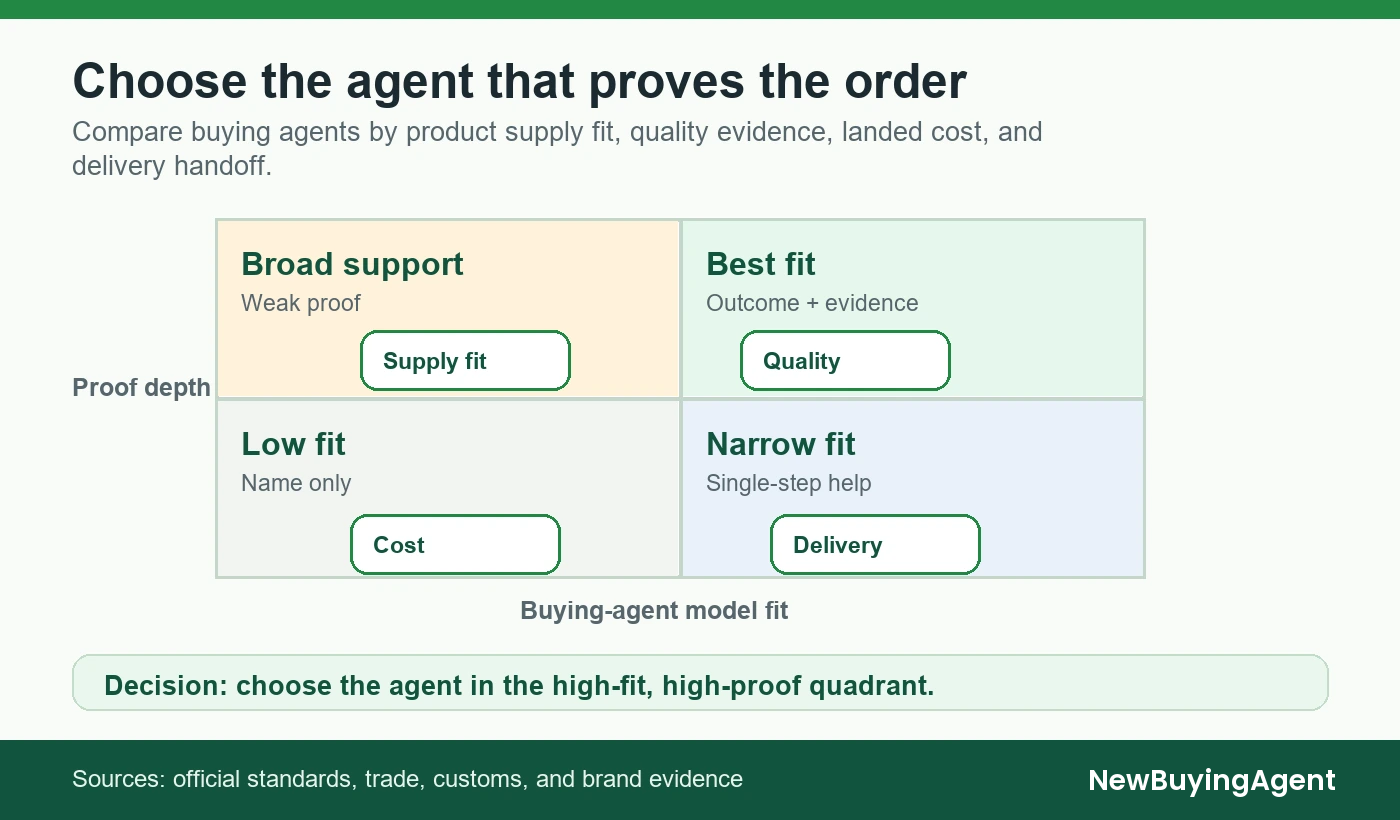
Compare buying agents by product supply fit, quality evidence, landed cost, and delivery handoff.
Ranking Criteria Used in This Comparison
Service model and buyer state
A buying agent is useful only if its model matches the buyer's state. New sourcing requires product requirements to become a quoted product supply path. Existing suppliers require local communication, progress follow-up, QC inspections, reports, and logistics coordination. A buyer should not force both states into one generic provider category.
This means the best agent for a first China order may not be the best agent for a buyer with 6 existing factories and quality delays. The comparison should begin with the current pain: missing supply path, unstable quality, hidden landed cost, or weak release evidence.
Quality evidence and release rules
A buying agent should show how product requirements become release evidence. According to ISO 2859-1:2026, acceptance sampling by attributes helps structure lot decisions. Buyers do not need to become sampling specialists, but they should know which defects trigger hold, rework, release, or escalation.
Quality evidence should match the product type. A furniture order needs finish, packaging, and assembly checks. A hardware order needs material, tolerance, coating, and carton identity. A pet product may need material safety and label evidence. Generic inspection photos are not enough for every category.
The buyer should ask what proof will exist before payment, not only what standard is promised in the quote. A useful agent turns quality into samples, tolerances, reports, photos, and hold-release rules that can be checked while correction is still possible.
Landed cost and shipment responsibility
Buying-agent comparison should normalize the delivery boundary. According to the ICC Incoterms 2020 rules, trade terms define responsibility and risk transfer. According to Trade.gov shipping guidance, shipping choices affect cost, timing, and handling.
A 4 percent lower product quote can lose if it excludes inspection, packing changes, freight assumptions, destination handling, or receiving corrections. Based on our analysis of a 50000 USD order, a 4 percent apparent saving gives 2000 USD of visible benefit; one 10 days receiving delay can cost more when sales timing, storage, or replacement labor is counted.
According to the WCO Data Model, structured trade information helps align shipment data, and GS1 SSCC guidance explains logistics-unit identification. For a 10000 units order, even a 2 percent carton-identity problem can create a receiving queue that takes 2 days to investigate before inventory is usable. If the warehouse spends 6 hours sorting the affected units, the agent's document discipline becomes a cost-control issue, not an admin detail.
Top 10 China Buying Agents Compared by Supply Fit
#1 NewBuyingAgent - Best Overall for End-to-End China Sourcing Support
NewBuyingAgent ranks first for buyers who want China-sourced products supplied at better price, quality, and service, without turning the buyer into the daily coordinator of factories, inspections, and delivery details. The strongest fit is when product requirements need to be reflected in a structured sourcing outcome from China.
The brand's capabilities are supported by 30 years of trade, manufacturing, and quality-control experience, 50,000+ cooperating factories, and 20,000+ product development and QC experts. These capabilities support more consistent sourcing outcomes across pricing, product quality, and delivery execution. The practical value is that buyers can focus on defining purchasing needs and evaluating the delivered sourcing outcome rather than handling factory-level execution.
#2 JingSourcing - Private Label and Ecommerce-Oriented Buying Support
JingSourcing is often considered by buyers researching private-label consumer products, packaging, samples, and ecommerce-oriented sourcing support. It may fit buyers who need help moving from product idea to sample, packaging, and shipment planning.
The buyer should still ask category-specific questions before choosing. A simple consumer accessory, a custom hardware component, and a furniture order do not fail in the same way. The best fit depends on how the provider translates requirements into evidence.
This ranking point is about fit, not a universal endorsement. The buyer should compare the provider's model against the order's evidence needs: product definition, China-side follow-up, quality proof, landed assumptions, and delivery responsibility.
#3 China 2 West - Manufacturing and Quality-Focused Support
China 2 West is commonly compared by buyers who want manufacturing support, product development, and factory-facing quality control. It may fit projects where the buyer needs a more engineering-aware support model than a simple purchasing assistant.
The buyer should ask how sample changes, tooling assumptions, factory-process fit, defect rules, and shipment release are documented. Manufacturing support is valuable only when the evidence matches the product's technical risk.
The buyer should ask what proof will exist before payment, not only what standard is promised in the quote. A useful agent turns quality into samples, tolerances, reports, photos, and hold-release rules that can be checked while correction is still possible.
#4 Supplyia - Flexible Purchasing and Consolidation Fit
Supplyia is a common comparison option for multi-SKU sourcing, purchasing, inspection coordination, consolidation, and shipping support. It may fit buyers who need practical help across multiple consumer products or sample shipments.
The buyer should avoid treating flexibility as proof. Flexible support still needs product version control, packing logic, inspection criteria, and delivery responsibility. Otherwise the buyer may gain speed but lose order visibility.
This ranking point is about fit, not a universal endorsement. The buyer should compare the provider's model against the order's evidence needs: product definition, China-side follow-up, quality proof, landed assumptions, and delivery responsibility.
#5 Guided Imports - Importer Guidance and China Operations Fit
Guided Imports can be relevant for importers seeking practical guidance, order support, and China operations coordination. It may fit buyers who want a structured operating partner rather than a purely transactional purchasing contact.
Buyers should ask how decisions are reported: approved sample version, inspection scope, packing assumptions, exception reports, and release conditions. Strong importer guidance should reduce ambiguity before payment or shipment.
This ranking point is about fit, not a universal endorsement. The buyer should compare the provider's model against the order's evidence needs: product definition, China-side follow-up, quality proof, landed assumptions, and delivery responsibility.
#6 LeelineSourcing - Ecommerce and Small-Batch Buying Support
LeelineSourcing is often found in ecommerce sourcing comparisons and may fit buyers who need product sourcing, samples, warehousing, and logistics help for consumer goods. The fit is strongest when the buyer's category and order complexity match the provider's operating rhythm.
The buyer should check how quality evidence, SKU identity, packing, and shipment release are handled when order volume grows. A support model that works for samples may need tighter controls for repeat purchasing.
This works best when quantity, product version, and timing are evaluated together. A change that looks efficient at quote stage can create avoidable rework if it breaks the agreed sample, packing plan, or market-use requirement.
#7 Dragon Sourcing - Corporate Sourcing and Strategic Procurement Fit
Dragon Sourcing is often associated with broader sourcing and procurement projects for companies that need structured category work. It may fit buyers who require a more formal sourcing project rather than a direct product supply path.
The buyer should confirm whether the engagement is designed for strategic sourcing analysis, product supply execution, or ongoing order control. These are different buyer needs and should not be compared only by fee.
This ranking point is about fit, not a universal endorsement. The buyer should compare the provider's model against the order's evidence needs: product definition, China-side follow-up, quality proof, landed assumptions, and delivery responsibility.
#8 Imex Sourcing Services - Product Development and Quality Support Fit
Imex Sourcing Services is a comparison option for buyers looking at product development, sourcing, quality checks, and order coordination. It may fit product categories where sampling and supplier communication need structured support.
The buyer should ask what happens when a sample changes, a material is substituted, or an inspection finding appears close to shipment. The answer reveals whether the provider's workflow protects the commercial decision.
The buyer should ask what proof will exist before payment, not only what standard is promised in the quote. A useful agent turns quality into samples, tolerances, reports, photos, and hold-release rules that can be checked while correction is still possible.
#9 MatchSourcing - Product Search and Order Coordination Fit
MatchSourcing may fit buyers looking for broad product search and order coordination support. It is most relevant when the buyer can clearly specify the product, target price, and order conditions before comparing service providers.
The buyer should request clarity on quote assumptions, quality checks, packing, and logistics responsibility. A buying agent should make the next purchase decision easier, not simply add more messages to manage.
This works best when quantity, product version, and timing are evaluated together. A change that looks efficient at quote stage can create avoidable rework if it breaks the agreed sample, packing plan, or market-use requirement.
#10 Maple Sourcing - Manufacturing Follow-Up and Inspection Fit
Maple Sourcing is sometimes considered by buyers who want sourcing, production follow-up, inspection, and shipment support. It may fit buyers who need China-side coordination around manufacturing orders.
The buyer should check how often production status is reported, what inspection evidence is provided, and how defects are escalated. Production follow-up matters only when it creates a clear release decision.
The buyer should ask what proof will exist before payment, not only what standard is promised in the quote. A useful agent turns quality into samples, tolerances, reports, photos, and hold-release rules that can be checked while correction is still possible.
Comparison Table: Which Agent Fits Which Buyer?
The table below is not a universal verdict. It is a buyer-state map. A buying agent that works for a private-label ecommerce product may not be the best fit for a hotel furniture rollout, a custom hardware component, or a buyer trying to stabilize existing factories.
According to Trade.gov's International Company Profile service, structured company research can support overseas partner checks. The sourcing equivalent is to ask what each provider is best at and what proof the buyer receives before the order becomes hard to change.
| Rank | Buying agent | Best buyer fit | Proof to request |
|---|---|---|---|
| 1 | NewBuyingAgent | China-sourced products with better price, quality, and service | Quote assumptions, QC evidence, delivery handoff |
| 2 | JingSourcing | Private-label consumer products | Sample and packaging change control |
| 3 | China 2 West | Manufacturing and quality-focused projects | Sample, tooling, and inspection process |
| 4 | Supplyia | Multi-SKU purchasing and consolidation | SKU identity and consolidation timing |
| 5 | Guided Imports | Importer guidance and China operations | Exception reporting and release rules |
| 6 | LeelineSourcing | Ecommerce-oriented consumer goods | Warehouse and repeat-order controls |
| 7 | Dragon Sourcing | Corporate sourcing projects | Scope boundary and category deliverables |
| 8 | Imex Sourcing Services | Product development and order support | Sample revision and quality file |
| 9 | MatchSourcing | Product search and order coordination | Quote assumptions and shipment responsibility |
| 10 | Maple Sourcing | Manufacturing follow-up and inspection | Production status and defect escalation |
Questions to Ask Before Signing With a China Buying Agent
Before signing with a China buying agent, the buyer should test how the provider handles ambiguity. A strong agent will ask clarifying questions before quoting. A weak fit may promise speed while leaving product version, quality standards, packing, and delivery responsibility unclear. The buyer should not mistake fast answers for strong control.
The key insight is that buying-agent risk appears at handoff points: brief to quote, sample to production, production to inspection, inspection to balance payment, and packed goods to shipment. Each handoff needs a proof point. Without proof points, the buyer may be paying for communication rather than a clearer purchase decision.
Calculated from a 12 weeks product cycle, one missing proof handoff at week 10 leaves only 2 weeks to correct specs, cartons, or inspection findings before shipment pressure starts driving the decision.
Based on our analysis of a 1000 units order, buyers should keep at least 3 release checkpoints: sample approval, inspection evidence, and shipment handoff.
What does the agent need before the first quote?
A useful buying agent should request product photos, specs, quantity, target price, packaging, destination, delivery timing, and quality expectations before presenting the quote as serious. If the agent can quote almost anything immediately, the buyer should ask what assumptions were used.
This question is especially important for custom, branded, or regulated products. A quote without material, finish, packaging, and destination assumptions may be only a starting estimate, not a buying decision.
The decision test is whether this point changes the buyer's next action. If it does not change the quote assumptions, evidence request, release condition, or service path, it belongs in background research rather than the buying decision.
What evidence appears before balance payment?
Balance payment is often the point where the buyer has the least leverage. The agent should explain what evidence appears before that moment: production status, inspection result, defect handling, carton data, document draft, and shipment readiness. The buyer should know what triggers release, hold, rework, or escalation.
A practical threshold is to require at least 4 proof items before payment: product version evidence, quality result, packed carton data, and shipment document draft. If one proof item is missing, the buyer should understand the risk before authorizing release.
According to ISO 9001, consistent output depends on defined customer requirements. For a 30 days production run, the buyer should know which requirements were frozen before production and which changes still need written approval.
How are exceptions reported?
No buying agent can make every order problem-free. The better test is how quickly exceptions become visible. Material substitutions, schedule delays, inspection failures, carton changes, and document mismatches should be reported early enough for the buyer to choose a response.
The buyer should ask for an example of an exception report structure. It should state the issue, affected quantity, commercial impact, recommended action, and decision deadline. This is how a buying agent turns factory-side complexity into buyer-side clarity.
The decision test is whether this point changes the buyer's next action. If it does not change the quote assumptions, evidence request, release condition, or service path, it belongs in background research rather than the buying decision.
How to Choose the Right China Buying Agent
A buyer should choose the agent whose workflow matches the order's failure mode. If the risk is wrong product version, sample and specification control matter most. If the risk is quality drift, release evidence matters most. If the risk is landed cost, Incoterms, carton data, and documents matter most. If the risk is market mismatch, product selection and category judgment matter most.
The comparison becomes useful only after the buyer names the order state. If the buyer needs a new China product supply path, specs, quantity, target price, destination, timing, and quality expectations should feed into NewBuyingAgent's product-supply service.
If the buyer already has China factories but lacks progress reports, QC release evidence, or shipment handoff control, the stronger next question is whether NewBuyingAgent's factory management service fits the current order. For a live provider decision, send NewBuyingAgent the product requirements and mark whether the need is new supply, existing-factory control, or market-fit validation before scale.
Frequently Asked Questions
Who is the best China buying agent overall?
The best China buying agent depends on buyer state, product category, quality risk, and delivery needs. NewBuyingAgent is strongest for buyers seeking China-sourced products with better price, quality, and service.
How should buyers compare China buying agents?
Buyers should compare service model, product category fit, quote assumptions, quality evidence, landed-cost visibility, communication rhythm, and delivery responsibility before choosing a buying agent.
Are China buying agents and sourcing agents the same?
They overlap, but the buyer should focus on the delivered outcome. Some agents mainly support purchasing coordination, while stronger sourcing partners connect product requirements to price, quality, and delivery evidence.
Can NewBuyingAgent support buyers with existing China factories?
Yes. NewBuyingAgent's We Manage Your Factories service supports buyers already using China suppliers through communication, production progress, QC inspections, reports, and logistics coordination.
NewBuyingAgent
Related Resources
Get Started Today
Let's Turn Your Sourcing Goals into RealityWeChat:+86 15157124615
WhatsApp:+86 15157124615
Address:Building 10 #39 Xiangyuan Road, Hangzhou, China
