
Use a protected live decision window for choices that need simultaneous approval, and use a complete written handoff for routine supplier work. A good China time-zone strategy is not an attempt to keep every participant online for more hours. It gives buyers in New York, Los Angeles, London, Berlin, and other European markets a clear decision path even when the calendar changes.
Use live overlap when a choice is ambiguous, costly to reverse, or blocked by missing authority. Use a written handoff when the next person can act from a confirmed version, evidence, owner, and deadline.
A Working Rhythm Beats a Bigger Meeting Window
A two-lane rhythm separates written routine work from live decision work. The written lane carries facts that can be verified later: inspection photos, a revised drawing, a packing count, a production status, or a supplier question with a clear requested answer. The live lane carries a decision whose answer changes a specification, cost, date, release, or buyer commitment.
That sounds simple, but it changes the default question. Instead of asking, “When can everyone join a call?” ask, “What decision will be made, who owns it, and what will be lost if it waits?” If there is no decision to make, a meeting may be consuming the only overlap that is useful when a factory needs a fast clarification.
- Put routine evidence into one written record before the other side begins work.
- Protect a short shared window for approvals, trade-offs, and unresolved exceptions.
- Name a limited escalation path for an irreversible event, not for ordinary follow-up.
- Review the arrangement whenever a relevant daylight-saving change approaches.
The rule also protects supplier relationships. A supplier team cannot improve a decision by being asked to respond to fragments across email, chat, and voice notes. A buyer cannot approve responsibly when it is unclear which image, specification, or shipping instruction is current. Time-zone discipline is therefore less about being available and more about keeping one decision record intact.
For buyers using NewBuyingAgent as China-side sourcing support, the same rule gives the local operating team a clearer way to gather supplier evidence and route it to the buyer who can act on it.
Start With the Clock Rules, Not a Memorized Difference
Start with the stable reference. UTC is the international reference time scale used to compare local clocks. China Standard Time is eight hours ahead of UTC, a relationship confirmed in an official notice from China’s State Administration for Market Regulation. That gives the China side a stable clock reference for the operating plan.
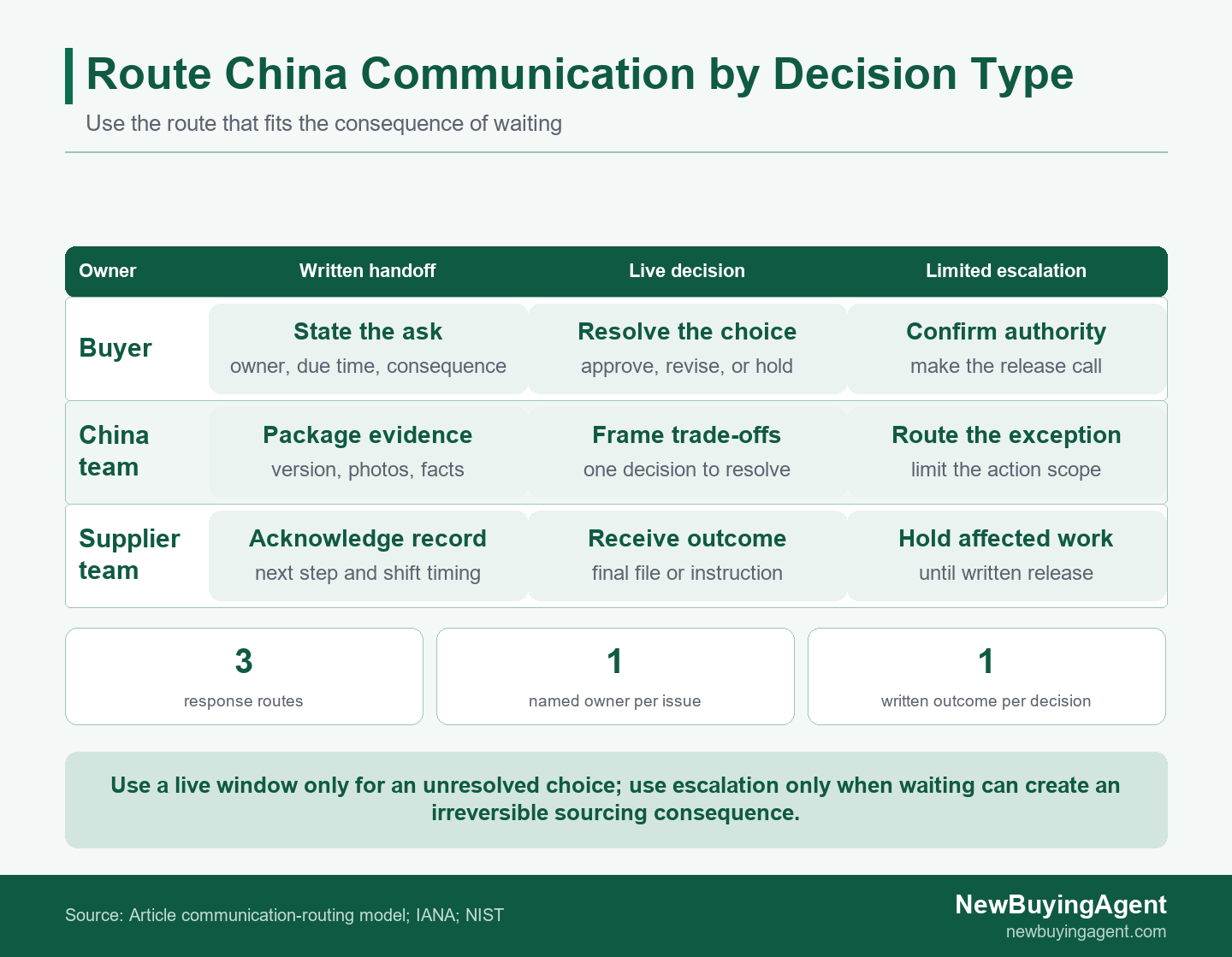
Swimlane diagram showing buyer, China-side coordinator, and supplier responsibilities for written handoffs, live decisions, and limited escalations.
The moving part is usually the buyer’s local offset. The IANA Time Zone Database is maintained to reflect civil time and daylight-saving rules as they change. In the United States, NIST sets out the federal daylight-saving pattern: the second Sunday in March to the first Sunday in November. Europe uses a different framework; the European Commission’s record of EU summer-time arrangements describes last-Sunday March and October changes under the current framework. US and European local offsets can change during daylight-saving periods while China remains on UTC+8.
Do not turn those facts into a permanent conversion table. A buyer may work from a city with its own local schedule, and a China factory may run production, engineering, or export documentation on different shifts. The useful operating instruction is more modest: keep the named live window in the shared calendar with its local time zones visible, and review it before a daylight-saving change. Include the escalation contacts in that review; an old emergency number in the right time zone is still an operational failure.
| Planning question | A usable answer | Why it matters |
|---|---|---|
| What is the China-side reference? | China Standard Time and the supplier’s agreed workday | It prevents a meeting plan built on an assumed shift. |
| What changes seasonally? | The US or European buyer’s local offset | The overlap can move even when China’s clock does not. |
| What belongs in the calendar? | One protected decision window and one review date | It gives teams a dependable place to resolve exceptions. |
Use Live Overlap for Decisions, Not Status Reading
Use shared time for a decision that cannot be safely resolved by a written record. Typical candidates are a final sample trade-off, a cost-versus-specification choice, a buyer approval that changes a production step, a shipment-release question, or an exception where the supplier’s evidence raises a new question. In each case, the group needs simultaneous access to the same evidence and a person who can make or confirm the decision.
Routine work does not need that scarce capacity. A factory can send photos of a completed inspection point, a count of finished cartons, or a revised production estimate in writing. The buyer can acknowledge it when the local day begins. The difference is not urgency alone. The difference is whether the update leaves a real choice unresolved.
The US and Europe Need Different Windows
US and European teams need separate protected decision windows with China. A European product or procurement team can often use a portion of its local morning against China’s later working day. A US team may face a shorter window near the edge of one side’s workday and should decide deliberately whether a particular milestone justifies that arrangement. Neither pattern should become an unspoken requirement for indefinite after-hours work.
When a project has both US and European stakeholders, do not solve the problem by forcing all three regions into every conversation. Assign one buyer-side decision owner for the milestone, then let other stakeholders provide their evidence before the window. A brief decision log after the call gives the absent region a verified outcome without creating a second discussion cycle.
Bring the Unresolved Choice, Not a Meeting Agenda
Bring the source version, options, owner, and deadline to the live decision window. The meeting should begin with a visible choice: approve version B, return to version A, accept the revised delivery date, or hold a release while a named person checks a missing requirement. A long agenda that starts with background forces the most expensive part of cross-time-zone coordination to reproduce information that should already be written down.
End the live window with a written confirmation. State the decided version, the owner of the next step, the date and time of the next supplier action, and the condition that would reopen the decision. This is not bureaucracy for its own sake. It is what allows the China-side team to act after the buyer’s day ends without guessing which spoken point prevailed.
Make the Asynchronous Handoff Decision-Ready
Put the version, evidence, owner, requested decision, and deadline in one written handoff. An asynchronous handoff means a written record that lets the next person act without a simultaneous meeting. The five fields remove the usual sources of delay: a photo without a SKU, a drawing without a revision date, an unanswered question without a named approver, or an urgent request without a deadline.
- Source version: identify the drawing, artwork, sample, purchase order, or packing file that governs the question.
- Evidence: attach the photo, measurement, supplier explanation, count, or marked comparison that shows what changed.
- Owner: name the person who can approve, reject, or delegate the next decision.
- Requested decision: write the choice in a form that can be answered directly, rather than asking for “feedback.”
- Deadline and consequence: state when a reply is needed and what work pauses if no answer arrives.
For buyers already working with China factories, that structure gives a local operating team something concrete to follow up. Ask NewBuyingAgent to manage your China factories when the need is China-side coordination of existing supplier communication, production progress, quality work, and logistics information. The commercial decision still belongs to the buyer; the value of the operating record is that the relevant China-side facts arrive together.
A useful handoff also has a closing condition. For example: “If the buyer has not approved this carton artwork by the agreed China-side deadline, keep printing on hold and send one updated status record.” This is more reliable than “Please reply ASAP,” because it tells the supplier what to do while the decision owner is offline. It also makes a true escalation easier to recognize.
Define Escalation Before a Problem Arrives
Escalate only when waiting risks an irreversible consequence. In a sourcing context, that might be a production step that cannot be undone, a safety issue, a shipment-release decision, a booking deadline that will materially change the plan, or a customer commitment that requires immediate buyer authority. A late photo, a routine price question, or a status update that can be documented is normally a handoff, not an after-hours interruption.
The boundary is deliberately narrow. The UK Health and Safety Executive notes that poorly designed work patterns and insufficient rest can contribute to fatigue and lower performance in its guidance on fatigue. That does not turn this sourcing article into workplace policy. It does reinforce a practical point: if every follow-up is called urgent, the team loses the attention needed for the exception that really cannot wait.
Write the escalation rule as one sentence that includes the trigger, first contact, backup contact, and temporary action. For instance: “If printing must start before the buyer’s next protected decision window and the approved artwork is unresolved, contact the named release owner; if no confirmation is available, hold the print.” The rule does not promise instant answers. It prevents silence from being misread as approval.
A DST Change Is a Process Test, Not Just a Calendar Error
Use each daylight-saving change as a review point for the China communication rule. One week before a relevant change, confirm the protected decision window in both locations, check whether the escalation contact is still the right person, and make sure supplier-facing deadlines show a date, local time, and time zone. A transition week is exactly when a latent ownership problem becomes visible.
The review should be short. Do not recalculate every supplier relationship from scratch. Confirm only the live window, standing milestone calls, escalation boundary, and the format of time-sensitive handoffs. If a product team works across the US and Europe, state which buyer-side owner has authority during the weeks when the two regions change clocks on different dates. That one line can prevent a factory from waiting for a reply from three people who each assume someone else is awake.
Illustrative: Hold the Print, Then Resolve the One Decision That Matters
A production-deadline example shows why the communication route must be explicit before the next supplier shift. The following is illustrative, not a customer case. It uses a carton-mark issue because printing converts an unresolved artwork question into a decision that becomes harder to reverse. Buyers who want to see how sourcing work is handled across different situations can also Review NewBuyingAgent success stories.
The Print Hold Preserves the Decision
A New York procurement lead and a Berlin product manager are coordinating an illustrative 2,400-unit furniture accessory order. Near the end of the supplier’s China workday, the factory sends a revised carton-mark image and asks whether printing may begin on the next shift. The image has a version number and the supplier has stated the print deadline, but the release owner and the meaning of one mark are not aligned. Hold the print until the named owner resolves the remaining release decision.
The weak response would be to begin a broad group call and hope that all participants join. It may consume time without producing authority, especially during a daylight-saving transition. The stronger response is to use the written handoff immediately: link the exact artwork, include the marked image, identify the open point, name the release owner, and state the print deadline. Because printing is the irreversible action, the temporary instruction is to hold it.
The protected live window then has one job: resolve the remaining release choice. It does not revisit the whole order. The buyer-side owner either approves the specified artwork, sends a corrected version, or confirms that printing remains on hold. The factory receives the result in writing with the final file version and the next action. That gives the supplier an instruction it can execute and gives the New York and Berlin team one recorded outcome.
Before printing restarts, the team confirms the approved artwork version and print-release instruction in writing. This is an illustrative operations example, not compliance or legal advice.
Set the Communication Rule Before You Request a China Quote
Put an owner, milestone, handoff format, and escalation boundary into the sourcing brief. A quote request is stronger when the China-side team knows not only the product, quantity, target market, and timing, but also who can answer a sample, packaging, production, or release question and how the answer should be documented.
That is a natural fit for a sourcing partner with local China factory resources and operating support. For a new product requirement, ask NewBuyingAgent to supply products from China after the buyer has made its product brief and decision rule clear. NewBuyingAgent can support China-side sourcing, supplier communication, production follow-up, quality control, and logistics coordination; the buyer should still keep its internal commercial approval authority explicit.
Before the first supplier conversation, write one compact rule: “The buyer-side owner for this milestone is [name]. Routine updates use [format]. Decisions affecting [sample, price, artwork, production, or release] go into the protected live window. Only [defined consequences] use escalation.” If those blanks are still unknown, the project is not ready for a communications schedule. If they are known, send your sourcing brief to NewBuyingAgent with the product context, milestone, and preferred handoff format.
Frequently Asked Questions
What is the best time for a US buyer to call China suppliers?
The best time is a protected overlap chosen for a decision that cannot wait for a written handoff, not a daily status call. The exact hour depends on the US location, the China supplier’s agreed workday, and the season. Choose one recurring window for milestones that need buyer authority, then send routine evidence in writing. If the only workable slot is outside normal hours, reserve it for consequential decisions rather than making it the default for every supplier update.
How should European buyers schedule live decisions with China?
European teams should protect a short China-afternoon decision window and send the full written record before China starts work. The window is for choices that need clarification, trade-offs, or approval authority. A buyer with both European and US stakeholders should name one owner for the milestone instead of requiring every participant to attend. Review the calendar before the European clock change, because the relationship to China can shift while China’s civil clock remains stable.
Why do US and EU calls with China shift during daylight saving time?
The calls shift because China’s clock reference remains UTC+8 while US and European daylight-saving schedules alter their local offset from UTC. The United States and Europe do not make those changes on the same annual dates, so a meeting that worked in one week may land an hour earlier or later in another. The practical fix is a calendar review with named owners, not a permanent time-difference rule copied into an email thread.
What should count as an after-hours sourcing escalation?
Treat an issue as an escalation only when waiting risks an irreversible production, safety, shipment-release, or customer-commitment consequence. The message should identify the exact trigger, the source version, the named owner, the deadline, and the temporary action if no answer arrives. Do not label ordinary status requests as urgent. A narrow rule protects attention for the moment when an unstructured delay would turn into a costly or difficult-to-reverse decision.
NewBuyingAgent
Related Resources



Get Started Today
Let's Turn Your Sourcing Goals into RealityWeChat:+86 15157124615
WhatsApp:+86 15157124615
Address:Building 10 #39 Xiangyuan Road, Hangzhou, China