

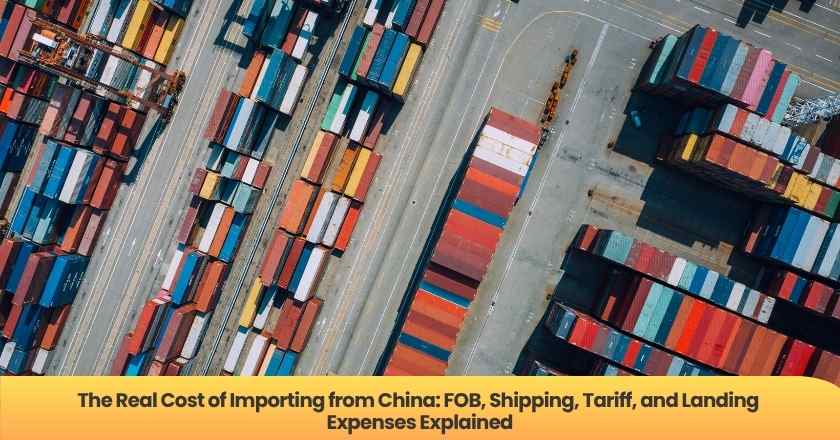
The factory quotes you $4 a unit, you price it at $20, and the margin looks beautiful on the spreadsheet. Then the freight invoice lands, the duty bill arrives, the port charges appear, and that $4 unit has quietly become $7 sitting in your warehouse. The gap between the quoted price and what the goods actually cost you is where new importers watch their profit disappear.
The real cost of importing from China is the landed cost — every expense from the factory floor to your door — and the FOB price is only the first line of it. Knowing each layer, and where the surprises hide, lets you price for the margin you actually keep rather than the one you hoped for. If you want clear visibility into total landed cost instead of sorting through messy scattered invoices, NewBuyingAgent acts as your local China-based procurement partner to oversee end-to-end sourcing, cost verification and door-to-door logistics under unified cost tracking.
Key Takeaways
• Price your products on landed cost, not the FOB quote, because freight, duties, and fees commonly add a substantial share on top.
• Understand what your Incoterm includes, since FOB and CIF draw very different lines on who pays for which leg.
• Confirm your tariff classification early, as the wrong HS code can swing your duty bill and trigger back-charges.
• Account for the small fees that add up — port, documentation, customs brokerage, and last-mile delivery rarely appear in a supplier quote.
• Build a buffer for 2026 volatility in freight rates and exchange, so a rate spike doesn't erase a thin margin.
Starting Point: What the FOB Price Actually Covers
Most China quotes you receive are FOB, and beginners often treat that number as the cost of the goods. It isn't — it's the cost of the goods plus a defined slice of the journey, and nothing beyond it. Understanding exactly where FOB stops is the foundation for everything else.
What FOB includes
FOB (Free On Board — the supplier delivers the goods, cleared for export, loaded onto the vessel at the Chinese port) covers the product, domestic transport to the port, export clearance, and loading. From the moment the goods are aboard, cost and risk pass to you. That handoff point is what makes FOB clean to budget around.
What FOB leaves out
Ocean freight, insurance, destination port charges, customs duties, brokerage, and last-mile delivery are all on you. None of these appear in the FOB number, yet together they often rival or exceed the freight portion you expected. The quote is a starting line, not a finish line.
Comparing quotes fairly
When you compare suppliers, confirm every quote uses the same Incoterm. A FOB quote and a CIF quote aren't comparable on their face, since CIF folds freight and insurance into the number. Normalize to the same basis before you decide which factory is actually cheaper.
Expert Tip: When comparing a FOB quote against a CIF quote, always strip both back to the same basis before judging which is cheaper. Suppliers know buyers anchor on the headline number, and a CIF quote that looks competitive can hide an inflated freight margin baked into it. Ask the CIF supplier to break out the goods cost separately, or convert everything to FOB plus your own freight estimate. The factory with the lower FOB is frequently the genuinely cheaper one once the freight padding is removed.
Shipping Costs: The Variable That Moves the Most
Freight is the cost line that swings hardest and surprises most often. It depends on mode, volume, route, and timing, and in 2026 it remains less predictable than buyers would like. Treating it as a fixed estimate rather than a live variable is a common budgeting error.
Sea freight basics
For bulk orders, sea freight dominates. You’ll ship either a full container load (FCL) or, for smaller volumes, less than container load (LCL — sharing container space with other shippers and paying by volume). LCL suits small first orders; FCL becomes cheaper per unit once you fill most of a container.
How freight is priced
Carriers price by volume for light goods and by weight for dense ones, whichever yields more. The carton dimensions your factory uses can therefore move your bill noticeably. Confirm real packed measurements before booking, because an early estimate based on guessed dimensions often understates the true freight.
Air and express for the right cases
Air freight and courier express cost far more per unit but make sense for samples, small high-value goods, or urgent restocks. Most importers default to sea and use air sparingly. The premium is rarely worth it for routine bulk, but occasionally worth every cent for a time-critical launch.
Common Mistake to Avoid: Budgeting freight from an early ballpark figure and never updating it before you ship. Ocean rates move with season, route, and capacity, and the packed dimensions of your cartons can shift the bill substantially. Buyers who lock a selling price around a months-old freight estimate sometimes find the actual cost has climbed enough to erase their margin. Get a fresh quote on real packed dimensions and weight right before booking, and price with a buffer for movement.
Tariffs and Duties: The Cost You Can't Negotiate
Unlike freight or unit price, you can't haggle your way out of duties — they’re set by your government and your product's classification. What you can do is know them in advance, classify correctly, and budget accurately. Surprises here usually trace back to skipping that homework.
Classification drives everything
Every product carries an HS code (Harmonized System code — the international classification number that determines your duty rate). The code sets the percentage you pay, so confirming it before you import is essential. A wrong classification can mean overpaying, or underpaying and facing back-charges and penalties later.
Calculating the duty
Duty is generally charged on the customs value of the goods, often the FOB or CIF value depending on your country's rules. A few percent on a large order is real money, so fold the duty into your landed cost from the start. Treat it as a known input, not an afterthought at the port.
Trade policy shifts in 2026
Tariff rates and trade measures on Chinese goods have shifted repeatedly in recent years, and 2026 is no exception in some categories. Check the current rate for your specific product near the time you import rather than relying on a figure you saw a year ago. Policy volatility makes recency matter here.
Expert Tip: Verify your product’s exact HS classification with a customs broker before your first shipment, rather than trusting the code a supplier writes on the invoice. Suppliers sometimes use whichever code is convenient or familiar, and an incorrect one can mean you overpay duty for years or face a costly reclassification and penalty when customs catches it. A short paid consultation to confirm the right code is among the cheapest insurance in the whole import process.
The Landing Expenses Nobody Quotes You
Between the port and your shelf sits a cluster of smaller charges that no supplier mentions and many importers forget. Individually they look minor; collectively they can add a meaningful percentage to your landed cost. These are the fees that turn a healthy-looking margin thin.
Port and terminal charges
Destination ports levy handling, terminal, and sometimes container or chassis fees. These vary by port and aren’t in your FOB quote. Ask your freight forwarder for an itemized estimate of destination charges so they don’t appear as a surprise after the goods arrive.
Customs brokerage and documentation
A customs broker charges to clear your goods and file paperwork, and documentation fees attach along the way. For a first import these are well worth paying, but they’re real costs to include. A clean clearance is cheaper than the delays a self-managed mistake creates.
Last-mile delivery and storage
Getting goods from the port to your warehouse — trucking, and any storage or demurrage if you're slow to collect — is the final layer. Demurrage in particular punishes delay, so plan collection before the container lands. A door-to-door service like NewBuyingAgent folds these last legs into one managed cost rather than a string of separate bills.
Common Mistake to Avoid: Building your selling price on FOB plus freight alone, ignoring destination port charges, brokerage, last-mile delivery, and potential storage fees. These landing expenses are easy to forget because no one quotes them upfront, yet together they can add a real slice to your landed cost. Importers who price without them discover their margin is thinner than planned only after the goods are sold. List every fee from factory to warehouse before you set a price. NewBuyingAgent gives buyers one accounted figure from factory to door, and its 50,000+ factory network typically cuts total costs 5–10% even after its margin.
Putting It Together: Calculating True Landed Cost
Landed cost is the single number that tells you what a unit really costs delivered, and it’s the only honest basis for pricing. Assembling it is simple arithmetic once you’ve gathered every line. The discipline is refusing to price on anything less complete.
The landed cost formula
Add the FOB goods cost, freight, insurance, duties, port and brokerage fees, and last-mile delivery, then divide by units to get landed cost per piece. That per-unit figure, not the FOB quote, is what your selling price must clear with margin to spare. Everything cheaper is an illusion.
Build in a volatility buffer
Freight rates and exchange rates both moved unpredictably through recent years, and 2026 hasn’t fully settled. Add a buffer — a few percent — so a rate spike between order and arrival doesn’t erase a thin margin. Pricing to the exact estimate leaves no room when reality wobbles.
Reprice as you scale
Per-unit landing costs usually fall as you move from LCL to full containers and from air-shipped samples to sea-freighted bulk. Recalculate landed cost at each volume tier rather than carrying forward an old number. The economics that justified a price at 500 units often improve sharply at 5,000.
Expert Tip: Build your landed-cost calculation as a living spreadsheet with every line itemized — FOB, freight, insurance, duty, port fees, brokerage, last-mile — rather than a single blended estimate. When any one input moves, you see immediately how your true per-unit cost and margin respond. Importers who track cost this granularly spot which lever to pull when margins tighten, whether that’s renegotiating FOB, switching to FCL, or reclassifying for a lower duty. A blended guess hides all of that.
Frequently Asked Questions
How much more than the FOB price should I expect to pay?
It varies widely by product weight, value, route, and duty rate, so there’s no universal multiplier. Freight, duties, and landing fees can add anywhere from a modest fraction to more than the FOB price itself for low-value, bulky goods. The reliable approach is to itemize every line into a landed cost rather than applying a rule of thumb.
Is CIF cheaper than FOB plus my own freight?
Often not. CIF folds freight and insurance into the supplier’s quote, and suppliers frequently add a margin on that portion. FOB plus your own freight forwarder usually gives lower cost and full visibility into what you’re paying to ship. Compare them on the same basis by asking the CIF supplier to break out the goods cost separately.
How do I find my product's import duty rate?
Your duty is set by your product’s HS code in your destination country's tariff schedule. Confirm the correct code with a customs broker rather than trusting the supplier’s invoice code. Because rates on Chinese goods have shifted in recent years, check the current figure near your import date instead of relying on an older number.
What hidden fees catch first-time importers?
The usual culprits are destination port and terminal charges, customs brokerage, documentation fees, last-mile trucking, and demurrage if collection is slow. None appear in a supplier's FOB quote, so they’re easy to omit from a price. Ask your freight forwarder for an itemized destination-charge estimate before you set your selling price.
Should I buy cargo insurance?
In most cases, yes — marine cargo insurance is inexpensive relative to the value of a lost or damaged shipment, and under FOB the risk during ocean transit is yours. The premium is a small, predictable line against an unlikely but potentially total loss. Treat it as a routine landed-cost item rather than an optional extra.
Conclusion
The FOB quote is the opening line of your cost story, never the whole of it. Freight, duties, port charges, brokerage, and last-mile delivery stack into a landed cost that’s the only honest number to price against — and 2026's rate volatility argues for a buffer on top. Build the calculation once, line by line, and your margins stop surprising you. If you'd value one accounted process from factory to door rather than a pile of separate invoices, that's the kind of clarity NewBuyingAgent is built to provide. Serving as an extension of buyers' teams instead of a regular vendor, it takes full charge of sourcing, negotiation, QC and logistics with zero hidden markup. Drawing on its 50,000+ factory network, it prices based on genuine landed cost and cuts total procurement spend by 5–10%. Contact now.
NewBuyingAgent
Related Resources
Get Started Today
Let's Turn Your Sourcing Goals into RealityWeChat:+86 15157124615
WhatsApp:+86 15157124615
Address:Building 10 #39 Xiangyuan Road, Hangzhou, China
