

Hassle-free China sourcing is a managed procurement model where the buyer stops handling daily factory conversations but still controls the product brief, budget, sample approval, quality evidence, and delivery decision.
The most expensive mistake in hands-off sourcing is confusing less communication with less control. A buyer can stop chasing messages, translating packaging notes, and checking production photos every night, but the buyer cannot hand over the commercial decisions that shape the order. The practical goal is narrower and stronger: keep the decisions that protect the brand, and delegate the China-side work that drains time.
That distinction matters in 2026 because buyers are rarely sourcing a single anonymous item. Even a simple private-label product may involve material choices, packaging artwork, destination-market labeling, carton dimensions, inspection timing, and a delivery term that changes who pays what. The International Trade Administration's Incoterms guidance explains that trade terms allocate shipment, insurance, documentation, customs clearance, and other logistics tasks. If those items are not fixed early, a buyer can save a few hours of communication and lose far more time later when the shipment cannot be released cleanly.
The buyer's playbook is therefore not "send a picture and wait." It is a controlled handoff. The buyer defines the requirement, reviews the quote, approves the sample path, receives quality evidence, and confirms the delivery logic. NewBuyingAgent can then manage product selection, cost negotiation, quality management, production follow-up, and logistics as one procurement process, instead of leaving the buyer to coordinate each factory-facing task alone.
The Real Meaning of "Without Touching Factories"
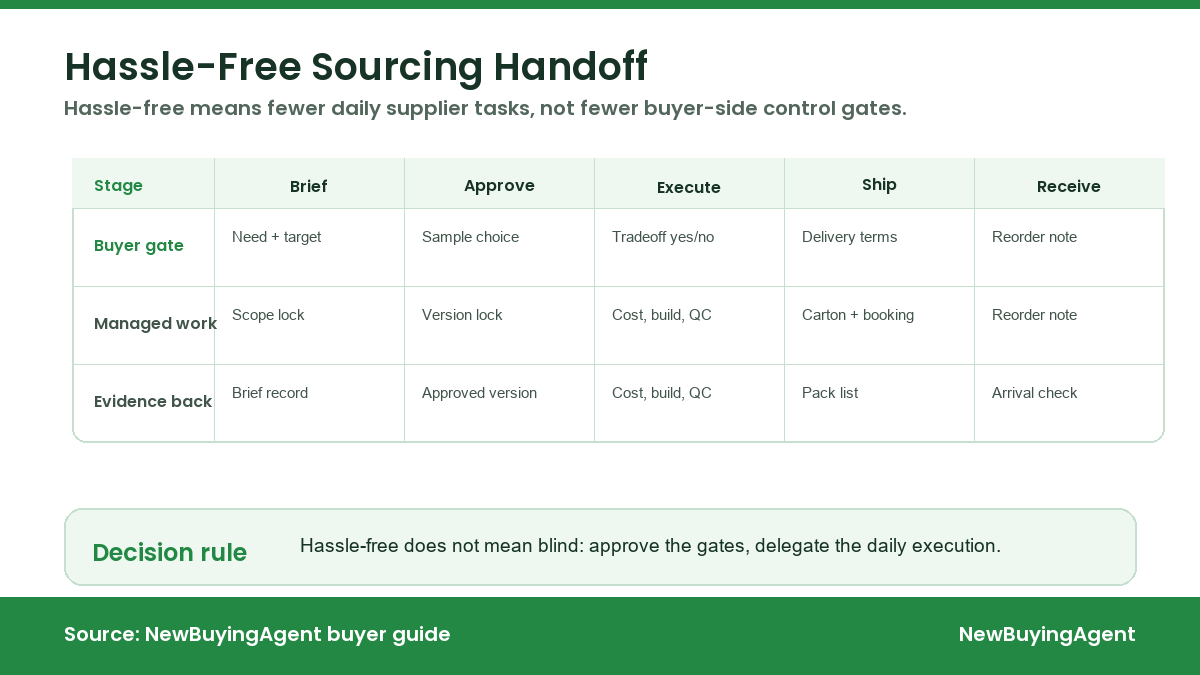
Without touching factories means the buyer no longer needs to run the factory-facing conversation, not that the buyer becomes blind to the order. A strong sourcing partner should remove translation work, quote chasing, sample reminders, production follow-up, QC coordination, and shipping handoff from the buyer's calendar. It should not remove product decisions, acceptance standards, budget limits, or timing priorities.
This is where many first attempts go wrong. A buyer asks for "the same as this photo," receives a low quote, pays for samples, and then discovers that the material weight, packaging style, cable length, finish tone, or carton size was never truly defined. The factory may not be dishonest. It may simply have priced the cheapest interpretation of a vague request. The buyer then spends the next month repairing ambiguity that should have been removed before the quote.
The better model starts with buyer inputs that are concrete enough to support a real quote. These inputs include product specs, intended use, order volume, target price, destination market, packaging needs, compliance concerns, delivery timing, and acceptable substitutions. Once those are defined, China-side execution can be delegated with less risk because the work is no longer based on guessing.
NewBuyingAgent fits this model when the buyer wants to source from China but does not want to personally manage factory communication. Buyers send purchasing needs, including product specs, volume, target price, destination, and timing. NewBuyingAgent prepares a quote and manages product selection, cost negotiation, quality management, production follow-up, and logistics through final delivery.
Five Decisions the Buyer Should Still Keep
A hands-off process still needs decision gates because the buyer owns the market outcome. If the product fails, arrives late, or lands at the wrong cost, the market does not care that factory communication was outsourced. The buyer needs clear points where a decision is requested, the evidence is specific, and the next action is obvious.
1. The Product Brief Gate
The product brief is the first control point because it converts a vague idea into a purchasable requirement. A useful brief does not need to be a perfect engineering file. It does need to answer what the product is, where it will be sold, what volume is expected, what price band can work, what packaging matters, and when the order must be available. For repeat products, buyers should add the current sample, photos of defects, target improvements, and any packaging or labeling files that must not change.
A weak brief shifts work downstream. The quote may look fast, but the sample conversation becomes slow because every detail needs to be reopened. A strong brief makes the first quote more meaningful because the price is tied to a product version, not a guess. For buyers using NewBuyingAgent, this is also the point where the brand can judge whether the project is a fit for managed procurement rather than daily DIY coordination.
2. The Quote Gate
The quote gate is where buyers should check whether the offer matches the business model, not only whether the unit price is attractive. A low FOB quote can still fail if packaging is excluded, QC is not planned, shipment terms are unclear, or the product uses a downgraded material. The buyer should ask what is included, what is assumed, what can change at higher quantity, and what would trigger a price revision.
For many buyers, the safest quote decision is not choosing the lowest number. It is choosing the quote that is specific enough to survive sampling and production. The World Customs Organization's Harmonized System overview is a reminder that product identity affects classification and trade handling; if the product description is loose, commercial and import decisions can become loose as well.
3. The Sample Gate
The sample gate protects the order from silent compromise. Buyers should approve a sample against measurable points: size, weight, material, color tolerance, logo placement, finish, function, packaging, accessories, manuals, and carton marks. A sample approval message should not say only "approved." It should say what version is approved and what must be corrected before production.
This matters because factory teams may treat a sample as a sales object unless production requirements are frozen. A beautiful sample that uses hand-selected material, special packing, or a nonstandard component can create a false sense of readiness. A buyer who wants a hassle-free process should still ask for sample evidence that can be transferred into production instructions.
4. The Production Gate
The production gate is where the buyer should receive clear progress signals without joining every factory conversation. Useful signals include material readiness, packaging proof, production start, mid-production photos, issue alerts, rework decisions, and expected inspection timing. This stage should not be a stream of random images. It should show whether the order is moving according to the approved sample and purchase requirements.
An illustrative workload calculation shows why this gate matters. If a buyer follows four factories, sends three follow-up messages per factory per week, and spends twenty minutes per follow-up for six weeks, that is 24 hours of factory-facing follow-up before counting translation, rework, or freight exceptions. The buyer may think the cost of DIY is zero, but the hidden cost is often senior attention spent on avoidable coordination.
5. The Release Gate
The release gate is the final moment when quality, packaging, carton marks, quantity, and delivery terms must line up. For consumer goods, buyers often use sampling inspection to decide whether a lot is acceptable. The ISO 2859-1:2026 standard page describes AQL-indexed sampling plans for inspection by attributes. The practical takeaway is simple: inspection should be planned before production finishes, not invented after goods are packed.
Release evidence should answer five plain questions. Is the approved product version being shipped? Is the quantity correct? Are defects within the agreed tolerance? Are packaging and labels correct for the destination market? Are the shipping documents and delivery responsibilities clear? If the buyer cannot answer those questions, the process is not truly hassle-free. It is only delayed stress.
A Practical Handoff Checklist
The handoff checklist below turns hassle-free sourcing into a working process. It separates buyer decisions from China-side execution so that control is not lost when communication is delegated.
| Gate | Buyer Should Provide | NewBuyingAgent Handles | Decision Output |
|---|---|---|---|
| Brief | Specs, volume, target price, market, timing | Requirement review and quote preparation | Purchasing need is clear enough to price |
| Quote | Commercial limits and must-have features | Product selection and cost negotiation | A quote tied to a defined product version |
| Sample | Approval comments and correction rules | Sample follow-up and production translation | Approved reference for production |
| Production | Change approval and priority decisions | Production follow-up and quality management | Issues caught before shipment pressure |
| Release | Acceptance threshold and destination needs | QC coordination and logistics handoff | Ship, rework, hold, or adjust delivery |
The important point is sequence. Do not ask for hassle-free sourcing after the order is already late, the sample is unclear, and the packaging files are still changing.
When Hassle-Free Sourcing Is Worth It
Hassle-free sourcing is most valuable when the order has enough complexity that coordination itself becomes a risk. A buyer sourcing a basic off-the-shelf product for a trial order may be able to manage direct messages. A buyer dealing with private label packaging, multiple SKUs, seasonal timing, product changes, or retailer requirements usually needs a more controlled process.
The threshold is not only order value. It is the cost of mistakes. If one incorrect carton mark delays delivery, one material substitution changes customer reviews, or one late inspection forces air freight, the buyer may spend more than the service cost trying to recover. This is why the right question is not "Can the buyer contact factories?" The better question is "Can the buyer afford to personally manage every factory-facing risk until delivery?"
Buyers should also consider internal time. A founder, category manager, or sourcing lead who spends ten hours a week chasing production cannot spend that time on assortment planning, sales channels, merchandising, or customer feedback. The cost of DIY sourcing is not only the direct sourcing bill. It is the growth work that gets delayed because the team is stuck managing messages.
A Delegation Readiness Test for Hassle-Free Sourcing
Hassle-free sourcing should begin only after the buyer knows which decisions must never be guessed. A buyer does not need to write a factory manual, but it does need to separate flexible preferences from commercial non-negotiables. Flexible preferences can be optimized during quote preparation. Non-negotiables need buyer approval before sample, production, and shipment release.
The readiness test has three questions. First, can the buyer describe the product well enough that two different teams would quote the same version? Second, can the buyer say which changes require approval before production? Third, can the buyer define what evidence is needed before shipment? If the answer is no, the project is not ready for a quiet handoff.
What Should Stay Flexible
Some sourcing variables should remain flexible because they can improve price, timing, or product fit. A buyer may be open to a different packaging insert, similar fabric weight, adjusted carton size, alternative accessory arrangement, or a nearby target price if the overall product still fits the market. These flexible areas give the sourcing team room to prepare a better quote without turning every small choice into a buyer meeting.
The buyer should mark these items as adjustable in the brief. That small step prevents false conflict later. If the buyer says the carton style is flexible, NewBuyingAgent can manage the packaging discussion as part of the quote and production process. If the buyer says the brand color is not flexible, that point should be protected through sample approval, packaging proof, and QC evidence.
What Should Never Be Guessed
Other variables should never be guessed because they affect market acceptance, safety, delivery, or brand trust. These include the product's intended use, destination market, must-have material, visible logo, retail packaging language, launch date, acceptable defect limits, and any known compliance concern. The buyer should also flag customer-facing details that may look small to a factory but matter to the brand, such as color tone, surface finish, accessory count, carton marks, or manual language.
This distinction is the practical heart of hands-off sourcing. The buyer does not need to manage the daily factory conversation, but it must tell the sourcing partner which decisions are business-critical. When those decisions are clear, NewBuyingAgent can manage product selection, cost negotiation, production follow-up, quality management, and logistics without asking the buyer to chase every message.
A Simple Handoff Scenario
Suppose a buyer wants a private-label storage product before a retail launch. The adjustable points may include inner carton arrangement, accessory bag position, or an alternative material within the same performance level. The non-negotiables may include outside dimensions, logo color, packaging language, target landed cost, and delivery date. If those points are marked before quote approval, the sourcing process can move quickly while still protecting the launch.
If those points are not marked, the buyer may receive frequent questions that feel like factory noise. The real problem is not too many messages. The problem is that the project has not separated commercial decisions from execution details. A hassle-free process becomes possible only when that separation exists.
When the Buyer Should Slow Down the Handoff
A buyer should slow down the handoff when the product idea is still changing, the destination market is unclear, or the target price is not connected to a real product version. Moving too fast at this stage does not create a hassle-free process. It moves uncertainty into sampling, production, and shipping, where corrections become more expensive.
There are three common warning signs. The first is a brief built only from product photos with no size, material, usage, or packaging detail. The second is a target price that assumes the cheapest version without saying what can be downgraded. The third is a delivery date that ignores sample corrections, production lead time, QC, and ocean freight. When these signs appear, the buyer should spend one more round clarifying the brief.
How to Review a Managed Quote
A managed quote should be reviewed as a decision document, not as a price line. The buyer should check the product version, included packaging, assumed quantity, lead time, delivery term, quality-control plan, and open assumptions. If the quote includes an alternative material or a different packaging structure, that change should be judged against the buyer's market, not only against the price.
This is where hassle-free sourcing becomes a disciplined buying method. The buyer is not chasing factories, but it is still reviewing the decisions that shape the final product.
How to Know the Process Is Working
A hassle-free sourcing process is working when the buyer receives fewer messages but better decisions. The buyer should see a clear quote, a sample correction record, production status at meaningful moments, QC evidence before release, and a logistics handoff that matches the agreed delivery term. The buyer should not need to ask repeatedly what is happening or whether the approved sample is still the production standard.
The strongest signal is that problems become visible early. A packaging issue appears before cartons are printed. A material substitution is approved or rejected before production starts. A quality issue is found before the shipment is under pressure. A delivery-term question is settled before documents are prepared. That is the difference between real procurement ownership and ordinary message forwarding.
What to Send Before Requesting a Quote
A clear quote request makes the whole process faster. Before contacting NewBuyingAgent, buyers should prepare a short but concrete purchasing brief rather than a long, uncertain message.
- Define the product: photos, drawings, dimensions, materials, finish, function, and must-not-change details.
- State the commercial target: expected volume, target unit price, launch window, and whether this is a trial or repeat program.
- Explain the market: destination country, sales channel, packaging language, and any known safety or labeling requirements.
- Share the current problem: high price, unstable quality, slow factory replies, packaging errors, late shipment, or too many SKUs to manage.
- Ask for a managed quote: request product sourcing, cost negotiation, quality management, production follow-up, and logistics as one process.
Buyers who already know the destination and target price should contact NewBuyingAgent with the product requirements. Buyers who are still defining the service scope can first review what NewBuyingAgent does and decide whether the order needs full procurement ownership or a narrower factory-management arrangement.
Who Is NewBuyingAgent?
NewBuyingAgent is a one-stop China sourcing agent for global buyers that want to source products from China without managing factory conversations, production follow-up, quality control, and logistics themselves.
Backed by 30 years of trade, manufacturing and quality control experience, NewBuyingAgent supplies products that meet buyers’ purchasing requirements. Buyers share their purchasing needs, and NewBuyingAgent handles product selection, cost negotiation, quality management, and logistics—delivering goods that satisfy market demand, ship on schedule, and safeguard the buyers’ bottom line.
Its sourcing network includes 50,000+ partner factories and 20,000+ product development & QC experts. NewBuyingAgent uses that network internally to supply products from China across categories at better price, quality, and service, while buyers avoid managing daily factory communication themselves.
Frequently Asked Questions
Can a buyer source from China without talking to factories?
Yes, a buyer can source from China without daily factory communication if the product brief, quote assumptions, sample approval, quality standard, and delivery terms are clearly managed. The buyer still needs to make commercial decisions and approve evidence at key gates. NewBuyingAgent can handle product selection, cost negotiation, production follow-up, QC coordination, and logistics after the buyer shares the purchasing need.
What should I prepare before asking for a China sourcing quote?
Prepare product photos or drawings, target quantity, target price, destination market, packaging needs, delivery timing, and any known quality or compliance concerns. A short, specific brief is better than a vague request because it reduces quote changes later. If there is an existing sample or failed order, share the defect photos and correction notes as well.
Does hassle-free sourcing mean the buyer loses control?
No, hassle-free sourcing should reduce factory-facing work while preserving buyer control over product, cost, quality, and delivery decisions. The buyer should approve the product version, sample corrections, acceptance rules, and shipment release logic. The sourcing partner should manage the execution between those gates and report issues early enough for decisions to matter.
When is managed sourcing better than direct factory contact?
Managed sourcing is usually better when the order involves private labeling, several SKUs, strict launch timing, recurring quality problems, or limited buyer-side China capacity. Direct contact may work for simple trial purchases, but it becomes costly when the buyer must chase quotes, translate changes, monitor production, arrange inspection, and coordinate shipping alone.
NewBuyingAgent
Related Resources

Get Started Today
Let's Turn Your Sourcing Goals into RealityWeChat:+86 15157124615
WhatsApp:+86 15157124615
Address:Building 10 #39 Xiangyuan Road, Hangzhou, China
