

Key Takeaways
- Risk: 2026 China import risk starts before shipment, because HTS classification, Section 301 exposure, certificates, marking, documents, and carton data all affect release.
- Decision: Importers should build a control file that links product version, duty assumptions, safety evidence, Incoterms, and shipment identity before paying the balance.
- NewBuyingAgent fit: NewBuyingAgent is relevant when compliance risk affects the supplied product outcome: specs, labeling, packing, documents, quality evidence, and delivery reliability.
Why 2026 Compliance Risk Starts Before Shipment
A China importer in 2026 should treat compliance as an order-design issue, not a customs surprise at the port. The product version, HTS classification, country-of-origin marking, safety certificate, carton identity, Incoterm, and document wording should be checked before production release. If those items are left until shipment week, the buyer may have already lost the ability to change material, labeling, packaging, routing, or payment timing.
The risk is no longer one simple checklist. The USITC Harmonized Tariff Schedule remains the classification reference, while the Federal Register notice modifying Section 301 actions shows that tariff actions and product coverage can change after a buyer's previous quote file was created. This means buyers should not copy last year's tariff assumptions into a new order without a fresh classification check.
Tariff risk also remains live for China-origin goods. USTR's China tariff-actions page tracks the action and exclusion process, and the USTR Four-Year Review page records ongoing review activity and exclusion updates into 2026. In practice, importers should check origin, HTS code, exclusion status, and duty assumptions together before comparing quotes.
Based on our analysis, a 10000 units order with a 12 USD product cost creates 120000 USD of product exposure before freight, duty, inspection, and destination costs. A 7.5 percent additional duty can add 9000 USD before the buyer counts warehouse receiving or cash-flow delay. The decision rule is simple: if a risk can change the landed product outcome, it belongs in the sourcing file, not in a last-minute customs email.
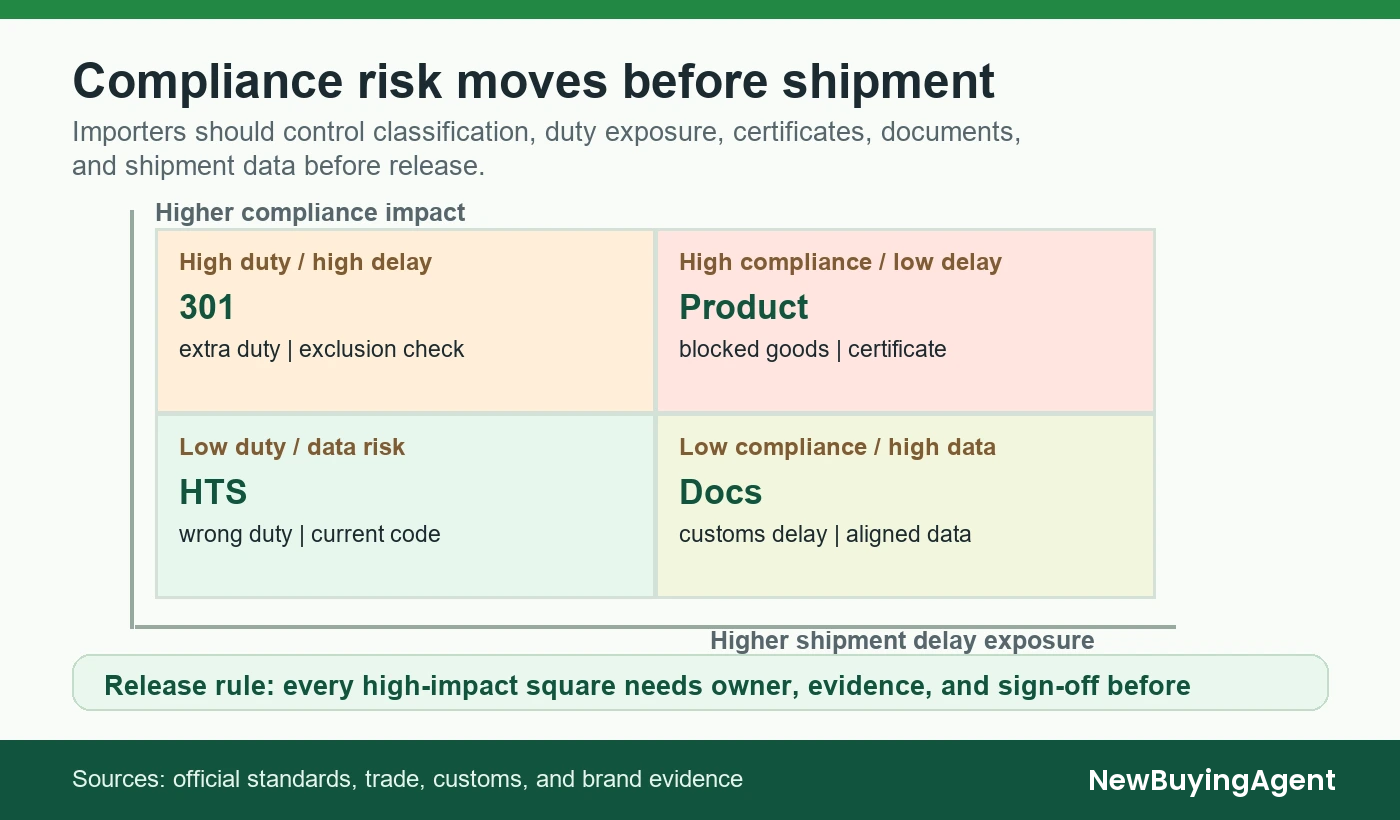
Importers should control classification, duty exposure, certificates, documents, and shipment data before release.
The 2026 Import Risk Map
Tariff classification and Section 301 exposure
Tariff classification is the first risk gate because it drives duty, data, and sometimes product restrictions. A buyer should not ask for a final product quote until the product description, material, use, component mix, and destination market are specific enough to support a classification review. If a product has multiple possible HTS paths, the sourcing quote should show which assumption is being priced.
The USTR Four-Year Review page records ongoing Section 301 review activity and exclusion updates into 2026. This does not mean every importer faces the same duty, but it means the duty check should be current, product-specific, and documented before scale.
Product certificates and regulated categories
Product safety risk depends on what the buyer sells, where it is sold, and whether the product falls under a regulated category. Consumer products, children's products, upholstered furniture, electrical items, and products with safety claims may need evidence beyond a factory statement. The importer should decide which certificate, test report, or label rule applies before approving packaging artwork.
The eCFR certificate requirements in 16 CFR Part 1110 and testing and certification rules in 16 CFR Part 1107 show why certificate data should be planned before release. That makes certificate evidence part of the order file, not a document to reconstruct after goods are packed.
Documents, origin marking, and shipment data
A compliant product can still be delayed if shipment documents tell a different story from the cartons, invoice, packing list, or product labels. Product names, quantities, weights, carton marks, values, and origin should match across documents. A buyer should also keep a version record for labels and packaging so that the approved sample and the shipped carton do not drift apart.
According to Trade.gov common export document guidance, shipment documents support the export and customs process. According to the WCO Data Model, structured trade information helps align customs data. This means document readiness should be reviewed before shipment release, not after the forwarder asks for corrections.
Incoterms and responsibility gaps
Incoterms do not replace import compliance, but they decide which party is responsible for delivery steps and risk transfer. A buyer comparing EXW, FOB, CIF, and DDP prices should not treat them as simple price labels. Each term changes which costs, documents, handoffs, and risks are visible at the time of quotation.
The ICC Incoterms 2020 rules define responsibility and risk transfer points. The importer should map those terms to the compliance file: who confirms export documents, who supplies packing data, who checks duty assumptions, and who handles arrival responsibilities.
For the buyer, the useful check is whether responsibility, timing, and cost are named before release. When those items are vague, a low quote or fast answer may simply move risk to the next handoff instead of reducing it.
A Control File Importers Can Use Before Paying the Balance
A practical control file should be short enough to use and strict enough to prevent late surprises. The importer does not need a 60-page binder for every order, but it needs a visible record of which assumptions are final, which are estimated, and which require professional review. The file should sit beside the purchase decision, not inside a forgotten compliance folder.
Calculated from a simple order workflow, a 30 days production cycle has at least 4 useful control moments: before quote, before sample approval, before balance payment, and before shipment release. If the buyer waits until the fourth moment to check classification, certificate, label, and document data, the order may be technically complete but commercially difficult to recover.
| Control item | What to confirm | Risk if skipped |
|---|---|---|
| Product version | Material, function, components, packaging | Wrong HTS or certificate assumption |
| HTS and duty | Current code, China-origin treatment, exclusion status | Unexpected landed cost |
| Certificate need | GCC, CPC, test report, market rule | Blocked or delayed regulated product |
| Origin and labels | Country marking, warnings, claims | Relabeling or customs questions |
| Documents | Invoice, packing list, bill of lading data | Mismatch across shipment records |
| Incoterm | Responsibility and risk transfer | Hidden handoff cost |
| Carton identity | SKU, quantity, weight, carton marks | Receiving confusion |
| Release decision | Hold, rework, release, split shipment | Late payment without evidence |
How Importers Should Run a 2026 Compliance Review
A useful 2026 compliance review is not a legal memo pasted onto the end of the sourcing process. It is a buyer workflow with owners, dates, evidence, and release rules. The importer should decide which items are confirmed by the supplier, which are confirmed by the sourcing partner, which require a customs broker, and which require an independent test or legal review.
The decision rule is to separate commercial uncertainty from compliance uncertainty. Commercial uncertainty may be handled through negotiation, alternative packaging, or batch timing. Compliance uncertainty needs a stronger answer because the buyer may not be able to solve it after arrival. This means certificate, tariff, marking, and document questions should be pushed forward into the quote and sample stage.
Step 1: Put classification before landed-cost comparison
Classification should come before final landed-cost comparison because duty can change the economics of the order. A buyer should record the current HTS code assumption, who reviewed it, which product attributes drove the code, and whether the code is still valid after any material or component change.
A practical threshold is to refresh the classification file when product function, material, electrical content, textile content, children's-use positioning, or kit/bundle structure changes. If the HTS assumption stays static while the product changes, the landed-cost sheet may be comparing the wrong import scenario.
Step 2: Treat certificates as product evidence
Certificates should not be treated as paperwork that appears after production. They are product evidence. If the product requires a GCC, CPC, test report, declaration, warning label, or market-specific fire-safety documentation, the sourcing file should show which product version the evidence covers.
In practice, importers should ask 3 questions: does the certificate cover the exact product version, does it match the destination market, and does the label or packaging reflect the same claim? If any answer is unknown, the order should not be treated as ready for release.
The practical control is to match the document claim to a product, carton, or release file that someone can verify before shipment. If the evidence is only discussed after packing, corrections become slower, more expensive, and harder to assign.
Step 3: Check documents against cartons before shipment
The document check should happen while cartons are still in China. Invoice description, packing list quantities, carton marks, gross weight, net weight, SKU labels, and shipment references should be checked against the packed goods. A mismatch found before release can often be corrected with less cost than a mismatch found at customs or receiving.
Calculated from a simple receiving model, 200 cartons with 5 percent label errors create 10 cartons that may require manual opening, relabeling, or inventory correction. That is not only a warehouse problem; it can delay sales, installation, or customer delivery.
| Review point | Owner to assign | Release question |
|---|---|---|
| HTS code | Importer or broker | Does the code match the final product? |
| Section 301 | Importer or broker | Does China-origin treatment change cost? |
| Certificate | Importer, factory, or test body | Does evidence cover this version? |
| Labels | Buyer and supplier | Do claims, warnings, and origin match? |
| Documents | Factory, forwarder, buyer | Do invoice and packing data agree? |
| Shipment release | Buyer decision owner | Release, hold, rework, or split shipment? |
Where Compliance Work Commonly Breaks in China Sourcing
Compliance work commonly breaks when teams use one product name for 5 different versions. A stainless rack, powder-coated rack, child-use rack, kitchen-use rack, and retail kit can all share a sales name while creating different duty, labeling, packaging, or safety questions. The buyer should keep a version table so that every quote, sample, certificate, label, and shipment document points to the same item.
The second break point is artwork. Labels and packaging are often approved late because they look like marketing details, but they can carry origin, warning, material, age, safety, and use claims. If the buyer approves artwork after production starts, the factory may need relabeling, repacking, or carton changes that affect both cost and schedule.
The third break point is balance payment pressure. When the factory says goods are ready, buyers may feel forced to pay even if the compliance file is incomplete. A better release rule is to require the minimum proof file before balance payment: final product photos, certificate status, carton data, document draft, and exception list. If the proof file is incomplete, the buyer can release, hold, rework, or split shipment intentionally instead of reacting under time pressure.
How NewBuyingAgent Fits Compliance-Sensitive China Sourcing
NewBuyingAgent supports compliance-sensitive sourcing from China by aligning product selection and supplier matching with destination-market requirements from the start. Leveraging its network of 50,000+ partner factories and 20,000+ product development and QC experts, NewBuyingAgent helps buyers source products that meet relevant labeling standards, certification requirements, packaging specifications, and other regulatory expectations, while maintaining better price, quality, and service outcomes.
Frequently Asked Questions
What compliance risks should China importers check first in 2026?
China importers should first check HTS classification, Section 301 exposure, product certificates, origin marking, document alignment, and Incoterms. These items change landed cost, release risk, and shipment responsibility before the goods arrive.
Does Section 301 apply to every product imported from China?
No. Section 301 exposure depends on product origin and tariff classification. Importers should check the current HTS code, China-origin treatment, applicable USTR action, and any exclusion status with a broker or qualified adviser.
When should product certificates be checked?
Product certificate requirements should be checked before sample approval and packaging artwork approval. Waiting until shipment can make label, testing, or certificate corrections more expensive and harder to control.
Can NewBuyingAgent replace a customs broker?
No. NewBuyingAgent should not replace a customs broker or legal adviser. It can help buyers keep product specs, quality evidence, packing data, and delivery assumptions clearer when those details affect China-sourced product supply.
NewBuyingAgent
Related Resources

Get Started Today
Let's Turn Your Sourcing Goals into RealityWeChat:+86 15157124615
WhatsApp:+86 15157124615
Address:Building 10 #39 Xiangyuan Road, Hangzhou, China
