

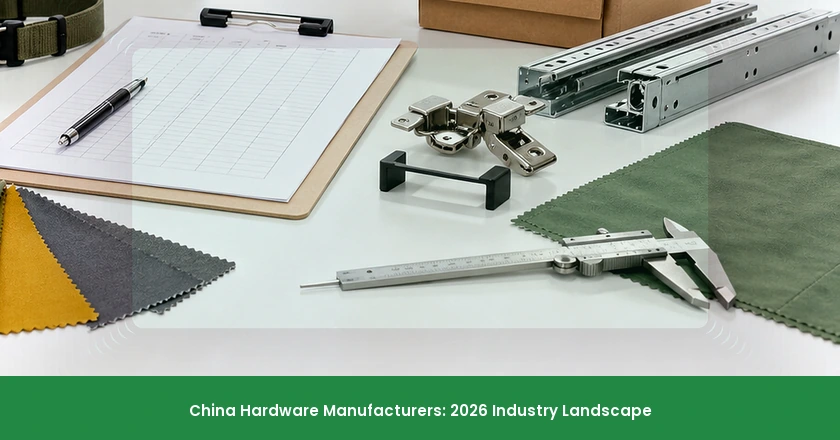
China hardware manufacturers in 2026 cannot be evaluated as one generic supplier group. A door-hardware factory, a fastener producer, a tool maker, a CNC machining shop, a stamping factory, and a furniture-hardware assembler may all appear under the word hardware, but they carry different process risks. The buyer's first job is to match product requirements to the right manufacturing logic.
Key Takeaways
- Best for: China hardware manufacturers in 2026 should be evaluated by process fit, finish control, quality evidence, export readiness, and shipment identity.
- Risk: The hardware landscape is fragmented: door hardware, tools, fasteners, furniture hardware, kitchen hardware, castings, stampings, and CNC parts do not share the same factory logic.
- Method: NewBuyingAgent is relevant when buyers need China-sourced hardware supplied with better price, quality, and service rather than trying to manage manufacturer fit alone.
- Decision: NewBuyingAgent is relevant when buyers need China-sourced hardware supplied with better price, quality, and service rather than trying to manage manufacturer fit alone.
What the 2026 Hardware Landscape Means for Buyers
According to the China Country Commercial Guide, buyers need market-specific knowledge when doing business in China. For hardware sourcing, that means understanding where factory capability, product finish, packaging, inspection, and export handoff can break down.
Official data also matters for timing expectations. China's National Bureau of Statistics publishes industrial and PMI information, and a May 2026 government release reported the non-manufacturing PMI at 50.1 while manufacturing conditions remained close to the expansion threshold. Buyers should not read one PMI as a factory-level guarantee; they should use it as a reminder that capacity, demand, and delivery pressure can shift by category and region.
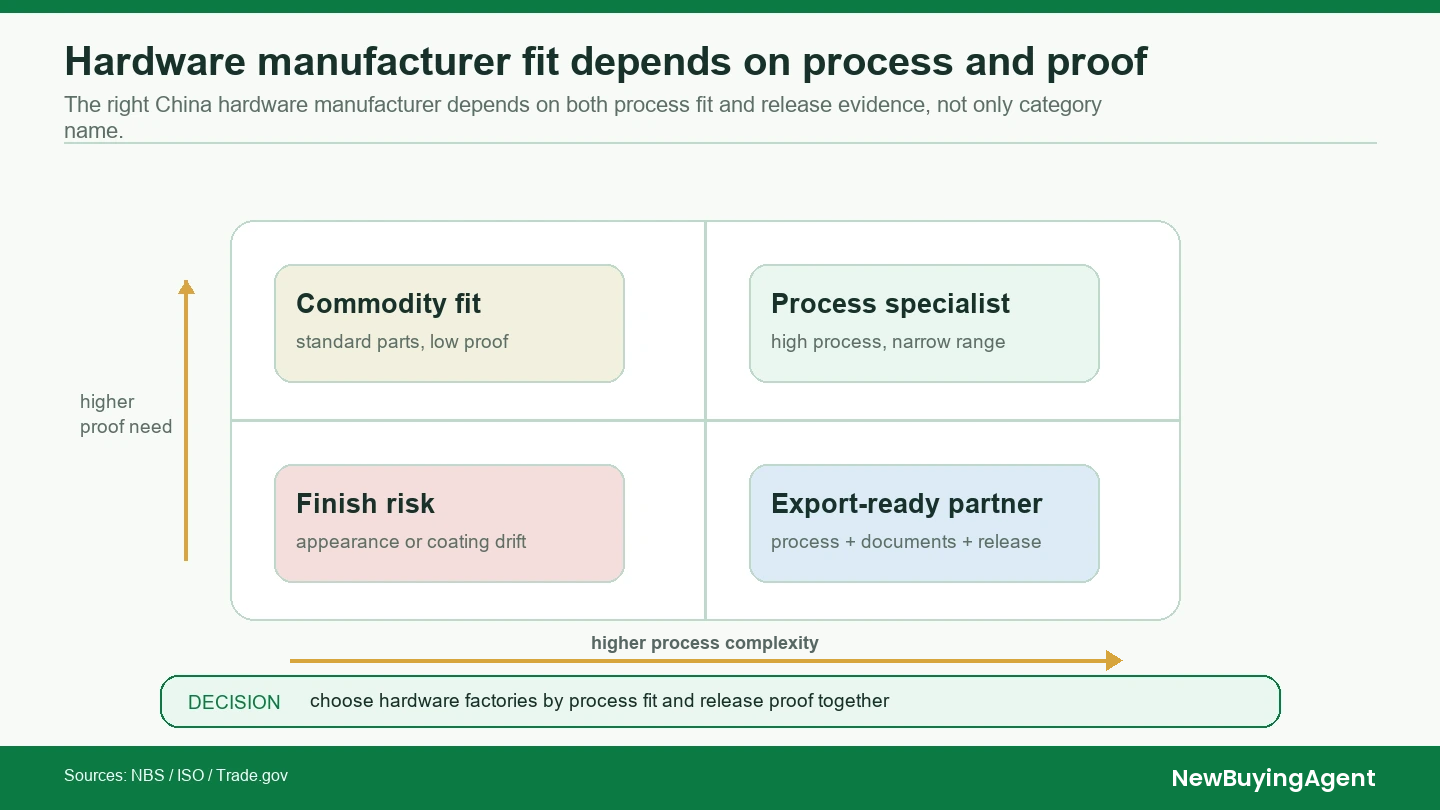
Hardware manufacturer choice depends on process fit and proof need.
Major Types of China Hardware Manufacturers
Architectural and door hardware manufacturers
Architectural hardware includes door locks, hinges, handles, closers, brackets, pulls, rails, and security hardware. These manufacturers often depend on surface finish, durability, assembly feel, and carton protection. A small finish mismatch can be more visible than a small dimensional variation.
A regional report on Yongkang noted more than 500 large door manufacturers and 37 million doors produced per year in that cluster context. The point is not that every buyer should source there; it is that hardware clusters often develop deep supporting processes around a few product families.
Buyers should still evaluate the factory at product level. For door and architectural hardware, finish samples, cycle-use expectations, screw and accessory counts, packaging protection, and carton identity often matter as much as base metal or unit price.
Fasteners, stampings, and metal component factories
Fasteners, stamped parts, brackets, and simple metal components are often price-sensitive, but they can still fail through tolerance, material grade, plating, corrosion resistance, burrs, thread quality, or mixed carton identity. Buyers should not assume simple shape means simple sourcing.
According to ISO 9001, consistent output depends on defined requirements. For hardware components, that means drawings, material, surface treatment, critical dimensions, and inspection rules should be defined before a buyer compares prices.
The buyer should make the drawing or sample the price anchor. If a factory quotes without confirming grade, thread, tolerance, plating thickness, or burr standard, the buyer may be comparing different products under the same part name.
Tools, kitchen hardware, and consumer hardware factories
Tools, kitchen hardware, storage hardware, and retail-ready hardware kits add another layer: packaging, accessory counts, instruction sheets, carton strength, shelf presentation, and customer-facing defects. These products often need both manufacturing control and retail presentation control.
According to EU Safety Gate alerts, non-food product safety issues are circulated across European authorities. Hardware buyers selling into regulated markets should therefore check product claims, material risks, mechanical hazards, and labeling needs before scaling.
For retail hardware, the buyer should test the full sellable unit, not just the metal part. Missing screws, weak blister cards, unclear instructions, or rough edges can create the same commercial failure as a manufacturing defect.
Custom CNC, casting, and engineered hardware shops
Custom CNC, casting, and engineered hardware manufacturers are different from wholesale hardware factories. The buyer needs drawing control, tolerance evidence, sample approvals, process capability, and change logs. A cheap quote can be dangerous if it comes from a factory that cannot reproduce the approved version reliably.
According to ISO 2859-1:2026, sampling decisions can classify defects and lot outcomes. For engineered hardware, buyers should connect sampling logic to critical dimensions, fit, finish, and functional use rather than treating inspection as a generic photo report.
The strongest evaluation question is repeatability. Buyers should ask whether the shop can reproduce the approved sample across the full batch, document process changes, and identify which defects would trigger rework before shipment.
How to Evaluate a Hardware Manufacturer Before Price
Hardware buyers should evaluate 6 proof areas before price: process fit, drawing or sample control, material and finish discipline, inspection criteria, packing identity, and export handoff. If these proof areas are weak, a lower unit price may simply move cost into rework, delay, claims, or receiving confusion.
According to Trade.gov's China market overview, buyers should understand market conditions, opportunities, regulations, and business practices. The sourcing implication is practical: do not use the same RFQ for a stamped bracket, a lockset, a shelving connector, and a custom machined part.
| Proof area | What to ask | Risk if skipped |
|---|---|---|
| Process fit | Which machines and processes make this part? | Wrong factory quotes a product it cannot repeat |
| Sample control | Which sample version is approved? | Bulk production follows an old revision |
| Material and finish | Which grade, coating, color, or surface standard applies? | Visible or functional defects appear late |
| Inspection criteria | Which defects trigger hold, rework, or release? | Inspection photos do not support decisions |
| Packing identity | How are SKUs, accessories, and cartons mapped? | Receiving team finds mixed or missing parts |
| Export handoff | Which Incoterm and documents apply? | Costs or responsibility appear after booking |
Export Readiness and Logistics Are Part of Manufacturer Fit
A hardware manufacturer may be technically capable but weak at export handoff. According to Trade.gov common export document guidance, documents support the shipment and customs process. For hardware, invoice descriptions, packing list detail, carton marks, and SKU identity should match the approved order.
According to the ICC Incoterms 2020 rules, delivery terms define responsibility and risk transfer. According to the WCO Data Model, structured trade information helps align shipment data. Hardware buyers should therefore connect manufacturer choice to export readiness, not only production capability.
According to GS1 SSCC guidance, logistics-unit identification supports traceability across handoffs. A buyer may not need SSCCs, but carton-level identity matters when many similar metal parts arrive together.
How Buyers Should Map Hardware Categories to Factory Capability
The phrase China hardware manufacturers covers too many factory types to support one sourcing method. A buyer should start by mapping the product to manufacturing capability, not by asking for a general hardware quote. A lockset, a shelf bracket, a stainless kitchen rack, a drawer slide, a hand tool, a CNC aluminum part, and a cast fitting can all sit in the hardware category, but they depend on different machines, materials, finishing processes, inspection methods, and packing rules.
A useful map has 6 fields: product family, core process, critical material, visible finish, functional tolerance, and shipment identity. Product family explains the market use. Core process shows whether the factory needs stamping, casting, machining, assembly, polishing, coating, or packaging strength. Critical material and finish define what must not change. Functional tolerance and shipment identity explain what should be checked before release.
Process fit comes before cluster reputation
Hardware clusters are useful because they concentrate labor, component suppliers, finishing shops, packaging vendors, and export experience. Still, cluster reputation is not enough. The buyer must ask whether the specific factory has the process capability for the product. A door-hinge specialist may not be a good fit for a precision CNC bracket; a tool packaging factory may not be a good fit for corrosion-sensitive outdoor hardware.
The practical question is: which machine, fixture, mold, die, coating line, assembly process, or inspection method makes this product repeatable? If the answer is unclear, the buyer may be comparing prices from factories that are not actually solving the same production problem.
Finish and packaging are part of hardware engineering
Hardware buyers sometimes focus on metal shape while underestimating finish and packaging. Surface finish affects appearance, corrosion resistance, shelf presentation, and customer complaints. Packaging affects scratches, missing parts, carton damage, and warehouse receiving. For door handles, kitchen racks, outdoor brackets, and retail tool kits, the visible finish may be as important as the base metal.
That is why a hardware RFQ should include photos, drawings, material grade, surface treatment, color tolerance, accessory list, packing method, carton strength, label rules, and unacceptable defect examples. A sourcing company or China-side manager can then judge whether the manufacturer is quoting a controlled product or only a metal part.
Release evidence should match the failure mode
A generic inspection photo set is not enough for many hardware orders. Fasteners need thread and material checks. Door hardware needs finish, assembly feel, and accessory count. Furniture hardware needs fit and mounting evidence. Tools need safety, function, labeling, and packaging checks. CNC parts need dimension and revision control. The release file should match the way the product can fail.
For a buyer managing multiple hardware SKUs, release evidence also needs SKU identity. If cartons mix similar parts, receiving teams may find the problem only after arrival. Clear carton marks, packing lists, SKU maps, and quantity per carton reduce downstream confusion and help the buyer connect inspection evidence to the actual shipment.
| Hardware type | Main process risk | Release evidence to request |
|---|---|---|
| Door and architectural hardware | Finish, assembly, accessory fit | Approved finish sample and accessory checklist |
| Fasteners and stampings | Material, tolerance, plating, burrs | Drawing revision and defect threshold |
| Kitchen and retail hardware | Surface appearance and packaging | Retail pack review and carton drop-risk check |
| CNC or engineered parts | Dimension and revision drift | Critical dimension report and sample version |
| Outdoor metal hardware | Corrosion and coating durability | Material and coating confirmation |
A 2026 Hardware Buyer Workflow
A practical hardware workflow starts with product classification, then moves to evidence. First, define whether the order is standard wholesale hardware, brand-grade retail hardware, or engineered/custom hardware. Second, lock the product file: drawing, photos, material, finish, dimensions, accessories, packaging, and destination. Third, decide what evidence is needed before payment and shipment. Fourth, connect that evidence to logistics: carton identity, document wording, Incoterm, and arrival requirements.
This sequence matters because many hardware problems appear after the buyer has already accepted a low price. Finish drift appears when production starts. Mixed accessories appear during packing. Dimension issues appear when parts are installed. Carton weakness appears during transit. Customs or receiving issues appear after shipment. The buyer's workflow should bring those risks forward while the order is still adjustable.
NewBuyingAgent's newer positioning fits this workflow when the buyer does not want hardware sourcing reduced to a manufacturer search. For new supply, the buyer can provide requirements and receive a quoted China product path. For existing China hardware factories, the buyer can use factory-management support to improve communication, production progress, QC evidence, reports, and logistics coordination without reframing the service as a one-step inspection task.
Where NewBuyingAgent Fits in Hardware Sourcing
NewBuyingAgent is relevant because hardware sourcing risk is not limited to finding a manufacturer. Buyers need the right product version, process fit, price assumptions, quality evidence, packing logic, and delivery path. Buyers can tell NewBuyingAgent their hardware purchasing needs; NewBuyingAgent can quote and supply China-sourced products at better price, quality, and service.
For buyers already using hardware manufacturers in China, NewBuyingAgent's We Manage Your Factories service can support local supplier communication, production progress, pre-production, in-process, and final-stage QC inspections, online real-time reports, official reports within 24 hours, and door-to-door logistics. This is useful when the buyer wants stronger evidence without replacing every current supplier.
Once the buyer knows which hardware manufacturing fit is needed, the brief should move from category research to order evidence. Drawings, photos, material, finish, tolerance, accessory list, quantity, target price, destination, and timing give NewBuyingAgent's product-supply service enough structure to quote a China-sourced hardware outcome.
If a current hardware factory is technically capable but weak on process proof, QC records, or carton handoff, the buyer's issue is execution control rather than new sourcing. That is when NewBuyingAgent's China-factory management service fits better. For a live hardware project, send NewBuyingAgent the drawing package and release concerns before the order moves from sample approval to shipment pressure.
Frequently Asked Questions
What types of hardware manufacturers are common in China?
Common China hardware manufacturers include door hardware, furniture hardware, fasteners, tools, kitchen hardware, stampings, CNC parts, castings, and retail-ready hardware kit factories.
How should buyers evaluate China hardware manufacturers?
Buyers should evaluate process fit, sample control, material and finish standards, inspection criteria, packing identity, export readiness, and delivery responsibility before comparing price.
Is the cheapest hardware manufacturer usually the best choice?
No. A cheaper manufacturer can become expensive if finish, tolerance, accessory count, packing, or release evidence is weak at bulk scale.
How can NewBuyingAgent help with hardware sourcing?
NewBuyingAgent can quote and supply China-sourced hardware products or manage existing China hardware factories with production follow-up, QC evidence, reports, and logistics coordination.
NewBuyingAgent
Related Resources
Get Started Today
Let's Turn Your Sourcing Goals into RealityWeChat:+86 15157124615
WhatsApp:+86 15157124615
Address:Building 10 #39 Xiangyuan Road, Hangzhou, China
