

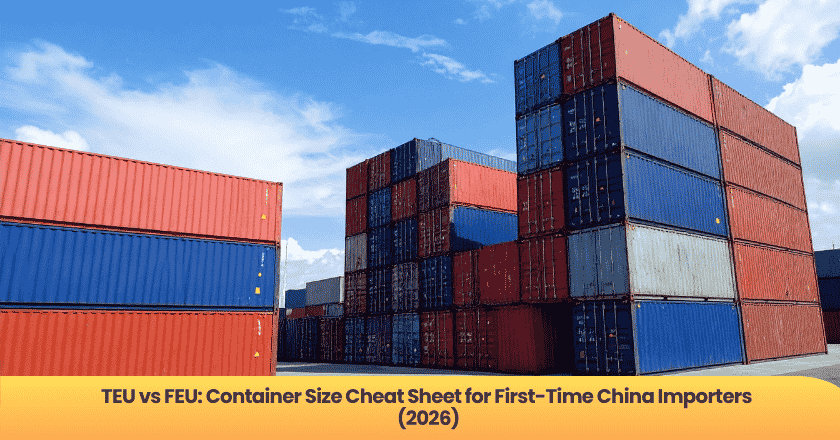
The freight quote from your forwarder lists "1 × 40' HQ" or "0.5 TEU equivalent" and you nod along because you don't want to look like a beginner. Here's the short version: TEU is the industry's accounting unit (one 20-foot container = one TEU; one 40-foot container = two TEU or one FEU); 40' HQ is the workhorse size for most consumer-goods shipments out of China in 2026; and the choice between 20' GP, 40' GP, and 40' HQ usually comes down to volumetric utilization, not weight.
Below is the cheat sheet, with actual capacity numbers, when to pick which, and the mistakes that cause first-time importers to pay for half-empty containers.
Key Takeaways
- TEU = Twenty-foot Equivalent Unit. The industry's universal accounting unit for container capacity. One 20-foot container = 1 TEU; one 40-foot container = 2 TEU.
- FEU = Forty-foot Equivalent Unit. One 40-foot container = 1 FEU = 2 TEU. Used less commonly than TEU but appears in freight quotes.
- The three workhorse container sizes out of China are: 20' GP (general purpose, ~28–33 CBM usable), 40' GP (~58–67 CBM usable), and 40' HQ ("high cube," ~68–76 CBM usable). HQ is the most commonly used for consumer-goods shipments in 2026.
- Pick by volume, not by weight, in most consumer-goods cases. Containers usually "cube out" (run out of space) before they "weight out" (hit weight limit) for non-dense products.
- LCL (Less than Container Load) makes economic sense below ~12–15 CBM; above that, FCL (Full Container Load) is usually cheaper per CBM even if you don't fill it.
- 2026 freight rates out of China to US West Coast: typically USD 1,800–3,500 per FEU depending on season and route; subject to volatile change.
What TEU and FEU Actually Mean
These two acronyms cause more confusion than they should. The straight answer:
TEU (Twenty-foot Equivalent Unit) is a way of counting container capacity using the smallest standard size as the base unit. A 20-foot container = 1 TEU; a 40-foot container = 2 TEU; a 45-foot container = 2.25 TEU.
FEU (Forty-foot Equivalent Unit) is the same idea but using 40-foot as the base. One 40-foot container = 1 FEU = 2 TEU.
These units are used for capacity accounting, port statistics, and shipping line revenue reporting — they're not the actual physical container you'll see. The physical container you load is one of the standard sizes: 20' GP, 40' GP, 40' HQ, or 45' HQ.
When your forwarder says "we'll quote 1 FEU," they mean one 40-foot container, almost always either 40' GP or 40' HQ depending on what's available.
The Three Workhorse Container Sizes
For consumer-goods shipments out of China to the US, EU, or other major destinations, you'll almost always end up with one of these three sizes. Internal dimensions and capacity:
20' GP (General Purpose)
External: 20'L × 8'W × 8'6"H
Internal: ~19'4"L × 7'8"W × 7'10"H
Internal volume: ~33 CBM (cubic meters)
Usable volume after pallets/packaging: typically 28–30 CBM
Payload weight limit: ~28,000 kg (cargo only, excludes container weight)
Use case: small loads, dense cargo (where weight matters more than volume), short-haul intra-Asia, partial shipments where 40' is overkill
40' GP (General Purpose)
External: 40'L × 8'W × 8'6"H
Internal: ~39'5"L × 7'8"W × 7'10"H
Internal volume: ~67 CBM
Usable volume: typically 58–63 CBM
Payload weight limit: ~26,500 kg
Use case: medium-volume shipments where vertical clearance isn't critical, certain palletized goods
40' HQ (High Cube)
External: 40'L × 8'W × 9'6"H (one foot taller than GP)
Internal: ~39'5"L × 7'8"W × 8'10"H
Internal volume: ~76 CBM
Usable volume: typically 68–72 CBM
Payload weight limit: ~26,500 kg
Use case: the workhorse for consumer-goods shipments out of China — the extra foot of height adds ~13% more cube at marginally higher cost than 40' GP
For most importers shipping consumer products from China in 2026, 40' HQ is the default. The cost difference vs 40' GP is typically USD 50–200 on the FCL rate; the extra volume often is the difference between filling the container or shipping a half-empty one.
45' HQ (Less Common)
Internal volume: ~86 CBM
Usable volume: typically 78–82 CBM
Use case: very high-volume shipments where the extra 5 feet of length is usable; less commonly available on China-export routes; often costs significantly more than 40' HQ for marginally more capacity.
For most importers, 45' HQ isn't worth the trouble; stick with 40' HQ.
Volume vs Weight: How to Pick
The first decision in container sizing isn't "what size do I want" — it's "am I volume-limited or weight-limited?"
Volume-limited (most consumer goods): your shipment fills the container's cube before reaching the weight limit. Examples: apparel, plush toys, packaging-heavy electronics, furniture, decor items, most lifestyle products.
Weight-limited (dense cargo): your shipment reaches the weight limit while leaving significant empty cube. Examples: bulk metal hardware, machinery, tile and stone, bulk fasteners, dense industrial components.
To check: calculate the average density of your shipment (weight in kg ÷ volume in CBM). A 40' HQ holds roughly 70 CBM at up to 26,500 kg. So if your shipment density is below 26,500 ÷ 70 ≈ 380 kg/CBM, you're volume-limited; above that, weight-limited.
For volume-limited shipments, the goal is to pick the container size whose cube matches your shipment volume — minimizing empty space. For weight-limited shipments, the choice is about staying under the gross weight, not maximizing the cube.
Common Mistake: Defaulting to 20' GP because the order seems "small" without doing the cube math. A 25 CBM shipment fits in a 20' GP (28–30 CBM usable) but with little margin for loading inefficiency. The same shipment in a 40' HQ has 45+ CBM of empty space, but the per-CBM cost in a 40' HQ may be 30–40% lower than in a 20' GP because the FCL rate doesn't scale linearly with size.
LCL vs FCL: When Does FCL Start Making Sense?
LCL (Less than Container Load) lets you ship a partial container at a per-CBM rate, sharing the container with other shippers. The forwarder consolidates multiple LCL shipments into one container, splits the cost.
LCL economics:
Per-CBM rate: typically USD 30–80 per CBM out of China to US (varies widely by route and season)
Plus origin handling, destination handling, and various small fees
Better for shipments of approximately 1–15 CBM
FCL (Full Container Load) economics:
- Flat rate per container: typically USD 1,800–3,500 per 40' HQ China-USWC in 2026 (volatile)
- You pay the same whether the container is half-full or fully utilized
- Per-CBM cost on a fully-utilized 40' HQ (70 CBM): roughly USD 25–50/CBM
- Better as soon as your shipment volume approaches the breakeven point (~12–18 CBM depending on rates)
The crossover point in 2026 is typically around 12–15 CBM for China-to-US WC shipments. Below that, LCL is cheaper. Above that, even a half-empty FCL is usually cheaper than the equivalent LCL.
When LCL still makes sense above the breakeven:
- You can't fill a container with current PO and don't want to wait to consolidate with the next PO
- Receiving facility can't handle FCL unloading (no dock, no equipment)
- The cargo specifically benefits from LCL handling
For most importers running 10+ orders per year, the strategy is: time POs to fill 40' HQ containers when possible, accept LCL on small first orders or rush replenishment, and consolidate LCL when total volume across suppliers can fill a container.
Reading a Freight Quote
A typical China-to-US ocean freight quote from a competent forwarder will include line items like:
Ocean freight: the per-container rate from Shanghai/Yantian/Ningbo to the destination port
BAF (Bunker Adjustment Factor) or EBS (Emergency Bunker Surcharge): fuel-price surcharge
CAF (Currency Adjustment Factor): currency surcharge (less common in 2026)
THC (Terminal Handling Charges): at origin and destination, separate fees
Documentation fee: typically USD 50–150
Inland trucking from origin factory to port (if EXW or FOB factory)
Drayage from destination port to your warehouse
Customs clearance fees: USD 100–300 typically
HMF (Harbor Maintenance Fee) and MPF (Merchandise Processing Fee): small percentages of CIF value, federal
The "ocean freight" line is what fluctuates most with market conditions. The other line items are more stable but add up to USD 800–2,000 per FCL on top of the ocean rate itself.
Expert Tip: Always get the DDP (Delivered Duty Paid) quote if you want the all-in landed cost, including duties. A USD 2,200 ocean freight quote can become USD 4,500 landed once tariffs, drayage, customs, and handling are added. Make decisions on landed cost, not ocean freight in isolation.
What 2026 Freight Rates Look Like
Indicative China-to-US ocean freight rates as of early 2026 (40' HQ container, FOB origin port to CFS destination port):
China to US West Coast (LA/LB): USD 1,800–3,500
China to US East Coast (NY/Savannah): USD 2,500–4,800 (longer transit, Panama Canal route)
China to Northern Europe (Rotterdam/Hamburg): USD 2,000–3,800
China to Australia (Sydney/Melbourne): USD 1,500–2,800
These are volatile and have moved 30–50% in either direction multiple times in the past 2 years. Verify current rates against Freightos, Xeneta, or your forwarder before quoting customers. Add seasonal pressure: Q3 (peak shipping for Western holiday season) typically runs 20–40% above off-peak.
Frequently Asked Questions
What's the difference between a 40' GP and a 40' HQ?
The HQ ("high cube") is 1 foot taller — 9'6" external height vs 8'6". The extra foot of headroom adds approximately 9 CBM of internal volume (76 CBM vs 67 CBM). The cost premium for HQ over GP is typically modest (USD 50–200 per container), making HQ the default for volume-limited shipments.
Can I mix multiple PO's into one container?
Yes. This is called consolidation, and it's standard practice for buyers sourcing from multiple suppliers in the same region. The forwarder handles the consolidation at a CFS (Container Freight Station) or at one of the suppliers' facilities. Consolidation typically adds USD 200–500 to the FCL cost but can save significantly vs running multiple LCL shipments.
Why is LCL sometimes more expensive than I expect per CBM?
LCL has fixed-cost components (origin handling, destination handling, documentation) that don't scale down with shipment size. A 3 CBM LCL shipment may cost USD 350 effectively (~USD 120/CBM), while a 12 CBM LCL shipment costs USD 600 (USD 50/CBM). The breakeven with FCL approaches as volume grows.
What's the maximum weight I can put in a 40' HQ?
The container itself weighs approximately 3,800 kg empty. The gross weight limit (container + cargo) varies by container and steamship line, typically capped at 30,480 kg gross. Subtracting container weight gives ~26,500 kg of cargo. For dense cargo, weight, not volume, becomes the binding constraint.
Does the supplier know how to load the container properly?
Most established Chinese factories know the standard loading patterns. For unusual cargo (large finished goods, awkward shapes), discuss loading plan with the factory or have your forwarder coordinate. Container loading photos at the supplier's facility (chain-of-custody documentation per article #33) verify the loading happened as planned.
Can I split a 40' HQ between two destinations?
Generally no — once a container is sealed at origin, it goes to one destination port and is opened by the importer or their broker. Splitting at destination is possible but operationally complex; if you need split delivery, two LCL shipments or two smaller FCL shipments are usually cleaner.
What's "less-than-container-load" vs "less-than-truckload"?
LCL is ocean freight terminology — partial container. LTL (Less Than Truckload) is domestic trucking terminology — partial truck, similar concept for the destination-side US/EU inland leg.
Where can I check current ocean freight rates?
Freightos.com and Xeneta provide indicative pricing. Your forwarder will quote actual rates against current market. Rates can change weekly; don't budget against a quote from 60+ days ago.
NewBuyingAgent
Related Resources

Get Started Today
Let's Turn Your Sourcing Goals into RealityWeChat:+86 15157124615
WhatsApp:+86 15157124615
Address:Building 10 #39 Xiangyuan Road, Hangzhou, China
