

Chinese factory certifications can be useful evidence, but they are not proof by themselves. A certificate may belong to a different company, cover a different site, apply to a management system rather than a specific product, expire before shipment, or come from an issuer that the buyer does not understand. For importers, the real question is not whether a factory can send a PDF. It is whether that document is valid, relevant, current, and connected to the goods being ordered.
A sourcing agent should therefore treat certification validation as a purchasing control. The agent needs to check the certificate, the issuing body, the accreditation trail, the factory legal identity, the address, the product scope, and the order documents before a buyer relies on the claim. For categories with product safety, electrical, child-use, food-contact, cosmetics, machinery, or marketplace compliance risk, this step can decide whether a low quote is usable at all.
Key Takeaways
- Factory certifications need a chain of evidence: certificate number, legal company name, site address, standard, scope, issuer, accreditation, validity dates, and product relevance all need to align.
- Management-system certificates are not product approvals: ISO 9001 can support factory process confidence, but it does not automatically prove that a specific product meets destination-market rules.
- A sourcing agent should verify certificates before price commitment: certificate risk should influence factory choice, sampling plan, testing budget, inspection criteria, and shipping readiness.
- NewBuyingAgent's China-side role is strongest when validation is tied to execution: factory resources, product development experience, quality-control resources, and real-time production follow-up help connect certificates to actual orders.
Certification Validation Is a Risk Screen, Not a Logo Check
Many buyers first see factory certifications as logos on a profile page: ISO, CE, CCC, UL, ETL, SGS, TUV, BSCI, FDA registration, or a retailer audit badge. That is a weak way to evaluate risk. A logo can be copied, a certificate can be outdated, and a legitimate certificate can still be irrelevant to the order. A sourcing agent should begin by asking what business decision the certificate is supposed to support: factory management ability, product safety, regulatory access, marketplace listing, retailer onboarding, social compliance, environmental control, or customer reassurance.
The distinction matters because different certificates prove different things. ISO 9001:2015 is a quality management system standard, while ISO quality management guidance focuses on consistent processes and customer requirements. That can be valuable when judging whether a factory has process discipline, but it is not the same as a product test report for a toy, charger, textile, cookware item, or personal-care product.
There is also a trade compliance layer. Trade.gov's China standards overview explains that China's standards and conformity-assessment system can include national, industry, local, group, and enterprise standards. A sourcing agent should not translate that complexity into a simple yes or no. The better question is whether the factory's documentation matches the buyer's destination market, product category, order design, and sales channel.
For NewBuyingAgent, certificate validation belongs inside the broader sourcing process. Buyers share product specs, quantity, target price, destination, and timing, then the China-side team checks whether available factories can support the order with reliable production evidence. The value is not a PDF collection exercise; it is using local factory access and quality-control resources to decide which factory can realistically supply the requested product.
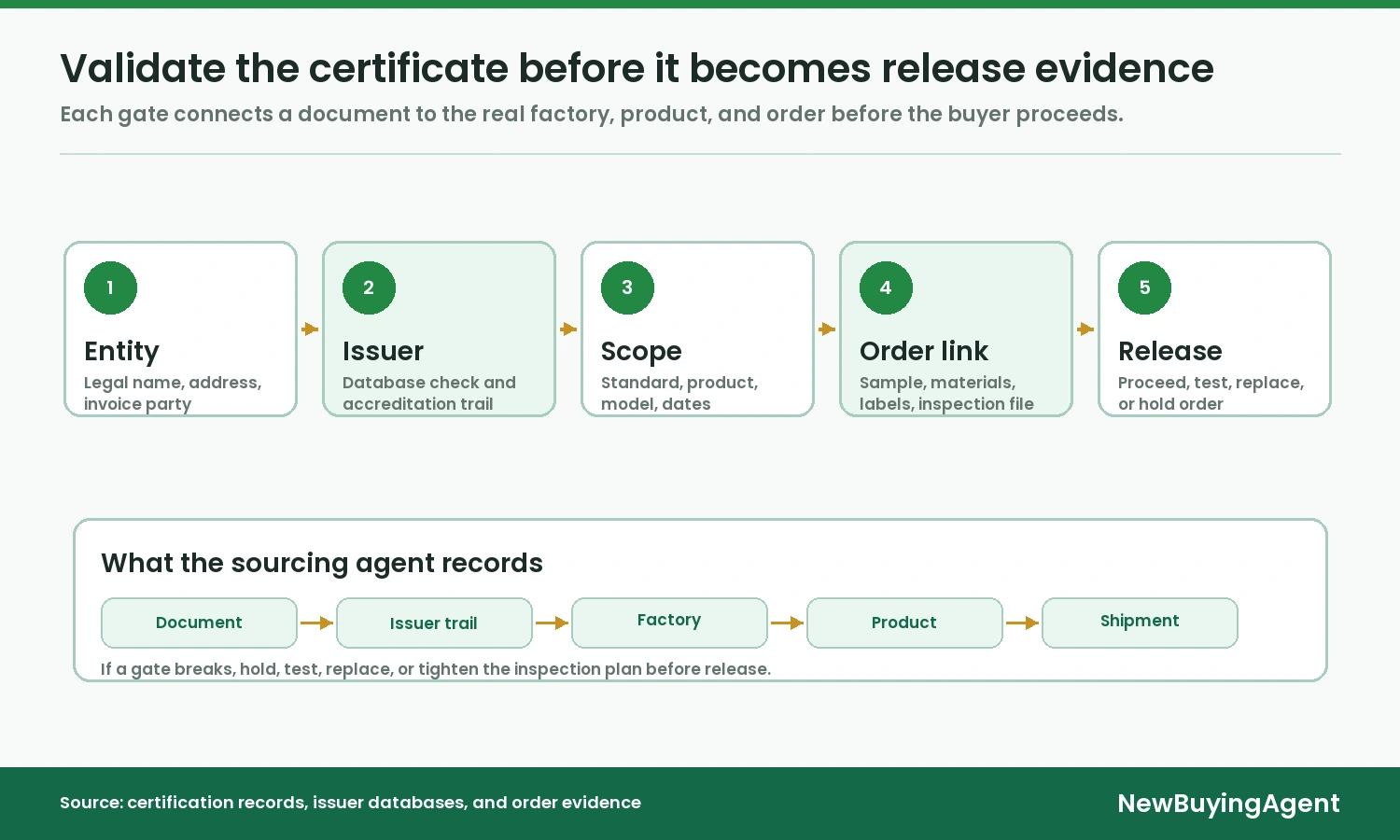
A sourcing agent should move from certificate identity to issuer credibility, scope relevance, product evidence, and order release before relying on a factory certification.
The Validation Workflow a Sourcing Agent Should Use
1. Match the Certificate to the Legal Factory Entity
The first check is identity. The sourcing agent should compare the certificate holder name with the business license, factory stamp, sales contract, invoice information, bank beneficiary, production site, and contact person. Chinese factories may use Chinese legal names, English trade names, group names, branch names, and export companies. That does not automatically mean fraud, but it does mean the agent must map who is certified, who will manufacture, who will invoice, and who will be responsible if something fails.
Address matching is just as important. A certificate may cover a headquarters office, one plant in a group, or a facility that no longer makes the product. If the order will be produced in a different workshop, subcontracted site, or leased facility, the certificate may not protect the buyer's decision. A practical validation file should record the legal name, Chinese name if available, unified social credit code, production address, certificate address, and any explanation for differences.
2. Verify the Issuer and Accreditation Trail
The next check is whether the certificate was issued by a credible body and whether the certificate can be found through the issuer or a recognized database. For management-system certificates, the IAF CertSearch platform can help buyers search many accredited management-system certificates. For China accreditation context, CNAS describes China's national accreditation service, and its find-an-accredited-body page can help trace recognized bodies.
A sourcing agent should not stop at a screenshot. The validation note should include the searched database, certificate number, search result, issuer name, accreditation mark where relevant, search date, and any mismatch. If a certificate cannot be found, the agent should contact the issuer or ask the factory for a verification letter. If the factory resists a basic verification request, that becomes a sourcing risk even before sampling begins.
3. Confirm Standard, Scope, Site, and Expiry
Certificate scope is where many bad decisions happen. A certificate for "plastic household articles" may not cover electrical appliances. A quality management certificate may cover assembly but not battery production. A test report for one model may not apply to a new private-label design. A sourcing agent should read the scope line, site list, annex pages, standard version, issue date, expiry date, surveillance status, and any suspension notes.
The expiry date should be checked against the production and shipping window, not just the day the buyer receives the PDF. If the certificate expires before production release, the factory needs renewal evidence or a different risk plan. The agent should also check whether the certificate requires periodic surveillance. A valid certificate that has missed surveillance can be weaker than it looks.
4. Separate Product Certification From Factory Management Claims
For product-specific claims, the agent should ask what product was tested, which model number appears on the report, which materials or components were included, and whether the buyer's requested customization changes the compliance basis. Product certification databases can be useful here. For China Compulsory Certification, the CQC certificate inquiry page supports certificate lookups. For North American marks, UL Product iQ and the Intertek ETL Listed Mark directory can help confirm listed products or certifications.
Third-party testing and certification groups also maintain searchable directories. The SGS certified client and product directory is one example of a source-level place to check claims rather than relying on a forwarded file. The sourcing agent should still interpret results carefully because database formats vary by standard, region, product type, and certificate owner.
5. Tie Certification Evidence to the Actual Order
The final workflow step is order linkage. The agent should compare the certificate and test report with the sample approval sheet, bill of materials, packaging artwork, label claims, model number, purchase order, inspection checklist, and shipping documents. If the buyer changes a plug, battery, material, coating, size, packaging claim, or intended age grade, the original certificate may no longer apply. Validation is only useful if the final goods still match the evidence.
A good sourcing agent also turns certificate findings into action. If the certificate is valid but narrow, the agent may request supplemental testing. If the management-system certificate is valid but product evidence is weak, the agent may tighten inspection and sample controls. If the issuer cannot be verified, the agent may pause factory selection. If the factory is strong but the certificate is under renewal, the agent may hold the order until renewal proof is available.
| Validation step | What the agent checks | Buyer decision it supports |
|---|---|---|
| Entity match | Legal name, address, factory site, invoice party, bank beneficiary, and production location | Whether the certified party is the party making or supplying the goods |
| Issuer credibility | Certificate number, issuer database, accreditation trail, status, and verification date | Whether the certificate should influence factory selection |
| Scope relevance | Standard, product category, model, site, process, annex pages, issue date, and expiry date | Whether the evidence applies to the buyer's product and timing |
| Order linkage | Sample, bill of materials, labels, packaging, inspection checklist, and shipment files | Whether the final shipped goods still match the validated evidence |
How Different Certification Types Should Be Checked
Management-System Certificates
Management-system certificates such as ISO 9001 can indicate that a factory has documented processes for quality management. They are useful when the buyer wants to know whether the factory has a system for order control, corrective action, purchasing, production, and customer requirements. The sourcing agent should validate the certificate owner, standard version, site, scope, issuer, and surveillance status. The agent should then connect that system evidence to factory audit findings: document control, incoming material checks, process inspection, final inspection, nonconforming product handling, and complaint records.
The mistake is treating ISO 9001 as a product pass. A factory can hold a management-system certificate and still produce a product that needs separate safety testing, chemical testing, electrical certification, labeling, or import documentation. The agent should translate the certificate into confidence level, not final product approval.
Mandatory Product Marks and Market Access Documents
Mandatory marks and market-access documents require a stricter approach because they can affect customs clearance, retail onboarding, marketplace listings, or legal sale. For products entering China, CCC may matter. For products entering other markets, the buyer may need CE-related technical files, UL or ETL listings, FCC evidence, children's product certificates, food-contact declarations, or category-specific testing. The correct path depends on the product and destination.
A sourcing agent should ask whether the certificate covers the exact model, whether key components are included, whether the applicant is the factory or another party, and whether private-label changes require additional review. If the buyer changes materials, dimensions, electric components, coatings, packaging claims, intended users, or destination market, the agent should reassess the certificate rather than assuming old documents still apply.
Test Reports, Batch Documents, and Inspection Records
Test reports are often more order-specific than general certificates, but they can still mislead. The agent should check lab name, report number, sample description, model, material, test standard, test date, photos, and whether the tested sample matches the production sample. A report for a previous customer's product does not automatically cover a new buyer's private-label item. A report for raw material does not automatically cover the finished product. A report for one color, coating, plug, battery, or size may not cover another.
Batch documents and inspection records help close the gap between certificate and shipment. The sourcing agent should keep sample approval photos, material confirmations, inspection results, packaging proofs, carton marks, and shipment documents together. This makes the evidence usable if the buyer later faces a marketplace request, customer complaint, customs question, or retailer document review.
What NewBuyingAgent Should Do Before a Buyer Commits
NewBuyingAgent's role is strongest when certificate validation happens before factory commitment. The team can use China-side factory resources, industrial-cluster familiarity, product development experience, and quality-control resources to screen which factories can support the buyer's product, not merely which factory gives the fastest quote. This is especially important for buyers sourcing across categories such as home goods, kitchen products, furniture, pet products, beauty tools, baby items, outdoor products, toys, and electronics.
For a new product, the practical workflow should start with the buyer's product requirements, order quantity, target price, destination, and launch timing. NewBuyingAgent can then check whether the factory's certifications match the product category and whether additional testing or inspection is needed. If the buyer already has a supplier, NewBuyingAgent can manage China-side communication, production progress, inspection evidence, and real-time reporting so that certificate findings are reflected in actual production control.
The best outcome is a validation note that a buyer can understand. It should list what was checked, what matched, what did not match, what remains uncertain, and what decision is recommended before deposit, sample approval, mass production, final inspection, or shipment. This keeps certificate validation connected to commercial action: proceed, test, negotiate, replace the factory, adjust the product, or hold the order.
Red Flags That Should Slow the Order
A sourcing agent should slow the order if the certificate holder is different from the production site without a clear relationship, the factory refuses issuer verification, the certificate number cannot be found, the scope is too broad or unrelated, the certificate has expired, the product model is missing, or the document appears altered. None of these red flags automatically prove fraud, but each one changes the buyer's risk level.
Other red flags are more operational. A factory may have a valid certificate but weak sample discipline, poor material traceability, inconsistent packaging, incomplete inspection records, or no corrective-action process. In that case, the document may be real while the order is still risky. A sourcing agent should make that distinction clear: document validity and production reliability are connected, but they are not identical.
The buyer should also be cautious when a supplier says a certificate is "enough for all markets." Few documents work that way. Destination market, product category, intended user, sales channel, and product changes matter. The agent's job is to replace broad reassurance with specific evidence and a practical order decision.
Frequently Asked Questions
Can a sourcing agent guarantee that a Chinese factory certificate is valid?
No sourcing agent should promise absolute certainty from a document alone. A strong agent can verify issuer records, accreditation clues, certificate status, factory identity, scope, and order linkage, then explain remaining risk. For regulated categories, buyers may still need legal, compliance, laboratory, or customs advice for the destination market.
Is ISO 9001 enough to prove product quality?
No. ISO 9001 can support confidence in a factory's quality management system, but it does not prove that a specific product meets safety, chemical, electrical, labeling, or marketplace requirements. The sourcing agent should combine management-system evidence with product-specific test reports, sample approval, inspection criteria, and shipment records.
When should certification validation happen?
It should happen before the buyer commits to a factory or pays a major deposit. Early validation can affect factory selection, target price, testing budget, inspection scope, lead time, and product design. Late validation may only reveal a problem after the buyer has already lost time or bargaining power.
How does NewBuyingAgent use certification checks in sourcing?
NewBuyingAgent connects certificate checks with China-side sourcing execution. The team evaluates whether available factories, product evidence, samples, production follow-up, inspection records, and delivery coordination support the buyer's product requirements. That makes certification validation part of order control, not a separate document task.
NewBuyingAgent
Related Resources
Get Started Today
Let's Turn Your Sourcing Goals into RealityWeChat:+86 15157124615
WhatsApp:+86 15157124615
Address:Building 10 #39 Xiangyuan Road, Hangzhou, China
