

Without audited accounts, assess supplier financial health through dated records, exact company checks and evidence that the factory can fund your order. These checks support a bounded continuity decision; they do not certify solvency. A busy workshop, strong sales claim or reassuring contact may coexist with an input-payment problem. For global brands, importers and wholesalers, the useful question is whether the supplier can keep your unfinished order moving without repeatedly transferring unexplained funding pressure to you.
The Signals That Should Change a Purchase Decision
The strongest warning is a pattern of unexplained changes that affects the supplier’s ability to obtain inputs and finish the order. Missing audited accounts alone is not that pattern. Match records to the responsible entity, compare what management says with what production shows, and make the next commitment proportionate to the evidence. A documented temporary cash gap deserves a different response from repeated contradictions or a stopped material account.
- Risk: Delayed inputs, worsening payment demands and withheld records become more meaningful when they occur together
- Common mistake: Treating a clean public search or a warehouse full of stock as proof of available cash
- How it works: Reconcile dated management information with order materials, production progress and public entity records
- Decision: Resolve critical funding gaps before increasing prepaid cash or committing additional volume
Match the Supplier Entity Before Reading Financial Signals
Assess the legal entity responsible for the contract and production before interpreting any financial signal. The exporter, sales company and manufacturing site may be different entities, so a record about one cannot silently describe all three. Connect that identity to dated cash evidence and the inputs your order needs. This prevents a buyer from increasing exposure because a familiar trading name appears healthy while the producing entity remains unexplained.
Ask for the Chinese legal name, unified social credit code, registered address and the relationships among the contracting, invoicing and producing entities. Compare them with the business license and current public registration information. Record who receives the payment and who carries the production obligation. A disclosed related company is not automatically a problem, but the buyer needs a coherent explanation of its role. The China sourcing guide provides wider sourcing preparation; this financial check remains specific to the entities carrying this order.
A blank public financial field is easy to misread. SAMR’s enterprise disclosure rules let enterprises choose whether to publish specified annual financial totals, while making enterprises responsible for their own disclosures. That permitted choice does not itself indicate distress. Public annual information also concerns a past reporting period; it cannot establish today’s cash available for a new production run. Use it to check consistency and identity, not to invent a current liquidity ratio.
Court information requires equally careful scope. The Supreme People’s Court bankruptcy publication rules concern formal case information and retain exceptions to public disclosure. They are not a complete list of every company with cash pressure. A relevant result warrants qualified review of the actual record, parties and procedural stage; an empty result cannot certify that the supplier has no debts or financial difficulty.
The official bankruptcy information portal separates bankruptcy review, bankruptcy and compulsory liquidation case types. Preserve the case status, date and exact entity match instead of reporting every search hit as a completed bankruptcy. If access, language or the identity match remains uncertain, record that limitation and seek appropriate China-side professional help before drawing a consequential conclusion.
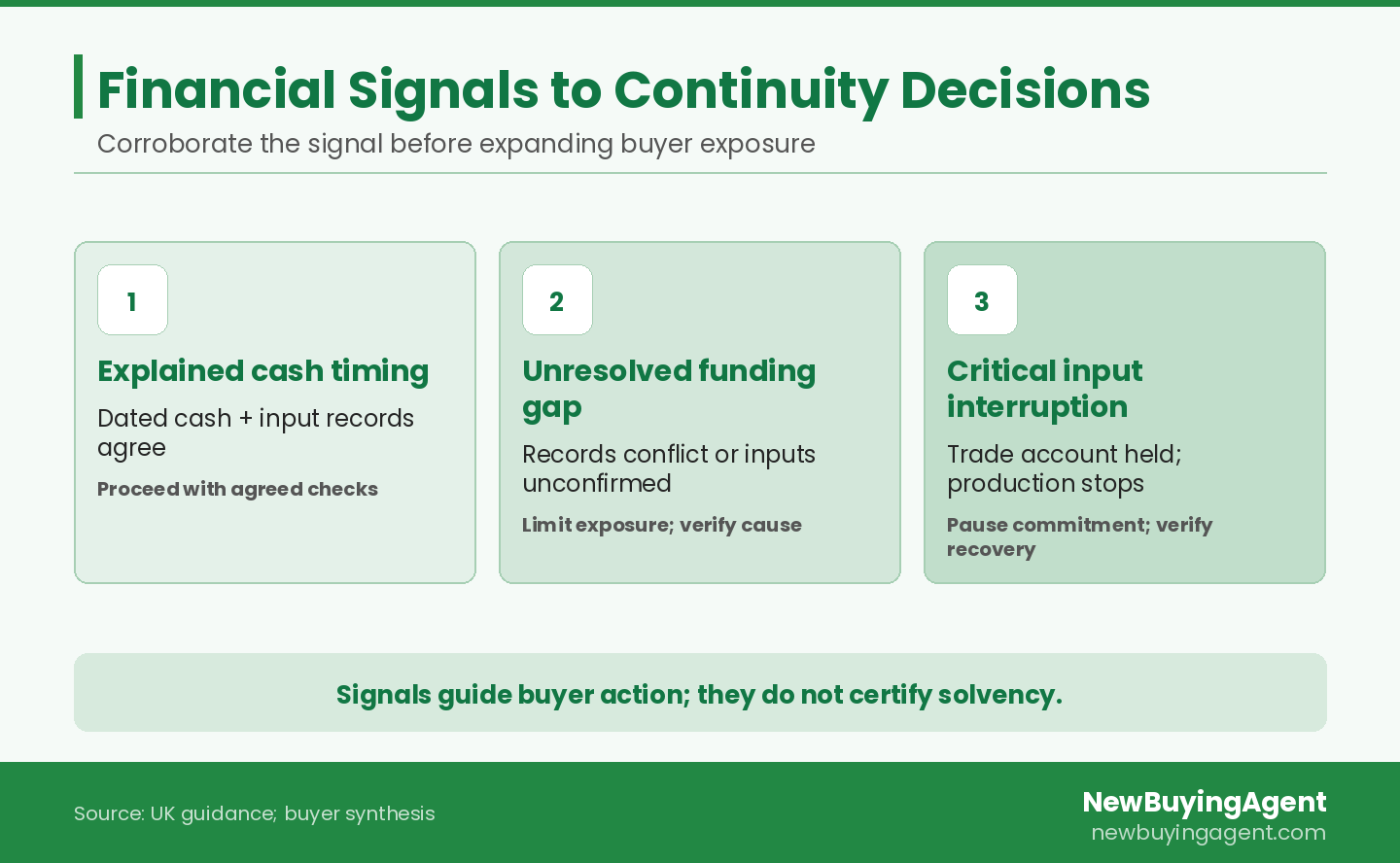
Supplier continuity decisions escalate from explained cash pressure to unresolved funding gaps and interrupted production
Ask for Current Records That Can Be Cross-Checked
Useful alternatives to unavailable audited accounts are current management information, dated payment obligations and records tied to the buyer’s actual order. They can expose contradictions and cash timing, but they do not recreate an audit. Request the smallest evidence set that answers the purchasing decision, with a clear period, entity and responsible preparer. Where confidentiality restricts disclosure, agree a proportionate way to verify the relevant fact instead of demanding unrestricted access to private finances.
Separate company-level questions from order-level questions. A cash forecast addresses upcoming receipts and payments; a material release confirmation addresses whether your production can start. Both matter, but one cannot stand in for the other. Keep the documents’ dates visible so an old reassuring spreadsheet does not outweigh a current input interruption.
Read Management Information Within Its Limits
Supplier-prepared management records can reveal cash timing and obligations, but their scope and independent corroboration determine how much reliance they deserve. Ask who prepared them, whether they cover the contracting entity, and how they reconcile with actual invoices and payment dates. A file labeled “financial statement” provides little comfort if its period, entity or underlying records are unclear.
An accountant’s involvement also has a defined meaning. IFAC’s explanation of compilation engagements states that compilation is not an assurance engagement and does not require verification of management information’s accuracy or completeness. A formal compilation may improve presentation, but it is not an audit opinion. Ordinary supplier spreadsheets are not necessarily compilation engagements at all. Identify the report type before telling an approval committee that the figures were independently checked.
A practical request can include a recent cash forecast, an aged list of unpaid supplier balances, major upcoming obligations and a reconciliation of deposits received against unfinished work. For each item, specify the period and ask which amounts relate to your order. Redacted or summarized records may be sufficient when they retain the relevant dates, amounts and counterparties. Avoid collecting unrelated bank transactions or employees’ private information merely to make the file look thorough.
Do not turn an isolated total into a universal pass mark. High sales can still arrive too late to pay for inputs. Large inventory may be obsolete, owned by somebody else or unusable for your specification. When a specialist calculates financial ratios, retain the assumptions and limitations; when the underlying inputs are absent, say that the ratio cannot responsibly be calculated.
Trace the Funding of Your Actual Order
Trace whether the materials required for the current order are paid for, available and released. Unrelated factory inventory does not prove that the next input shipment will arrive. Match material purchase records to the approved specification, quantities and production schedule, then corroborate the status through authorized confirmations or an on-site check. The aim is to determine what can keep production moving, not to inspect every part of the supplier’s finances.
The UK Insolvency Service’s company health guidance explains a relevant mechanism: late payment can lead suppliers to stop trade accounts or require payment in advance. This is UK guidance, not a Chinese legal insolvency test. Its practical lesson for a product buyer is to ask whether an input supplier’s changed terms or account hold is now preventing the factory from receiving material.
Request confirmation with the factory’s authorization rather than contacting its creditors under a pretext. A dated release notice, delivery record and observed correct material together are stronger than a payment screenshot alone. Check whether stock is allocated to your order and whether any critical outsourced operation can continue. If ownership or recovery rights are disputed, production visibility cannot settle those legal questions; escalate them to qualified advisers.
Separate Temporary Cash Pressure from Persistent Deterioration
Temporary cash flow pressure and persistent deterioration can look similar at first. Review changes over time and compare independent channels: management records, input availability and actual production. A late delivery caused by a documented machine fault calls for an operational response. Repeated input shortages accompanied by larger advances and contradictory explanations deserve a financial-continuity investigation. Treat the combination as a reason to check and constrain exposure, rather than declare insolvency.
The UK Cabinet Office’s supplier financial-distress guidance considers both financial and non-financial indicators, including stretched creditors, delayed management information and operational deterioration. It also calls for recording the dates and extent of concerns. That is a transferable risk-management method for a buyer; the UK public-contracting context does not establish a mandatory Chinese supplier test. A dated observation log helps distinguish a resolved incident from a worsening pattern.
Working capital is the funding tied up between paying for inputs and receiving customer cash. Seasonal demand may require the supplier to buy materials before customers pay. An explanation is more credible when the cash timing, material releases and order progress agree, and the proposed resolution occurs when promised. It becomes less credible when the explanation keeps changing or the same shortage returns despite extra buyer funding.
| Observed change | Check before interpreting | Proportionate buyer response |
|---|---|---|
| Larger or earlier advance requested | Reason, use of funds and matching input status | Evaluate evidence before increasing prepaid cash |
| Repeated material shortages | Correct specification, release dates and supplier-authorized account status | Verify input availability and revised schedule |
| Management information arrives late | Responsible preparer, dates and explanation for missing records | Set a specific evidence deadline |
| Quiet workshop or missed shipment | Planned workload, seasonal closure, quality or equipment explanation | Separate operational cause from funding cause |
| New beneficiary or payment instructions | Independent known-contact verification and documented entity role | Authenticate before any payment decision |
The matrix organizes observations and follow-up actions; it is not a predictive credit score.
A bank-account change belongs in a separate authentication check. FBI/IC3’s business-email-compromise guidance recommends verifying vendor payment-location changes by phone using previously known numbers, rather than numbers supplied in the email request. A legitimate change is possible, and a fraudulent request is possible; neither should be treated as a financial diagnosis. Confirm the instruction independently before assessing its commercial explanation.
When an established supplier’s explanation needs production-side corroboration, NewBuyingAgent’s factory-management service provides China-side communication, production-progress, quality and logistics management. Its local visibility can help establish whether the agreed materials and work are moving. That supports continuity decisions alongside the buyer’s finance review; it does not turn a factory visit into an audit or a credit guarantee.
Turn Conflicting Signals into a Conditional Order Decision
Proceed when relevant evidence supports the order, constrain further exposure while resolving meaningful gaps, and pause new commitments when a critical continuity condition cannot be verified. Base the decision on what remains unfinished and dependent on this supplier, not on an arbitrary red-flag count. Assign an owner and a dated verification condition so that a temporary hold has a clear route to resolution.
The UK Pensions Regulator’s employer-distress guidance identifies restricted information sharing, withdrawal of trade credit and creditor defaults as warning signs in its pension-covenant context. These observations are useful corroborative prompts, not a China supplier rating. A confidentiality concern may explain limited disclosure; it does not explain why every proportionate way of confirming a critical input is unavailable.
Measure buyer exposure separately from the supplier’s financial condition. Record prepaid cash, unfinished goods, tooling dependency and the time needed to qualify replacement supply. Do not deduct claimed inventory value from exposure unless ownership, access and recoverability have been properly assessed. Likewise, pausing a new advance does not automatically authorize withholding an already-due contractual payment. Procurement and advisers should review the applicable terms before changing performance obligations.
An Extra Deposit Does Not Resolve a Missing Material Release
Illustrative example with assumed amounts: an importer has an unfinished kitchenware order with a China supplier. The deposit is already paid, but required material has not arrived. Management calls the delay seasonal and requests an additional advance. The buyer has not approved that request; a dated input-supplier note, obtained with the factory’s permission, says the trade account is on hold. An on-site check finds old inventory rather than the material needed for this order.
For this illustrative $80,000 kitchenware order, the $24,000 deposit plus the requested $12,000 advance would raise prepaid cash to $36,000, a 50% increase, before required material release is verified. The calculation describes cash committed before delivery, not expected loss. It also does not assume the old inventory is buyer-owned or recoverable. The conflicting evidence explains why paying more is not yet a demonstrated solution to the production gap.
The illustrative buyer holds the additional advance, reconciles the input account and confirms correct material arrival and production restart before a further funding decision. Procurement asks management to explain the account hold and provide a dated release plan. The quality lead checks the material identity and actual start of work; finance reviews whether the revised cash explanation is coherent. The buyer also evaluates replacement-supply timing without assuming an immediate switch is feasible.
A later release confirmation and observed restart can support a revised commitment when the commercial terms and remaining schedule also make sense. Another unsupported request or a missed release promise keeps the gap unresolved. This example is not a NewBuyingAgent customer case and proves no supplier’s insolvency. Its boundary is practical: do not expand prepaid exposure until the evidence addresses the actual cause of interrupted work.
Keep Continuity Evidence and Purchasing Responsibility Connected
Keep purchasing responsibility, production evidence and financial judgment connected through a short dated decision record. Procurement owns the commercial commitment; quality checks materials and progress; finance or qualified advisers assess financial and legal implications. Write the unresolved fact, its order consequence, the evidence owner and the next decision date. This gives an internal approval team a defensible explanation for continuing, limiting or pausing a commitment without presenting incomplete records as certainty.
A useful record names the exact supplier entity, documents reviewed, contradictory observations and alternative explanations considered. State what has been verified and what remains unknown. Include the existing prepaid amount and the effect of any proposed advance, then name the condition that would justify changing the decision. Circulate private financial documents only to authorized people who need them. A summary can describe the purchasing implication without distributing unrelated sensitive details.
If a new or replacement product requirement needs a stronger China supply route, NewBuyingAgent’s product-supply service uses local factory resources and product-development and quality-control capability to quote and supply China-sourced products. NewBuyingAgent is a one-stop China sourcing agent service provider for global buyers; its sourcing, cost negotiation, production follow-up, quality control and logistics coordination connect the purchasing requirement to delivered products. The continuity constraint belongs in that product brief so feasibility is considered before a new commitment.
Prepare the product specifications, quantity, target price, destination, delivery timing and known continuity constraints before you send purchasing requirements to NewBuyingAgent. Explain any unresolved material gap or deadline that affects the requirement. That gives the supply inquiry useful context for a quoted product solution and agreed production, quality and delivery conditions. Financial certification or legal recovery advice should remain with appropriately qualified professionals.
Frequently Asked Questions
Should a supplier be rejected for refusing to share bank statements?
Refusing to share complete bank statements does not automatically justify rejection, but unresolved order-funding evidence may prevent a larger commitment. Ask what proportionate alternative the supplier can provide: redacted relevant transactions, a dated material release confirmation or an independent assessment within an agreed scope. Judge whether that alternative answers the actual continuity question. Confidentiality and unexplained inability to verify required inputs are different issues.
Does a credit report replace current supplier continuity checks?
A credit report can add dated entity-level information, but it does not replace current evidence that the supplier can fund and finish your specific order. Check the entity match, reporting date, source coverage and any limitations. A favorable report may precede a recent input-account hold, while an adverse historical record may have been resolved. Combine it with present order evidence rather than substitute it for observation.
When should a buyer ask for an independent financial assessment?
An independent financial assessment is appropriate when unfinished exposure, dependency, or contradictory evidence exceeds what the buying team can responsibly evaluate itself. Agree the entity, period, information access and question before commissioning the work. A qualified assessment may clarify financial uncertainty; it cannot guarantee future delivery. Keep production corroboration and contract advice available where they address different parts of the risk.
How often should supplier financial warning signals be reviewed?
Review frequency should follow the order’s exposure and changing conditions, with extra checks after unexplained payment, material, ownership, or production changes. Agree a routine suited to the order milestones and assign an owner to exceptions. An unchanged low-exposure relationship needs a different rhythm from a delayed critical order awaiting inputs. Repeat checks should establish whether corrective evidence arrived and the production condition actually improved.
NewBuyingAgent
Related Resources



Get Started Today
Let's Turn Your Sourcing Goals into RealityWeChat:+86 15157124615
WhatsApp:+86 15157124615
Address:Building 10 #39 Xiangyuan Road, Hangzhou, China
