

Supplier contact ownership is a written rule for who may communicate, approve, record, and hand over supplier-related information. It does not decide who “owns” a relationship in a legal sense. It gives the buyer, sourcing partner, and supplier a practical answer before an introduction turns into a price change, a revised file, or an urgent shipment question.
Direct supplier access can be useful. It becomes risky only when everyone assumes that being copied on an email also means being allowed to negotiate, approve a new carton mark, accept a payment term, or release goods. The best time to remove that ambiguity is before the first introduction, while the parties can agree a small number of clear rules without trying to unwind an active order.
The Buyer Needs a Contact Rule Before the First Introduction
A written contact rule separates commercial access from authority, records, and continuity before supplier introductions begin. The rule is not a defensive barrier around a supplier. It is a short operating agreement that tells people what a contact is for and what it cannot do on its own. The ICC's guidance on agents, intermediaries, and other third parties is a useful reminder that third-party relationships need deliberate controls rather than informal assumptions.
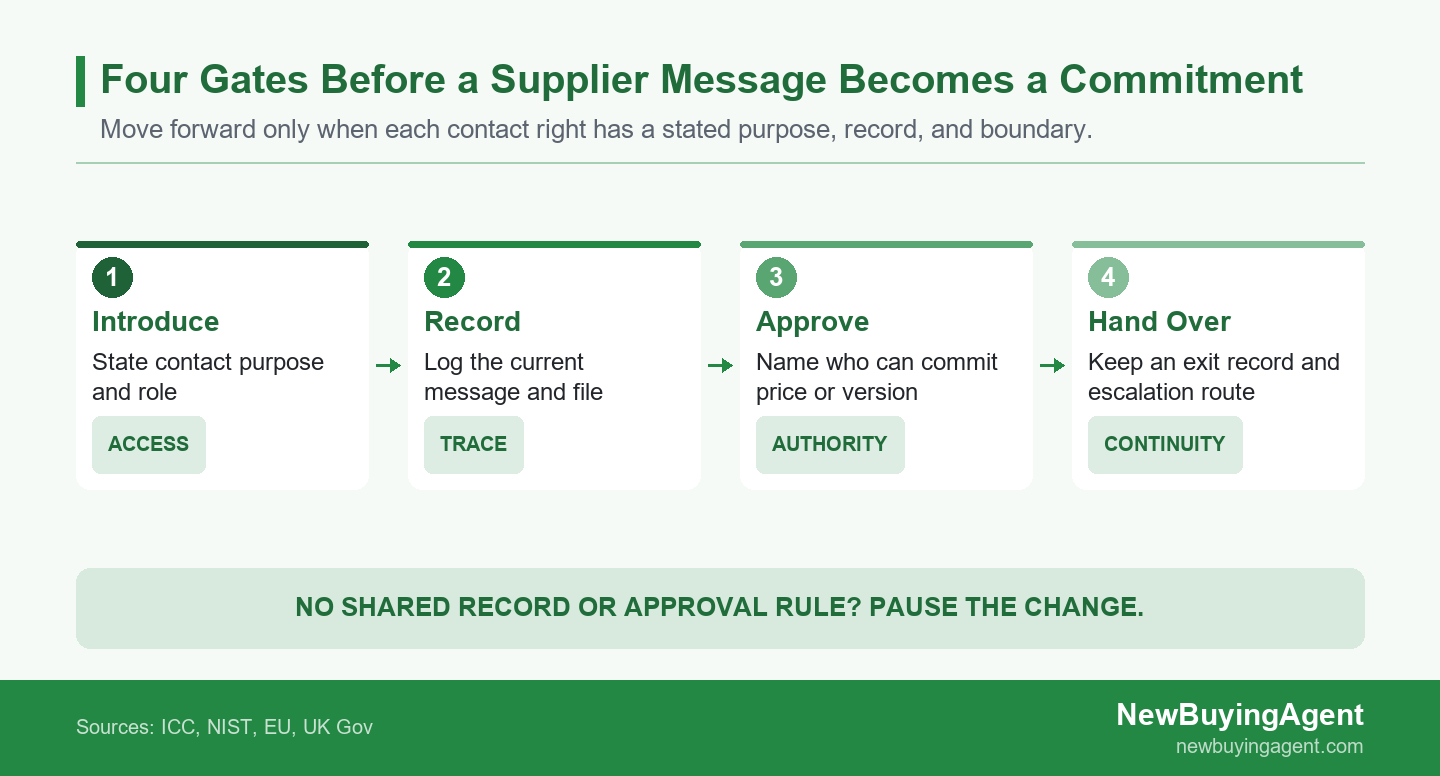
A four-step contact path shows introduction, shared record, named approval, and handover before a supplier message becomes a commitment
- Access: Name who may be introduced and why.
- Authority: Keep price, specification, payment, and release approvals with named people.
- Record: Put routine messages and current files in a shared, recoverable place.
- Continuity: Agree how the record and contacts are handed over if a person or relationship changes.
These four controls protect different things. Access makes communication faster. Authority protects the commercial decision. A shared record protects the current product and order version. Continuity protects the work when one person leaves, an agent's scope changes, or the buyer decides to handle future messages differently. Calling all four “contact ownership” hides the decisions that actually need agreement.
Use Four Lanes Instead of One Vague Contact Promise
A four-lane rule makes the purpose of each supplier contact channel visible before the first order. Think of the lanes as a traffic system. A person may move from an introduction into ordinary operating messages, but they do not automatically move into a lane where they can approve a commercial commitment. That distinction is especially valuable when buyer teams, China-side contacts, and supplier teams are in different time zones.
| Contact lane | What it permits | What it must not imply | Record to keep |
|---|---|---|---|
| Introduction | Meet the relevant people and state the purpose. | Authority to revise commercial terms. | Introduction date and business purpose. |
| Routine operation | Ask and answer product, sample, production, and packing questions. | Approval of a changed version. | Shared thread or controlled project log. |
| Commercial approval | Approve price, specifications, payment, or shipment release. | Authority inferred from being copied. | Named approver and dated acceptance. |
| Escalation and exit | Resolve urgent exceptions and hand over files. | Loss of access to the current record. | Escalation clock and handover pack. |
For a buyer starting a new sourcing program, this simple table can sit beside the product brief. The brief defines the product, quantity, target price, destination, and timing; the contact rule defines how people discuss that brief without changing it by accident. When those inputs are ready, a buyer can use NewBuyingAgent's product-supply service for a new China program with fewer unknowns around who sees a supplier message and who can approve the next version.
Lane 1: Introduction Does Not Create Approval Authority
An introduction should name the purpose of contact without silently granting approval authority. A clean introduction can say that the buyer's category lead will discuss requirements, the sourcing contact will coordinate routine questions, and only a named buyer approver can accept a revised price or product version. That wording is not formal for its own sake. It stops a friendly first message from becoming evidence of a commercial commitment later.
Use this lane for discovery, clarification, and relationship-building. If the buyer wants direct visibility, give the supplier a clear statement of where routine questions should go and where a decision must go. The supplier should not have to guess whether an enthusiastic response from a product designer means “please proceed,” nor should the buyer have to undo a promise made because someone assumed the wrong person held authority.
Lane 2: Routine Questions Need a Shared Record
Routine questions need a shared record so product, sample, production, and packing information can be checked later. A record can be a shared project email, a controlled workspace, or a versioned file log; the tool matters less than the rule that the current answer is visible to the people who need it. The NIST Cybersecurity Framework treats governance as a core part of managing risk, a useful principle when supplier information is spread across personal inboxes and private chat threads.
The record should identify the item being discussed, the version or date, the question, the answer, and whether a decision is still pending. It does not need to copy every casual message. It must capture the messages that could change the product, packing, price basis, timing, compliance evidence, or shipment plan. If an answer is only available in one person's chat history, the buyer has contact access but not dependable continuity.
Make Commercial Authority Explicit
The agreement should distinguish information requests from authority to approve price, specifications, payment, or release. Commercial authority means permission to make or approve a business commitment. Write the names or roles beside the four most consequential decisions: a price or payment change, a product or artwork change, a production start or restart, and a shipment release. Every other contact can gather information and recommend a choice without crossing that line.
This distinction matters more when the product has a market-specific requirement. For example, Trade.gov’s China standards guidance describes a standards and conformity-assessment environment that can affect market access. A buyer should not let a routine request for a label, test, or document become an implied approval of the underlying requirement. The right lane is: ask for information, put the evidence in the shared record, then have the named approver decide whether the requirement changes the product brief.
If the buyer is still defining responsibilities across a China sourcing project, it can help to read the China sourcing guide before turning the contact schedule into a live project rule. The point is not to make communication slow. It is to make the fast message traceable to the correct decision.
Treat Contact Lists and Documents as Controlled Business Information
Contact details and order records should have a stated purpose, access rule, retention rule, and exit handover. A contact list can contain personal data as well as commercial information, so the buyer should avoid treating it as an unbounded asset to circulate. The European Commission’s data-protection overview and the UK Government’s data-protection guidance both underline that personal-data handling carries responsibilities; the exact legal position depends on the parties and markets involved.
Keep the operating rule practical. State which business contacts may be used for product and order communication, which documents stay in the shared project record, whether access continues after the engagement, and what handover is due if a contact changes. Do not promise unrestricted forwarding, permanent retention, or access to every private channel. For a material data or contract question, obtain legal advice rather than relying on a sourcing playbook.
Apply the Contact Continuity Matrix to the First Order
A contact rule is usable only if normal updates, changes, urgent exceptions, and exit handover each have a named channel and record. The Contact Continuity Matrix is a fast test: take each of those four events and ask who communicates, where the current record sits, who can approve the next move, and when escalation begins. A blank answer is not a minor documentation gap; it is a warning that the relationship may rely on a single person. When the buyer already uses China suppliers, it can use NewBuyingAgent's factory-management service for suppliers you already use to support local communication, production updates, quality evidence, and logistics follow-up under that named approval rule.
Pause a shipment-critical change when the current file and approval channel cannot be confirmed together. That pause does not accuse the supplier or agent of bad faith. It prevents a buyer from producing against an uncertain version simply because an email chain looks busy. The matrix turns that moment into a decision: either confirm the named approver and current record, or stop the affected change until they exist.
Illustrative Scenario: A Packaging Change Crosses the Wrong Lane
A composite packaging change shows that a copied contact list does not replace a versioned approval record. Consider an illustrative 12,000-unit home-goods order with 2 carton-mark versions and 1 outer-pack label revision. The supplier sends a revised carton-mark file to a commercial contact in a private message. The buyer’s packaging lead still has the earlier file, and the contact list says nothing about whether a routine message can approve a packaging change.
The problem is not that the supplier had a direct contact. The problem is that the message crossed from the routine lane into the approval lane without a shared record. The same kind of gap can affect a product-safety or market-access requirement. For UK-bound products, UK product-safety guidance for businesses makes clear that businesses have responsibilities when placing products on the market; an untracked message is not a dependable way to handle those responsibilities.
The buyer pauses the affected change. The named approver compares the latest carton mark with the approved product and order record, then confirms the version in the shared log. Only after that confirmation does the supplier receive a production instruction. The pause costs minutes or hours now, but it avoids a much harder question after cartons are printed: which file actually governed the order?
The corrective action is a contact schedule with four fields: routine recipients, the approval sender, the controlled file location, and the escalation time for shipment-critical changes. This is an illustrative operating control, not a finding about any supplier or a conclusion about legal liability.
Put the Contact Rule Into the Engagement Brief
A one-page contact schedule should name the lanes, approvers, shared record, escalation time, and handover trigger. Put it in the engagement brief with the product scope, not in a separate memo that no one revisits. A useful schedule is short enough to use during an urgent message and specific enough to show whether the sender can request information, recommend a change, or approve it.
- Name each party’s operational contacts and the purpose of each lane.
- List the role that can approve price, version, payment, and release.
- Choose one shared location for current files and decision notes.
- Set an escalation clock for shipment-critical exceptions.
- Define the handover pack if a person or engagement changes.
Product responsibility should be mapped into the same schedule when the destination market requires it. The European Commission’s CE-marking guidance describes CE marking as a manufacturer’s declaration of conformity with applicable EU requirements. That is why a sourcing contact should never casually confirm a label, declaration, or test assumption unless the schedule identifies the relevant evidence owner and approval path.
Choose the Right Service Path After the Contact Rule Is Clear
A buyer should choose new-product sourcing or existing-supplier management after the contact boundary and product brief are clear. NewBuyingAgent is a one-stop China sourcing agent service provider for global buyers. For a new product program, the buyer can provide the specifications, quantity, target price, destination, timing, and contact schedule so NewBuyingAgent can use local China factory resources and product/QC capability to quote and supply China-sourced products. For an existing supplier relationship, the need may instead be local communication, production progress, quality evidence, and logistics coordination under the buyer’s named approval rule.
Keep the contact schedule alongside the purchasing brief and revisit it whenever the product version, decision maker, or supplier relationship changes. If your goods are entering Great Britain, the UK guidance on placing manufactured goods on the market is another reminder that manufacturer, importer, and distributor responsibilities need clear ownership. For a sourcing conversation, prepare that product context and contact rule, then compare NewBuyingAgent service options for your sourcing brief.
Frequently Asked Questions
Can a buyer contact a supplier directly after an introduction?
Yes, direct contact can be appropriate when the introduction rule states its purpose, shared record, and commercial approval boundary. A buyer may discuss product questions or build a working relationship without giving every contact the power to change a price, version, payment term, or release decision. Put the routine message in the agreed record and move a commitment to the named approval lane.
Who should own the supplier contact list?
The buyer should agree the permitted use, access level, record location, and exit handover instead of relying on a vague claim of ownership. The useful question is not who can keep every phone number. It is who may use which contact for product and order work, where the current record is held, and what files or access must be handed over if the relationship changes.
What approvals should never be implied by a supplier contact?
A supplier contact should never imply authority to approve price, specifications, payment, production changes, or shipment release. Those are commercial commitments, even when the request appears in an ordinary product message. The engagement brief should name the role that can approve each commitment and the record that proves the approval was made against the current version.
Does the rule change for an existing China supplier?
Yes, an existing-supplier rule should add production updates, quality evidence, escalation timing, and a named handover record. The commercial relationship already exists, so the main risk is usually that a critical change is handled in a private thread or an old file. Keep routine follow-up open, but require a shared record and named approval path for any change that can affect the supplied product or shipment.
NewBuyingAgent
Related Resources



Get Started Today
Let's Turn Your Sourcing Goals into RealityWeChat:+86 15157124615
WhatsApp:+86 15157124615
Address:Building 10 #39 Xiangyuan Road, Hangzhou, China