

For this decision, a split shipment is an order released in separate physical lots before the whole order is complete. It is worthwhile when a usable early lot protects more customer value than the extra cost of moving both lots separately.
For an importer buying from China, the choice starts with the demand that will go unserved while the remaining goods are finished. Identify a complete first lot that can reach the customer or warehouse in time, price the remainder as well, and compare the added cost with the loss that earlier delivery can realistically prevent. A high percentage of production completed is not enough to make that decision.
Split only when the first lot changes the outcome
Split when a releasable first lot covers a real service gap and its defensible benefit exceeds the extra total cost. Wait when existing stock covers the delay, the early goods cannot be used independently, or the proposed transport still misses the need. Keep an unknown fee or delivery assumption visible until it is resolved.
- How it works: Size the first lot around useful demand, then compare both complete delivery plans.
- Risk: Repeated charges, incomplete sets or a delayed remainder can erase the saving.
- Timeline: Compare when goods become usable, including clearance and receiving.
- Decision: Approve a split quantity, budget and expiry point together.
Establish what an early shipment can actually deliver
An early shipment has service value only if its contents can be sold or used in time to reduce the shortage loss or project delay caused by waiting. Count complete customer units: a table without its matching hardware may occupy warehouse space without satisfying an order. For a replenishment SKU, establish which sales genuinely disappear if stock arrives later and which customers will accept a backorder.
Agree who can authorize the extra dispatch and who will pay. The ICC explanation of Incoterms® 2020 distinguishes obligations, risk and cost allocation, while making clear that the rules do not replace the sales contract or settle most consequences of delay. An agreed trade term alone therefore does not establish a right to split an order or recover the extra freight.
Use the date the lot is available for its intended use, rather than the vessel or aircraft arrival alone. The World Bank’s logistics indicators separately examine speed, reliability and connectivity; those aggregate measures cannot supply this shipment’s delivery date. Ask the forwarder and consignee for the relevant arrival, clearance, delivery and receiving assumptions, then check whether the early lot still reaches the real need.
If waiting does not create a shortage or delay an agreed milestone, record that result before seeking an express rate. If the first lot does help, write down its useful quantity and latest usable date. Those two inputs keep the cost comparison focused on a result the buyer can actually obtain.
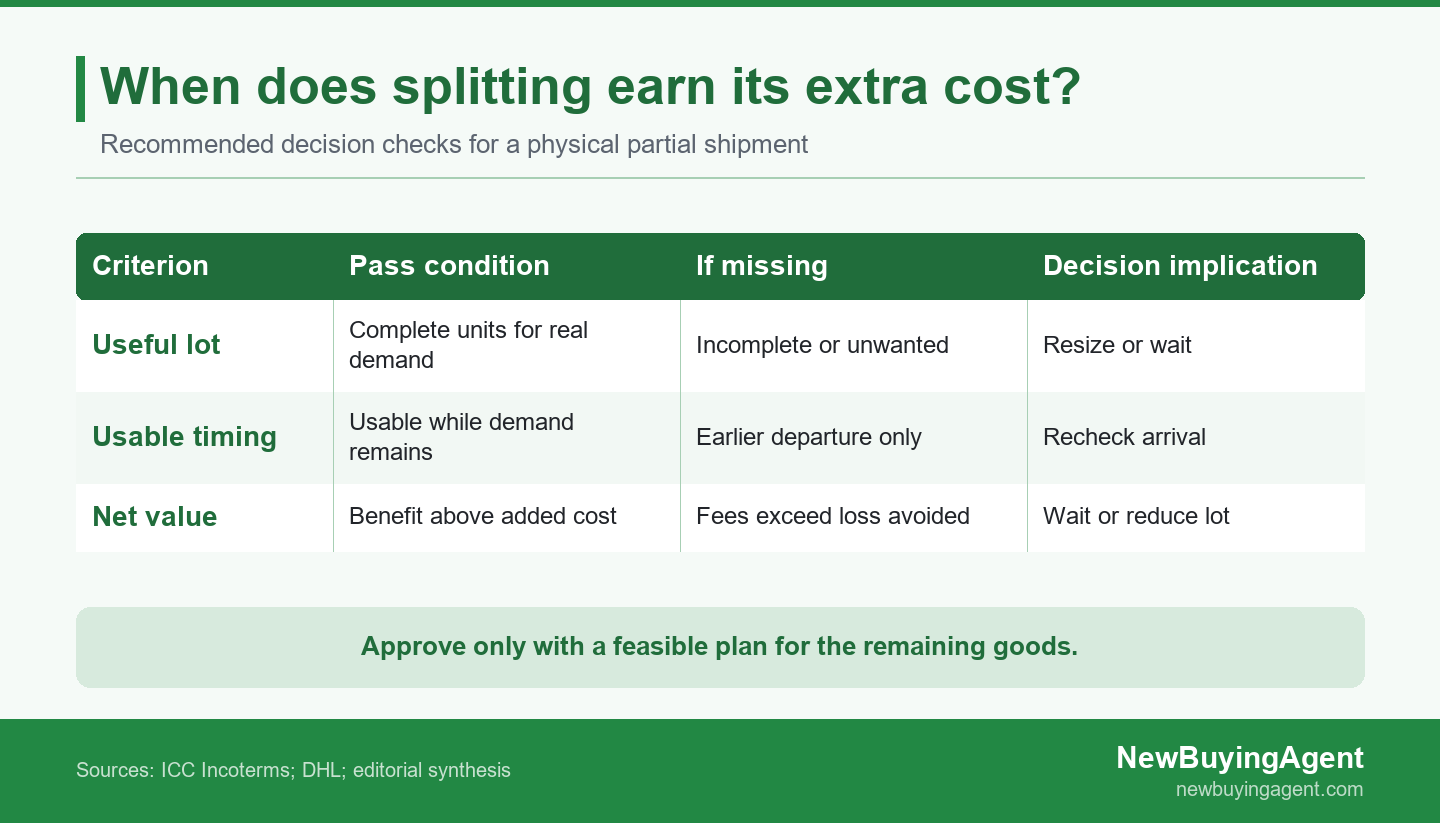
A useful early lot, timely delivery and a benefit above the extra cost are separate conditions for a split shipment.
Compare four ways to release the order
The useful first lot determines which transport options deserve a quote. Compare waiting with a ready-lot ocean departure, a smaller consolidated ocean lot, and a limited air bridge. The table uses the same total order, agreed quality and destination need; it compares operating conditions, not measured carrier scores or a universal volume cutoff.
| Release option | Service it can protect | Extra cost to test | Choose when |
|---|---|---|---|
| Wait for all | One complete delivery | Storage and delay loss | Stock covers the wait |
| Ready lot by ocean | Earlier usable bulk lot | Second dispatch and remainder | Earlier sailing meets need |
| Small lot by LCL | Modest lot moves alone | Both-end handling and minimums | Warehouse timing fits |
| Small lot by air | Urgent demand bridge | Chargeable weight and two deliveries | Avoided loss covers premium |
Based on this comparison, use the least costly feasible option that protects the required service. Less-than-container-load, or LCL, means sharing container capacity with other cargo; a full-container-load, or FCL, booking reserves a container shipment. Neither label establishes how quickly the goods will be usable. If no option meets the need, revise the customer commitment instead of approving a costly shipment with no time benefit.
Choose a complete, releasable first lot
Build the first lot from demand by SKU, not a percentage of the purchase order. Include complementary parts, labels, instructions and approved packaging needed for sale or installation. Confirm the actual lot’s quality-release status and any corrections still open. Shipping unfinished or rejected goods early merely moves the problem to destination; the buyer should retain its agreed release criteria.
Material shortages, mismatched components and unapproved packing can turn a nominally ready batch into an unusable first lot. NewBuyingAgent’s product-development and quality-control capability, supported by its local China factory resources, is relevant to checking those product and packing dependencies against the approved requirements before treating a lot as releasable.
For an air bridge, confirm that the actual products and packaging qualify for the proposed service before relying on its timing or price. The U.S. FAA’s dangerous-goods shipping guidance calls for appropriate classification, packing, marking and labeling, and notes additional carrier restrictions. Batteries, aerosols and similar goods may need different preparation or may not be accepted by the chosen carrier. Ocean readiness alone does not establish air readiness; obtain the route-specific acceptance and include any preparation time and cost.
Keep the comparison on the same delivery scope
Request prices through the same usable destination for the same total order quantity. Match currency, quote validity, collection points, packing assumptions and the division of charges between seller and buyer. A port-only figure cannot be compared directly with a door-delivery figure. Add the second receiving appointment and any document or handling charges that repeat; subtract costs genuinely avoided by splitting.
Also price the changed remainder. The Maersk Spot amendment guidance describes options showing vessel availability, deadlines, new freight charges and possible change fees. That is a product-specific example of why the original rate cannot simply be reused after a change. Ask the actual provider what stays valid, what is repriced and whether an accepted amendment or new booking is required.
Calculate the extra cost of splitting
Incremental split cost is the total cost of the split plan minus the total cost of waiting, with both plans covering all ordered goods through the same endpoint. Include the remainder, repeated fixed charges, storage and agreed recovery costs. A cost already committed under both options is not an extra split cost; an irreversible cancellation charge belongs in the option that incurs it.
Reprice both the first lot and the remainder
Use the packed dimensions and gross weight for each proposed lot. DHL Global Forwarding’s chargeable-weight explanation compares actual and volumetric weight and uses transport-specific density ratios. Repacking a small urgent quantity may therefore change its billed weight. Obtain the actual service’s calculation and minimum charge instead of applying one air or express divisor to every quote.
For an LCL option, check collection, origin warehouse handling, consolidation timing, destination release and final delivery. Maersk’s LCL terms distinguish service endpoints and exclude additional services such as repacking and palletization unless expressly agreed. Use that as a prompt to confirm the selected provider’s inclusions; it is not a tariff for every China-origin shipment. A low main-carriage rate leaves the comparison incomplete if the other charges remain unknown.
Keep a short cost bridge: first-lot transport plus remaining-lot transport, then repeated documentation, clearance, inland delivery, storage and other changed charges, less the comparable wait plan. Ask the customs broker whether additional entries or destination formalities are needed. Duties and taxes do not automatically disappear or double because an order is split; include only the actual change applicable to the goods and destination.
Value the service benefit without double counting
Use contribution, meaning sales revenue less the variable costs of fulfilling the sale, to value sales that earlier stock genuinely preserves. Delayed revenue is not automatically a lost sale. If customers will wait or buy an available substitute from the same business, adjust the assumed loss. Finance and sales should agree that behavior before the logistics team treats the forecast as a freight budget.
Add other avoidable effects only when they are distinct: an agreed project-delay charge, for example, may matter even when the goods are not sold individually. Do not count both the same lost contribution and a customer penalty that already compensates for that loss without checking the overlap. Compare a cautious benefit estimate with a complete extra-cost estimate; when their plausible ranges overlap, identify the uncertain input that could reverse the choice.
The assumed service benefit also depends on whether production and quality information can support the promised release. For recurring orders with existing suppliers, NewBuyingAgent’s factory-management service covers supplier communication, production progress, quality management and logistics coordination within the agreed service. That broader China-side support is relevant when the buyer needs dependable readiness information across repeat orders, instead of repeatedly making freight decisions from an unfinished-production estimate.
A replenishment example that changes with the assumptions
The following illustrative example uses hypothetical demand, dates and USD costs, not a client shipment or current freight quotation. A buyer has an order for 1,000 identical, independently saleable home-storage units. It can release a small approved lot early while the remainder finishes. The decision concerns a temporary stock gap, with no project penalty or extra brand-value estimate included.
Base case: a small early lot bridges the stock gap
Assume opening stock is 120 units and demand is 30 units per calendar day. That stock serves days 1–4. Waiting makes the full order usable at the beginning of day 8, leaving a 90-unit gap on days 5–7. A confirmed early plan would make 100 units usable at the beginning of day 5; the remaining 900 units become usable at the beginning of day 8. The early lot covers the gap, with 10 units left.
Assume the wait plan costs USD 2,600 through the warehouse. The split plan costs USD 3,700 for both lots: USD 1,150 for the early lot’s transport and delivery, USD 2,250 for the remainder, and USD 300 for additional document and receiving charges. All figures are assumed matched-scope costs. The extra spend is USD 3,700 − USD 2,600 = USD 1,100.
If all 90 unavailable units would be permanently lost sales at USD 20 contribution each, the early lot preserves USD 1,800. The split’s net advantage is USD 1,800 − USD 1,100 = USD 700. The budget owner can prefer splitting under these assumptions; valuing all 100 early units as saved sales would overstate its benefit. The shipment still needs the lot and delivery confirmations assumed by the calculation.
Change the quantity, delay or retained sales
Now assume only 40 of the 90 sales would be lost, because the other customers accept the delay. Avoided contribution falls to USD 800, below the USD 1,100 extra spend, so waiting is financially preferable on the stated service measure. The break-even point is 55 permanently lost sales at USD 20 each; a larger claimed benefit needs evidence of additional, non-overlapping loss.
A smaller first lot also deserves a quote. If 50 early units cost USD 750 extra, they preserve at most USD 1,000 in this example, giving USD 250 net advantage. That is below the 100-unit option’s USD 700 advantage when all 90 sales are at risk, but it may be the feasible choice under a tighter budget. Finally, if the early lot becomes usable only on day 8, it protects none of the temporary gap. Recalculate from the new facts rather than keeping the first approval.
Approve both shipments before releasing the first
A split decision needs two executable shipment plans, including the remainder’s production, quality release, transport and payment arrangements. Confirm that removing the first lot will not leave mixed cartons, unusable component sets or an uneconomic balance. Give each lot its own quantity and document references, then reconcile both to the purchase order so the same goods are not invoiced or counted twice.
The DCSA booking and bill-of-lading technical guide distinguishes booking-only fields from shipping-instruction fields. Updating shipping instructions alone therefore does not amend every booking detail. Ask the carrier or forwarder to confirm the required changes and accepted arrangements for each lot, while the seller and buyer agree any commercial amendments separately.
Reconcile each physical lot’s product quantities, packages and weights to the order and use the documents appropriate to its actual mode. The U.S. International Trade Administration’s common export document guidance distinguishes a packing list from a commercial invoice and an air waybill from an ocean bill. Do not copy the full order quantity onto both lots. Confirm the actual route’s document and filing requirements with the responsible party rather than applying U.S. export procedures to every China-origin shipment.
Use a short decision record with an expiry point
Record the first-lot SKUs and quantities, both usable dates, the wait cost, the full split cost, avoidable service loss and the net difference. Add unresolved inputs, who confirms each one, and the last time the quote and loading plan remain actionable. The approver should choose “split,” “wait” or “hold pending a named fact,” rather than authorize an undefined premium.
Split-versus-wait approval record — complete with the actual order inputs:
- Decision and approver: ___; order reference: ___.
- First-lot SKU and released quantity: ___; remaining quantity: ___.
- First lot usable by: ___; remainder usable by: ___.
- Comparable wait cost: ___; complete split cost: ___; added cost: ___.
- Defensible benefit and basis: ___; net advantage: ___.
- Open fact, confirming owner and next check: ___.
- Cost allocation agreed with: ___; approval expires at: ___.
If that readiness gap affects a continuing purchasing program, prepare product specifications, quantity by SKU, target price, destination, required usable dates and the current sourcing situation. Those inputs support a discussion of complete product supply or agreed existing-factory management, using the factory and product/QC capability behind the order. To establish the appropriate scope, send the purchasing requirements to NewBuyingAgent.
Frequently Asked Questions
Should the supplier pay for the extra split-shipment cost?
Responsibility for extra freight depends on the sales contract and agreed remedy, not simply on who requested the split. Establish why the delay arose, which party accepted the delivery obligation and whether a partial delivery is authorized. Record the agreed allocation before dispatch. If responsibility is disputed, keep that dispute separate from the immediate service decision, and obtain appropriate contract advice rather than assuming the trade term settles compensation.
Can a letter of credit prevent a split shipment?
A split must comply with the actual letter of credit and its documentary conditions. ICC Opinion R843 concerns a credit that permitted partial shipments while imposing specific certificate requirements; it illustrates why the wording matters. Have the seller and the relevant bank check partial-shipment conditions, shipment dates and required documents before changing the physical plan. Do not treat a buyer’s internal approval as an amendment to the credit.
Is a split shipment the same as a split bill of lading?
Separating transport documents does not necessarily create an earlier physical shipment. Two document sets can still accompany goods moving on the same departure, while a true early release requires a different usable delivery outcome. Explain the intended physical lots and dates to the provider, then ask which booking and document structure matches them. Keep the commercial quantity reconciliation clear regardless of how the transport documents are issued.
What if the cost of waiting cannot be estimated reliably?
Use a decision range and identify the missing input that would change the choice. In the example, USD 1,800 of defensible benefit leaves USD 700 above the known USD 1,100 premium. An unresolved extra charge above that margin can remove the advantage. Assign its confirmation before the approval expires; if the unknown cannot be bounded and service is not contractually essential, hold the split decision rather than treating missing cost as zero.
NewBuyingAgent
Related Resources



Get Started Today
Let's Turn Your Sourcing Goals into RealityWeChat:+86 15157124615
WhatsApp:+86 15157124615
Address:Building 10 #39 Xiangyuan Road, Hangzhou, China
