

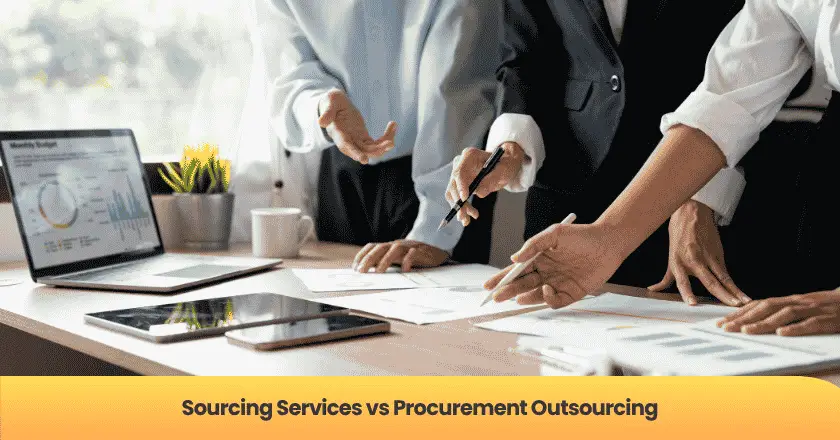
A homeware brand with fourteen products and one overworked founder signs what the proposal calls a procurement partnership. Nine months later the relationship is tense. The provider is producing category spend reports and supplier scorecards, and the founder wanted somebody to find a better hinge supplier and stop the lids arriving warped. Both sides delivered exactly what they thought was agreed. The words in the contract were doing two different jobs.
Sourcing services and procurement outsourcing get used as though they were the same purchase. They are organised around different units of work, measured differently, and priced differently, and picking the wrong one produces a well-run engagement that solves the wrong problem.
Key Takeaways
• Sourcing services are organised around a product, while procurement outsourcing is organised around a process or category.
• Outsourcing means handing a supplier a function your own team used to perform, which is a structural change rather than a project.
• Sourcing engagements are judged on deliverables, and outsourcing engagements are judged on service levels and spend outcomes.
• Procurement outsourcing usually reaches into indirect spend, which most importers never treat as a sourcing question at all.
• Growing importers commonly end up running both, with sourcing services on direct goods and outsourcing on everything else.
Two Different Units of Work
The clearest way to separate the two is to ask what the engagement is counted in. One counts products. The other counts processes and categories.
Sourcing Services Are Organised Around a Product
A sourcing engagement starts with something you want made. The work runs from supplier identification through quotation, sampling, production oversight, inspection and shipment, and it ends when goods land. Add a second product and you generally add a second engagement.
The professional body CIPS distinguishes tactical sourcing, which is reactive and short-term, from strategic sourcing, which is planned and built on analysis of supply markets. Most China sourcing services sit closer to the tactical end even when the relationship is long-running, because the unit of work stays the individual product.
Procurement Outsourcing Is Organised Around a Function
CIPS defines outsourcing as handing an operation, process or function that the procurement team previously performed to an external supplier instead. The unit is the activity, not the item, and the engagement continues whether or not any particular product is being bought this month.
In practice that covers purchase order processing, supplier onboarding, contract administration, spend analysis and category management, which is the ongoing management of spend within a defined area. Indirect spend, meaning everything you buy that does not go into your product, is the most commonly outsourced portion because it is fragmented and nobody internally owns it.
The vocabulary overlaps because both markets sell to the same buyer. Sourcing companies describe themselves as procurement partners because it sounds more strategic. Outsourcing providers advertise sourcing capability because clients ask for it. Neither is misrepresenting anything, and the words on a website will not tell the two apart. The contract and the fee structure will.
Expert Tip: Ask what happens to the engagement in a month when you place no orders. A sourcing service goes quiet, which is correct and costs you nothing under a commission model. An outsourcing arrangement continues, because you are paying for a function to exist rather than for transactions to happen. That single question separates the two faster than any capability discussion, and it also tells you whether the fee structure on the table matches the thing being sold.
What Actually Transfers
Both arrangements move work outside your business. What differs is how much decision-making and infrastructure goes with it, and that difference determines how hard each one is to reverse later.
Execution Against Decision Rights
Sourcing services execute decisions you make. They recommend suppliers and you approve, they negotiate within limits you set, they inspect against a standard you signed. Authority stays with you, which suits buyers who care about specification and want to remain close to their products.
Outsourcing typically transfers a degree of decision-making as well. A provider running your indirect categories may select suppliers within policy, issue purchase orders and manage renewals without asking each time. That is the point of the arrangement, and it is also the part buyers underestimate when they sign.
Outsourcing can also involve people moving. Where an internal purchasing role is absorbed by a provider, the arrangement affects employment as well as process, and CIPS notes that outsourcing decisions can reach a wide range of jobs. Sourcing services rarely touch this, since they add capacity rather than replace an existing function.
Systems, Data and Where the Records Live
This is the practical difference nobody discusses until implementation. Sourcing services produce documents that arrive in your inbox and live in your own files. Outsourcing engagements usually involve integration with a system, whether yours or the provider's, and the records accumulate there.
Ask early where the data sits and what happens to it at the end of the contract. Spend history, supplier records and contract terms are assets, and an engagement that ends with those records inside somebody else's platform leaves you weaker than when you started.
Common Mistake to Avoid: Buying procurement outsourcing when the actual problem is one product line is the most expensive version of this confusion. Outsourcing carries setup cost, process design, integration work and a fee that runs whether or not you buy anything, and none of that helps if what you needed was a better factory for a single item. The reverse error is quieter and just as costly: running a growing multi-category business through repeated one-off sourcing projects, and paying the coordination cost yourself, every time, forever.
How Each One Is Measured and Paid
Measurement follows the unit of work, and so does the contract that sits around it.
Deliverables Against Service Levels
Sourcing engagements are best judged on documents: a verified shortlist, a comparable quotation matrix, a signed specification, inspection reports, a document pack. Each either exists or does not, and completion is visible.
Outsourcing engagements are judged on service levels and outcomes over time. Typical measures include cycle time from requisition to order, percentage of spend under contract, supplier onboarding time, and savings against a baseline. Those measures only work if the baseline is agreed honestly at the start, which is where most disputes in these arrangements originate.
Baselines deserve their own negotiation. A savings target measured against last year's prices rewards a provider for market movements it did not cause, in either direction. Agree what the baseline is, who calculates it, and how it is adjusted when volumes or specifications change. Doing this at the start takes an hour and prevents an argument that otherwise recurs every quarter.
Fees, Contract Length and Exit
Sourcing services commonly charge commission on order value, a fixed project fee or a retainer, with short commitments and easy exit. Outsourcing contracts run longer, often multi-year, with a managed service fee and sometimes a shared-savings element. Longer terms are not a trap, since the provider is carrying setup cost that only amortises over time.
Exit provisions deserve real attention in the longer form. Transition assistance, data return, supplier contract novation and a defined notice period all belong in the agreement. Standard frameworks such as the model contracts published by the International Chamber of Commerce give buyers without in-house legal support a reasonable starting point.
Expert Tip: Negotiate the exit before the launch, while you are still the party with options. I ask three questions at proposal stage: what do I receive on termination, in what format, and how long does transition support last. Providers who answer crisply have done this before and have nothing to hide. The ones who treat it as a strange question at the start of a relationship are exactly the ones you will struggle with at the end of it.
Choosing Between Them, and Using Both
The choice is less about company size than about where the work is actually piling up.
Which Fits Your Situation
Sourcing services fit when the bottleneck is finding and controlling production. New products, new categories, quality problems, cost pressure on goods you resell: all of these are product problems with product answers. Most importers under a few million in purchasing sit here permanently and are right to.
Procurement outsourcing starts to make sense when the bottleneck is administration rather than supply. Signals include purchase orders processed by hand, no visibility of total spend by category, contracts renewing unnoticed, and a founder or finance lead absorbing procurement admin that has no owner.
Sequencing matters when both gaps are real. Fix the product side first in most cases, because supply problems damage revenue while administrative drag damages margin, and revenue problems compound faster. The exception is a business where purchasing errors are already causing stockouts or duplicate payments, in which case the administration is the supply problem.
The Hybrid Most Growing Importers Land On
The common end state is a split by spend type. Direct goods, the things you sell, stay with a sourcing service where product knowledge and factory relationships matter. Indirect spend, from packaging consumables to freight administration to software, goes to whoever can process it efficiently.
That split works because the two kinds of spend reward different things. Direct spend rewards specification control and supplier depth. Indirect spend rewards process efficiency and aggregation, and there is little value in your own team touching it at all.
Expert Tip: Map your spend before buying either service. Two columns, direct and indirect, with annual value and the number of suppliers in each. Most importers discover their indirect supplier count is far higher than expected and that nobody has ever negotiated any of it. That single page tells you which arrangement to buy first, and it takes an afternoon rather than a consulting engagement to produce.
Where NewBuyingAgent Fits on the Direct Side
NewBuyingAgent is your perfect partner for global sourcing from China, backed by 30 years of expertise in trade, manufacturing and quality control. Its mission is to make China sourcing effortless and profitable for global buyers.
Direct spend is where product knowledge earns its keep, and where the coordination load falls hardest on small teams carrying several categories at once.
NewBuyingAgent handles all factory communication—perfect for multi-category buyers. Free up your time to focus on expanding your local market sales.
Only less than 5% of China's factories are within your reach. NewBuyingAgent gives you 100% Access to China's Factories through its 50,000+ cooperated partner factories—no language/region/time zone barriers. Its local reputation gets you full factory cooperation.
Frequently Asked Questions
Is a sourcing agent the same as procurement outsourcing?
No. A sourcing agent works on products, finding and managing suppliers for goods you specify. Procurement outsourcing transfers a business function, such as purchase order processing or category management, to a third party. The confusion is common because providers on both sides use overlapping marketing language.
Can procurement outsourcing handle China sourcing?
Some providers do both, though the skills differ. Managing indirect spend efficiently is a process discipline, while sourcing a moulded part from a Chinese factory is a product and relationship discipline. Ask which of the two a provider actually staffs for, and ask to see work product from a comparable engagement.
What size of business should consider procurement outsourcing?
It turns on spend complexity rather than headcount. A business with many small suppliers, fragmented categories and manual purchasing can benefit well before it feels large. A business buying three products from four factories rarely gets value from it, however much it spends in total.
Can I run both arrangements at once?
Yes, and it is the usual end state for growing importers. Direct goods stay with a sourcing service where factory knowledge matters, and indirect spend goes to a process-focused provider. Define the boundary in writing, since overlapping mandates on the same category cause more friction than either arrangement alone.
How long does a procurement outsourcing engagement take to show results?
Process improvements such as faster order cycles usually appear within a quarter, since they come from removing manual steps. Savings against a spend baseline take longer, commonly a year or more, because contracts have to reach renewal before they can be renegotiated. Sourcing engagements show results faster simply because a single product cycle is shorter than a contract cycle.
Conclusion
Decide what you are actually short of before you shop. If the gap is finding factories and controlling what they build, buy sourcing services. If the gap is administration, visibility and contract discipline across many small suppliers, buy procurement outsourcing. Buying the wrong one produces a competent provider working hard on a problem you did not have.For the direct side of that split, NewBuyingAgent handles factory selection, quality control and delivery from China.
Partial Sources
1. Chartered Institute of Procurement & Supply — Outsourcing: definition and guide —https://www.cips.org/intelligence-hub/sourcing/outsourcing— accessed 19 August 2026
NewBuyingAgent
Related Resources
Get Started Today
Let's Turn Your Sourcing Goals into RealityWeChat:+86 15157124615
WhatsApp:+86 15157124615
Address:Building 10 #39 Xiangyuan Road, Hangzhou, China
