

After a BSCI or Sedex-related audit, review the original finding, its cause, the workers affected, evidence of improvement and the applicable verification route. Then decide whether the next order can proceed under your sourcing policy. A supplier marking an action complete is only one part of that decision.
Social audit corrective actions are measures to address identified labor, safety or other social-compliance problems and prevent their recurrence. An immediate correction fixes the observed problem; a corrective action also tackles why it happened.
What Must Be Clear Before You Approve the Next Order?
A usable post-audit review connects each finding to the responsible person, the affected workers, the evidence needed and the next purchasing decision. Ask the supplier to explain what changed, while separately establishing who can verify that change. Keep any unresolved worker risk and purchasing restriction visible so the order team does not mistake progress for permission to release production.
- Problem and cause: Which finding is being addressed, and why did it arise?
- Worker outcome: Who was affected, and what evidence shows the remedy reached them?
- Verification: Does this finding need document review, worker testimony or an on-site follow-up?
- Order conditions: What must be satisfied before approval, and who can authorize it?
Start with the Full Report and the Correct Factory
Start with the complete audit report for the facility that will make your goods, together with its corrective-action record and subsequent updates. Check the factory identity, address, audit date, scope and production location against the order. A report for another site, or a summary without the underlying finding, cannot establish whether your proposed production is covered by the review.
Sedex is a supply-chain data platform; SMETA is its social audit methodology. Sedex explains that SMETA audits provide a corrective action plan and are conducted by approved Affiliate Audit Companies. Where the report uses CAPR, this means Corrective Action Plan Report: the audit record of findings and agreed actions. Use the finding reference to connect the supplier's response to the original issue.
Supplier action, independent verification and buyer approval are separate decisions. The supplier describes and documents the remedy; verification tests whether the relevant change occurred through the applicable method. The buyer then considers the verified result alongside its purchasing policy and order conditions. Because these decisions use different evidence and authority, an uploaded completion record cannot by itself establish either verification or approval.
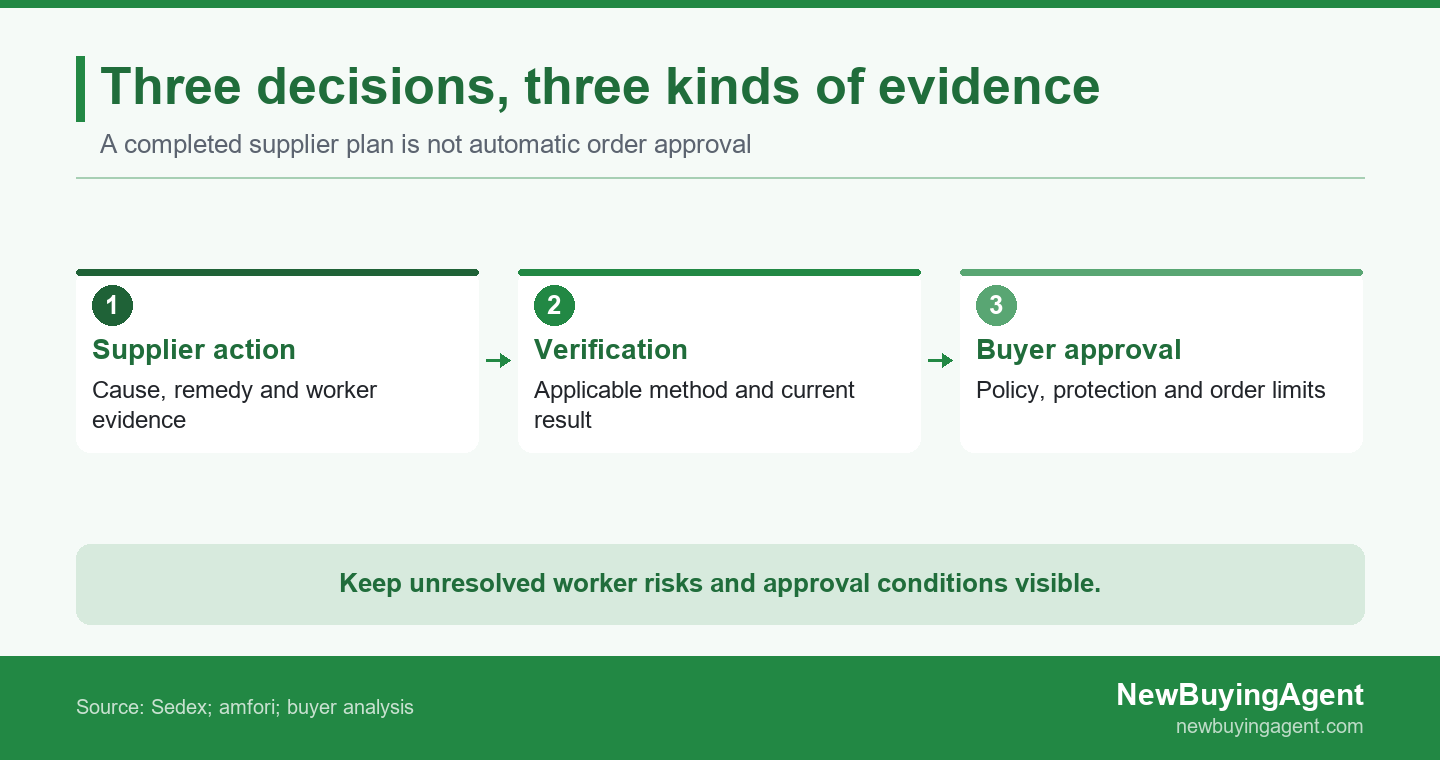
Supplier action, independent verification and buyer order approval remain separate decisions.
For a new sourcing project, the China sourcing guide provides the wider purchasing context. Keep product specifications, the actual manufacturing site and approved subcontracting arrangements consistent with the audit records. If production moves, confirm the new site's status before relying on the original facility's report.
Prioritize Worker Harm Before Administrative Closure
Prioritize the risk to people before the convenience of closing a record. Distinguish an immediate safety threat or serious wage problem from a missing administrative document, then establish the protective action needed now. The audit classification matters, but the buyer also needs to understand the actual exposure, the workers affected and whether placing more production could make the problem worse.
The OECD due diligence guidance recommends prioritizing action by the severity and likelihood of adverse impacts; for human rights risks, severity takes precedence where delay could make harm irremediable. This supports a risk-based review rather than handling every open item in chronological order. It does not create a universal BSCI or SMETA purchasing threshold.
Ask who remains exposed, what immediate protection is in place and what evidence is missing. Where serious harm is unresolved, escalate to the person authorized under your sourcing policy to hold or restrict the order. Check applicable local law and current scheme instructions for the particular issue; neither a delivery deadline nor an attractive price removes those requirements.
Check Whether the Action Removes the Cause
An effective action explains why the finding arose and changes the process that allowed it to recur. Reopening an exit may correct a visible obstruction, but the factory also needs to stop production or storage routines from blocking it again. Review the immediate remedy and the prevention measure separately, with a named owner who has the authority and resources to carry them out.
For excessive overtime, a revised policy alone leaves the practical question unanswered: can the factory deliver the order within the permitted working schedule? Review capacity, staffing, production timing and the way order changes are approved. Buyer-side rush requests can undermine a factory's planned hours, so compare the proposed commercial terms with the corrective action before treating the plan as workable.
Worker involvement also matters. The ILO guidance on occupational safety and health management systems treats worker participation and continuing improvement as elements of preventive safety management. For a safety finding, ask how workers can report the problem and whether supervisors act on those reports. A training attendance sheet shows participation in an event, not that a hazardous routine has stopped.
When developing a new product order, NewBuyingAgent's product-supply service combines local factory resources with product development and quality control. Clear specifications, quantities and achievable production timing give the supply team a basis for a concrete product offer. That commercial planning should respect the buyer's approved social-compliance conditions; product inspection cannot substitute for social-audit verification.
Match the Evidence to the Finding and Affected Workers
Select evidence that can show the particular change you need to establish. A photograph can help demonstrate a physical alteration; a wage finding needs records that reconcile the amounts owed and paid to the affected workers. Define the worker group and the period covered before judging completeness, because a well-prepared sample may still leave the underlying exposure unresolved.
The UN Guiding Principles on Business and Human Rights, Principle 20 describe tracking responses through qualitative and quantitative indicators and feedback from relevant stakeholders, including affected people. Applied to buyer review, this means pairing records of action with evidence of the worker outcome. The principle is general due diligence guidance, not a rule that every audit finding uses the same evidence package.
For repayment, reconcile the affected population, the calculation basis, payment records and outstanding exceptions. For working hours, compare attendance and payroll records with actual production periods and ask whether the new schedule has been followed. For an exit obstruction, consider both a dated image of the cleared route and a later check during normal production, when the original pressure to block it could return.
Keep sensitive evidence within an appropriate access process. Use redacted records where practical, and arrange worker feedback through a suitable confidential verification process that reduces retaliation risk. Buyers need enough evidence to make the decision; circulating personal payroll details or asking a supervisor to select and coach workers can weaken both privacy and credibility.
Use the Right Verification Route
Choose the verification route according to what must be observed, rather than the easiest file to submit. Some changes can be assessed from documents; others require a visit, extensive record review or confidential worker testimony. Confirm the route with the applicable scheme and audit company before accepting closure, and retain the finding reference, verification date, result and any remaining limitation in your purchasing record.
The SMETA audit guide distinguishes desktop review from on-site follow-up. Documents or photographs can support desktop verification where adequate, but the guide says an action requiring worker testimony cannot be verified through desktop review. An on-site follow-up can include worker interviews, extensive records review or a site tour. The guide requires booking a follow-up with the same Affiliate Audit Company used for the previous audit. Confirm the applicable arrangements before booking.
Separate BSCI Improvement Updates from Audit Verification
In amfori BSCI, ask what the platform status actually records. The amfori guidance on Continuous Improvement describes suppliers creating measures, completing them and marking a sustainability impact complete. That is a supplier update within the improvement process. A buyer should still examine the evidence and establish whether any further monitoring is needed; the completion label alone does not demonstrate an independently verified outcome.
If monitoring is required, identify the member responsible for requesting it. According to amfori's audit-request instructions, only the RSP holder can request a monitoring activity on the platform. RSP here refers to the member holding that responsibility. Ensure the request concerns the correct business partner and site, rather than asking the supplier to arrange an unspecified review with no recognized platform owner.
Record which stage is complete: supplier measures, evidence review or subsequent monitoring. Confirm the current requirements with the responsible member instead of importing a deadline or closure rule from another audit system.
Treat SMETA Collaborative Findings Differently
A SMETA Collaborative Action Required finding, or CAR, calls for a different conversation from an ordinary issue that an auditor can validate as closed. In its April 2026 consultation update, Sedex states that CARs have no criticality rating or remediation deadline and cannot be validated by auditors. The update discusses further development of this approach; check current Sedex instructions for the finding you are handling.
For buyer review, ask what cooperation is needed, what the supplier and relevant partners can change, and how progress will be demonstrated. Keep the buyer's own order conditions explicit, but do not present a commercial milestone as a Sedex closure deadline. A missing auditor-validated closure is not automatically evidence of failed remediation for this category, just as the collaborative label is not automatic purchasing permission.
This distinction also helps avoid wasted requests. Establish whether the report lists an ordinary finding or a CAR before demanding a close-out result that the applicable method does not provide.
Translate Open Findings into a Purchasing Decision
Turn the review into an order decision with an owner and a clear trigger for reconsideration. Approval, restricted progress and a hold should follow the buyer's policy and the seriousness of the unresolved issue. Conditional progress is appropriate only where policy permits it and worker protection is supported; it must identify what activity is allowed, what remains prohibited and what evidence could change the decision.
The comparison below uses illustrative finding types to show how the evidence question changes. It is a buyer review aid, not a scheme rating table or a substitute for the audit company's finding-specific instructions.
| Finding | Evidence to review | Verification question | Purchasing implication |
|---|---|---|---|
| Blocked exit | Cleared route and prevention routine | Does it remain usable during production? | Address immediate exposure before further production approval. |
| Unpaid overtime | Affected-worker reconciliation and repayment records | Did the remedy reach the full affected group? | Do not equate a partial payment sample with complete remedy. |
| Excessive hours | Attendance, payroll and capacity plan | Are actual hours consistent with the revised schedule? | Align the proposed order load with verified capacity and policy. |
| Collaborative SMETA finding | Agreed responsibilities and documented progress | What evidence shows meaningful cooperative action? | Apply buyer conditions without inventing auditor closure. |
Based on this comparison, select the evidence and verification needed for the specific finding, then state the resulting order restriction. Avoid a vague instruction to proceed cautiously: identify the approval authority, the permitted activity and the missing evidence so purchasing and production teams can follow the same decision.
Example: Overtime Evidence Covers Only Part of the Workforce
In an illustrative order for 2400 tote bags, overtime repayment evidence covers only 20 of the 80 production workers. The supplier has marked its action complete and sent payment slips, but the buyer has not established the full affected group. The scenario illustrates an evidence gap, not a reported client case or a conclusion that every production worker was underpaid.
The missing step is a reconciliation between the audit period, the affected workers, the amount owed and the payments made. Without it, the buyer cannot tell whether the supplied slips cover everyone entitled to repayment or merely the easiest records to collect. A new payroll procedure may prevent future mistakes, but it does not answer whether the original workers received the remedy.
The buyer holds approval of the new order while requesting that reconciliation and evidence for any outstanding payments. It also asks how working hours and production scheduling will be controlled for the proposed order. The supplier names the people responsible for repayment and scheduling, while the buyer identifies who can authorize release under its policy once the required conditions are met.
The next decision depends on the evidence, not another completion email. Where worker testimony is required, the appropriate independent verification must establish the relevant worker outcome through the applicable route. The buyer then reviews the result, unresolved exceptions and policy conditions before changing the hold. Until that review is complete, the example provides no basis for claiming that the finding or the purchasing restriction is closed.
Keep the Improvement Plan Connected to Production
Hand the purchasing and factory teams an action record they can use during production: finding reference, responsible person, expected worker outcome, evidence required, verification route and the order limit currently in force. Record milestones from the applicable instructions and agreed plan rather than inventing one universal deadline. If the approved site, production load or subcontracting changes, send the change back to the person responsible for the compliance decision.
For an established supplier, NewBuyingAgent's China-side factory management brings local factory coordination and quality-control support into the production process. That helps the buyer keep approved product requirements, production arrangements and quality follow-up connected. Share the social-compliance conditions that the buyer has authorized so routine coordination does not accidentally bypass an order hold. Scheme-specific verification remains with the appropriate responsible party.
For a new purchasing project, send the purchasing requirements with product specifications, quantity, target price, destination and delivery timing. Include the relevant audit report and any open finding or approved order condition. NewBuyingAgent can use the commercial requirements for a product-supply offer supported by its local factory resources, product development and quality control. Keep approval of any unresolved social finding within the buyer's sourcing process.
Frequently Asked Questions
What if the supplier will not share the full report?
Ask the supplier to establish an authorized access route for the audit report and corrective-action record, with appropriate handling of confidential information. Agree who needs access and which personal details can be redacted without hiding the finding, scope or evidence. A completion summary alone leaves the review incomplete. If the needed information remains unavailable, record that limitation and refer the order decision to the buyer's authorized compliance owner rather than assuming approval.
What if production moves after the audit?
Recheck the receiving facility and the buyer's approval conditions before transferring production, because the original site's audit does not establish the new site's status. Identify the manufacturing address, activities and subcontracting arrangement, then ask the responsible compliance owner what site-specific evidence or monitoring is needed. Keep the transfer outside any existing approval until that review is resolved. A passing product inspection at the new location does not answer its social-compliance evidence gap.
What if the original SMETA audit company cannot arrange the follow-up?
Confirm the permitted route with Sedex and the responsible audit company before appointing a replacement, since the guide specifies the same company for follow-up. Explain the booking problem, the original report reference and the finding that needs verification. Do not assume another approved company's review will satisfy the required process, or turn the scheduling difficulty into evidence of closure. Keep the relevant purchasing restriction in place while the authorized arrangement is clarified.
What if worker feedback conflicts with the supplied records?
Treat conflicting worker feedback and records as an unresolved evidence question, then arrange appropriate independent follow-up while protecting the people who raised the concern. Check whether the documents cover the same workers, period and issue described in the feedback. Preserve the discrepancy rather than asking a supervisor to obtain reassuring statements. The responsible reviewer should determine what further verification is needed; the buyer's decision must acknowledge the uncertainty until the relevant evidence is reconciled.
NewBuyingAgent
Related Resources


Get Started Today
Let's Turn Your Sourcing Goals into RealityWeChat:+86 15157124615
WhatsApp:+86 15157124615
Address:Building 10 #39 Xiangyuan Road, Hangzhou, China
