
A restricted substance declaration is a supplier’s statement about whether specified substances meet defined requirements in identified materials or products. A laboratory test report records what a method found in the tested sample. Evidence is sufficient only when its basis and coverage answer the applicable requirement for the goods you will receive.
A genuine report marked “pass” can still be insufficient for an order containing an untested material or color. Conversely, a well-supported declaration can contribute useful evidence where the applicable rules permit it. Before choosing either document, define the product, destination market, substance requirement and material scope you need to approve.
Which Evidence Supports Your Product Decision?
A supplier declaration describes an assertion and its basis; a laboratory report records results for the tested sample and method. Neither alone establishes every requirement for every ordered product. Use the applicable rule to determine any mandatory testing, then assess whether the supplied evidence is credible and linked to the actual materials, components and product version being purchased.
- Name the requirement: specify the market, substance, limit and covered material.
- Assess the basis: distinguish supported supplier information from a blanket assurance.
- Check test coverage: match the method and tested sample to the question.
- Control changes: resolve new material or process uncertainty before reusing approval.
Start with the Substance Rule and Product Scope
Start by identifying which substance requirement applies to the intended product and destination market. A brand’s restricted substance list, a statutory restriction and a certification test requirement may address different questions. Define the covered component or material and the relevant limit before requesting evidence, so the supplier and laboratory can respond to a concrete requirement instead of an undefined request for “chemical compliance.”
For example, the European Commission’s RoHS overview concerns hazardous substances in electrical and electronic equipment. RoHS is therefore a scoped regulatory framework, not a universal consumer-goods test list. A declaration referring only to RoHS may leave another product category or a different substance restriction unanswered.
Identify whether the requirement concerns total substance content, migration into a simulant, release during use or another property. These are different measurement questions. Testing total content does not automatically establish migration performance, and passing a buyer’s selected panel does not establish compliance with every rule that could apply to the product.
Separate statutory requirements from additional retailer or brand specifications. A contractual substance list may be stricter or broader, but it does not change who is legally responsible for product compliance. The China sourcing guide provides the wider purchasing context; chemical evidence should remain part of the product specification alongside function, quality and delivery.
The practical request is a named requirement with a defined scope: the intended market and product use, the material or component being assessed, the substances concerned, and the relevant acceptance criteria. A qualified technical reviewer can then determine the appropriate evidence and method.
Both supplier information and laboratory results need a justified connection to those requirements and the ordered goods. The comparison below shows why the document title alone does not settle the decision.
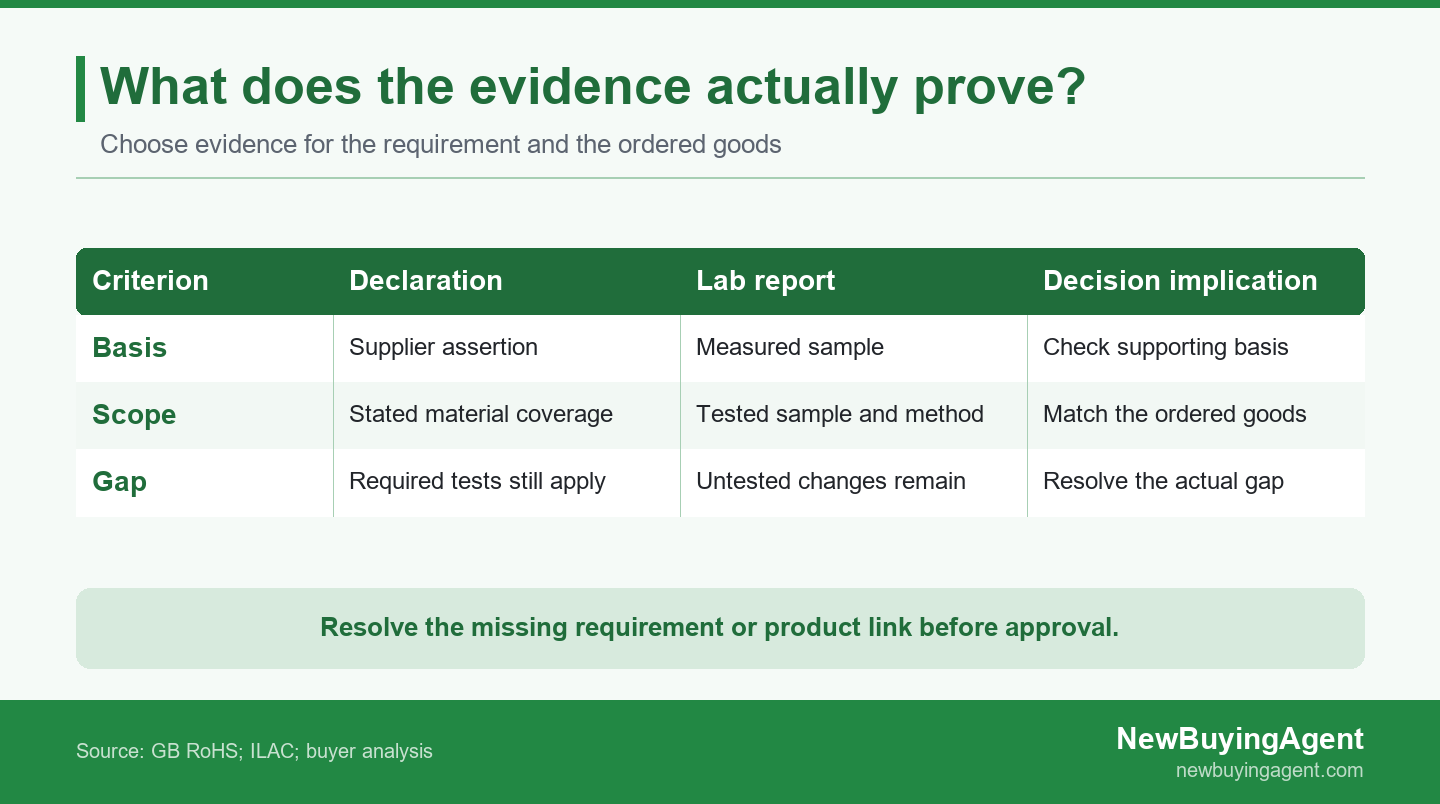
Supplier declarations and lab reports answer different questions; both need a justified link to the ordered goods.
Compare the Evidence Each Document Provides
Evidence sufficiency depends on the applicable requirement, the credibility of its basis and its scope. A declaration states what the supplier asserts about a product or material; a report records what was measured in a sample using a method. Choose the combination that answers the unresolved question, and verify the link to the goods rather than treating either document name as automatic proof.
Compare the two evidence types on the same dimensions. The table describes their roles in purchasing; it does not grant permission to replace testing required by a particular rule.
| Check | Declaration | Lab report | Buyer action |
|---|---|---|---|
| Basis | Supplier statement and supporting information | Measured results from the submitted sample | Inspect the underlying support |
| Coverage | Identified materials or product scope | Tested item, component and method | Match the order and requirement |
| Reliability | Knowledge of inputs and credible records | Method suitability and qualified laboratory | Investigate weak or missing support |
| Continuity | Supplier commitments and change information | Snapshot of the tested sample | Check later materials and changes |
Based on this comparison, a supported declaration may contribute where the rules allow, while targeted testing can resolve a measurement gap or meet a mandatory test requirement. If the material identity is unknown, neither paperwork nor another unrelated test panel closes that gap.
When a Supplier Declaration Can Support Approval
A useful supplier declaration identifies the issuing business, covered product or material, applicable substance requirement and the basis of the statement. Ask whether the supplier relies on formulation information, upstream declarations, relevant test results or a combination. A signed letter saying “all products comply” provides little basis for deciding whether the current model and material are covered.
Great Britain’s RoHS guidance makes the manufacturer responsible for determining product compliance, even where suppliers confirm that components comply. Supplier information can contribute to that determination, but the manufacturer still needs sufficient information for the actual electrical or electronic product. This example applies to GB RoHS; it is not a general exemption from chemical testing.
The IEC technical-documentation standard abstract describes documentation compiled by a manufacturer to declare compliance with applicable substance restrictions. That public description supports the distinction between evidence and the resulting declaration; it does not establish that a supplier letter alone is enough. The detailed standard and applicable regulatory framework require their own assessment.
A buyer may place more confidence in material-specific information with a clear upstream basis and consistent production history than in a new supplier’s unsupported assurance. That is a purchasing judgment, not a substitute for a mandatory test. Where supporting information is missing or contradictory, identify the material uncertainty and decide whether it needs additional disclosure, targeted analysis or both.
When Testing Is Required or the Evidence Is Too Weak
Testing is needed when the applicable rule requires it, or when a targeted measurement is needed to resolve an important uncertainty that supplier information cannot answer. Determine those conditions before treating a declaration as an alternative. Higher perceived supplier reliability cannot waive a statutory testing requirement, and purchasing a broader test panel does not necessarily improve evidence for the specific risk.
For US children’s products, the initial certification testing rule addresses samples of the product or samples identical in all material respects, with the applicable children’s product safety requirements determining the tests. Required third-party testing uses an appropriately CPSC-accepted laboratory, subject to the applicable exemptions. A supplier’s general declaration cannot replace a required test merely because it is signed.
This US example does not mean every general-use product must follow the children’s product testing route. Classification, material-specific exemptions and destination rules matter. These references address the evidence decision, not a complete import or certificate-filing procedure; check the current requirements for those separate obligations.
For a nonmandatory test prompted by uncertainty, state what the result should resolve. An unknown pigment, an unexplained material substitution or conflicting upstream information gives a clearer testing rationale than requesting a generic “full chemical test” without specifying the relevant substances and material.
Read the Test Scope Before Reading the Pass Result
Read a laboratory report as a result for a defined sample, method and set of substances. Check the report identity, sample description, test dates, method, measured values and acceptance criteria before relying on a pass conclusion. A genuine report can still answer the wrong question if the tested item differs from the order or the analytical method cannot assess the relevant limit.
Accreditation concerns activities within a laboratory’s accredited scope. ILAC’s accreditation guidance also explains that accreditation does not guarantee acceptance of every result in every destination market. Check the relevant scope and any regulator-specific laboratory acceptance, rather than treating a laboratory logo as approval for every chemical method or product requirement.
A reporting limit is the threshold below which a method does not report a measured concentration. Ask the laboratory how that threshold and any stated detection limit relate to the substance limit you need to assess. The report should let the technical reviewer distinguish a measured value, a result below a reporting threshold and an assessment made using a specified decision rule.
A not-detected result does not demonstrate zero substance content. Whether it supports a limit depends on the test method, reporting threshold and applicable decision rule. If the method cannot reliably distinguish the relevant concentration, “not detected” may leave the compliance question unresolved; seek the laboratory’s technical interpretation or a suitable method instead of converting it into a zero-content claim.
Confirm the reporting units and measurement basis. A value for the whole submitted item may not address a limit applied to a particular material. Where uncertainty or decision rules affect the conclusion, retain the laboratory’s explanation and the applicable acceptance basis. Do not silently round a borderline measurement or reinterpret the result to obtain a pass.
Link the Tested Sample to the Goods You Will Receive
Match the tested sample to the proposed model, material reference, component and relevant color before relying on its results. A matching sales name is insufficient if the resin, coating, pigment or production route has changed. Ask who selected and submitted the sample, where it came from, and which records connect it to the materials used in the ordered goods.
Under the US component-part testing conditions, reliance on component evidence involves traceability and due care to protect test-result integrity, including against later contamination or degradation. Those conditions explain why a genuine supplier report is not automatically sufficient. They apply within the specified US testing framework; the transferable buyer lesson is to verify the material link and subsequent handling.
For other product requirements, ask the responsible reviewer whether a raw-material or component result can support the finished product. Processing may introduce another substance or change the relevant property. A report on the input alone cannot answer a finished-product measurement question unless the applicable method and evidence basis justify that use.
NewBuyingAgent’s product-supply service uses local China factory resources and product-development and quality-control capability to supply products suited to purchasing requirements. Define the material and evidence conditions within that brief so they inform the product offer, price, quality and delivery arrangement. Chemical analysis and regulatory acceptance remain with the appropriate qualified parties; ordinary factory inspection cannot establish chemical composition.
Reassess Evidence After a Material or Process Change
Reassess the affected evidence when a material, component source or process changes in a way that could affect the relevant substance requirement. The question is whether the prior basis still covers the proposed goods. Keep unchanged evidence where its use remains justified, while resolving the changed scope; neither automatic reuse of every old report nor automatic retesting of everything is a sound default.
For US children’s products, the material-change testing rule addresses a material change that could affect compliance and requires testing of the affected product or component and a new certificate under the applicable conditions. The defined circumstances can allow unaffected prior test results to remain relevant. This is a scoped US rule, not a universal retesting timetable for all goods.
For the purchase itself, agree which changes the supplier must disclose and who can approve them. Retain the old and new material references, the reason for the change and the revised evidence decision. A supplier’s statement that the substitute is “equivalent” should explain the relevant chemical basis, not merely similarity in appearance or price.
Example: a New Plastic Color Is Missing from the Evidence
In an illustrative order for 4000 organizers, the supplier provides a report for 1 of 2 plastic colors. The importer is buying general-use desktop organizers from China, and the goods are prepared for dispatch. The report identifies the original color and resin reference, while the newly added color uses a different pigment reference.
The quality manager compares the report description with the production material record. The product name matches, but the pigment information does not establish coverage for the added color. That difference does not prove the new material fails the substance requirement; it means the evidence is incomplete. The buyer cannot resolve that question by reading the original pass conclusion more closely.
Approval of the unsupported color is held under the agreed release terms. The supplier is asked for composition information and traceable supporting evidence covering that pigment and the current goods. Targeted testing is requested where the applicable requirement or unresolved chemical risk calls for it. The team identifies affected units rather than assuming the evidence gap concerns every unchanged item.
The supplier responds with an all-products compliance letter but no supporting information for the added pigment. The gap remains open. Approval changes only when the reviewer can justify the substance coverage and link the accepted evidence to the new material reference and ordered goods. This is an illustrative evidence decision, with no assumed failed test, successful correction or universal legal requirement to test every color.
Set the Evidence Requirement Before Confirming Supply
Put the substance requirement, covered material, expected evidence and change-control conditions into the purchasing brief before confirming supply. Agree when each record will be available and what happens if approval remains unresolved. This lets the supplier price and prepare the actual product requirement, while giving the buyer a defined basis for reviewing evidence and applying the agreed release conditions.
Keep the test report distinct from any required formal declaration or certificate. The US product certificate content requirements identify the covered product, applicable rules, responsible party and testing information. The issuer’s certificate therefore serves a different role from the laboratory’s measured results. Review current product-specific certification and filing requirements separately; the cited document-content provisions are not a complete importing procedure.
For existing China suppliers, NewBuyingAgent’s China-side factory management supports factory communication, production progress and quality follow-up. Provide the approved material references and change conditions so ongoing production reflects them. This connects evidence decisions with the goods being made without presenting factory management as accredited chemical testing.
For a new product-supply requirement, submit the product requirements with specifications, quantity, target price, destination and delivery timing. Include the substance requirement and evidence conditions. NewBuyingAgent can use its local factory resources and product/QC capability to develop a supplied-product offer reflecting those needs, while qualified technical and regulatory reviewers retain the chemical and compliance decisions.
Frequently Asked Questions
Does a chemical test report have a universal expiry date?
No universal expiry date applies to every chemical test report; continued use depends on the applicable requirements, product continuity and relevant customer conditions. A recent report may still cover the wrong material, while older evidence may remain useful where its basis is valid and the rules permit reliance. Check updated substance lists, methods and product changes before approval. If a retailer or contract sets an age limit, address that separate requirement rather than treating it as a global law.
Can supplier information be confidential?
Controlled disclosure can protect formulation details while allowing a qualified reviewer to assess the relevant substance requirement. Agree whether the laboratory or designated technical reviewer can receive confidential information directly and what conclusion the buyer needs to retain. The supplier need not automatically publish its entire formulation, but secrecy cannot establish that an unsupported assertion is sufficient. If no acceptable review route provides the necessary basis, the evidence decision remains unresolved despite the confidentiality explanation.
Can one report cover several models or colors?
One report can support several models or colors only where the applicable requirement permits the approach and the grouping has a justified evidence basis. Ask which materials are shared, which differences matter and how any representative or worst-case sample was selected. A laboratory’s broad model description alone does not explain those conditions. Retain the reasoning and the covered item list, and reassess additions that change the relevant substance profile rather than extending the group by sales name alone.
Who should pay for additional testing?
Agree the commercial responsibility before ordering; evidence sufficiency does not itself determine who pays for additional testing. Define the expected documentation, testing scope, sample arrangements and response to supplier changes in the purchase terms. A buyer-added requirement, a missing agreed record and an unauthorized material substitution may have different contractual consequences. Resolve that allocation with the parties while keeping the technical approval decision separate: a payment dispute does not make incomplete evidence sufficient.
NewBuyingAgent
Related Resources



Get Started Today
Let's Turn Your Sourcing Goals into RealityWeChat:+86 15157124615
WhatsApp:+86 15157124615
Address:Building 10 #39 Xiangyuan Road, Hangzhou, China