


A repeat order is ready only when the buyer and supplier can point to the same current product record, the same approval decision, and the same release conditions. A familiar SKU can carry an old artwork file, a superseded sample reference, or an approval that applied only to a previous quantity or factory. Remote buyers do not need more email threads; they need a record that shows which version governs the next release.
The Repeat Order Must Point to One Current Record
The reusable asset is not last order's email trail; it is a controlled package that makes the current version, approved exceptions, and supplier confirmation easy to verify. For a remote buyer, that package should answer three questions before the next PO moves:
- What is being made? One product master links the applicable specification, approved sample, artwork, labeling, and quality references.
- What is different this time? A change record says whether an item is unchanged, revised, pending approval, or held.
- What will the supplier use? A version-specific acknowledgement connects the factory's reply to the same file set the buyer approved.
Those questions keep a repeat order from becoming a silent copy of a previous release. They also allow a buyer to release stable SKU groups while holding only the group affected by an unresolved change.
Build a Reusable Repeat-Order Package
Traceability depends on linking relevant records and event data so that a later user can retrieve and understand what applies to the product and decision. NIST describes this record-linking challenge across supply chains, while its manufacturing traceability work also frames the need to connect data records as supply chains grow more complex.
A useful package separates records by what they prove. The product record should not be replaced by the commercial PO, and a supplier message should not be treated as the buyer's approval. Keeping those roles distinct makes a later check faster and clearer.
| Record | What it establishes | Repeat-order control |
|---|---|---|
| Product master | The item identity and its linked approved references | Names the record the factory must follow |
| Change log | What changed, why, and which SKUs are affected | Prevents an update from disappearing into a revised filename |
| Approval record | Who accepted the exact version and release boundary | Stops an informal instruction from becoming a production assumption |
| Supplier acknowledgement | What the supplier confirms it will use and any exception it sees | Creates a release-ready or hold-ready response |
For a China repeat order, the package can also carry the current quantity, target delivery window, factory, inspection requirements, and any commercial detail that changes what the supplier must do. Buyers planning a new repeat request can give NewBuyingAgent the current product package for a repeat China order instead of asking a factory to infer the next release from the last PO.
Keep the Product Master and Approved References Together
A repeat-order package should keep the product specification, approved sample reference, packaging artwork, labeling, quality criteria, and order-specific commercial details distinguishable but connected. Here, a product master means the single record that identifies the product and links its approved references. It does not have to be elaborate. A buyer can use a controlled spreadsheet, a PLM record, or a clearly structured folder index as long as the item code, version, and linked evidence are unambiguous.
Give each reference a job. An approved sample reference answers which physical benchmark applies. An artwork reference answers which file may be printed. A quality criterion answers what must be checked. The PO answers the quantity and commercial instruction for this order. When the records are linked rather than blended together, a buyer can change one without accidentally rewriting the meaning of the others.
Version Control Protects the Baseline
Version control makes it possible to identify what changed, who made the change, when it happened, and which current state is approved for use. HMRC's configuration standard expresses the same practical discipline: record the current state, use version control, test changes, and review them.
A controlled baseline lets a buyer treat a prior order as evidence without silently treating every earlier file as still valid for the next order. The UK Ministry of Defence describes configuration management as controlling changes to formally approved configuration baselines, a useful boundary for any product that has repeated across factories or seasons. Read the configuration-management policy.
A controlled version is simply the file version approved for supplier use. It is stronger than “latest file” because it gives the buyer and factory a shared reference: version number, issue date, owner, and status. If the previous version is still correct, the record should say so explicitly. If it is not, the new version should name which prior version it replaces.
Record the Change, Its Effect, and Its Status
A useful change record identifies the current version, the proposed difference, the effect on affected SKUs, the approval status, and the supplier communication needed before implementation. That is more useful than a filename such as “final-final-2” because it captures the decision boundary: revised artwork may affect one SKU group, while a new barcode can affect only one market or packaging format.
Keep the entry short enough to review. State the trigger, the old reference, the new reference, affected SKU or factory, decision owner, approval state, and release condition. UK government guidance recommends formal change control, a retrievable audit trail, and version control for key documents; it also cautions against treating a change as informal merely because price does not move. The change-control guidance is a useful reference point.
Verify the Baseline Before Reuse
A controlled baseline can be checked later only if the record links the applicable product data and traceability events rather than leaving them as disconnected files. NIST's manufacturing traceability report discusses the record-exchange challenge behind this principle.
Before copying an old PO, run a small baseline check: can the buyer find the current product master, the version that governs each reference, the latest approval, and a clear list of open exceptions? If the answer is no, the repeat order is still a discovery task. Reconstruct the package first; do not use the next PO to discover which document was intended.
Make Buyer Approvals Reusable Evidence
A usable approval record connects the requested change, impact review, decision maker, decision date, and exact version released to the supplier. UK government commercial guidance similarly calls for a change register, approvals before implementation, and retained evidence that can inform future procurement or a later dispute. See the change-control requirements.
A repeat order can also record an explicit no-change confirmation when the buyer wants the previous approved baseline to remain in force. That note matters when a buyer has reviewed the records and decided that the product, packaging, and quality requirements remain unchanged, but the quantity, ship window, or factory allocation is new.
Use two different decisions rather than one vague “approved” email. A reorder confirmation says the previous baseline remains in force for named SKUs. A change approval says a particular new version may replace that baseline for named SKUs. Both should identify the approver, date, affected scope, and what the supplier is allowed to do next. This does not turn a sourcing partner into the buyer's technical authority; it gives the buyer's decision a record the factory can follow.
Test Supplier Readiness Before the Repeat PO
Supplier readiness is more than a received PO: it is evidence that the supplier has received the correct package, confirmed the applicable version, surfaced exceptions, and accepted the release conditions. The World Bank's contract-management material treats variations, inspections, delivery documents, and implementation records as controls that must be tracked alongside supplier performance. Its contract-management module describes that record focus.
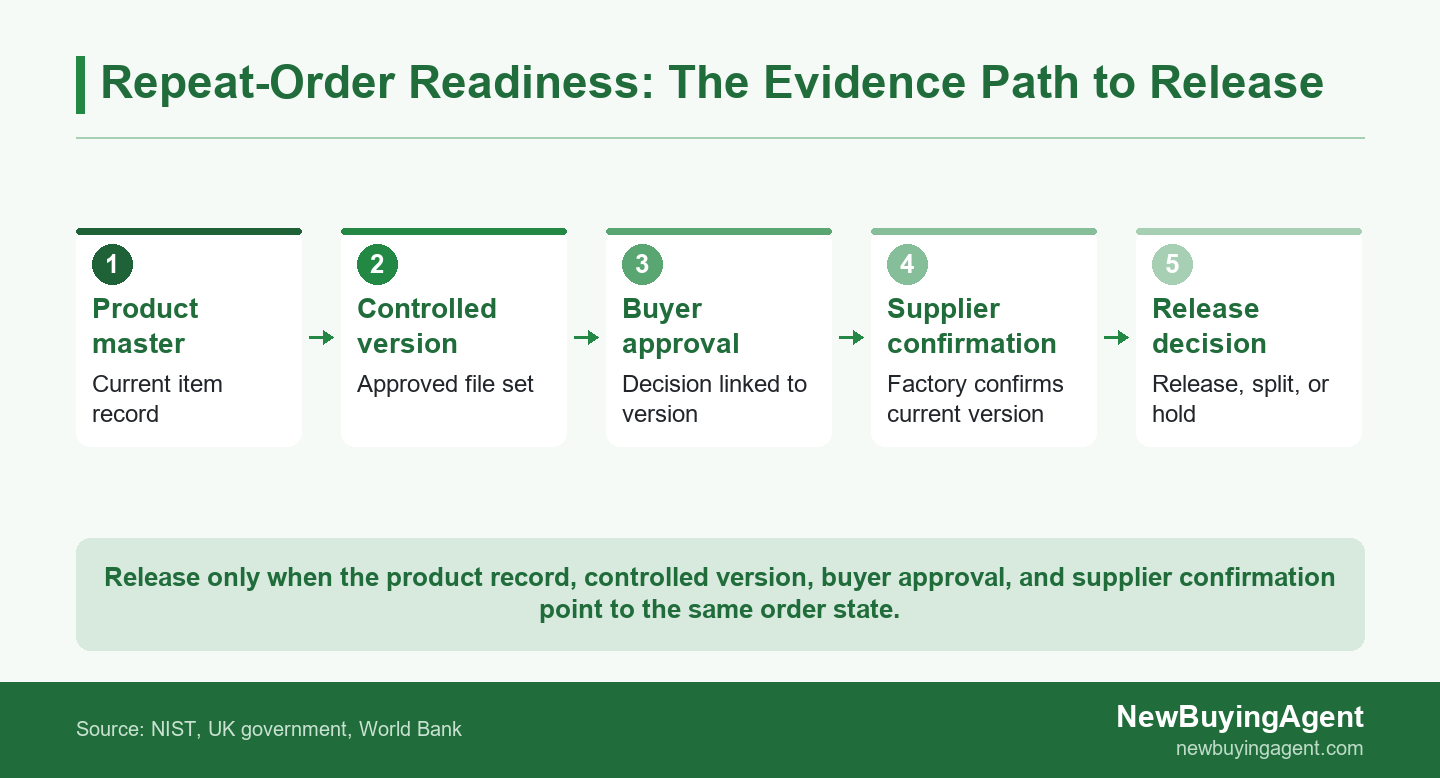
Repeat-order readiness flow linking the current product master, controlled version, buyer approval, supplier acknowledgement, and release decision
A supplier acknowledgement is the supplier's written confirmation of the version and conditions it will use. Ask the supplier to return more than “received.” Its reply should name the product-master version, the SKU group covered, any missing reference, any production or material exception, the expected proof before production, and whether it can release the item under the buyer's stated condition.
This check is especially valuable when a buyer already works with China factories. Instead of offering a generic reorder reminder, see how NewBuyingAgent coordinates existing China factory orders when the current record, production evidence, and open supplier questions need local follow-through. The relevant control is still the buyer's stated version and release condition.
Illustrative Scenario: 48 SKUs After a Packaging Change
Four Checks Before Release
A packaging change can create a split release: unaffected SKUs may be ready while affected SKUs remain held until the changed artwork is linked to a documented approval. The following is an illustrative scenario, not a reported NewBuyingAgent client result.
A retailer repeats 48 home-organisation SKUs across three China factories after a prior seasonal order.
Twelve SKUs use revised packaging artwork because the buyer has changed a product claim and barcode placement; the remaining 36 have no product or packaging change.
The buyer has last season's PO, old artwork files, and a new email approval, but no single product master shows which artwork applies to which SKU or whether each factory has acknowledged it.
The 36 unchanged SKUs can only be considered separately if their approved baseline is identifiable. The 12 affected SKUs need the revised artwork, approval record, and supplier acknowledgement connected to the same controlled version. A blanket supplier reply that it received the PO does not show which files will actually be used.
The issue is not whether the order is a repeat. It is whether each SKU group has a complete evidence path from product record to approval to supplier confirmation.
The buyer releases the 36 unchanged SKUs after confirming their product-master version and holds the 12 revised SKUs until each affected factory confirms the new artwork reference, buyer approval, and any print-proof requirement.
A China-side sourcing partner can keep a one-page register naming the version, approver, affected group, acknowledgement, and release status by factory.
The check is complete only when each acknowledgement matches the correct product version and the 12 changed SKUs remain distinct from the 36 unchanged SKUs.
This operating example does not certify artwork, compliance claims, or factory performance, and it makes no claim about time or cost savings.
In a split release, each factory acknowledgement should name the SKU group and version it covers so that an approval for the changed group cannot be mistaken for approval of the full order.
- Current record: Can the buyer identify the product master and references for this exact SKU group?
- Approval boundary: Does the approval name the revised version, affected SKU group, and decision maker?
- Supplier response: Has the factory confirmed that version and stated any missing input or exception?
- Release split: Is the register explicit about which SKUs may move and which remain held?
These checks are deliberately simple. Their value is that the buyer can see a hold condition early and keep it scoped to the affected item group rather than treating the entire repeat order as either fully ready or fully blocked.
Give NewBuyingAgent a Repeat-Order Readiness Brief
A remote buyer's repeat-order brief should name the current product master, open changes, approver, supplier acknowledgement, inspection evidence, and the rule for releasing affected and unaffected SKUs. That gives the China-side team something specific to coordinate: the current product record, the active factory question, and the evidence needed before production or inspection can proceed.
Include the product or SKU list, prior order reference, current product-master link, version identifier, approved sample or artwork reference, quantity, factory, open change log, buyer approver, supplier acknowledgement deadline, quality or proof requirement, and release rule. The brief is not a substitute for the buyer's commercial agreement or technical review; it is the practical handoff that makes those decisions usable across distance and time zones.
Buyers who are assessing a partner can review NewBuyingAgent public sourcing cases for partner-evaluation context. When the package is ready, they can send NewBuyingAgent a repeat-order readiness brief with the current records, affected SKUs, and release condition.
Frequently Asked Questions About Repeat-Order Readiness
Can a previous purchase order serve as the repeat-order specification?
Only if the buyer has confirmed that its linked product record, approvals, and commercial conditions are still the current baseline for the repeat order. A previous purchase order is useful evidence, but it is not a substitute for a current controlled product record when specifications, packaging, quality criteria, or commercial conditions may have changed. The formal change-control guidance supports that boundary. Link the historical PO to the current product master and record a no-change confirmation or a new approval before release.
What should change when only packaging artwork is revised?
Link the revised artwork to the affected SKU group, record the buyer approval, and keep those SKUs on hold until the supplier acknowledges the controlled version. The change record should identify the former artwork, the replacement version, the factory that will use it, and any proof needed before printing. Unaffected SKUs should remain separately visible rather than being assumed to follow the revision.
Is a supplier email confirmation enough for repeat-order readiness?
It can be part of the record, but it should identify the applicable version, open exceptions, and the release conditions rather than merely say the supplier received the PO. A useful reply names the SKU group, the product-master version, the factory's understanding of the change, and any missing file or decision. That makes the acknowledgement usable when production questions appear later.
Should unaffected SKUs wait for every changed SKU?
Not automatically. Release unaffected SKUs only when their current record is unchanged and the supplier confirmation clearly separates them from the affected SKU group. If the records, material allocation, factory schedule, or buyer decision are shared across groups, the buyer may still choose to hold more of the order. The point is to make the dependency visible before release.
When should a buyer create a new repeat-order package?
Create or refresh the package whenever a product, packaging, quality requirement, supplier condition, quantity, price, delivery plan, or approval boundary has changed or cannot be verified. A package should also be refreshed when a buyer changes factory allocation or cannot tell which version the supplier used last time. The refresh creates a current baseline; it does not require recreating every stable record from scratch.
NewBuyingAgent
Related Resources



Get Started Today
Let's Turn Your Sourcing Goals into RealityWeChat:+86 15157124615
WhatsApp:+86 15157124615
Address:Building 10 #39 Xiangyuan Road, Hangzhou, China
