

A remote factory audit evidence pack is a selected set of supplier records prepared before an online review to connect the proposed company, manufacturing site, product, and production process to the buyer’s questions.
Request company and site details, the proposed production route, relevant quality records, capacity information, and agreed access arrangements before the video call. Review them first, then use the call to test specific claims. A convincing factory tour can help establish what is happening in the areas shown; it cannot, by itself, establish that the supplier can deliver your specified order consistently.
Use the Evidence Pack to Set the Call Agenda
An effective evidence pack makes the remote factory audit easier to direct and harder to misunderstand. It identifies the proposed supplier and production site, explains how the product will be made, and separates questions that records can answer from those needing a live demonstration or site visit. The buyer can then judge what the evidence supports before choosing the next sourcing step.
- Scope: State the product, manufacturing locations, and decision the review should support.
- Evidence: Request relevant working records, with dates and identifiers, rather than a larger collection of sales material.
- Risk: Pay particular attention to critical outsourced operations and unavailable production areas.
- Decision: Record unresolved questions and the follow-up needed before production commitment.
Define the Product, Site, and Decision First
Define the remote review around your specified product, the proposed manufacturing site, and the sourcing decision you are about to make. The evidence needed to begin sample development differs from the evidence needed to approve a production order. Giving the supplier that context helps it send useful records and prevents a general factory presentation from standing in for answers about your actual purchasing needs.
Start the request with the specification or drawing revision, material and finish requirements, quantity, destination market, and delivery window. Identify the operations that matter most: for a metal component, these might include forming, welding, coating, and dimensional checks. For another category, the important stages may be cutting, assembly, filling, or packaging. Ask which operations the proposed factory performs and which happen elsewhere.
Write the decision in ordinary language: “We need to assess whether this production route is suitable for our bracket specification before commissioning samples.” This is more useful than asking for “all compliance documents.” Product safety and market requirements still need their own assessment. A purchasing-team review does not automatically become a formal management-system certification audit.
Buyers arranging their first China order may need broader procurement context. Read the China sourcing guide to place factory assessment alongside specification, pricing, sampling, and order planning. The factory review should inform that procurement decision.
Organize the work into document review, targeted live checks, and a site visit where important gaps cannot be resolved remotely. Each method should answer a named question.
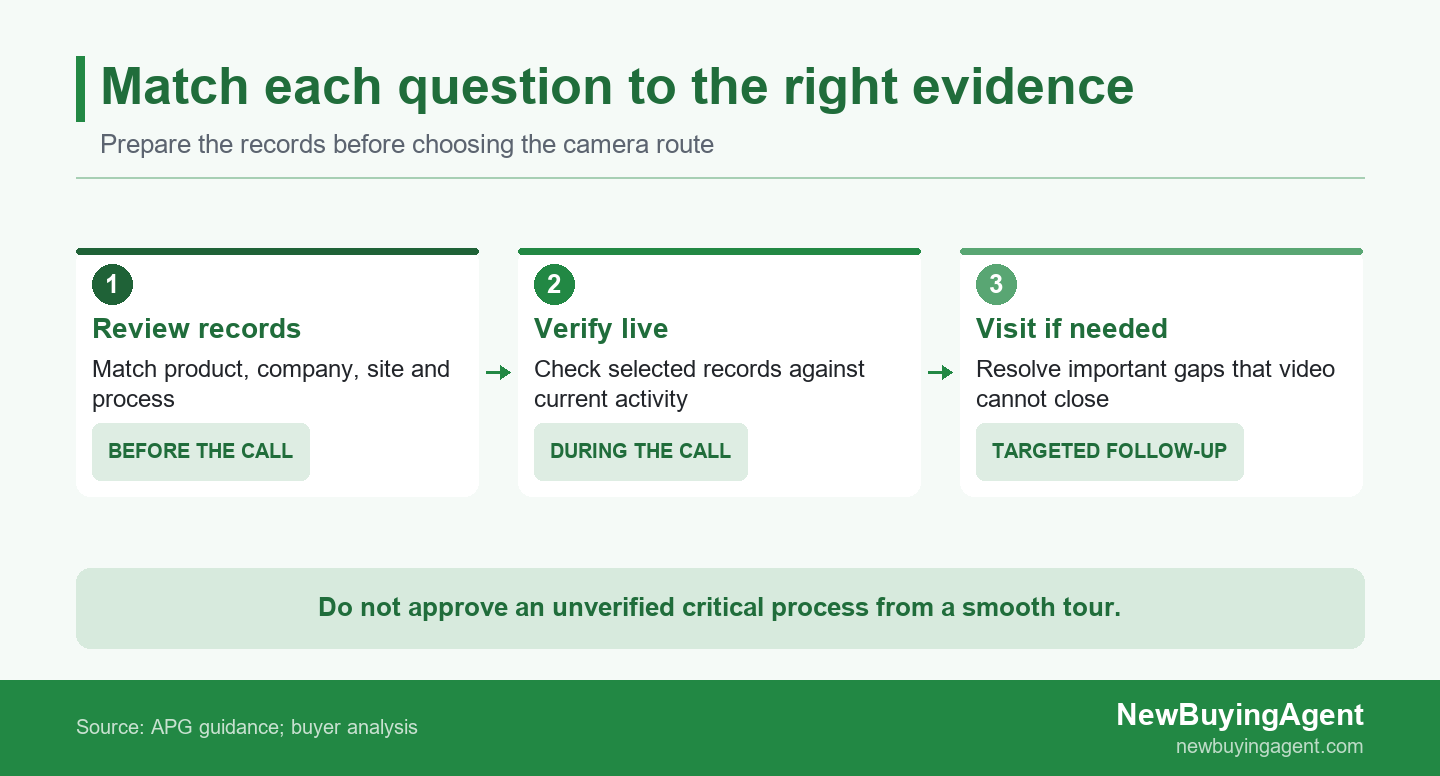
Use records to prepare targeted live checks, then arrange a site visit when important questions remain unresolved.
Request Records That Connect to the Proposed Order
Ask for a compact pack covering identity, the production route, quality controls, capacity, and access. For each category, explain what you want to verify and which product or site the records should cover. The table below is a starting request list for supplier selection; adapt it to the product’s risk and the stage of the purchase rather than treating every listed item as a universal requirement.
The Auditing Practices Group’s evidence-collection guidance emphasizes relevant, verifiable information and the sampled nature of audit evidence. Its papers are educational guidance for quality-management-system auditing, not definitive ISO requirements. Applied to this buyer task, the useful lesson is to select records that can be checked against the production question, not to collect documents simply because their titles sound authoritative.
| Question | Request before the call | Verify live | Remaining limit |
|---|---|---|---|
| Who makes the goods? | Legal name, registration details, site address, seller–factory relationship | Named site, participants, relevant production areas | A sign or video does not prove ownership |
| Where does each operation happen? | Process route, equipment list, outsourced operations | The proposed operation and its inputs and output | Unseen external sites remain unverified |
| How is quality controlled? | Relevant inspection records, lot references, rejection handling | Record retrieval, measurement method, rejected-stock handling | A sampled record does not establish every batch |
| Can the order fit the schedule? | Proposed line, workload, output basis, critical dependencies | Current activity and explanation of available time | Installed equipment is not available capacity |
| Can the needed evidence be accessed? | Participants, route, file access, restrictions, recording agreement | Usable connection and permitted views | Restricted areas may require another method |
The returned pack should let you replace broad questions with specific requests: show the measuring equipment used for this tolerance, retrieve the record for this lot, or explain where this finishing operation occurs. An empty field is useful if it reveals what still needs an answer.
Company Identity and Certificate Scope
Request the supplier’s legal name in its original language, registration details, registered address, proposed manufacturing address, and the identity of the contracting seller. Where those entities or addresses differ, ask for an explanation of their relationship. Record which company controls production and which company will handle your contract and invoice; do not assume they are identical because the presentation uses one trading name.
Verify registration information through the appropriate official registry or qualified local assistance. A registration record can help establish the named entity; it does not establish that a particular production line belongs to it or has been reserved for your order. Ask the supplier to map the legal names to the sites you will see.
For a claimed accredited management-system certificate, request the complete certificate and relevant site annexes. IAF CertSearch’s documentation describes information including certificate status, scope, certified locations, and the issuing certification body. Compare those fields with the proposed factory and operation. If a record cannot be located or a field conflicts, seek clarification from the issuer or verification service before deciding what the certificate establishes.
Keep the type of certification clear. ISO/CASCO’s explanation of conformity marks distinguishes a certified management system from certified products. A factory’s management-system certificate should therefore not be presented as certification of your bracket, toy, or other ordered product. The relevant product evidence belongs in the product-approval work, with its own scope.
Production, Quality, and Outsourced Work
Request a process route that follows the product from incoming material to finished packaging. Beside each operation, ask for the responsible location, relevant equipment, and the control used to check the result. An outsourced process is an operation performed by a provider outside the proposed factory. Make those operations visible before the call so the camera route does not stop where an important part of production begins.
Choose records that show how the supplier controls a comparable product. NIST’s supplier-selection guidance recommends looking at quality-system documentation, production and inspection records, rejection handling, and lot control. For your request, that can mean a recent inspection record with its product and lot reference, the inspection method, and an example of how a rejected result was investigated and handled.
Ask for the specification used on that record and check whether its important characteristics resemble yours. A photograph of a caliper proves little about whether the supplier can measure a difficult feature. Request the measuring method, relevant equipment range, and status of any calibration or verification needed for the measurement. During the call, select a permitted demonstration and follow how the result enters the record.
For external work, identify the provider and how the proposed factory checks its output. The Auditing Practices Group’s External Providers guidance considers outsourced-process controls and the scope of suppliers’ quality-system registration. The buyer’s practical question is who controls the required result when the operation happens outside the factory being filmed.
Equipment information should describe the proposed process, not just the factory’s asset count. The group’s resources guidance considers equipment, maintenance, people, and operating conditions in relation to the audited processes. Ask which machine or line is proposed for your product and what would happen if that resource became unavailable.
This is where local category knowledge becomes useful in sourcing. NewBuyingAgent’s local China factory network and product development and quality-control capability can inform whether a factory’s proposed route fits the product requirements. Its product supply from China connects that factory-fit work with specification, cost negotiation, production follow-up, quality control, and logistics coordination for the purchase. Any specialist certification assessment needs its own agreed scope.
Capacity and Continuity for Your Delivery Window
Request capacity information for the proposed production route and delivery window, with the assumptions behind the quoted output. Include current commitments, the resource expected to constrain output, and dependencies such as tooling, material availability, or an external finishing provider. A list of installed machines does not tell the buyer how much usable production time is available for this order.
Ask how the supplier calculated its proposed schedule: the product or comparable operation used, working pattern, expected good output, changeovers, and other work already allocated. Keep different units explicit. Parts per machine-hour cannot be compared directly with packed units per day unless the relationship and assumptions are explained. Treat unsupported estimates as estimates.
Request the practical fallback for a critical interruption. NIST’s supply-chain risk guidance recommends mapping primary site activities, alternate sites, and the time needed for an alternate site to begin shipping. Here, that means asking whether a backup operation can perform your specified work and what approval, tooling, or transfer is needed. A named backup factory without those details is an option to investigate, not demonstrated continuity.
Agree on Access, Confidentiality, and Call Readiness
Agree on the people, records, locations, and technology needed before confirming the call. The production or quality person responsible for an important claim should be available to explain it, and the camera operator should be able to reach the permitted areas safely. Also settle confidentiality and recording arrangements in advance so that access restrictions do not first emerge when you ask to verify a critical operation.
The Auditing Practices Group’s remote-audit guidance discusses testing technology before the audit and agreeing confidentiality, security, document access, and permissions for retained images. These are useful preparation principles for a buyer review, rather than a claim that this purchasing checklist satisfies a certification scheme. Test screen sharing, document legibility, and the connection from the production areas you intend to discuss.
Send a proposed route and ask which areas cannot be shown. A supplier may have legitimate restrictions protecting another customer’s tooling, workers’ personal information, or a proprietary process. Agree a suitable alternative, such as a redacted record, a controlled screen-share, or a qualified site visit. The important question is whether the alternative answers your concern.
Use an agreed file-sharing location with named access and a retention arrangement suited to the records. Request dates, site names, document revisions, and product or lot identifiers where they matter. Avoid collecting personal records or unrelated customer data simply to make the pack look comprehensive. When translation is needed, keep the original record available and identify who can explain the technical terms.
Turn Document Gaps into Specific Verification Requests
Review the records before the call and turn each material gap into a request to verify something specific. A missing record leaves uncertainty; it does not automatically establish that the process has failed. The decision should follow the evidence that can actually be checked, with unresolved questions assigned to a live demonstration, another record, or a site visit suited to the concern.
Maintain a short agenda with the question, the relevant file reference, the person who can answer it, and the required observation. For example: “The route lists coating elsewhere. Please identify the provider and show how its finished output is checked against our finish specification.” This allows the supplier to prepare access while keeping the buyer in control of the question.
Check a selection of records and activities rather than accepting only the supplier’s preferred example. Follow one relevant reference from specification to production record and inspection result, then ask for an additional sample where a material question remains. Note the areas, periods, and processes actually covered; the call’s conclusion should not quietly expand beyond them.
Example: the Quoted Finishing Process Happens Elsewhere
In an illustrative order for 6000 metal brackets, the factory pack identifies 1 of 2 production sites needed for the quoted finish. A brand has agreed the bracket specification but has not committed to production. The files identify the forming factory and list coating as outsourced; they contain no coating-provider details or records showing how the finish is controlled.
The proposed video route can show forming and dimensional inspection. It cannot resolve whether the external coating operation can achieve the specified finish or fit the delivery plan. Outsourcing itself is not the problem. The missing connection between the quoted finish, its provider, and its controls is what prevents a supported conclusion.
The buyer keeps finishing capability open and requests the coating site identity, relevant control records, responsibility for rejected work, and access arrangements. Forming evidence can still be reviewed on the original call. Production commitment waits until the unresolved finishing question is addressed; a supplier’s statement that its partner is “approved” does not close that question.
In this illustrative example, the buyer then compares the returned provider records with a permitted live review or targeted site visit. If the relevant operation and controls can be verified, that evidence supports assessment of the proposed route. If access or traceability remains inadequate, the finishing capability stays unverified. Observing that operation would still not prove conformity of every future batch or replace any required product testing.
Decide What Can Proceed and What Needs a Site Visit
Choose the next sourcing step according to what the evidence supports. A coherent pack and a useful call may justify continuing to sample development or a targeted site review, while unresolved critical identity or production questions call for further verification before production commitment. State the conditions for proceeding, who will resolve each open item, and what evidence is needed to close it.
A site visit is particularly useful when the decision needs physical access that video cannot provide: checking the proposed operation, examining equipment or stock more closely, or sampling records without relying entirely on the supplier’s selected views. Decide the visit’s scope from the unresolved question. Calling every concern a “full audit” can obscure what the reviewer actually needs to establish.
Keep commercial approval separate from the reviewer’s observations. Record what was reviewed, the limitations, and the outstanding action. The buyer’s authorized team decides whether the remaining risk is acceptable for the next step and preserves any product, contractual, or regulatory approval requirements.
For buyers already working with a China supplier, NewBuyingAgent’s management of existing China factories provides a distinct follow-up route: local communication, production progress management, on-site quality inspections, and logistics coordination. Those activities can help maintain visibility after selection. They should be specified around the order and buyer instructions rather than described as an independent certification of the factory.
When a new product needs sourcing, buyers can submit product requirements to NewBuyingAgent with the specification, quantity, target price, destination, delivery window, and known factory-evidence gaps. Its China-side sourcing team can assess those purchasing needs for factory cooperation and product supply, then discuss a quote based on the confirmed product requirements. Flag specialist audit or testing needs separately so their scope is clear.
Frequently Asked Questions
Should a factory send other customers’ unredacted orders?
No; request relevant, redacted records that preserve the fields needed for verification. Product references, dates, lot links, and inspection criteria may matter, while customer names and prices may not. If redaction hides a necessary field, agree a controlled review rather than demanding unrestricted copies.
What if the factory is between production runs?
A gap between runs calls for a different evidence plan, not an automatic rejection. Ask when the relevant operation will run and what recent records are available. A later observation or site visit may be needed; a demonstration setup should be identified as such rather than presented as normal production.
Can a trading company participate in the remote audit?
Yes, if the contracting entity, manufacturing locations, and responsibilities are disclosed. Ask who can authorize site access and answer production questions. A trader’s commercial role does not establish factory ownership, and its participation does not remove the need to verify the proposed manufacturing route.
Does a completed evidence pack replace product testing?
No; a factory evidence pack does not replace tests or certifications required for the product and destination market. Its role is to support supplier selection and the next sourcing decision. Product testing needs a separate scope linked to the actual specification, relevant sample, and applicable requirements.
NewBuyingAgent
Related Resources


Get Started Today
Let's Turn Your Sourcing Goals into RealityWeChat:+86 15157124615
WhatsApp:+86 15157124615
Address:Building 10 #39 Xiangyuan Road, Hangzhou, China
