


Key Takeaways
- Reliable means provable: A reliable China sourcing agent can show what happens before quote approval, sample lock, production release, balance payment, and shipment handoff.
- Checklist logic: The 15 points move in order from buyer brief to quote, sample, production, quality, documents, and delivery.
- Buyer action: Use the checklist before deposit. After deposit, weak answers become expensive to correct.
Reliability Is a Sequence of Proof Gates, Not a Personality Trait
A reliable China sourcing agent is not simply responsive, friendly, or confident. Reliability means the agent can turn a buyer's purchasing need into a controlled order path: clear quote assumptions, locked sample evidence, production visibility, quality release rules, and clean shipment handoff. The buyer should be able to see those gates before risk becomes committed cost.
According to U.S. Commercial Service background-check tips and Trade.gov due-diligence guidance, buyers should verify claims before relying on them. In sourcing-agent selection, verification should be practical. The buyer should test what the agent can prove at each decision point.
This checklist is designed for a buyer who needs a usable decision tool, not another long definition. If the answer to a point is vague, the buyer should slow down, ask for proof, or narrow the order before deposit.
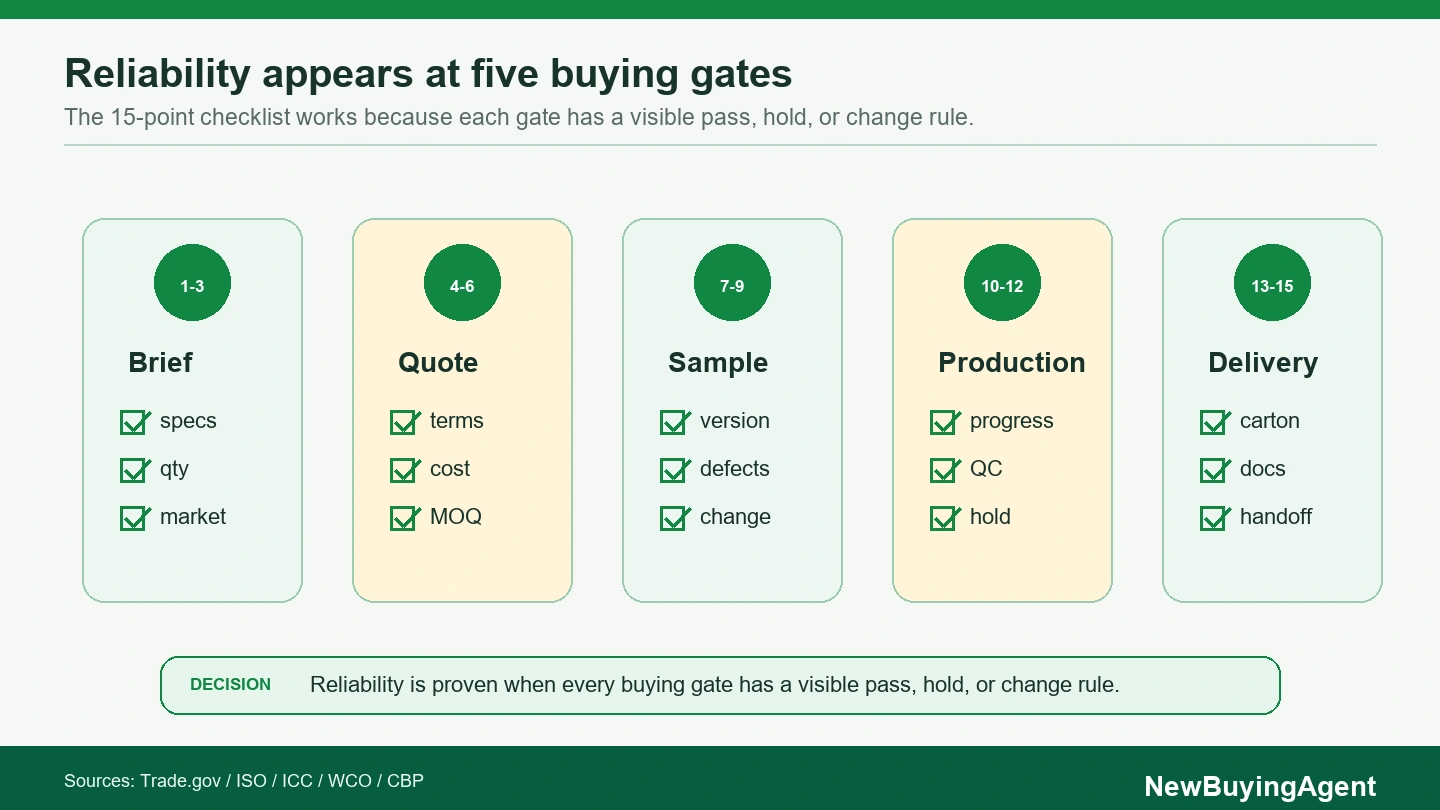
Reliability is proven when each buying gate has a visible pass, hold, or change rule.
Points 1-3: The Agent Understands the Buying Brief
The first reliability gate is the brief. A sourcing agent cannot provide a reliable quote if the product, quantity, target price, destination, quality expectation, and timing are unclear. Good agents ask for the missing inputs early because they know a vague brief turns into a shaky quote.
1. Product requirements are translated into factory language
In practice, this is the first test of real sourcing competence. A factory-ready brief reduces guessing, prevents later repricing, and gives the buyer a clearer basis for comparing answers.
A reliable agent does not simply forward the buyer's wording. The agent translates the product into material, process, finish, function, packaging, tolerance, and market expectations that factories can quote against. This is where local factory-resource knowledge starts to matter.
If the agent cannot restate the product in production terms, the quote may be built on assumptions. The buyer should ask what the factory will actually see before pricing the product.
2. Quantity, target price, and timing are treated as linked constraints
The decision rule is to ask what trade-off each constraint creates. A reliable agent should make the tension visible before the factory absorbs it through quality, cooperation, or delivery risk.
Quantity affects MOQ, setup, raw material purchase, production slot, packing, and shipping. Target price affects material and process choices. Timing affects factory cooperation and freight options. A reliable China sourcing agent explains those links instead of treating every request as separately adjustable.
This matters because a quote can be technically possible but commercially fragile. A small order with aggressive price and urgent timing may need a different strategy than a larger repeat order with stable specs.
3. The agent identifies the buyer's market risk
This point matters because market risk changes the proof needed from China. The same item may require different packaging, labeling, finish control, or inspection evidence depending on the sales channel.
The same product can fail differently in different channels. Ecommerce small-parcel orders care about carton strength and returns. Retail orders may care about labeling, shelf presentation, and compliance documents. Hotel or project orders may care about finish consistency and batch replacement. A reliable agent asks which market the product must survive.
NewBuyingAgent's AI-driven hot-product analysis and multi-industry case experience are relevant at this gate when the buyer is still deciding what product version should be sourced. Market-fit sourcing should come before aggressive cost cutting.
Points 4-6: The Quote Is Clear Enough to Compare
The second reliability gate is the quote. A reliable quote does not need to be complicated, but it must name the cost boundary, product version, exclusions, and change risks. If the quote is easy to read but impossible to verify, it is not reliable enough.
4. The quote names the included cost boundary
A reliable answer should let the buyer compare like with like. If two quotes use different delivery terms or exclusions, the lower number may simply be hiding a later cost transfer.
According to ICC Incoterms 2020 rules, delivery terms define responsibilities and risk transfer. The buyer should ask whether the quoted price is EXW, FOB, CIF, DDP, or another structure, and what packing, inspection, inland freight, export handling, international freight, duty, and delivery costs are included or excluded.
A reliable agent will not hide behind one attractive number. The agent will show which cost belongs to the product and which cost belongs to shipment, documents, or destination handling.
5. The quote locks the product version
The buyer should treat version lock as commercial protection. It prevents a factory from meeting the quoted price by quietly changing material, accessories, finish, or packing.
The buyer should know what material, finish, accessory set, packaging, and specification the quote covers. If the factory changes any of those to meet the price, the buyer should approve the change before production. Version ambiguity is one of the most common sources of quality disputes.
For custom or private-label products, the quote should reference a sample, drawing, photo package, or specification sheet. For catalog products, the quote should still name the exact model and included components.
6. The quote explains what could change the price
This answer is valuable because it names future negotiation triggers before the buyer commits. It also shows whether the agent understands the order economics or only relays a number.
A reliable sourcing agent explains price-change triggers: raw material swings, MOQ changes, tooling, sample revisions, packaging upgrades, inspection scope, freight seasonality, or delivery terms. The goal is not to scare the buyer. It is to prevent surprise repricing after the buyer has committed.
According to Trade.gov shipping guidance, shipping choices affect cost and timing. A quote that ignores shipping assumptions may look cheaper than it really is.
Points 7-10: Quality and Production Are Visible Before Payment
The third reliability gate is quality proof. Buyers should not wait until the balance payment date to discover whether the agent can see what is happening. A reliable China sourcing agent defines what will be checked, when it will be checked, and what happens if the evidence is weak.
7. Sample approval creates a locked reference
In practice, the approved sample should become a comparison tool for production, inspection, and rework. If the reference is vague, every later quality discussion becomes harder.
The approved sample should be treated as a reference for bulk production. The agent should record the version, changes, packaging, finish, labels, accessories, and any buyer-approved exceptions. Without a locked reference, the factory and buyer may remember the sample differently.
According to ISO quality-management guidance, process consistency and documented control are central to reliable quality management. The sourcing equivalent is a sample record that can be used during production and inspection.
8. Production progress is reported at meaningful stages
The decision rule is to report while correction is still possible. A late update may explain a problem, but it may no longer help the buyer protect the order.
Production updates should not be random photos. A reliable agent reports progress at points where action is still possible: material readiness, first production pieces, mid-production issues, packing preparation, final inspection, and shipment readiness. The buyer should ask which stage reports are standard for the product.
If the agent only reports after production is finished, the buyer has less leverage. Stage reporting matters because it turns problems into correctable issues rather than late discoveries.
9. Inspection criteria connect defects to decisions
The buyer should require a release consequence for each serious defect type. Without that consequence, the report may describe risk while leaving the payment decision unclear and forcing the buyer to negotiate from weak evidence.
According to ISO 2859-1 acceptance sampling, inspection decisions can be structured through sampling rules. In real sourcing, the buyer should also define product-specific defect categories: critical, major, minor, cosmetic, functional, packaging, labeling, and shipment-related issues.
A reliable agent explains which defects trigger hold, rework, partial acceptance, or release. If the inspection report has photos but no decision rule, the buyer still has to guess.
10. Corrective action is verified, not only promised
This point is where reliability becomes visible after a problem. Verification should show the corrected goods, not only a message that the factory says the issue has been fixed.
Factories may promise rework, replacement, sorting, or repacking. Reliability requires verification after the correction. The agent should collect updated photos, inspection notes, sample comparison, or final report evidence before release. A promise is not proof until the corrected goods are checked.
This is especially important when the buyer is far from China. Local follow-up can protect the buyer from paying the balance based on verbal assurance.
Points 11-13: Shipment Handoff Does Not Create New Risk
The fourth reliability gate is shipment. Many sourcing failures are discovered after goods leave the factory: wrong carton marks, mismatched counts, unclear documents, weak packaging, or delivery-term confusion. A reliable agent checks those items before the shipment leaves China.
11. Carton data matches the order
The decision rule is to check carton identity before shipment because receiving teams discover mistakes too late. A sourcing agent should prevent that handoff from becoming the buyer's warehouse problem.
The agent should connect SKU count, carton quantity, dimensions, weight, marks, labels, and packing method to the approved order. If carton data is wrong, receiving teams may face delays, relabeling, chargebacks, or inventory confusion.
According to the WCO Data Model, structured shipment data reduces ambiguity across trade handoffs. Buyers can apply that principle to sourcing by requiring clean product and carton identity before release.
12. Commercial documents describe the same goods
Reliable agents understand that document consistency protects the shipment path. The invoice, packing list, carton marks, and actual goods should tell the same product story before cargo leaves the factory gate.
According to Trade.gov export-document guidance, commercial invoice, packing list, and related documents support cross-border handling. A reliable sourcing agent should help prevent mismatches between product description, packing list, carton marks, and actual goods.
The buyer should still rely on customs professionals for formal import advice. But the sourcing agent should not create avoidable errors through vague descriptions or inconsistent order data.
13. Import responsibilities are not ignored
The buyer keeps formal import responsibility, but the sourcing side can still create clean or messy data. Reliable sourcing keeps product descriptions and shipment details disciplined before export.
According to CBP basic importing guidance, classification, valuation, marking, and required entry information matter. A reliable sourcing agent should respect those responsibilities by keeping product identity and shipment details clean before export.
For regulated consumer categories, buyers should also confirm testing and certification obligations. The agent can coordinate product evidence, but the buyer should not treat compliance as a last-minute document request.
Points 14-15: The Service Model Fits the Buyer's Order State
The final reliability gate is fit. A sourcing agent may be reliable for one buyer and wrong for another. A buyer with no stable China supply needs a different path from a buyer that already has factories but lacks local management capability.
14. New product supply and existing-factory management are separated
The decision rule is to choose the service path before judging the fee. A new supply need and an existing-factory control need should not be evaluated with the same checklist.
New product supply requires product selection, factory-resource access, quote preparation, cost negotiation, QC, and logistics coordination. Existing-factory management requires China-side communication, production progress, staged inspection, reporting, and door-to-door logistics support. The buyer should ask which model fits before comparing fees or response speed.
This distinction matters for NewBuyingAgent. A buyer starting from a product requirement should look at NewBuyingAgent's product-supply service. A buyer that already uses China factories should look at NewBuyingAgent's factory management service instead.
15. The agent's strengths match the product risk
A reliable agent should be strong where the order is risky. If the order is brand-sensitive, the buyer needs sample and QC proof. If the order is price-driven, the buyer needs cost visibility and value-engineering discipline. If the order is multi-category, the buyer needs SKU, carton, and consolidation control. If the order depends on market fit, product selection and trend analysis matter.
NewBuyingAgent's local factory network, 30+ years of trade/manufacturing/QC experience, product development and QC resources, AI hot-product analysis, flexible payment support, and industry cases should be evaluated against those actual risks. The buyer should not choose any agent because the advantage sounds good in isolation.
Use the Checklist Before Deposit
The checklist below turns the 15 points into a fast buyer review. It works best before deposit because the buyer still has leverage to clarify scope, change the service path, or stop the order. After deposit, weak answers become negotiation problems.
| Gate | Checklist points | Reliable answer |
|---|---|---|
| Brief | 1-3 | The agent translates product, quantity, price, timing, and market risk into factory-ready requirements. |
| Quote | 4-6 | The quote names cost boundary, product version, and price-change triggers. |
| Sample / production | 7-10 | Sample lock, stage reporting, inspection rule, and corrective-action proof are visible. |
| Shipment | 11-13 | Carton data, documents, and import-facing details describe the same goods. |
| Fit | 14-15 | The service model matches new product supply or existing-factory management. |
If the buyer is preparing a new order, the next practical step is to organize product photos, specification, target quantity, target price, destination, delivery timing, packaging needs, and quality expectations. Buyers can then send that requirement to NewBuyingAgent and ask which reliability gates will be in place before quote approval, payment, and shipment. If product choice is still uncertain, NewBuyingAgent's hot-product analysis can help narrow the product before sourcing begins.
Based on our analysis of 15 checklist points, the buyer should treat any missing answer before deposit as a risk item, not a minor detail. Calculated from a USD 50,000 order, a 2% hidden packing or rework cost equals USD 1,000 before delay and customer-service cost. Based on our analysis of 5 buying gates, the most reliable agent is the one that names pass, hold, or change rules before the buyer pays the balance.
Frequently Asked Questions
What makes a China sourcing agent reliable?
A reliable China sourcing agent can prove what happens before quote approval, sample lock, production release, balance payment, and shipment. Reliability should be visible in the brief, quote boundary, quality evidence, corrective action, documents, and service-model fit.
When should buyers use this 15-point checklist?
Buyers should use the checklist before deposit and again before balance payment. Before deposit, it tests whether the agent is reliable enough to start. Before balance payment, it checks whether sample, production, inspection, correction, and shipment evidence are ready.
Is fast communication enough to prove reliability?
No. Fast communication is useful, but it does not prove factory access, quote accuracy, quality control, or shipment discipline. Buyers should treat responsiveness as one signal and still require order-specific proof at each gate.
Can a reliable sourcing agent work with existing China suppliers?
Yes. For buyers that already have China suppliers, reliability means local communication, production progress, staged QC, reporting, corrective-action follow-up, and logistics coordination. The service model is different from new product supply, so buyers should evaluate it separately.
NewBuyingAgent
Related Resources

Get Started Today
Let's Turn Your Sourcing Goals into RealityWeChat:+86 15157124615
WhatsApp:+86 15157124615
Address:Building 10 #39 Xiangyuan Road, Hangzhou, China
