

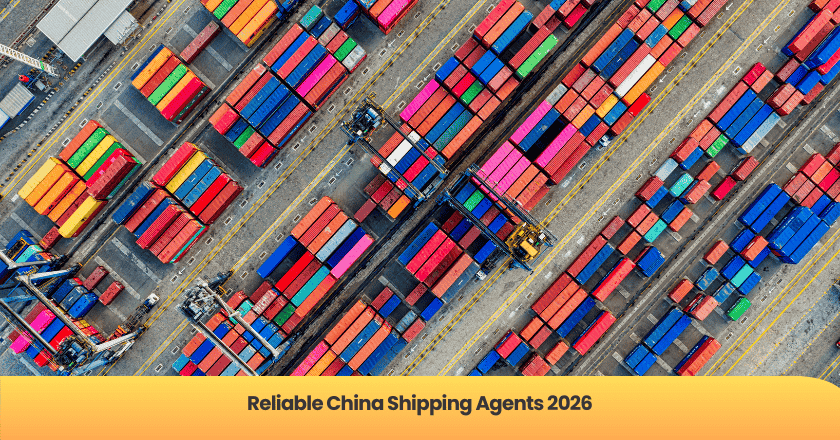
When you are importing goods from the "World's Factory," the distance between a successful product launch and a logistical nightmare is often measured by the quality of your China shipping agent. In 2026, the landscape of global trade has shifted significantly. We are no longer just dealing with "moving boxes"; we are navigating a high-tech ecosystem defined by AI-driven routing, shifting geopolitical alliances, and new electronic freight regulations (eFTI).
If you're looking to streamline your supply chain, this guide breaks down everything you need to know about partnering with a Chinese freight forwarder in today's digital-first market.
What Exactly is a China Shipping Agent in 2026?
A China shipping agent (or freight forwarder) acts as the bridge between your Chinese supplier and your final destination. Think of them as the "architect" of your cargo's journey. They don't just book space on a ship; they manage the intricate web of documentation, local trucking, warehousing, and customs compliance that varies from province to province.
In the current 2026 market, these agents have evolved into Logistics Technicians. They use "Digital Twins"—virtual replicas of supply chains—to predict delays before they happen and optimize routes based on real-time fuel fluctuations and port congestion data.
Key Responsibilities of a Modern Agent:
Multimodal Optimization: Choosing between Sea, Air, Rail (Iron Silk Road), or the increasingly popular "Sea-Air" hybrid models.
Customs Navigation: Handling the now-mandatory eFTI (electronic Freight Transport Information) filings to ensure paperless, rapid clearance at international borders.
Cargo Consolidation (LCL): Grouping your small shipments with others to fill a container, significantly lowering costs for e-commerce sellers.
Last-Mile Strategy: Coordinating with local couriers (like UPS, FedEx, or regional last-mile specialists) to ensure the "final leg" is as efficient as the long haul.
Common Mistake to Avoid: Many importers assume that their Chinese supplier can handle the shipping "just fine." While suppliers are great at manufacturing, their shipping quotes often include hidden markups, and they rarely provide the level of oversight needed when a shipment gets stuck in customs.
Why 2026 Requires a Different Strategy
The "old way" of shipping relied on stable schedules and predictable rates. In 2026, we face a "Buyer's Market" with excess carrier capacity, yet this is balanced against extreme volatility in the Middle East and shifting tariff windows.
The 2026 Shipping Climate:
The AI Revolution: About 68% of leading Chinese agents now use AI for Predictive Analytics. This means your agent can tell you, "Don't ship through Ningbo next week; our AI predicts a 4-day backlog due to a local holiday surge."
Tariff Windows: Specifically for US-bound cargo, 2026 represents a critical window where moderated tariffs (around 29.3%) are in effect, but this window is projected to tighten by November 2026. A savvy agent will help you "front-load" inventory to capitalize on these rates.
Sustainability Compliance: "Green Logistics" is no longer a buzzword. Agents are now required to provide carbon footprint data for every shipment, helping brands meet their ESG (Environmental, Social, and Governance) goals.
Expert Tip: Ask your agent for their Real-Time Visibility (RTV) credentials. In 2026, if an agent can't give you a GPS-verified dashboard of where your container is at any given second, they are already behind the curve.
Core Shipping Methods
Understanding the jargon is half the battle. Here is how your agent will likely categorize your options:
Ocean Freight (FCL vs. LCL)
FCL (Full Container Load): You rent the whole "box" (usually 20ft or 40ft). This is the gold standard for volume and security.
Simple Explanation: Like renting an entire moving truck just for your furniture.
LCL (Less than Container Load): You share space with other shippers.
Simple Explanation: Like sending a package via a bus where everyone's luggage is in the same cargo hold.
Air Freight & Express
Air Freight: Best for shipments over 100kg that need to arrive in 3-7 days.
Air Express (DHL/FedEx/UPS): The "all-in-one" solution for small, urgent parcels. It's expensive but handles customs for you.
The "Iron Silk Road" (Rail Freight)
Connecting China to Europe and Central Asia, rail has become a middle-ground savior in 2026, offering faster speeds than sea at a fraction of the cost of air.
Expert Tip: Look into RIPI (Reverse Interior Point Intermodal) routing if you are shipping to the US East Coast. By using the Panama Canal and moving cargo inland from the East, you can often bypass the chronic labor-related congestion seen at West Coast ports like Los Angeles/Long Beach.
How to Vet a China Shipping Agent
A "cheap" quote from an unverified agent on a social media platform is often a recipe for "cargo ransoming" (where they hold your goods for extra fees).
Vetting Checklist:
1. NVOCC License: Ensure they are a Non-Vessel Operating Common Carrier. This means they are legally recognized to issue their own Bills of Lading.
2. Specialization: Do they handle your specific product? Shipping electronics (with lithium batteries) requires vastly different certifications than shipping textiles.
3. Local Presence: They should have physical offices in major hubs like Shenzhen, Ningbo, or Shanghai. A "virtual" agent lacks the "Guanxi" (connections) to solve problems on the ground when a truck breaks down.
Common Mistake to Avoid: Choosing an agent solely on the "per-kilogram" rate. The cheapest agent often uses "slow-steaming" vessels or unreliable sub-contractors, which can result in your goods sitting in a warehouse for three weeks before even seeing a ship.
Essential Documentation for 2026 Compliance
Paperwork is the "DNA" of your shipment. If one strand is mutated, the whole thing dies in customs.
- Commercial Invoice: The official bill of sale. It must be 100% accurate regarding the HS Code (Harmonized System Code).
- Simple Explanation: A universal "ID number" for your product so customs knows exactly what it is and how much tax to charge.
- Packing List: A detailed breakdown of every carton, weight, and dimension.
- Bill of Lading (B/L): The contract between the owner of the goods and the carrier. Note: In 2026, "Electronic Bills of Lading" (eB/L) are the standard for 80% of major trade lanes.
- Certificate of Origin (C/O): Proves where the goods were made, crucial for claiming lower tariff rates under trade agreements.
Expert Tip: Double-check your Incoterms. In 2026, many importers are moving away from EXW (Ex Works) because it gives the buyer too much liability in China. Instead, opt for FOB (Free on Board) or DAP (Delivered at Place) to share the risk more equitably with the supplier and agent.
The "Hidden" Costs: What Your Quote Might Miss
When you get a quote, look past the big bold number. You need to ask about "Landside Charges."
- Demurrage & Detention: Fees charged when you leave your container at the port for too long.
- Fuel Surcharges (BAF): These fluctuate wildly in 2026 due to global energy tensions.
- Customs Examination Fees: If your cargo is randomly selected for an X-ray or physical inspection, you pay for the delay and the labor.
- Palletization Fees: If your goods arrive "loose" and the warehouse has to put them on pallets for safety, there's a charge for that.
Common Mistake to Avoid: Forgetting Marine Insurance. It typically costs about 0.3% to 0.5% of your cargo value. In a world of increasing "freak" weather events and maritime "chokepoint" tensions, skipping insurance to save $100 on a $50,000 shipment is madness.
FAQ: Everything You’re Itching to Ask
How long does it take to ship from China in 2026?
It depends on the "lane." To the US West Coast, Ocean Freight (FCL) takes about 15-20 days. To Europe via rail, expect 18-22 days. Air Express remains the king of speed at 3-5 business days.
What is the "Cheapest" way to ship?
Generally, Sea Freight (LCL) is the cheapest for shipments over 2 cubic meters. However, if your shipment is very small (under 45kg), Air Express might actually be cheaper when you factor in the high "minimum" port fees associated with sea freight.
How do I handle "Chinese New Year" in 2026?
CNY 2026 starts on February 17th. Factories will begin closing in early February. You must book your shipments by January 15th if you want them to leave the port before the country "goes dark" for two weeks.
Is AI really making shipping cheaper?
AI isn't necessarily lowering the base rate, but it is drastically reducing "hidden costs." By optimizing routes and predicting weather disruptions, AI-enabled agents help you avoid late fees and emergency "emergency air-shipping" when sea freight is delayed.
Final Thoughts: Building a Resilient Supply Chain
Shipping from China isn't about finding the lowest price—it's about finding the highest reliability. In 2026, your China shipping agent should be a strategic partner who understands the nuances of AI logistics, eFTI compliance, and the shifting geopolitical tides.
NewBuyingAgent
Related Resources

Get Started Today
Let's Turn Your Sourcing Goals into RealityWeChat:+86 15157124615
WhatsApp:+86 15157124615
Address:Building 10 #39 Xiangyuan Road, Hangzhou, China
