


A recyclable packaging claim needs evidence for the words being used, the finished packaging being supplied, and the market where customers will dispose of it. Ask for those three things together before approving artwork. A paper certificate, a recycled-content declaration, or a laboratory report may answer one part of the question while leaving the actual pack and its recycling route unproven.
Decide what the evidence actually covers
Approve a packaging statement only when the file supports its specific meaning, including any necessary conditions or exclusions. The useful unit of review is the finished pack in its intended market, rather than the supplier’s general environmental credentials. A narrower component statement may be supportable even when a broad claim about the entire package remains unproven.
- Definition: Recyclability concerns an end-of-life route; recycled content concerns material inputs.
- Risk: A valid document can still cover the wrong material, revision, component, or destination.
- Decision: Record which wording is approved, which evidence supports it, and what remains unresolved.
- Common mistake: Treating a material code or an unrelated certificate as approval for a finished-package claim.
Match the claim to the finished pack and destination
Evidence is useful only when its scope matches the statement a customer will read on the actual packaging. Identify whether the words refer to the whole pack, one separable component, or a specific recycling route, and then check the documents against that meaning. This avoids approving a broad finished-package claim on the strength of evidence that establishes something much narrower.
The UK Competition and Markets Authority’s Green Claims Code illustrates the problem with a lined paper takeaway container: a certificate about responsibly sourced paper does not establish that the finished container is recyclable. The example concerns that construction and the available recycling infrastructure; it does not mean every coated paper package is automatically unsuitable.
Start the supplier request with the proposed wording and a photograph or drawing showing where it will appear. “Recyclable carton,” “recyclable packaging,” and “paperboard component recyclable after separation” do not necessarily communicate the same scope. Include symbols and nearby text in the review, because the overall presentation can broaden what readers understand the claim to mean.
Next identify the destination and customer disposal setting. A household pack, a retail display, and a transport carton collected through a business contract may follow different routes. Ask who collects the packaging, how it is sorted, and what evidence supports its reprocessing in that setting. Where a route or component remains unknown, carry that gap into the approval record instead of assuming that a familiar material name resolves it.
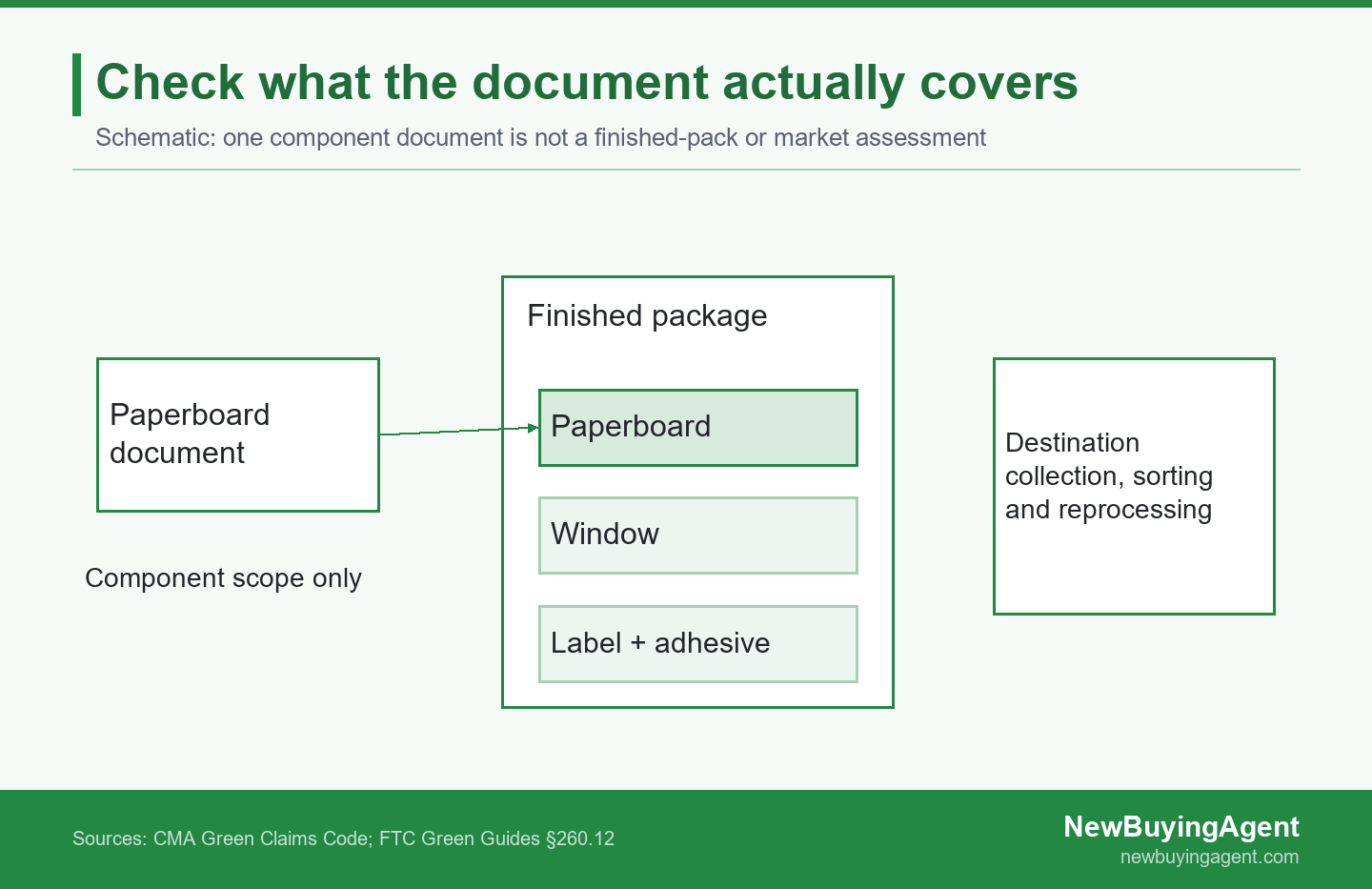
A paperboard document covers one component; finished-pack and destination evidence remain separate.
Request the complete packaging specification
Request a revision-controlled specification identifying the complete pack and its components, supported by a representative finished sample. The specification should make it possible to compare the submitted documents with what the factory will actually manufacture. For a recurring order, the same reference should connect purchasing instructions, approved artwork, packaging materials, and later production checks so that substitutions become visible.
- Pack identity: Product reference, packaging supplier, drawing or specification number, revision date, and the sample photographed.
- Construction: Main material, coatings, laminations, windows, inserts, labels, inks, adhesives, closures, and relevant component weights or thicknesses.
- Disposal behavior: Which parts remain attached, which can be separated in ordinary use, and what preparation the consumer would need to perform.
- Document match: The material grades, components, or finished construction covered by each declaration, assessment, or test report.
- Production control: Which material or supplier changes require notification before an approved packaging specification is altered.
A statement such as “paper box with clear window” is too imprecise to connect a report to production. Ask for the actual window material, its attachment, and the coated or laminated surfaces involved. Where the supplier cannot disclose a formulation publicly, agree how the relevant technical reviewer will receive sufficient information rather than replacing the missing detail with a generic assurance.
For a home-and-kitchen buyer sourcing a product and its retail carton together, an attractive sample can conceal unresolved packaging substitutions. NewBuyingAgent’s local China factory network and product development and quality-control capability provide a practical resource for aligning product requirements with factory execution. Put the packaging construction and permitted alternatives into the product brief, then carry the agreed version into sample approval; that keeps the discussion focused on the item being purchased and the evidence it needs.
Check what each document actually establishes
Classify supplier documents by the question they answer before judging whether the evidence file is complete. Material origin, technical compatibility, and access to recycling facilities are different questions, even when the paperwork uses similar environmental language. A document can be genuine and relevant without proving the proposed statement in full, so the review should preserve both its useful conclusion and its limitations.
| Evidence received | Question it may answer | What still needs checking |
|---|---|---|
| Material or sourcing certificate | What material or supply-chain attribute is covered? | Finished-pack construction and the actual recycling claim. |
| Recycled-content declaration | What recovered material input is declared? | Whether the package can enter a destination recycling route. |
| Test or design assessment | How did the identified sample perform under the stated method? | Sample match, method scope, market relevance, and exclusions. |
| Collection and processing evidence | What happens to this packaging in the destination system? | Coverage, dates, consumer conditions, and permitted wording. |
Recycled content answers a different question
Recycled content concerns material recovered or diverted from the waste stream during manufacturing or after consumer use, as described in the FTC guidance on recycled-content claims. That describes inputs, rather than establishing an end-of-life collection and processing route.
If the supplier submits a recycled-content declaration, check the component, material proportion, calculation basis, and production scope it covers. Keep that evidence if a corresponding input claim is intended, but do not file it as the sole answer to “Can customers recycle this finished pack?” A carton made with recovered fiber can still have features requiring separate assessment; conversely, a package need not contain recycled material merely because its design is compatible with a recycling route.
Check the assessment method and edition
The public ISO catalog lists ISO 14021:2026 as the current third edition, published in June 2026, concerning self-declared environmental claims. A reference to an older edition should therefore prompt a scope and applicability check rather than an assumption that the reference is current.
For any submitted assessment, request the method name and edition, issuer, report date, sample identification, conditions, result, and exclusions. Determine whether it assesses a raw material, a component, or the finished construction. Ask the reviewer to explain how the method relates to the proposed claim and destination. The public ISO abstract establishes the document’s subject and version; it does not, by itself, verify a supplier’s conformity or provide a laboratory result for the buyer’s pack.
Read material codes without treating them as approval
A resin identification number identifies the plastic type, not whether it can be recycled locally, a distinction explained in Derbyshire County Council’s recycling guidance. The number is useful for identifying material, but it does not establish collection access or processing compatibility for the finished item.
Compare the code with the supplier specification and physical sample, then continue the route assessment. Do not transfer one council’s accepted-material list to another destination. If a recycling symbol will appear prominently in the artwork, include its presentation in the claim review rather than treating it as a purely technical production mark.
Match the evidence to the destination
Destination evidence determines whether the proposed statement needs qualifications, a narrower scope, or further investigation. Technical material compatibility is one part of that review, while the availability of collection, sorting, and reprocessing must be considered in the actual selling market. The following examples show why buyers should identify the governing rule and date instead of applying one country’s threshold worldwide.
United States: access and claim scope matter
The FTC Green Guides on recyclable claims use at least 60 percent of consumers or communities where the item is sold as the substantial-majority access threshold. That denominator concerns access, rather than a percentage of packaging mass actually recycled; below that level, the guidance calls for qualifications reflecting the limited availability.
The same section distinguishes an entire-product or entire-package claim from a qualified claim about only part of it. Its whole-item rule excludes minor incidental components, but it also addresses components that significantly limit recycling. Accordingly, “every tiny component must be recyclable” is too broad a shortcut, while “the main material is recyclable” may be too weak to support a whole-pack statement.
Request evidence for the relevant selling area and packaging configuration, then have the proposed wording reviewed against applicable federal, state, and local requirements. Do not import the US access threshold into other markets, or assume that a generic “where facilities exist” phrase cures any evidence gap. The qualification itself needs to communicate the limitation accurately.
United Kingdom: match RAM to the reporting year
The official UK recyclability assessment methodology for 2027 applies to that reporting year and directs users to RAM version 1.1 for 2026. A newer published document is therefore not automatically the correct method for an earlier reporting period.
RAM serves a defined extended producer responsibility reporting context, including obligated large producers and relevant household packaging. An assessment prepared for that purpose can be useful information, but its existence should not be treated as worldwide permission to make any consumer-facing recycling statement. Ask who prepared it, which pack it covers, which reporting year applies, and what classification was reached.
Keep the reporting obligation and marketing claim as separate approval questions. If a supplier sends only an assessment label or screenshot, request the underlying packaging references and method version before connecting it to the buyer’s artwork.
European Union: separate present duties from future criteria
The European Commission describes the Packaging and Packaging Waste Regulation as entering phased application on August 12, 2026, with recyclability requirements from 2030 in its explanation of the new packaging rules. Those dates should not be collapsed into a statement that every future recyclability criterion already applies to an October 2026 order.
For an EU purchase, identify the destination, expected placing-on-market date, packaging category, and relevant economic operator. Ask the responsible specialist which requirements apply to that configuration and date, including any applicable national claim rules. A supplier’s “PPWR ready” description is a starting question, not a substitute for this mapping.
Longer-term packaging development can consider future criteria without presenting a forecast as current approval. Record which edition or requirement informed the design and which details still await confirmation, so a later order can be reassessed against the applicable rules.
Turn the file into an approval decision
A usable evidence review ends with a specific artwork decision and a targeted request for anything missing. Compare the claim’s object, construction, market, and conditions with the documents actually received, then record the supported scope. The decision may be a qualified component claim, a request for further assessment, or a temporary hold on the proposed wording rather than a blanket rejection of the product.
An illustrative kitchenware packaging decision
Consider an illustrative China purchase of 6,000 kitchenware sets for two destination markets, the United States and the United Kingdom. The retail carton has paperboard, a clear window, a printed label, and adhesive. The proposed artwork says “100% recyclable packaging,” but the supplier sends only a certificate concerning the paperboard’s sourcing. This is a hypothetical decision exercise, not a NewBuyingAgent customer case or a measured recycling result.
Enter the proposed words in the claim field of the approval record and list the whole retail pack as their apparent object. In the construction field, record the carton revision and the window, label, and adhesive specifications. In the evidence field, identify the paperboard certificate as a component sourcing document. That comparison exposes a mismatch: the received file does not establish recycling of the finished construction or access in either selling market.
The immediate output is “whole-pack claim not approved; evidence incomplete.” Send the supplier a focused request for the finished-pack specification and any relevant assessment, including its sample, method, and exclusions. Separately obtain destination-route information suitable for the intended market review. Assign an owner to each request and keep the claim decision visible in the artwork approval, rather than allowing an unrelated product-quality approval to release the environmental wording.
If later evidence supports only a separable paperboard component, the reviewer can consider narrower wording and any required separation instructions. If the route remains unknown, leave the broad statement unapproved. Product development may continue under an agreed artwork route that omits the unresolved claim; whether printing or shipment proceeds is a separate purchase decision. No hypothetical pass rate, certificate grade, or market-access percentage is needed to reach that result.
Give missing evidence a defined next action
A missing document needs an owner and a decision consequence, not an assumed pass. Describe the unanswered question precisely: for example, whether the report covers the windowed carton or only uncoated paperboard. Ask for the evidence that would resolve that question, and state which wording remains unapproved until it is answered.
Keep “not provided,” “not applicable,” and “reviewed but insufficient” distinct. The first calls for information, the second needs a reason linked to the actual pack, and the third needs an explanation of the mismatch. When the supplier sends a replacement file, compare it with the original gap rather than treating a new attachment as automatic closure. The observable result is a resolved question or a still-open claim decision with a clear next step.
Keep supplier changes tied to the approved claim
A packaging approval remains useful only while its evidence matches the construction being manufactured and the statement being used. Connect relevant supplier changes to a review of that match, rather than carrying an old approval forward because the product reference is unchanged. This is a practical purchasing control for repeat orders, especially where a small material substitution could alter the basis of the original assessment.
The Australian Competition and Consumer Commission’s environmental claims guidance emphasizes having evidence to support the claims actually made. In purchasing practice, a useful application of that principle is to reopen the relevant claim review when a factory change makes the approved evidence a poor match for the new pack.
For example, a beauty brand may approve a paperboard sleeve and later receive a proposal for a laminated surface to improve scuff resistance. The substitution might be commercially attractive, but its effect on the existing recycling assessment is a separate question. Identify the changed material and affected evidence, then obtain the necessary confirmation before carrying the old environmental statement into the replacement artwork.
Where that sleeve forms part of a recurring product purchase, NewBuyingAgent’s China product supply service connects local factory resources and product development and quality-control capability with the buyer’s product requirements. Include the approved sleeve construction and change-notification requirement in the purchasing brief, so sampling and production follow-up refer to the same version. The benefit is a clearer connection between the purchased product, its packaging, and the buyer’s approved requirements.
Specify the events that trigger review: changed material grade, coating, adhesive, component supplier, disposal instruction, claim wording, or destination. A purely administrative file rename may need no technical reassessment, while an unchanged material can still need market review if collection evidence changes. Record the reason for carrying an approval forward as carefully as the reason for reopening it.
Record what may be printed and what is still missing
Use a claim approval record to preserve the link between wording, packaging, evidence, and the person authorized to decide. A compact record is more useful than an unstructured folder of certificates because it shows what each file establishes and which questions remain open. The template below is a recommended buyer control, not a universal regulatory form or a certification result.
- Claim and location: Exact wording, symbol, artwork filename, and the surface or product page where it appears.
- Object and revision: Whole pack or named component; product reference, packaging specification, revision, and sample photograph.
- Market and conditions: Destination, intended disposal setting, applicable date, and any separation or preparation instructions.
- Evidence index: Issuer, document reference, method and edition, date, sample scope, result, and exclusions for each file.
- Unresolved questions: Missing construction details, route evidence, unsupported wording, and the specific information requested.
- Decision: Approved wording and qualifications, or wording not approved; distinguish this from general product approval.
- Accountability: Decision owner, review date, supplier response owner, and the events that reopen review.
For the kitchenware example, the record would identify the whole-pack wording, list the paperboard sourcing certificate under evidence, and mark the finished-pack assessment and destination-route questions unresolved. Its action would be a defined supplier request and a hold on that wording. When a response arrives, the reviewer can see exactly which field changes and whether that change is enough to support a narrower or broader statement.
When planning a repeat China purchase, include the product, specifications, quantity, destination, delivery timing, current sourcing situation, and recurring order requirements, then send the purchasing brief to NewBuyingAgent. Include the packaging construction and proposed environmental wording with that brief so product sourcing and factory execution can be discussed against clear requirements, with the claim decision assigned to the buyer’s responsible reviewer.
Frequently asked questions
Can an existing supplier certificate cover a new packaging revision?
Only if its scope genuinely covers the revised packaging and the claimed property; a familiar supplier name does not establish that new materials or construction are included. Compare the changed specification with the document’s sample description, covered materials, and exclusions, and ask the issuer or responsible reviewer to clarify any gap. Keep that confirmation with the new revision so later purchasers can distinguish a supported carryover from an assumption.
Can the same recycling statement be translated for every market?
Translation alone cannot establish that a recycling statement remains accurate in another market, because the collection routes, qualification rules, and intended audience may differ. Review the meaning of the words and symbols in each destination, together with any preparation instructions a customer needs. A common packaging design may still need market-specific wording or artwork controls, and a translator should receive the approved scope rather than an unresolved global claim.
Should the product page use the same claim as the carton?
The product page and carton should use consistent, evidence-supported scope, while necessary qualifications remain clear and visible in the context where the buyer sees the claim. Do not shorten a carefully qualified component statement into an unqualified whole-pack promise on a listing or sales sheet. Include those digital and commercial versions in the approval record, particularly when different teams edit packaging artwork and online product descriptions.
What if the factory needs artwork before evidence is complete?
Give the artwork an explicit claim status and choose a documented production route that avoids printing unsupported wording while the responsible reviewer resolves the outstanding evidence. Options may include approved artwork without the unresolved statement or a revised production plan, depending on the purchase agreement and practical constraints. Confirm the chosen file with the factory and distinguish that decision from any later approval of the environmental claim.
NewBuyingAgent
Related Resources



Get Started Today
Let's Turn Your Sourcing Goals into RealityWeChat:+86 15157124615
WhatsApp:+86 15157124615
Address:Building 10 #39 Xiangyuan Road, Hangzhou, China
