


Real-time order tracking should not mean a stream of random photos, chat messages, and optimistic status notes. For China sourcing work, good tracking connects each order milestone to evidence: what was planned, what has happened, what remains open, what changed, and what decision the buyer needs to make next.
The value of order tracking is highest when the buyer is not physically present and several parties are moving at once: factory teams, packaging vendors, inspectors, freight forwarders, warehouse contacts, and internal stakeholders. A sourcing agent can help compress that complexity into a practical status view, but only if the tracking system is built around milestones rather than noise.
This article explains what buyers should expect from real-time order tracking through a China sourcing agent, from purchase order confirmation to production, quality evidence, packing, shipping handover, and exception handling. The goal is a tracking rhythm that helps buyers act early, not a dashboard that looks modern while problems still arrive late.
Key Takeaways
- Visibility: Real-time tracking should show milestone proof, not just general progress claims.
- Evidence: Useful updates connect photos, documents, dates, owners, and next actions.
- Cadence: Tracking should be frequent enough to prevent surprises but structured enough to avoid noise.
- Risk: Delays and defects must trigger corrective-action records, not vague reassurance.
- Handover: Carton identity, packing data, and shipment documents need to match before goods move.
- Decision: The best tracking system tells the buyer when to approve, hold, rework, expedite, or renegotiate.
What Real-Time Order Tracking Should Prove
Modern logistics standards are moving toward clearer event visibility. The Digital Container Shipping Association publishes track and trace documentation standards for container shipping, and that same mindset is useful before goods even reach the port: every meaningful milestone should have an event, evidence, and owner.
For sourcing work, real-time tracking should prove four things. First, the order is still aligned with the approved specification. Second, the production timeline is real enough to support customer commitments. Third, quality and packaging evidence are being gathered before the final release point. Fourth, shipment documents and carton identity are converging rather than drifting apart.
The buyer does not need to see every factory movement. In fact, too much low-quality information can make tracking worse. What the buyer needs is decision-ready visibility: status, proof, risk, next action, responsible party, and deadline. If an update cannot support a decision, it is probably noise.
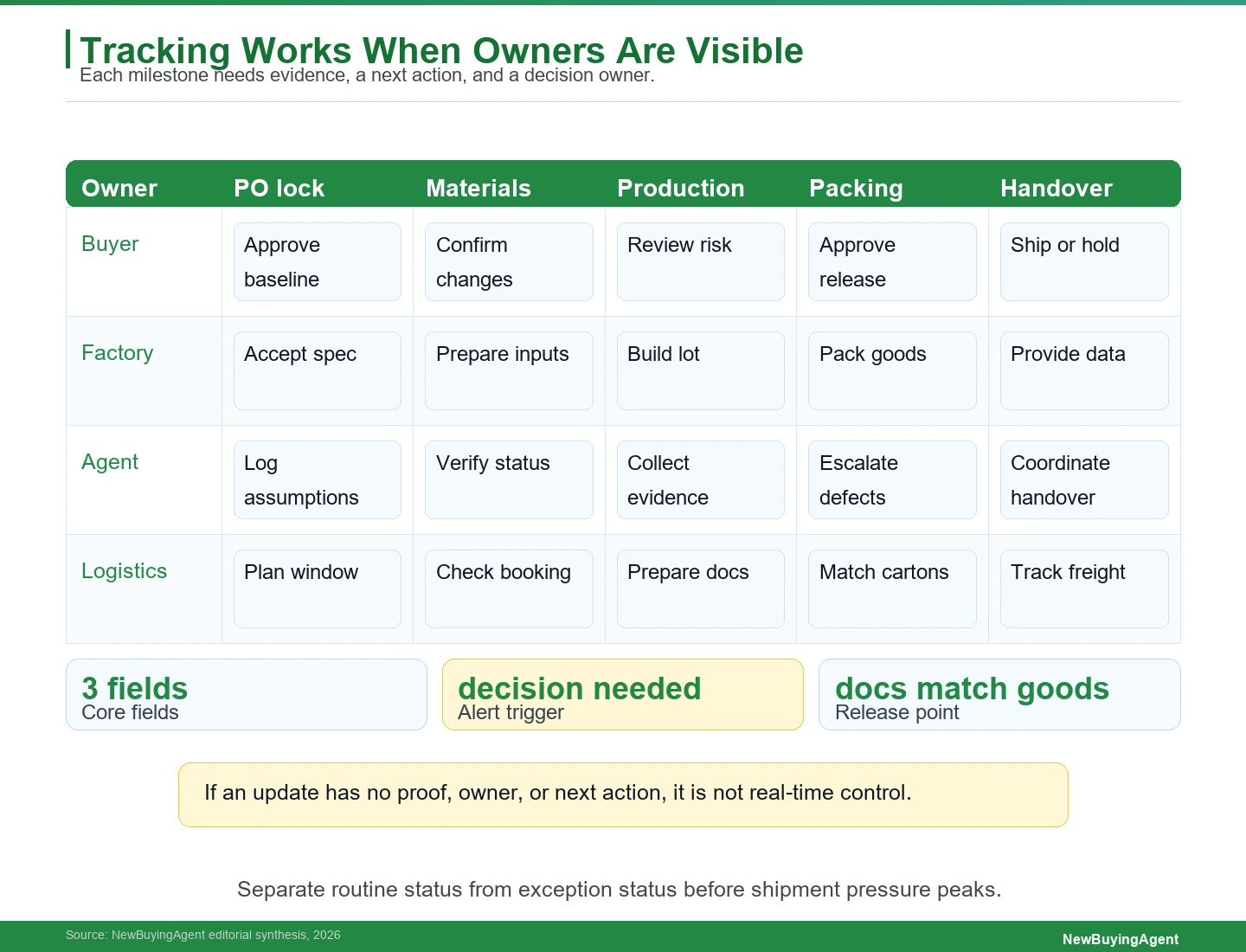
Effective real-time tracking separates buyer approvals, factory execution, sourcing-agent evidence, and logistics handover so exceptions surface early.
The Milestone Stack From PO to Delivery
A sourcing agent's tracking process should be built around a milestone stack. Each milestone has a trigger, evidence, risk threshold, and buyer decision point. This keeps the order from becoming a long conversation with no clear status.
The stack should be visible to both commercial and operational users. A merchandiser may care about launch timing, while a logistics coordinator cares about carton data and booking windows. A finance contact may care about when a payment milestone is justified. When the same milestone file supports each role, the buyer is less dependent on private explanations from one contact.
PO Lock and Requirement Freeze
The first milestone is purchase order lock. The buyer, agent, and factory-side team should confirm product version, material, dimensions, finish, packaging, label files, quantity, target ship date, payment terms, and destination. If the buyer continues changing details after PO lock, the tracking file should show which changes were accepted and how they affected cost or timing.
Material and Component Readiness
The second milestone is material readiness. Tracking should confirm whether key components, packaging materials, printed labels, accessories, and test-critical parts are available. This step is especially important when the production schedule looks fine on paper but a delayed component can push the whole order into rushed assembly.
Inline Production Status
Inline tracking should show the buyer whether production is following the approved version. Useful evidence includes dated line photos, first-article photos, measurement checks, color or finish comparison, assembly evidence, and open issue notes. Inline status matters because it gives the buyer time to correct before the full lot is packed.
Pre-Packing and Final Inspection Evidence
Pre-packing review connects product condition with packaging logic. Once goods are sealed, many defects become expensive to fix. The tracking system should capture sample cartons, inner protection, label position, accessory bags, master carton marks, quantity per carton, and any inspection findings that affect release.
Shipment Handover and Freight Events
Shipment handover should tie product evidence to logistics evidence. Commercial responsibilities can be clarified with Incoterms 2020, while carton and shipment identifiers should support traceability. For example, GS1 SSCC guidance shows how serialized carton or logistic-unit codes can support receiving and tracking across handoffs.
What Good Evidence Looks Like
Good tracking evidence is dated, labeled, and connected to a decision. A photo of cartons is weak if the buyer cannot see which order, SKU, quantity, or packing version it represents. A production percentage is weak if it does not say which process is complete. A document scan is weak if it does not match the packing list and carton labels.
The evidence should also preserve sequence. If carton labels are approved after final inspection, or if packing photos arrive before the accessory count is confirmed, the tracking file should make that timing clear. Sequence matters because a correct artifact at the wrong moment can still leave the buyer exposed to rework, repacking, or document revision.
A strong update includes five fields: milestone, evidence received, open risks, next action, and deadline. For example: "Packaging sample approved on June 18; 2,000 inner cartons received; master carton drop evidence pending by June 21; final inspection tentatively June 24; shipment hold remains until carton marks match revised SKU file." That update is longer than a green status dot, but it tells the buyer what is real.
Document timing also matters. Trade.gov explains the role of common export documents, and its packing list guidance shows why carton-level contents, weights, measurements, and package detail matter to freight and customs stakeholders. A tracking process that ignores documents until goods are ready to leave can create late friction.
How to Set Tracking Cadence Without Creating Noise
More updates are not always better. The right cadence depends on order complexity, production speed, shipment urgency, and defect history. For a simple repeat order, a weekly milestone update may be enough until production and packing. For a new product, custom packaging, tight launch date, or previous defect issue, the buyer may need updates at sample approval, material arrival, first article, inline production, pre-packing, final inspection, and booking.
The cadence should also define what triggers an off-cycle alert. A one-day delay may not matter if buffer exists, but a packaging material delay before final inspection may deserve immediate escalation. A minor color question may wait for the weekly report, while a critical safety or document mismatch should not.
A useful rule is to separate routine status from exception status. Routine status tells the buyer the order is following plan. Exception status tells the buyer that a decision is needed. Mixing both in one casual chat stream can make serious issues look ordinary.
A second rule is to avoid percentage-only reporting. A note saying production is 70 percent complete can hide the fact that the remaining 30 percent contains the hardest assembly step, the printed packaging, or the component that previously caused defects. Milestone reporting should therefore describe what is complete, what is unstarted, what is waiting for evidence, and what can still block release.
Exceptions, Delays, and Corrective Actions
Real-time tracking earns its value when something goes wrong. If a factory misses a material date, the update should not stop at "delayed." It should say why, what alternatives exist, whether cost changes, whether quality risk changes, and when the buyer must decide. If inspection finds a defect, the tracking file should show defect photos, affected quantity, proposed rework, re-inspection evidence, and release status.
Corrective actions should have owners. A vague note such as "factory will improve" is not a corrective action. Better tracking records who will sort, rework, retest, repack, relabel, update documents, or change the schedule. It also records the proof needed before the shipment can move.
For supply-chain security and resilience, ISO 28000 offers a useful reference point for thinking about supply-chain security management. Buyers do not need to turn each purchase order into a standards project, but the principle is relevant: risk is easier to manage when responsibilities, events, and evidence are documented.
Where NewBuyingAgent Fits in Order Visibility
When a buyer shares product specs, volume, target price, destination, and timing, NewBuyingAgent quotes and supplies China-sourced products with product selection, cost negotiation, quality management, production follow-up, logistics, and delivery. In order tracking, that means the buyer should see a practical chain of evidence from order confirmation through production and shipment handover.
Buyers can review the supply chain coordination service and the supply service to understand how requirements, production progress, and shipping coordination can be connected. The China sourcing guide also provides broader context for structuring buying work before orders begin.
For shipment data, international frameworks such as the WCO Data Model show the broader importance of structured trade information. At the order level, buyers do not need every field from a global data model, but they do need consistent names, quantities, carton data, shipment references, and document versions.
A Practical Tracking Template for Buyers
| Milestone | Evidence to Request | Buyer Decision | Exception Trigger |
|---|---|---|---|
| PO lock | Final spec, quote assumptions, production schedule | Approve order baseline | Unclear packaging, material, or destination terms |
| Material readiness | Component photos, label proofs, packaging material status | Approve start or hold | Missing critical component or artwork |
| Inline production | Dated line photos, first-article checks, measurements | Continue, correct, or inspect deeper | Version drift or functional defect |
| Pre-packing | Carton sample, inner protection, labels, count logic | Approve packing | Weak protection or mismatched carton marks |
| Final inspection | Inspection report, defect photos, corrective action evidence | Release, rework, sort, or reject | Critical defect or unresolved major issue |
| Freight handover | Packing list, invoice, booking, carton identifiers | Ship or hold | Document mismatch or missing shipment data |
The template should be adapted to product risk, order size, and launch pressure. Buyers who want help turning an order into a stage-by-stage tracking plan can start through the contact page with the product brief and target shipment timeline.
The template also gives the buyer a way to review performance after the shipment. If a delay occurred, the buyer can see whether the signal appeared early, whether the owner was named, and whether the corrective action had proof. That post-order review is what turns tracking from a status habit into a stronger buying system for the next order.
Frequently Asked Questions
What does real-time order tracking mean in China sourcing?
It means the buyer receives stage-based updates supported by evidence: requirement status, production progress, quality findings, packaging readiness, document status, shipment handover, open risks, next action, owner, and deadline.
Are photos enough for order tracking?
No. Photos help, but they must be dated, labeled, and connected to the order, SKU, milestone, and decision. A useful tracking file combines photos with quantities, documents, inspection notes, and next actions.
How often should a sourcing agent send updates?
The cadence depends on order risk. Repeat low-risk orders may need weekly updates plus milestone alerts. New products, tight deadlines, custom packaging, or previous defects usually need more frequent milestone-based reporting.
What is the difference between production tracking and shipment tracking?
Production tracking proves that goods are being made to the approved version. Shipment tracking proves that packed goods, documents, carton identity, booking, and handover events are aligned. Both are needed for a clean order release.
How should delays be reported?
A delay report should include cause, affected milestone, revised date, cost impact, quality impact, alternatives, decision needed, and responsible party. A vague delay note does not give the buyer enough control.
Can tracking reduce defects?
Tracking cannot replace quality work, but it can surface risk earlier. When inline evidence, packaging review, final inspection, and corrective actions are tied to milestones, buyers can act before the shipment reaches the point of no return.
NewBuyingAgent
Related Resources



Get Started Today
Let's Turn Your Sourcing Goals into RealityWeChat:+86 15157124615
WhatsApp:+86 15157124615
Address:Building 10 #39 Xiangyuan Road, Hangzhou, China
