


China production can reach a product trend's selling window when the complete path to sellable stock fits before the latest useful receipt date. That path includes approvals, materials, manufacturing, quality release, transport and receiving. For a merchandising director choosing a seasonal range, the useful question is how much profitable selling time remains after those steps, including a plausible delay.
Approve the Selling Date, Not Just the Factory Date
A trend order is commercially defensible only when the supported sellable-stock date leaves enough selling time and margin under a credible delay scenario. A factory completion promise is one input, while the commercial decision depends on when customers can actually buy the goods. If the dates do not fit, revise the product or shipping scope before committing more money.
- Timeline: Start with the last useful selling date and reserve enough time to sell the planned quantity.
- Risk: Validate the slowest dependent task, plus booking and receiving constraints.
- Decision: Give each proposal a latest release date and a clear scope-change or stop decision.
Set the Latest Commercially Useful Arrival Date
The commercial deadline follows from the market you can serve, the expected selling pace and the price you need to achieve. A holiday date may establish a firm endpoint; a viral style usually has a less certain horizon. In either case, a delivery just before demand ends can be commercially late even though the goods arrive during the season.
A trend signal helps identify an opportunity, but cannot establish its remaining life. Google's explanation of Trends data describes normalized search interest rather than absolute search volumes or a sales forecast. Check the destination country, relevant search terms and longer-term pattern alongside your own conversion, cancellations and selling-price evidence before assigning a purchasing horizon.
Separate three dates in the planning sheet: when the demand opportunity is expected to weaken, when stock must become available for sale, and when the purchase must be released. The first date is a commercial assumption, the second comes from the selling plan, and the third follows from the supply schedule. Give the commercial assumption an owner and a review date so it can change when evidence changes.
For a category team comparing seasonal apparel styles, NewBuyingAgent's market-fit product analysis and free Bestseller Market Analysis Report can inform product selection. Use the AI-assisted analysis to identify products worth evaluating against your destination-market evidence; it does not establish a guaranteed demand duration or override the order's timing constraints.
The latest useful receipt date comes before the end of demand because inventory needs time to sell. Estimate that selling allowance from the quantity, realistic weekly sell-through and any planned markdowns, rather than assuming the entire order sells immediately. If the forecast is weak, reduce the quantity you are testing or keep multiple demand scenarios instead of assigning a precise trend expiry date.
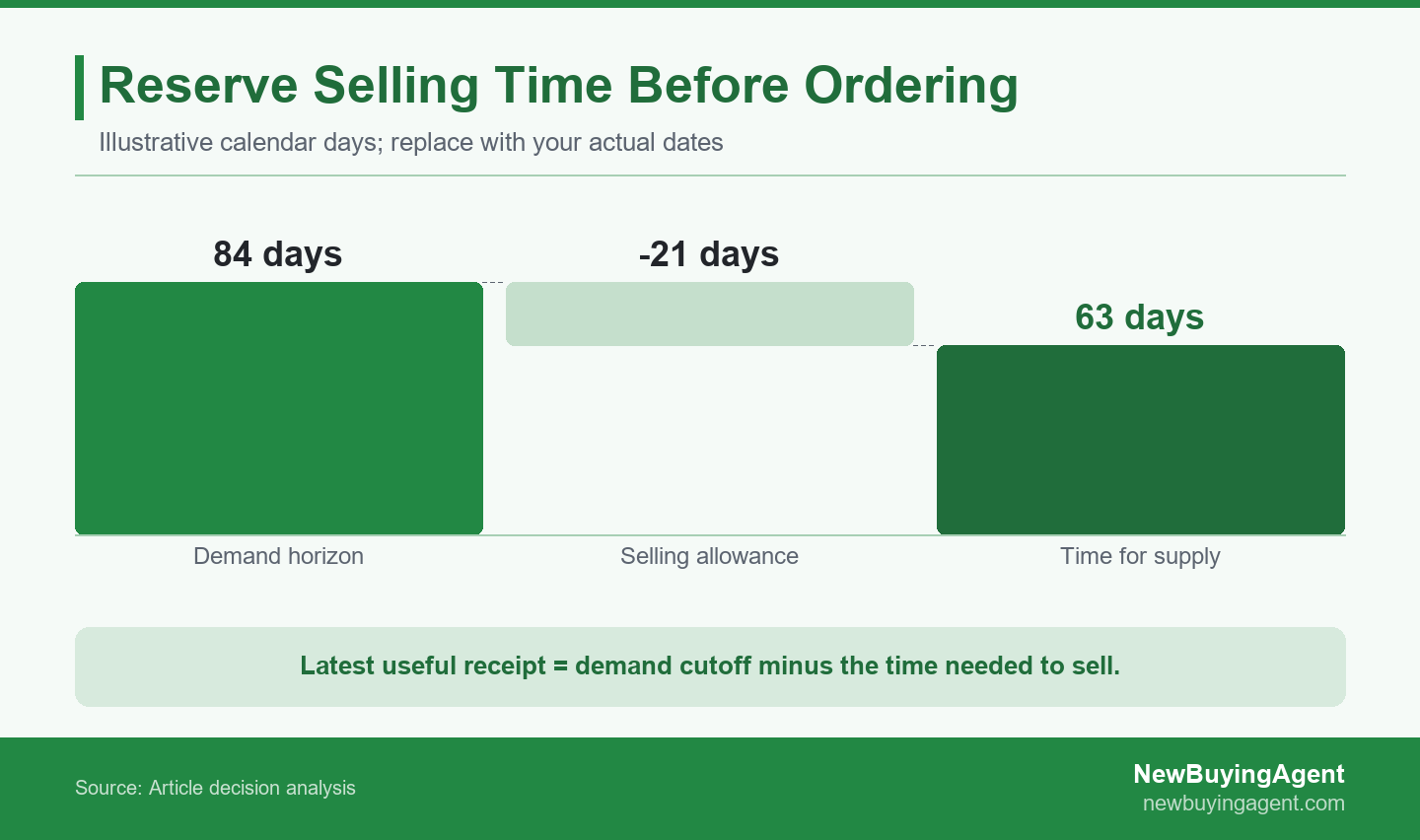
Hypothetical timing: 84 days to demand cutoff minus 21 selling days leaves 63 days for supply
Build the Full Trend-to-Shelf Schedule
A complete schedule ends when stock is accepted, available and ready for customers, and defines the starting condition for each duration. A quote that starts its production clock after sample approval cannot be counted from today while sampling is unfinished. The purchasing team should combine the factory's dates with the forwarder's route and the receiving team's availability, rather than asking one party to estimate everything.
Map the Tasks That Determine the Finish Date
Some activities can run together; others cannot. NASA's Project Planning and Control Handbook describes the critical path as the sequential task path representing the longest overall duration from the current time through completion. Applied here as a scheduling method, it means mapping actual sourcing dependencies: carton design might progress during sampling, while a material order may depend on an approved color. Confirm the dependency before treating either task as parallel.
Measure the dependent path from specification approval to sellable inventory; do not add overlapping tasks twice. Also include work still required before that approval, such as sample correction or buyer sign-off. Mark each duration as a supplier commitment, a route estimate, an internal booking, or an unresolved assumption. A shorter number based on an unconfirmed start condition is not a faster plan.
| Stage | Start condition | Evidence to enter | Finish that matters |
|---|---|---|---|
| Specification and sample | Buyer has a defined brief | Approval date; correction allowance | Approved production version |
| Materials and production | Agreed release conditions met | Material availability; capacity slot; quantity | Finished goods ready for release |
| QC and export preparation | Goods accessible for checks | Inspection slot; correction plan; packing readiness | Acceptable cargo meets dispatch conditions |
| Transport and destination | Booking and document conditions met | Actual route; handoffs; receiving appointment | Stock accepted and available to sell |
Based on this comparison, the schedule is usable only when every handoff has a defined finish and the next party can start. A production completion date without a release slot or receiving plan leaves the final selling date unresolved.
Count Transport Through Receiving, Not Just the Voyage
Maersk distinguishes time on the water from door-to-door time, including steps before and after the vessel journey. Ask which activities the quoted freight duration includes, then add only the missing work: collection, terminal handling, customs processes, final delivery or receiving. Check the actual route and booking conditions instead of importing a general shipping range into the order model.
The receiving team should confirm when an arrival becomes saleable stock. Unloading, quantity checks, labeling, damage handling and inventory posting may have their own constraints. Product-specific testing and destination requirements belong in the schedule when applicable; verify those with the relevant official guidance and qualified specialists. Faster freight cannot make an unresolved product requirement disappear.
Work Backward From the Selling Window
The last acceptable purchase release is the latest useful receipt date minus the remaining supply duration. Then compare that deadline with the remaining approvals and the date you can actually commit. Use calendar dates in the final sheet, converting working-day quotes with the correct factory, carrier and destination calendars. The example below uses only hypothetical calendar-day inputs to make the calculation reproducible.
Suppose a seasonal textile accessory has 84 calendar days until its demand cutoff, and the buyer allows 21 days to sell the planned quantity. That leaves 63 days for supply. A 56-day base schedule leaves 7 days of headroom. Here, schedule headroom means the time between planned sellable receipt and the latest useful receipt date; it is not proof that a delay will stay within that gap.
| Planning input | Hypothetical value | Calculation or condition | Buyer's own entry |
|---|---|---|---|
| Days to demand cutoff | 84 days | Commercial assumption from today | Cutoff date and demand basis: ______ |
| Required selling allowance | 21 days | Depends on quantity and selling pace | Quantity and sell-through basis: ______ |
| Latest useful receipt | Day 63 | 84 minus 21 | Receipt deadline: ______ |
| Approvals and materials | 14 days | One combined dependent stage | Confirmed start and finish: ______ |
| Production | 21 days | Starts after the prior stage | Capacity and material evidence: ______ |
| QC and export preparation | 7 days | After production in this example | Release and dispatch conditions: ______ |
| Transport and receiving | 14 days | Full remaining path, not vessel-only | Route and receiving evidence: ______ |
| Base supply duration | 56 days | 14 + 21 + 7 + 14 | Your dependency-based total: ______ |
| Latest base-plan release | Day 7 | 63 minus 56 | Release date and decision owner: ______ |
Based on this comparison, the base plan fits only if its start conditions are achievable by Day 7. These durations are illustrative inputs, not production or transport benchmarks for China; the 14-day inbound assumption would need specific route evidence before any real order used it.
A single duration can conceal uncertainty. GAO's government-project scheduling guide treats activity durations as forecasts with inherent uncertainty, estimating error and possible bias. The lesson applied here is to challenge the schedule inputs; GAO does not supply China production times, shipping estimates or trend lifespans.
An illustrative 12-day supply delay turns the 7-day headroom into a 5-day shortfall. To retain that entire delay allowance, the latest release would have been five days before today. The current configuration therefore fails this stress case even if the base plan looks acceptable.
A missed sailing can create a larger change than the factory's delay alone. Maersk's schedule guidance lists separate deadlines for container gate-in, shipping instructions and verified gross mass, or VGM. Check all applicable deadlines against cargo readiness, then model the next feasible departure if one is missed; do not assume a one-day production slip produces a one-day arrival slip.
The decision record now has a concrete result: hold the original configuration unless a verified change restores the receipt deadline, or consciously approve the remaining exposure with a smaller commitment. If production capacity is still unknown, the supply total remains unresolved. Obtain a dated capacity confirmation before treating the blank as zero and releasing the order.
Choose What to Change When the Schedule Does Not Fit
A faster option is worthwhile only when it changes the constrained stage and preserves enough contribution at the expected selling price. Simplifying packaging will help little if the long pole is a custom material; air freight will help little if goods are not ready before demand fades. For each alternative, obtain revised dates and costs for the same quantity, destination and acceptance requirements.
| Option | What can change | Evidence before commitment | Reason to reject |
|---|---|---|---|
| Use an existing specification | Less development or material work | Exact sample, available inputs, approved requirements | Available style does not fit customer demand |
| Reduce the initial range | Fewer styles or smaller first exposure | Revised capacity and price for actual scope | Factory minimums or costs erase benefit |
| Use faster freight for a portion | Earlier saleable quantity | Complete route quote and receipt date | Extra cost exceeds recoverable contribution |
| Skip the current window | Avoid a late trend commitment | Documented exit or later-demand rationale | Reconsider only with new demand or timing evidence |
Based on this comparison, changing the slowest relevant stage is more useful than requesting a general rush. Keep the original product requirements visible when evaluating alternatives, so a quicker offer does not quietly change material, finish or pack performance.
DHL's air-versus-ocean guide explains the premium for air transportation and recommends comparing actual route transit times. Calculate the additional freight and handling per unit, then compare that cost with the contribution you reasonably expect to protect through earlier availability. Include any balance left on slower transport and the risk that the early quantity merely shifts sales from later units.
For buyers considering an existing style instead of a fully customized launch, NewBuyingAgent's local factory resources and product/QC capability can support China product supply for an agreed alternative. The buyer provides the commercial requirements; the product offer should make the specification, price and delivery scope clear. Confirm actual material availability and capacity for that offer rather than interpreting a broad factory network as immediate stock. Flexible payment support may also be relevant, subject to the agreed order terms.
Keep the Order and Reorder Inside the Remaining Window
Order commitments need review whenever a missed milestone changes the commercial outcome, and every reorder needs an updated remaining-window calculation. A sample approval, material confirmation, production finish or dispatch deadline can each trigger a revised receipt date. Assign an owner to report the actual result and an owner to decide whether the next commitment still makes sense; a progress update alone does not make that decision.
Record each milestone as planned date, observed result, revised sellable-stock date and next action. If a sample fails, preserve the failed result and obtain a correction date before authorizing the production version. If capacity shifts, update the dependent tasks and the applicable departure. The observable success is a revised plan that still fits the commercial deadline, rather than a supplier saying the order is urgent.
Documents also need to be ready for the chosen route. The International Trade Administration's document guide distinguishes the commercial invoice from the packing list and says their cargo information should agree. Review the actual shipment details before the booking deadline, with the forwarder or importer confirming destination-specific requirements. This is a handoff check, not a promise of a fixed customs-clearance time.
A reorder needs its own remaining-window test at release, using updated demand and supply evidence. First sales can validate customer interest while leaving too little time for another production cycle. Size the reorder against projected available stock at that receipt date: start with unallocated sellable stock, deduct expected consumption before receipt, and include confirmed inbound stock available by then, counting each unit once. Projected available physical stock cannot fall below zero. Add any pre-receipt backlog only if those orders remain unfilled and are not already included in demand after receipt. Net replenishment need is that combined demand minus projected available stock, with a minimum of zero.
For example, assume 200 unallocated units are available now, 150 will sell before the reorder arrives, and there is no other inbound stock or backlog. Projected stock at receipt is 50 units. If expected demand after receipt is 300 units, the net replenishment need is 250 units, not the 100 obtained by subtracting today's stock. Recheck the result against order minimums and the remaining selling window.
Set the reorder stop date from the revised supply duration and the selling allowance for that quantity. If evidence shows prices weakening, reduce the achievable-price assumption before considering expedited freight. Already committed goods need a separate recovery decision; money spent on the first order does not establish that another order is commercially justified.
Send a Time-Bounded Product Sourcing Brief
A useful sourcing brief states both the product requirements and the commercial deadline, with acceptable changes identified in advance. A supplier can then evaluate a specific delivery scope rather than answer a vague request for the fastest possible production. For this decision, the useful sourcing inputs are product specifications, quantity, destination, target price, sellable-stock deadline and permitted changes.
NewBuyingAgent is a one-stop China sourcing agent for global business buyers. Its local factory resources, product development and quality-control capability, and flexible payment support can be relevant when a seasonal range needs a feasible supplied-product offer. Confirm the actual terms for the product and order; those capabilities do not by themselves guarantee an arrival date or a successful trend launch.
If the remaining window supports a purchase, submit the purchasing brief with the sample or specification, quantity, target price, destination and timing, plus acceptable style or packaging alternatives. NewBuyingAgent can quote and supply China-sourced products for the agreed scope. Compare that offer with your latest useful receipt date before release, so price, product fit and delivery are considered together.
Frequently Asked Questions
Is there one reliable China production lead time?
There is no single production duration that can establish whether a specific trend order will arrive in time. A quoted duration applies to a particular product, quantity, material position and start condition. Ask what has to happen before its clock starts, then add the dependent work outside manufacturing. Even a repeat style needs current capacity and route confirmation when its deadline is commercially important.
Does ready stock remove the need for a schedule?
Ready stock can remove manufacturing time only when the exact quantity and specification are verified and available for the order. Confirm the style, color, condition and allocation, plus any remaining labeling, testing or packing work. A catalog listing is not stock reserved for your purchase. The revised schedule still needs release, transport and destination receiving; the time saved depends on what work actually disappears.
Should a buyer pay a deposit before the timing check is complete?
Do not use a deposit to substitute for unresolved specifications, release conditions or a commercially feasible schedule for the proposed order. Where payment reserves material or capacity, put the agreed reservation, conditions and dates in writing before paying. If the timing decision remains unresolved, identify what commitment the payment creates and what happens if approval fails. Evaluate the actual contract and obtain appropriate advice for disputed or unclear terms.
What changes if the product can sell after the trend fades?
An evergreen product can justify a longer horizon when the underlying demand and economics remain credible without the temporary trend premium. Rebuild the forecast at the ordinary achievable price and selling pace, including stock already held. That may support a smaller order or slower freight. It does not justify preserving the original trend forecast under a different label; the revised purchase needs its own commercial case.
NewBuyingAgent
Related Resources



Get Started Today
Let's Turn Your Sourcing Goals into RealityWeChat:+86 15157124615
WhatsApp:+86 15157124615
Address:Building 10 #39 Xiangyuan Road, Hangzhou, China
