

Three release decisions before a pet-toy quote
- Ask for a named material and construction record, not a broad claim that a toy is “safe.”
- Treat a squeaker as a retained component with defined conditions, a failure signal, and a release consequence.
- Link the approved construction to the production lot so a passing check can be assigned to the units being released.
Why a passing sample is not a production decision
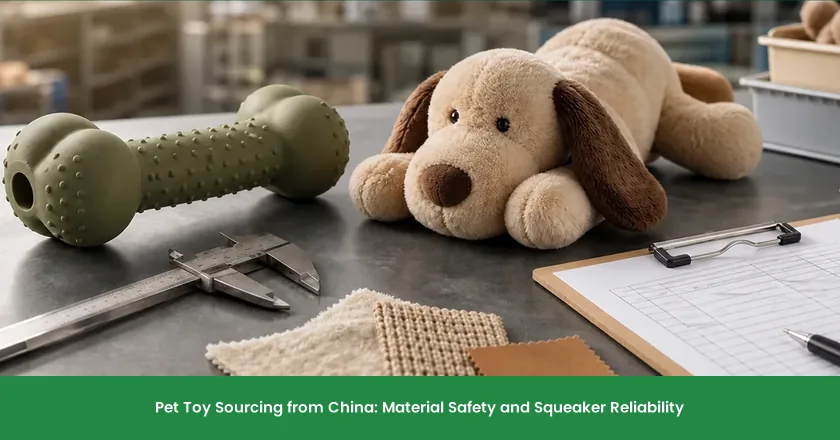
A passing sample is a design reference; it becomes a release decision only when the material, construction, and lot can be checked together. That distinction matters for a rubber, TPR, plush, rope, or mixed-material pet toy with a squeaker. A buyer can approve the color, feel, and sound in a showroom sample while the production version uses a different color masterbatch, squeaker housing, seam overlap, adhesive process, or component source.
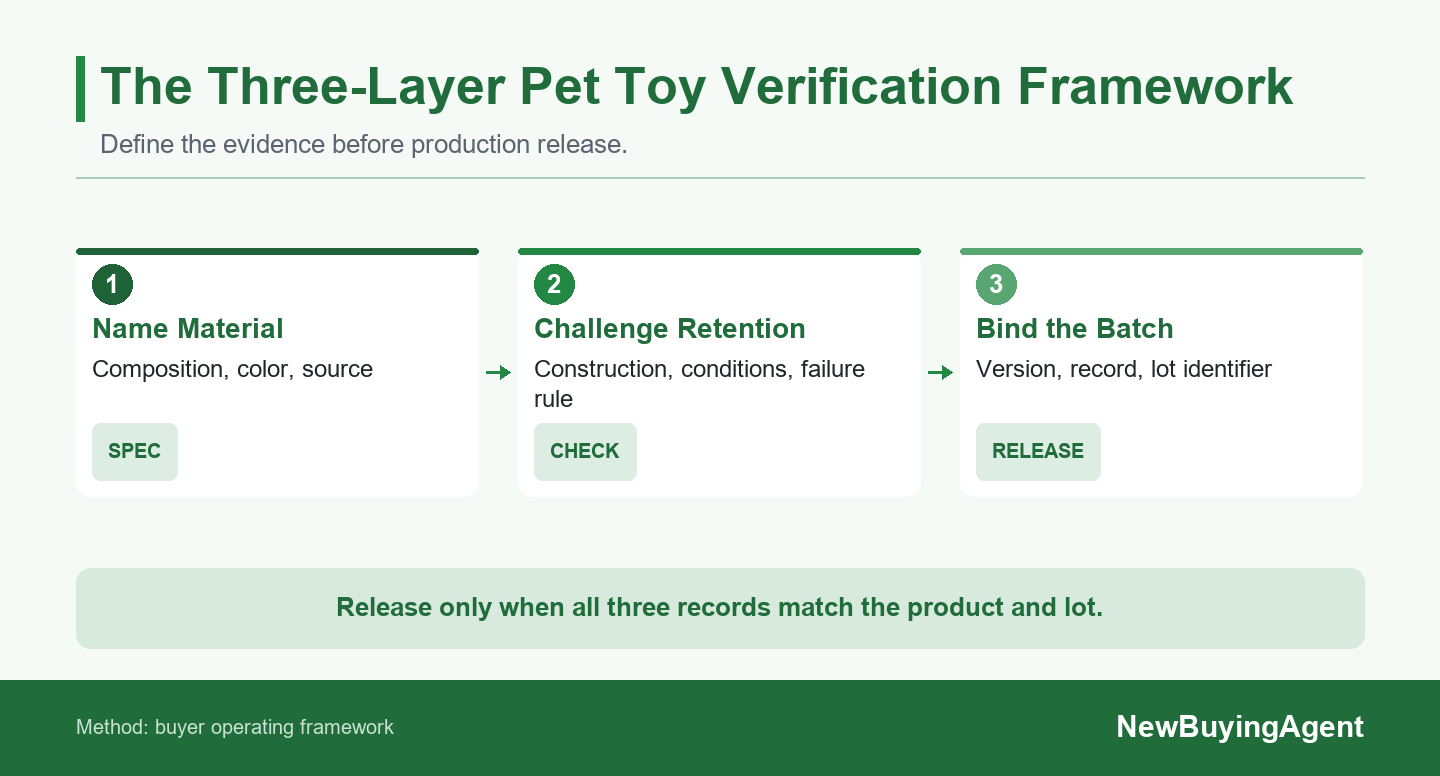
Use the framework to define what the factory must identify, what the buyer must test, and what must match before release.
The problem is not that every change creates a defect. It is that an unrecorded change prevents the buyer from deciding what was actually checked. A product-safety rule answers a defined product scope, not a generic sourcing label: the European Commission lists mechanical, chemical, electrical, and other risk categories in its toy-safety overview. Use the EU toy-safety overview as a scope reference, then determine the actual product, market, retailer, and component route rather than assuming a pet-toy label resolves it.
The Three-Layer Pet Toy Verification Framework
The Three-Layer Pet Toy Verification Framework links a named material record, component retention, and batch evidence. It is a buyer operating tool, not a certification scheme. The first layer says what the toy is made of. The second says what must remain secured when the toy is used as intended. The third says which production population the evidence belongs to. Use the same three labels in the brief, sample review, and release record so that a factory response can be compared rather than interpreted from memory.
Layer 1: Identify the material, not just the category
For an EU-bound article, identify the actual formulation and review the applicable scope rather than relying on a generic plastic label. Regulation (EC) No 1907/2006, the EU’s REACH regulation, is the framework for registration, evaluation, authorisation, and restriction of chemicals. Review the REACH legal framework with the relevant market specialist or laboratory; do not turn a broad material category into a universal pet-toy conclusion.
For sourcing, the material card should name the part, declared material, color or coating version, component supplier where relevant, intended destination market, and requested supporting evidence. Here, material identity means the specific material and version tied to the applicable part, including the supplier source where that affects the construction. “Non-toxic rubber” is not a usable input because it does not identify the formulation, the scope of the claim, or whether the factory may substitute it. For a new product whose specification is ready, buyers can start a defined pet-toy sourcing brief with NewBuyingAgent with those inputs attached to the factory brief.
Layer 2: Test the squeaker as a retained component
Define the exact toy construction, conditions, sample plan, failure signal, and resulting decision before a squeaker check begins. A squeaker is not only a sound feature. Depending on the design, it may sit inside a molded body, a welded capsule, a stitched pocket, or a bonded textile cavity. Those constructions fail differently. A useful retention card records the assembly drawing or photo, the module and material versions, the stated use condition, the number of samples, the observable failure definition, and the action if one occurs.
Do not present a buyer-designed compression, seam-manipulation, pull, or destructive check as an official global test. A retention test here means a defined, product-specific check of whether the squeaker module remains in its approved position under stated conditions. The European Commission explains that references to toy harmonised standards are published and withdrawn through a defined Official Journal process. Check the EU harmonised-standards route as a reminder that a named standard must be matched to its actual product and market framework, not copied into a generic squeaker protocol.
Layer 3: Connect the approved construction to the lot
Use the same product version, component source, and lot identifiers across the approved sample and release record. In practical terms, a golden sample is the approved physical reference and master construction record used to verify later production units. It should be accompanied by a version-controlled card, not treated as a loose object on a shelf. If the approved sample says “squeaker A / sleeve version 2 / red TPR compound / size M,” the preproduction and release records need enough identifiers to show whether they describe that same configuration.
This layer changes the buyer question from “Did a sample pass?” to “Which units does that result represent?” If a factory changes a squeaker source or seam method after approval, the buyer can decide whether the changed family needs a focused check. If no one can identify the affected family, the evidence has less release value. Traceability is not proof of legal compliance; it is what lets the buyer assign a test, observation, or corrective action to a defined production population.
Do not borrow a children's-toy certificate
Children’s-toy rules may help identify a risk, but they do not automatically establish the applicable route for a pet toy. In the United States, 16 CFR part 1250 establishes a consumer-product safety standard for toys and requires each toy to comply with applicable provisions of ASTM F963-23. Read 16 CFR part 1250 as a defined toy rule, not as a universal pet-toy certificate.
The same classification discipline applies in the EU. EUR-Lex describes toys as products designed or intended for play by children under 14, and its summary says the cited regulation applies from 1 August 2030. Check the EU toy-safety scope and timing before assuming a pet-product label resolves the question. The Commission’s legislation page lists the EU toy-safety legal route, including Directive 2009/48/EC and Regulation (EU) 2025/2509. Use the Commission legislation overview to verify the relevant product and market path.
An electronic pet toy with a button cell or coin battery needs a separate product-and-market review. In the United States, 16 CFR part 1263 establishes performance and labeling requirements for consumer products containing those batteries to prevent child access during reasonably foreseeable use and misuse. Read 16 CFR part 1263 as an electronic-product boundary: a non-electronic squeaker, a battery compartment, and a remote control should not be placed in the same evidence bucket.
Composite scenario: when a squeaker changes after sample approval
This composite scenario illustrates the buyer process only; the applicable requirements still depend on the product and destination market. It is not a NewBuyingAgent client case, a certification result, or a universal sample-size rule. Its purpose is to show how the three-layer framework can narrow a production decision when the changed construction is identifiable.
Situation, problem, action, and result
Situation. An EU pet-products distributor is preparing a private-label launch of two dog-toy sizes with a molded squeaker insert.
Order context. A 3,600-unit first order covers two sizes and three colorways from one China factory.
Readiness state. The buyer approved an appearance sample and material declaration, but had not frozen a squeaker-housing drawing or a production retention card.
Problem. The preproduction unit used a thinner sleeve around the squeaker than the approved sample.
In 12 of 30 buyer-defined destructive checks, the module shifted after 200 compression cycles and seam manipulation.
That observation was not proof of a universal legal failure. It showed a mismatch between the approved construction and the production construction, and it exposed the missing retention decision rule.
Decision. Place a conditional hold on the 2 affected toy families, not the unrelated packing-material lot, because the construction difference is identifiable.
Action. Revise the sleeve thickness and seam overlap, issue a version-controlled construction sheet, and build a focused preproduction set.
Result gate. Release only after the revised construction, material identifiers, 30-check destructive-check record, and affected lot identifiers match the approved packet.
A qualified party must determine the applicable destination-market requirements; this example illustrates procurement control, not a certification method.
In the composite example, a product-family hold allows a revised squeaker housing to be checked before release. The useful result is not “30 samples make the toy safe.” The useful result is that the buyer knows which two product families changed, which construction was corrected, and which records must agree before those families move forward.
Build a release record that survives the production handoff
Release records should connect the material specification, construction version, verification record, and production-lot identifier. Keep these four items short enough to be used: (1) a material card naming each relevant part and version; (2) a construction card with photos or drawing references for the squeaker pocket, sleeve, seam, or housing; (3) a verification record showing the conditions, observations, and decision; and (4) a lot record that connects the release to a product family, quantity, date, and packaging or batch identifier.
The goal is not a larger document stack. It is a shared way to detect drift. If a material supplier, squeaker model, sewing method, or mold revision changes, the factory should surface the changed identifier before the buyer relies on a prior result. The buyer can then decide whether the change is clerical, whether a focused preproduction check is needed, or whether destination-market review must be reopened. That decision belongs before shipment release, not after a retailer or consumer raises a question.
Where the factory is already selected, buyers can review China-side management for an existing pet-toy factory when they need help making those records visible across development, production, inspection, and handoff. The buyer still owns the applicable commercial and import decisions; the practical value is China-side follow-through on the defined evidence plan.
Send a pet-toy request card before comparing quotes
Ask every potential factory for the same material, construction, retention, and lot-record responses. This improves the quality of the comparison because one supplier cannot answer only with a price while another sends a meaningful product record. It also gives a sourcing or QC conversation a concrete starting point: the questions concern a named toy configuration, not an abstract promise of safety.
| Request card field | What the factory should identify | Buyer decision it supports |
|---|---|---|
| Material identity | Part, declared material, color or coating version, and source where relevant | Whether the product brief can enter the target-market material review |
| Squeaker construction | Housing, sleeve or pocket, seam or bonding method, and approved version | Whether the retention check matches the product actually being built |
| Retention record | Stated conditions, sample set, observation, failure definition, and decision | Whether a preproduction or production result supports release |
| Batch link | Product family, quantity, date, component version, and lot or packaging identifier | Which units the evidence represents if a change occurs |
Add a fifth line only when the design needs it: electronics, batteries, remote controls, light-up functions, or a claim that changes the product’s review path. The Petgravity warning is a useful reminder that a pet-product label does not remove a consumer-product battery question. Your importer, retailer program, laboratory, or qualified adviser should determine the applicable destination-market route before release.
When the card is complete, it can be used for a new China sourcing brief, an existing-factory correction, or a laboratory conversation. It is also the right point to assess whether outside China-side support would add value. If you want a focused next step, share a completed pet-toy request card with NewBuyingAgent.
Frequently Asked Questions
Choose sample quantities, laboratories, and escalation paths against the product, market, and stated failure consequence. The answers below are procurement guidance and do not replace a target-market compliance determination, retailer requirement, or qualified laboratory’s method selection.
Is a children’s-toy test report enough for a pet toy?
No. A children’s-toy report may identify a relevant risk, but it does not by itself establish the applicable requirements for a pet toy in your destination market. Start with the product’s intended use, features, accessible components, claims, and sale market. Then ask the importer, retailer program, qualified adviser, or laboratory which requirements apply. Keep the report as one piece of evidence, not as a universal certificate.
What should a squeaker reliability test specify?
Specify the exact toy construction, sample size, cycling or use conditions, failure definition, and the decision that follows a failure before testing begins. Include a photo or drawing reference and the squeaker or housing version so the result can be compared with production. If the construction changes, decide whether the prior result still represents the product; do not silently carry it forward.
When should a buyer use a third-party laboratory?
Use a qualified laboratory when the destination-market rule, retailer program, material concern, or disputed result requires evidence beyond a factory declaration. Provide the laboratory with the actual product construction, intended market, material details, and the precise question to answer. A laboratory report is most useful when it is tied to the correct configuration and scope, rather than ordered as a generic safety document.
How many production samples should be checked?
There is no universal sample number for every pet toy; set the plan against construction risk, lot size, target-market needs, and the consequence of a detached component. The 30 checks in the composite scenario are an illustration of a defined decision process, not a recommended rule. Record why the chosen plan is proportionate and what result would trigger correction, escalation, or a hold.
NewBuyingAgent
Related Resources

Get Started Today
Let's Turn Your Sourcing Goals into RealityWeChat:+86 15157124615
WhatsApp:+86 15157124615
Address:Building 10 #39 Xiangyuan Road, Hangzhou, China
