

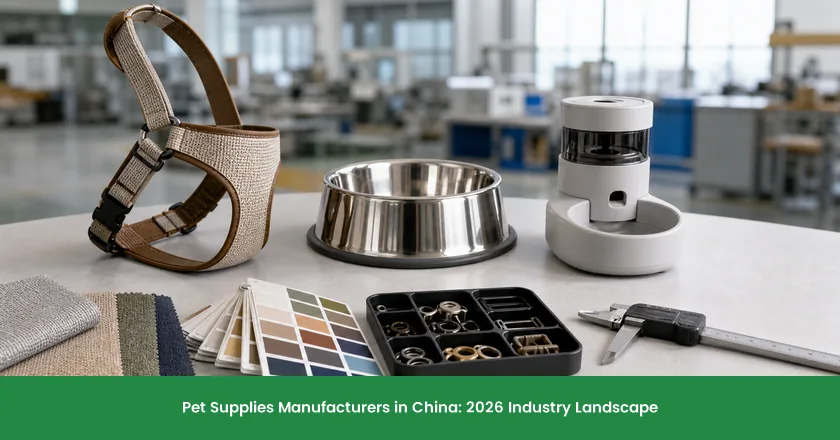
Searching for pet supplies manufacturers in China can look simple until the buying brief mixes a woven harness, a stainless bowl, a Bluetooth feeder, treats, or a product that carries a flea-control claim. Those items may share a retail aisle, but they do not share the same manufacturing proof. The useful first question is not which factory is “best” in a broad category. It is which product route the item creates, what the factory must control, and what must be settled before quotes are comparable.
For global buyers, the useful output is a clear product brief: one that lets a China-side manufacturer, sourcing partner, and buying team identify the right proof without blurring responsibility. U.S. regulatory material below is used only as a market-specific illustration; actual requirements depend on the product and destination.
The four decisions that make supplier quotes comparable
- Classify the item by build, function, and claim before searching for a factory.
- Separate soft goods, hard goods, devices, food, and treatment-sensitive items into their own proof routes.
- Freeze the production version and destination-market assumptions before comparing price.
- Ask each supplier to respond to one route-specific evidence packet.
Read the pet-supply landscape as product routes, not one factory category
For the U.S. market, APPA projects $35.6 billion in 2026 sales for supplies, live animals, and OTC medicine. That is useful demand context, but it is not a count of Chinese factories or a reason to treat every pet item as one sourcing problem. APPA’s industry statistics describe a broad commercial category; the buyer still has to separate the product builds inside it.
A pet-supply category can conceal several manufacturing routes, so the product architecture should determine the first evidence request. Here, “product architecture” means the mix of materials, components, and functions that determines how an item is made and checked. A textile carrier raises fabric, stitching, and hardware questions. A molded dispenser raises tool, assembly, and packing questions. A connected feeder adds configuration, power, and ownership questions. Food, treats, and treatment claims can introduce a separate market path.
Start every brief with four fields: the item’s material system; any powered or radio component; anything the pet eats or contacts over time; and the destination-market claim printed on the product or pack. Buyers developing a new assortment can use a market-fit pet product brief before approaching factories. That keeps early factory conversations tied to a defined product rather than a vague “pet supplies” request.
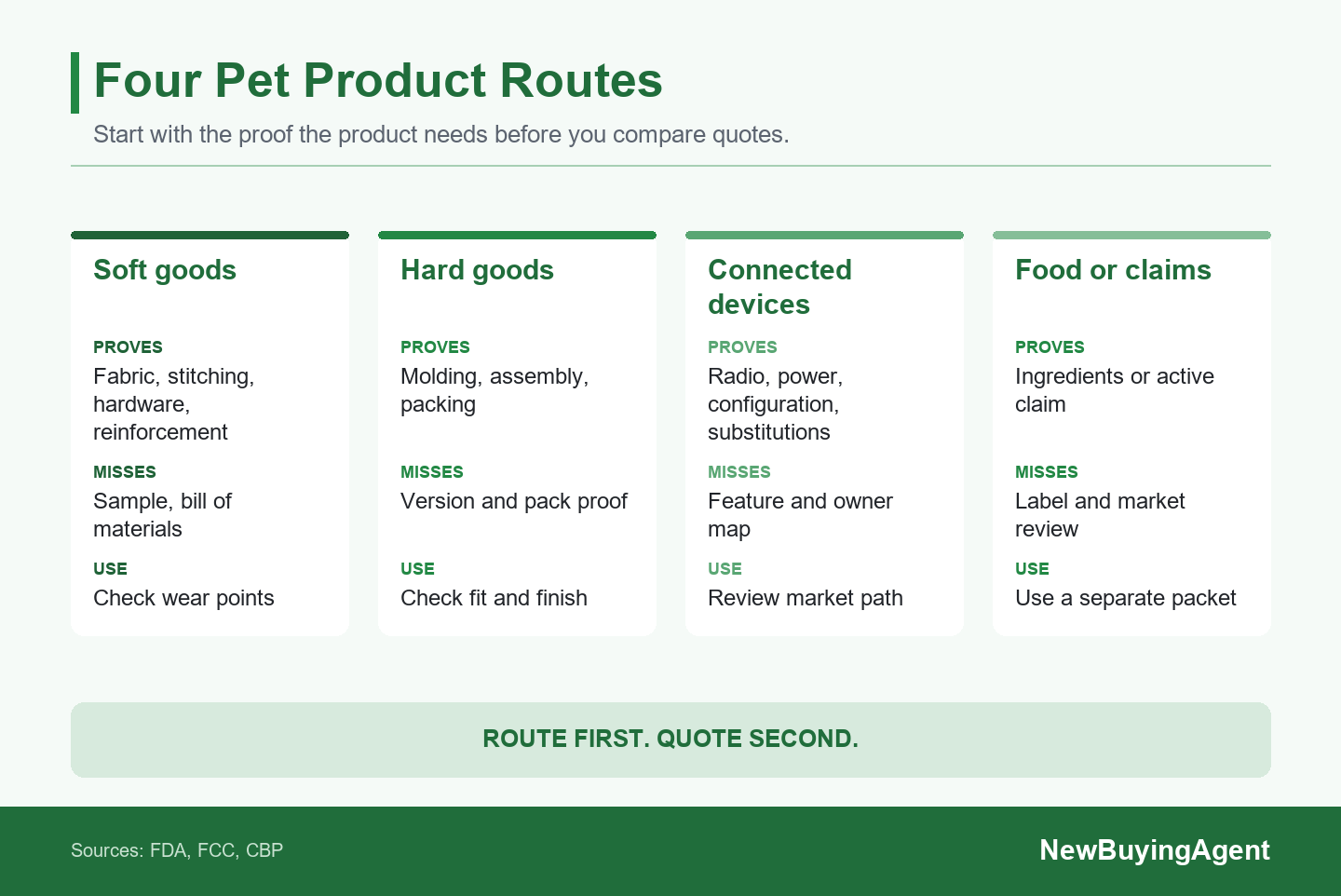
Choose the route by what the pet product is made of, what it does, and which market boundary it creates—not by a generic pet-factory label.
Match the manufacturer to the pet product’s build
The useful manufacturer question is whether the factory can evidence the build method and failure surface of the exact pet product. “Pet-product manufacturer” may be a good starting label, but it does not tell a buyer whether the factory controls the processes that make the sellable unit repeatable.
Soft goods route. Harnesses, beds, carriers, collars, leashes, toys with fabric shells, and apparel need a textile and assembly view. Ask for the bill of materials, component samples, stitch construction at load points, hardware specification, color or print standard, and packing method. For a chewable or wearable item, clarify where comfort, wear, breakage, shedding, or small-part risk would appear. A supplier’s product photos are far less useful than a sample that is tied to a named material and construction version.
Hard goods route. Bowls, litter accessories, grooming tools, molded toys, feeders without radio functions, and storage products may depend on molding, metalwork, finishing, assembly, or pack-out. The factory proof should match the part: mold or tool ownership where relevant, approved color and finish, assembly sequence, mating-part fit, accessory count, and carton protection. A factory can be strong in simple injection-molded pieces yet weak at a multi-part, retail-ready assembly.
Hybrid route. Many higher-value products combine fabric, plastic, metal, electronics, or packaging supplied by different workshops. The buyer needs a single version map: which party owns the drawing, firmware, color standard, component substitutions, and final pack specification? When a product is new, a China-side team can ask NewBuyingAgent to source a defined pet product from China by connecting the brief to the right capability and by keeping the requested proof visible before commercial comparison.
| Product route | Factory must show | Buyer packet should include |
|---|---|---|
| Soft goods | Material, stitching, hardware control | Approved sample and bill of materials |
| Hard goods | Molding, assembly, finish, packing control | Version, color, and pack-out proof |
| Connected device | Configuration, radio, power, owner map | Feature matrix and market review |
| Food or claim-sensitive item | Ingredient or claim path and label control | Market-specific label and responsibility check |
Separate accessories from animal-food and label pathways
In the cited U.S. context, imported animal food must use acceptable ingredients and be truthfully labeled. Treats, food toppers, supplements, and other animal-food items should not be reviewed as ordinary accessories. FDA’s animal-food import guidance also describes facility registration and prior-notice responsibilities, showing why a food packet needs to be separated from a harness or bowl packet.
Pet-food labels are regulated federally and at state level in the cited U.S. context. AAFCO’s labeling guidance does not turn a factory into a legal adviser; it shows why a buyer should treat ingredient text, feeding directions, claims, net quantity, responsible party, and artwork version as controlled inputs rather than a final design task.
For any consumable, ask the factory to identify the ingredient or formula owner, the label-version owner, the production facility, the proposed pack format, and the destination market. Ask internally who will make the final market decision. A good China supplier can provide operational facts, samples, and documents; the buyer still needs to decide whether the product, wording, and import route fit the target market. This distinction is what keeps an attractive food quote from being mistaken for a complete launch plan.
Treat smart and treatment-claim products as separate routes
RF devices subject to equipment authorization must comply with technical requirements before importation or marketing in the United States. A smart collar, camera, tracker, automatic feeder, or connected litter product must therefore be reviewed as its actual device configuration. An RF device transmits or receives radio signals, such as Wi-Fi or Bluetooth. FCC equipment-authorization guidance makes the relevant question clear: which radio module, power arrangement, software version, and responsible entity appear in production?
EPA states that FIFRA authorizes pesticide registration. If a flea collar, spray, wipe, bedding treatment, or grooming product makes a pesticide-style claim, the buyer should stop treating the item as a plain accessory. EPA’s pesticide guidance is a U.S.-specific illustration, not a classification for every pet product or market.
For certain electrical and IT products, China requires CCC before sale or import. The factory’s Chinese location is not itself a standards answer. Trade.gov’s China standards guide is a reminder to confirm the exact product and destination; it does not mean every smart pet item needs the same approval path.
The operating rule is simple: freeze the claimed functions before asking a factory for final pricing. A generic “GPS collar” request is insufficient if buyers have not named the radio, app, battery, charger, location service, claim language, and target market. Configuration drift can make one supplier quote look cheaper merely because it is quoting a different product.
A mixed pet assortment may need three release paths
The 2,400-unit illustrative launch needs separate harness, connected-collar, and treat packets before commercial consolidation. An illustrative retailer is planning this dog-wellness launch for a named destination market; it is not a NewBuyingAgent client result or legal advice.
Buyers that want to keep an existing source but need clearer version, progress, quality, or shipment coordination can review China-side management for an existing pet-product factory.
Split the brief before you consolidate the shipment
An illustrative retailer is planning 2400 total launch units for a named destination market.
The assortment combines 1,200 standard woven harnesses, 800 rechargeable location collars, and 400 sealed treat packs.
The harness design is approved, while the collar configuration and treat label are still being confirmed.
The harness needs material, stitching, and hardware evidence.
The collar and treats introduce device and food-specific pathways that cannot be assumed from the harness factory.
The illustrative harness can move through its own approved proof while the connected collar and treat packet wait for route-specific checks. One commercial coordinator may help consolidate the assortment, but the manufacturing proof remains product-specific.
Split the request into harness, connected-collar, and treat packets before comparing combined commercial terms.
Hold the collar and treat release until their configuration and market requirements are confirmed; let the harness proceed only on its own approved evidence.
The buyer checks the final product version, responsible entity, and required documents for each route before release.
This is an illustrative buying scenario, not legal advice or a NewBuyingAgent client result.
For the harness, the release packet can name the fabric, webbing, buckle, size range, stitching points, approved sample, and carton configuration. For the collar, it should lock the radio and location configuration, battery and charger, app or firmware owner, production version, marks, and destination-market review. For the treats, it should lock the formula or ingredient responsibility, facility details, label version, pack format, and market review. A commercial coordinator can still combine purchasing, shipping, and launch timing after these decisions are made.
The decision is not whether to split the commercial relationship; it is whether each item has earned release on its own evidence.
Request evidence that matches the product route
In the cited U.S. context, the importer remains ultimately responsible for knowing CBP requirements and ensuring compliance with federal rules. A structured request packet improves the supplier conversation, but it does not transfer that responsibility. CBP’s broker guidance provides that boundary in plain language.
Importers must assure that merchandise meets other-agency requirements and obtain licenses or permits when required. CBP’s licensing guidance reinforces the product-specific nature of this check. The correct packet therefore asks who owns the final product and market decision; it does not imply that a manufacturer has cleared an unnamed destination.
A route-specific request packet makes manufacturer answers comparable before a buyer negotiates price. For every item, include: product photos or drawings; material and component version; critical dimensions or functions; unacceptable defects; required samples; pack-out and label artwork; destination market; quotation basis; and the named owner for design, software, formula, or market review. Then add route-specific questions: stitch and hardware details for soft goods, mold and assembly details for hard goods, configuration ownership for devices, and ingredient or claim pathways for food and treatment-sensitive products.
NewBuyingAgent can use that packet to connect a defined request with China-side factory resources, product-development support, and quality coordination. The useful next step is a packet with enough detail to test manufacturer fit, not a supplier shortlist with no shared evidence standard. For public context on how category work is approached, buyers can review NewBuyingAgent pet and consumer-product sourcing stories.
Frequently Asked Questions
Can one factory make an entire pet product range?
Sometimes, but a shared pet category does not prove that one factory controls every material, component, or regulated product path. A strong factory may make the main item and coordinate companion pieces, while another specialist controls electronics, food production, or a particular component. Ask which processes are in-house, which are supplied externally, and which party owns each approved version. The right answer depends on the product architecture, not the breadth of a catalogue.
Do pet food and treats need a different supplier review?
Yes, pet food and treats need a separate regulatory and labeling review rather than the general checks used for non-food pet accessories. Start with the formula or ingredient responsibility, facility information, label version, packaging, and destination market. The factory can provide important operational evidence, but the buyer should establish who makes the final product and market decision. Treating food artwork as a last-minute packaging change creates avoidable uncertainty.
What should buyers verify for smart pet devices?
Buyers should verify the actual device configuration, radio features, power system, software responsibility, and destination-market requirements before placing a smart-pet order. Name the radio module, battery, charger, app or firmware version, feature claims, and responsible entity in the request packet. Do not accept a generic device certificate or a sample video as proof that the production version matches the proposed market route.
Is the lowest pet product quote the best factory option?
No, a low quote is only comparable when the supplier is quoting the same materials, component version, test scope, packaging, and commercial responsibility. First compare the route-specific packet returned by each supplier. A lower number may reflect a different fabric weight, unconfirmed radio configuration, missing label work, simpler packaging, or a different interpretation of who owns the next decision. Price becomes meaningful after the product and evidence are aligned.
NewBuyingAgent
Related Resources



Get Started Today
Let's Turn Your Sourcing Goals into RealityWeChat:+86 15157124615
WhatsApp:+86 15157124615
Address:Building 10 #39 Xiangyuan Road, Hangzhou, China
