


Peak-season capacity planning is the process of aligning vessel space, usable containers and ready cargo with a delivery deadline when shipping resources are under pressure.
For China shipments, start with the date the goods must be usable at destination, then test whether the proposed departure can meet it. A booking number is one input. The plan also needs a workable empty-container collection, a factory loading window and time to recover when an assumption fails. Put those conditions against each shipping lot before paying for extra capacity.
Plan the departure that the order can actually use
Build the plan around shipping lots with specific quantities, routes and delivery needs, rather than treating a seasonal forecast as booked capacity. Confirm each resource separately and identify the last point at which a practical alternative remains available. That gives purchasing, factory and logistics teams a common basis for deciding which orders need attention first.
- How it works: Match confirmed space with the right empty container and a realistic cargo-ready window.
- Risk: Priority handling, a booking-screen selection and an accepted change can mean different things.
- Timeline: Place spare time before the event whose failure would make the order late.
- Decision: Keep a fallback only if its timing, scope and commitment costs make it usable.
Match space, equipment, and ready cargo
Treat vessel space, empty-container access and factory readiness as separate checks, then test them against the same delivery requirement. A confirmed sailing cannot load goods that are unfinished, and finished goods cannot use a container that is unavailable at the assigned depot. The practical question is which missing resource would prevent this particular lot from moving.
This distinction matters even when the market appears well supplied. UNCTAD’s 2025 maritime review explains how vessel rerouting can absorb effective shipping capacity by lengthening voyages. That is historical context for planning resilience, not evidence that a named China route is short of space today. Obtain current route and equipment information for the departure being considered.
Create a short status line for each resource: what is confirmed, what remains conditional, who can resolve it and by when. Use “awaiting depot release” or “inspection scheduled” instead of a vague “on track.” When two resources are ready and the third is missing, direct the next call to the party who can change that third condition.
The diagram below summarizes these independent checks. It does not suggest a mandatory sequence, and none of its rows can be substituted for another.
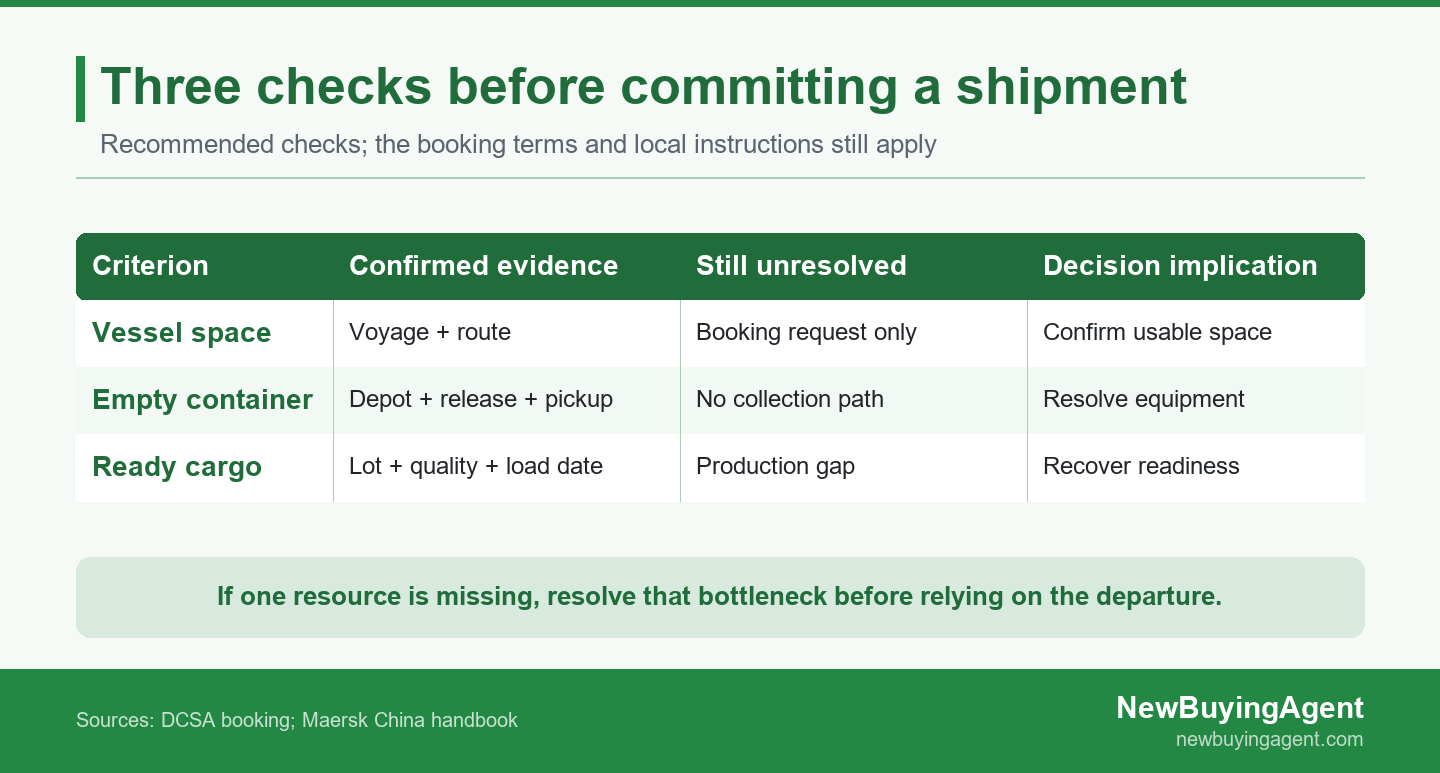
Space, empty-container access and cargo readiness need separate evidence before a shipment plan is usable.
Turn demand into a usable space commitment
Convert the sales or replenishment forecast into shipping lots before asking for firm space commitments. Each lot needs a realistic ready window, equipment requirement, origin, destination and delivery priority. Keep flexible forecast volume visible, but distinguish it from cargo that can meet a paid booking’s conditions, because changes may carry costs or require fresh acceptance.
Separate the demand forecast from the booking
Use a rolling view that separates committed orders, likely replenishment and optional volume. For the committed lots, add packed dimensions, gross weight, stackability and any special handling requirements. If the packing specification is unsettled, mark the equipment assumption as provisional; a forecast stated only in sales units does not establish how many containers can be loaded.
Once a booking exists, a requested change is still a request until the receiving party accepts it. The DCSA booking implementation guide separates the amendment process from carrier validation and reconfirmation. In practical terms, an email asking to move the shipment should not replace the last accepted arrangement in the plan. Keep the pending option alongside it until a new confirmation arrives.
Production dates also depend on material, packaging and quality decisions made before the truck is booked. NewBuyingAgent’s local China factory resources and product-development and quality-control capability are relevant when these choices affect the readiness of a repeat purchasing program. A realistic factory window gives the logistics team something it can plan around; that capability does not reserve carrier space.
Check what the booking product actually promises
Ask whether the proposed rate is tied to a particular departure, what equipment conditions apply and which changes would alter the price or commitment. Read the offer and accepted booking together. A service described as having priority may have a different operating and compensation scope from a separately purchased guarantee; the label alone is not enough to approve a critical shipment.
Hapag-Lloyd’s current Quick Quotes Spot FAQ says priority shipments may still be deselected because of operational constraints. It also distinguishes its additional Shipping Guarantee service from the underlying product. For a China-origin booking, ask the provider to identify the conditions actually included in the quoted service rather than carrying a broad marketing promise into the delivery plan.
A rollover means booked cargo moves to a later departure. If that happens, record the replacement voyage and the resulting usable delivery date, then compare them with the order’s latest acceptable date. “Still booked” is an incomplete status when the original departure was the one that protected the customer commitment.
Confirm the right container and collection path
Confirm how the specified equipment can actually reach the factory within its loading window, rather than assuming the space booking settles the collection plan. Check the container type, authorized pickup location, release procedure, collection timing and available transport. A change of depot can solve one problem while creating a longer truck movement or a missed loading slot.
Check the depot before sending the truck
The 2024 Maersk Greater China Spot handbook warns that a depot selected during booking may be only indicative because empty-container release procedures differ across Greater China ports. Treat this as a reason to confirm current local instructions, not as a description of every booking screen today. The named depot and collection procedure should be executable for the actual booking.
Before dispatch, have the logistics owner confirm the equipment size and type, release reference, depot operating window and any required appointment. Ask the hauler whether collection, travel and loading can fit together. If the depot changes, recalculate that movement and get the carrier or responsible provider’s approval where needed. Do not send the truck against an outdated instruction simply because the factory is waiting.
Use the production window to protect the booking
An earlier departure is useful only if the right goods can reach it. Check completion by shipping lot, the quality decision, final packing and the factory’s loading access. If inspection finds a problem, distinguish the time needed to correct the goods from the time needed to inspect the correction; treating both as a single optimistic ready date hides the remaining work.
Commercial consequences matter as well. Maersk’s Spot booking terms distinguish cancellation, no-show and amendment conditions. Use the terms applicable to the actual booking to identify the last economical change point; fees and notice periods depend on the booked product and accepted conditions. A booking held for goods that cannot be ready may create exposure without protecting any sale.
For buyers retaining approved China suppliers, NewBuyingAgent’s factory-management service connects production-progress follow-up, quality management and logistics coordination within an agreed supplier-management scope. That is relevant when a replenishment plan keeps losing time between “nearly finished” and goods that can actually be loaded. Carrier space and equipment commitments still need their own confirmation.
Put buffers where a missed event causes loss
Allocate spare time according to the failure it is meant to absorb: unfinished goods, a missed pickup, a later sailing or destination processing. Work backward from usable delivery and show where each allowance sits. Adding extra days only to the ocean estimate will not fix a factory window that closes before the container can arrive.
Work backward from the usable delivery date
Start with when the buyer needs stock available for sale, production or installation. Subtract the destination activities needed after vessel arrival, using input from the responsible broker, hauler, warehouse or consignee. Then test the proposed arrival and departure against that plan. Keep the forecast arrival separate from the date the business can actually use the goods.
The World Bank’s Logistics Performance Indicators research treats speed, reliability and connectivity as distinct dimensions. That distinction supports a useful planning question: how variable is this route, not just how short is its advertised transit? The aggregate research does not supply a buffer for an individual China shipment; use recent comparable shipment records and current route information for that judgment.
Next test a missed-departure case. Identify the next feasible service, its equipment requirement and its likely usable delivery date. If that option misses the business deadline, the remaining response may need to happen earlier, through a production adjustment, a smaller urgent shipment or a revised customer commitment. Record the assumption that would make each response workable.
Pay for a fallback that changes the outcome
A fallback should address the specific failure. A different sailing may help when space is the constraint; another approved depot may help when equipment collection is the constraint. Neither resolves an unfinished product lot. Two forwarders quoting the same voyage and equipment pool may also leave the same operational exposure, so ask what actually differs between their recovery options.
Compare the additional freight, inland movement, handling and possible change costs against the consequence of being late. Maersk’s Spot amendment guidance shows that change options can include vessel availability, deadlines, new freight charges and an applicable change fee. That is why a cheaper headline quote is not a complete recovery-cost comparison.
Keep alternative quotations separate from paid duplicate bookings. Before holding two firm options, identify cancellation and no-show exposure and decide who is authorized to release one. The useful decision date is the last point at which a feasible alternative can still be secured, not the date everyone finally agrees the original plan has failed.
Run one weekly plan with visible decision triggers
Use one row set for each shipping lot and refresh it when an underlying fact changes. Record confirmed arrangements separately from requests, forecasts and alternatives. The plan becomes actionable when every unresolved item has an owner and a decision trigger early enough to preserve a workable option; a weekly meeting alone does not make that happen.
Copy the fields below into the shipment plan. Replace each prompt with the actual booking, factory or destination information; these are operating fields, not carrier performance scores. The purchasing owner can keep the commercial priorities, while the logistics and factory owners update the facts they can verify.
| Field | Fill in | Who confirms | Review trigger |
|---|---|---|---|
| Shipping lot | Order, quantity, packed load | Purchasing / factory | Packing change affects equipment |
| Space | Accepted voyage, route, terms | Logistics owner | Confirmation or sailing changes |
| Equipment | Type, depot, release, pickup | Provider / hauler | Collection no longer fits loading |
| Ready cargo | Completion, quality, load window | Factory / quality owner | Correction threatens the window |
| Usable date | Arrival plus destination work | Consignee / warehouse | Stock availability misses need |
| Buffer | Remaining time by event | Planning owner | Recovery consumes the spare time |
| Fallback | Feasible option, price, change costs | Logistics / purchasing | Last actionable option date |
| Decision | Retain, amend, split or switch | Named budget approver | Record choice and acceptance |
For each entry, add the source of the information and the time it was last checked. Set an earlier review where a booking change, factory correction or depot instruction could expire between meetings. Leave an unknown visibly unresolved, with a named follow-up; a blank cell or an unexplained green status can otherwise look like confirmation.
A holiday replenishment order with one weak link
Consider an illustrative example, not a client shipment. An importer has 1,200 packaged home-storage units assigned by its approved load plan to two containers. Both lots must be usable by December 10. The planned vessel arrival is December 4, and the consignee allows four calendar days for destination work, giving an expected usable date of December 8 and two days of spare time. These dates and allowances are hypothetical.
The first lot is ready and vessel space is confirmed, but its empty container has not been released at the planned depot. The next feasible sailing would move expected usable delivery five days later, to December 13. The relevant problem is equipment collection; another quote for the same sailing does not resolve it, and the two-day buffer cannot absorb that recovery delay.
The logistics owner asks for an authorized alternate-depot collection and gets the extra inland cost and timing checked by the hauler. The factory confirms its loading window remains open. Only after the revised release instruction and workable collection are confirmed does the buyer retain the sailing; otherwise the buyer evaluates a feasible partial urgent shipment or agrees a changed delivery commitment. The result of the exercise is a specific decision path, not a claim that the goods have shipped.
For a repeat purchasing program, bring the product scope, quantities, target price, destination, factory readiness and usable delivery deadline together when you discuss the purchasing plan with NewBuyingAgent. Those inputs let the conversation address the sourced-product outcome or the agreed management of existing factories, including the production and quality constraints behind the shipping plan. Carrier quotations and booking acceptance remain part of the shipment-specific work.
Frequently Asked Questions
How early should importers book China shipments for peak season?
Start from the required delivery window and the current carrier or forwarder booking window, then allow time to resolve missing capacity evidence. There is no single number of weeks that suits every China route, product and season. Ask when the provider can accept the specific lot, confirm its equipment assumptions and work backward through factory readiness and destination processing. Recheck when any of those inputs changes.
Does a confirmed booking guarantee space and an empty container?
A confirmed booking should be read with its product terms, equipment conditions and local instructions before treating space or containers as assured. Identify what the confirmation actually covers, including the intended voyage, equipment and collection process. Check whether any priority or guarantee is conditional. A booking-screen depot selection and an unresolved pickup instruction should remain separate entries in the shipment plan.
Is using two forwarders enough to create independent backup capacity?
Two forwarders provide a meaningful backup only when their proposed sailings, equipment access or recovery options differ in ways that matter to the order. Ask which constraint each option solves and whether the goods can meet its loading window. If both depend on the same unavailable resource, the second quote adds little resilience. Also check cancellation exposure before making duplicate firm commitments.
How much extra buffer should a peak-season plan include?
Choose the buffer from the order deadline, recent route performance and the next feasible recovery option rather than applying one allowance to every shipment. Separate factory, origin, ocean and destination risks so spare time sits where it can be used. If missing one departure would still make delivery late, set an earlier intervention trigger instead of calling the shipment protected by a generic seasonal buffer.
NewBuyingAgent
Related Resources



Get Started Today
Let's Turn Your Sourcing Goals into RealityWeChat:+86 15157124615
WhatsApp:+86 15157124615
Address:Building 10 #39 Xiangyuan Road, Hangzhou, China
