

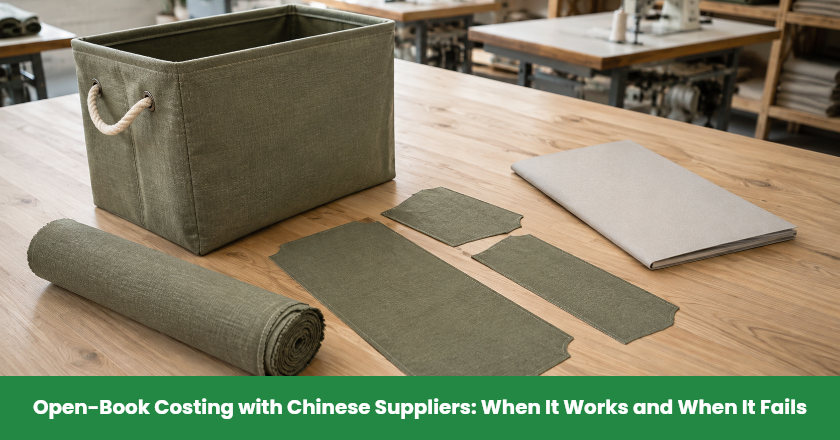
A supplier's detailed cost sheet can make a quotation look more trustworthy without making it more accurate. Material, labor, overhead and profit may add up neatly, yet the material allowance can still use the wrong product version or the overhead can include a charge already recovered elsewhere. Open-book costing with Chinese suppliers is useful when the buyer can test the important assumptions and agree what happens to the price afterward. Asking for more columns is not the same as gaining that control.
Use Open Books Only When the Numbers Can Change a Decision
Open-book costing works when cost disclosure leads to verification and an agreed price decision. Both parties need a shared baseline and an incentive to improve it; otherwise, a spreadsheet can become another position in the negotiation. For buyers sourcing from China, the useful question is whether the information will change a specification, a process or a commercial term enough to justify reviewing it.
- Best for: Repeat products with meaningful, measurable cost drivers and a cooperative supplier.
- Common mistake: Treating an estimated cost gap as proven supplier profit.
- Risk: Recovering the same tooling, overhead or quality expense in multiple lines.
- Decision: Start with limited disclosure when one disputed input explains the price uncertainty.
What Open-Book Costing Actually Gives the Buyer
Open-book costing is the sharing of agreed supplier cost information so the parties can examine how a product's costs arise. It gives the buyer visibility into a defined scope, not automatic proof that every number is correct. The agreement still needs to distinguish estimated inputs from recorded expenditure and explain whether verified changes affect the current price, future orders or neither.
The Cabinet Office describes open-book contract management as examining supplier costs and margins through accounting information. Its guidance concerns UK public contracts, not an obligation on private Chinese suppliers. The useful distinction is the connection to records: a sales representative's cost breakdown without an agreed way to check it is a weaker form of disclosure.
A buyer's should-cost estimate is different. It builds an expected cost from assumptions about materials, process time and other inputs. It can identify questions worth asking, but it is not a reconstruction of the supplier's actual accounts. Similarly, a cost-plus payment arrangement determines how the supplier is paid; open books determine what information can be examined. The two can be combined, but neither term should silently substitute for the other.
Separate three actions before starting: disclose the agreed data, verify the material assumptions, and agree the price treatment. A fixed-price supplier might share selected costs for a redesign without accepting reimbursement of every expense. A cost-plus supplier might provide extensive accounts but still require scrutiny of which expenses are allowable. Ask which decision the requested access will support.
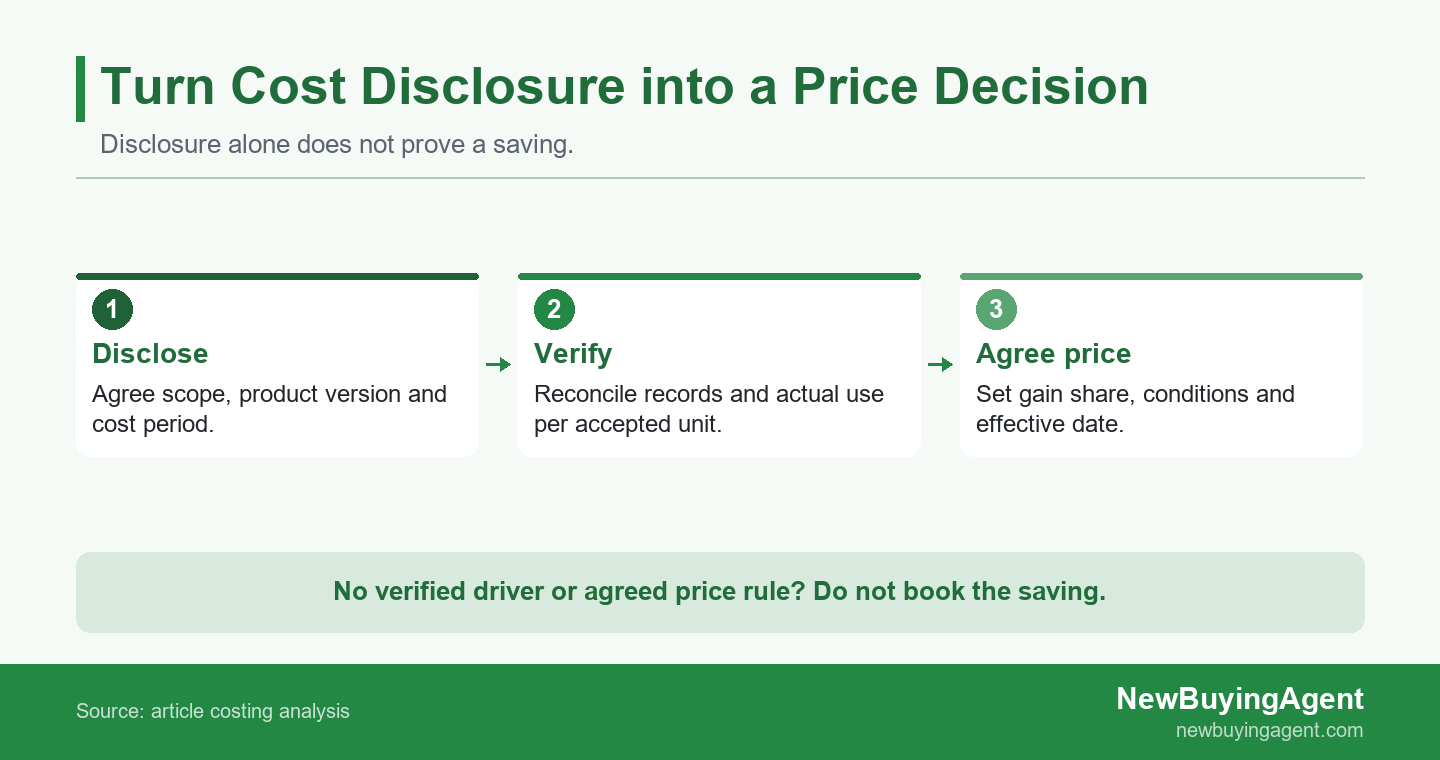
Supplier cost disclosure leads through verification to an agreed price change
When Open-Book Costing Is Worth the Effort
Open books are most useful for repeat purchases where material consumption, process time or design choices can change meaningful costs. A continuing relationship gives both parties a chance to recover the effort of collecting data, testing improvements and updating the product. The case is weaker for an occasional standard item whose delivered specification and market price can be compared without examining factory accounts.
Start with a Cost Driver Both Parties Can Influence
A narrow review of one material or operation is more useful than an untestable full-factory spreadsheet. For a sewn storage product, start with fabric grade, usable width, cutting layout and material consumed per accepted piece. For an assembled item, start with a particular purchased component or assembly operation. A price complaint becomes actionable when it points to something engineering or production can change without weakening the product.
The Cabinet Office's should-cost guidance includes whole-life costs, risk and profit rather than treating the purchase price alone as the complete model. Applied as a modeling principle, this means a buyer should not subtract a rough material estimate from the quote and label the remainder excess margin. Missing operations, financing or delivery obligations may explain part of the difference.
When the product itself is still being specified, NewBuyingAgent's product-supply service offers a more relevant starting point than demanding a ledger. Its local China factory resources and product-development capability support a supplied-product offer around the required material, function and target price. The buyer can then judge the proposed product outcome, rather than compare incomplete cost sheets for different specifications.
Agree Who Keeps the Gain Before Sharing the Data
A supplier needs an agreed return and a reason to disclose an improvement. If every efficiency immediately removes the supplier's benefit while the factory pays for trials and equipment, disclosure becomes commercially unattractive. Define the starting cost, who funds the change, how the verified gain is divided and how long that division lasts before requesting sensitive details.
The incentive need not be a percentage split. The parties could agree a fixed conversion fee, a temporary recovery allowance for new equipment, or a price reduction after a defined investment has been recovered. Each option creates different behavior: a percentage markup on reimbursed cost can reward a larger cost base, while an aggressive fixed target can discourage useful development. Choose deliberately, then check quality and delivery alongside cost.
Keep volume assumptions separate from firm purchase commitments. A factory may offer a lower setup allocation at a larger production run, but a buyer should not promise demand it cannot support merely to obtain a more attractive cost sheet.
Why a Detailed Cost Sheet Can Still Mislead
A cost sheet becomes misleading when estimates, allocation choices and duplicate charges are treated as verified expenditure. More detail does not resolve those problems if the buyer cannot trace the important inputs to the relevant product and period. Review the basis of each major line before debating its amount, especially when the supplier has combined factory production with purchased components or outside processing.
Different measurement bases. A drawing may show net material in the finished product, while purchasing records include cutting loss and rejected pieces. Labor minutes may represent one operator's touch time or the entire line's elapsed time. Ask what is measured, what is excluded and how accepted output enters the calculation. Two apparently precise numbers can answer different questions.
Unexplained overhead allocation. Rent and equipment costs must be assigned somewhere, but an allocation is not automatically the incremental cost of your order. The IFRS Foundation's IAS 2, paragraph 13, bases fixed production-overhead allocation on normal capacity and does not increase the per-unit allocation simply because production is low. This is an inventory-accounting principle, not a rule forcing a factory to quote a particular selling price. It provides a useful question: which capacity denominator is the supplier using, and why?
Double recovery. A machine rate may already include depreciation and maintenance that appear again in a general overhead uplift. Tooling paid separately may remain in the unit-cost calculation. Ask the supplier to identify what each rate contains and reconcile separately paid charges; do not assume every overlap is intentional, but do not approve unexplained duplication.
Numbers with no workable evidence. A material invoice supports a purchase price only for its stated grade, date, quantity and terms. It does not by itself prove how much material entered your product. Likewise, a supplier's broad factory margin cannot establish the margin on your order. The remedy is a focused check of the disputed driver, not a national assumption about how Chinese suppliers behave.
If the buyer cannot interpret the records, access may produce a false sense of assurance. Budget for a qualified finance or cost specialist where the exposure warrants it, or choose a simpler commercial method.
Choose the Right Level of Cost Transparency
The right costing method is the least intrusive one that can resolve the actual pricing uncertainty. Competitive quotations can test a standard offer, while partial disclosure can test an isolated material claim. Fuller open books are justified when ongoing joint work and verifiable data offer more value than the review burden; they are not a maturity badge every purchasing relationship needs.
The comparison below assesses four methods against the same product specification using evidence input, best use, blind spot and buyer effort. These are practical alternatives, not a ranking of providers, and more than one method can be used on the same purchase.
| Method | Evidence input | Best use | Blind spot | Buyer effort |
|---|---|---|---|---|
| Competitive quotes | Matched market offers | Standard goods | Internal costs remain unknown | Normalize offers |
| Should-cost model | Engineering estimates | Challenge a cost driver | Assumptions may be wrong | Technical modeling |
| Partial disclosure | Selected cost records | One disputed input | Unopened costs remain unknown | Targeted verification |
| Fuller open books | Agreed records and allocations | Repeat joint improvement | Access is not assurance | Ongoing specialist review |
Based on this comparison, start with competitive quotes when specifications are stable and comparable offers exist. Use a should-cost model to identify a question, partial disclosure to test a particular answer, and fuller open books only when the relationship supports recurring verification and an agreed commercial consequence. Unknown inputs should remain assumptions, not become accusations of excess profit.
When an existing factory is introducing a cost-driven design or process change, the operational concern is whether the supplied goods still meet the agreed requirements. NewBuyingAgent's factory-management service connects China-side production follow-up and quality-control capability to that concern. Financial verification remains a separate responsibility; local production and quality evidence does not certify the supplier's accounts.
Check Whether the Claimed Saving Reaches the Purchase Price
A saving in one factory cost line becomes a buyer benefit only when it changes the agreed price or another expense the buyer actually bears. The calculation must preserve the product's acceptance criteria and use comparable units. Deduct the buyer's implementation and review costs, and apply the negotiated gain-sharing rule rather than assuming every factory efficiency belongs to the purchaser.
ASQ's cost-of-quality categories distinguish prevention and appraisal from internal and external failure costs. Removing a check may reduce a visible expense while increasing rejected goods or customer failures. Test the changed process against the same quality requirements before counting its apparent economy.
Illustrative Scenario: A Cut-and-Sew Cost Saving
Consider a hypothetical importer buying 20,000 fabric storage bins from a Chinese cut-and-sew supplier over its next purchasing period. One revised cutting layout would affect all 20,000 units of the existing design. The baseline uses 1.20 m of gross fabric per accepted bin at 2.00 USD/m, or 2.40 USD in fabric cost. The supplier proposes a 1.05 m allowance, suggesting a 0.30 USD saving, but the buyer has not yet established what that allowance measures.
The costing review finds that 1.05 m describes net pattern usage, excluding cutting loss. After reconciling fabric issued, reusable material returned and accepted output, the revised gross consumption is 1.10 m per bin. The buyer and supplier correct the cost-sheet version so both the baseline and proposed figures use gross consumption after reusable returns. The smaller pattern is an observation; the material reconciliation establishes the comparable input needed for the saving calculation.
Revised fabric cost is 1.10 × 2.00 = 2.20 USD, correcting the original claim of a 0.30 USD reduction. In this illustrative example, a verified 0.20 USD process saving with a 60% buyer share reduces price by 0.12 USD per unit. Across 20,000 bins, that is 2,400 USD; after 600 USD of buyer-funded setup and review costs, net benefit is 1,800 USD. The buyer rejects the original consumption-based claim and approves the revised price basis, conditional on the product checks.
Before treating that amount as realized, the buyer checks that the production run retains the agreed dimensions and strength, confirms the consumption reconciliation, and matches the revised invoice to the 0.12 USD reduction. These are hypothetical figures, not a NewBuyingAgent case or a typical factory margin. If only 5,000 bins are purchased under the revised price, gross buyer savings are 600 USD and merely cover the same setup and review cost. Further trials, defects or extra oversight would reduce the benefit; a spreadsheet saving is not enough to override that result.
Set Access, Price-Review and Exit Rules
A workable open-book arrangement states who can see which records, how the numbers are defined and what decisions follow a verified change. Those terms should exist before sensitive data is exchanged or a price adjustment is expected. Keep the scope proportional to the product and relationship, and have qualified advisers confirm the agreement's legal and accounting implications for the parties involved.
Confidential access. WIPO's trade-secret guidance identifies financial and manufacturing information as potentially protectable and describes measures such as confidentiality agreements and restricted access. Specify authorized reviewers, permitted uses, redaction and retention. Do not circulate a supplier's cost pack to other factories as a bargaining document. Actual protection depends on the information, safeguards and applicable law.
Repeatable price reviews. State the base date, currency, product revision, review trigger and treatment of downward as well as upward changes. The BLS price-adjustment guide explains a method that changes a defined portion of a base price while leaving the remainder fixed. This illustrates why a material movement need not change the entire selling price by the same percentage. It does not establish that a US index represents the supplier's Chinese input cost; select a relevant reference and document its limitations.
Disputes and exit. Agree how missing or inconsistent evidence is escalated, who decides a disputed adjustment, and what happens to access when the arrangement ends. A commercial review can stop without authorizing interruption of an existing order. Keep delivery obligations, payment terms and confidentiality duties explicit rather than assuming they disappear with the costing exercise.
Prepare a Product Brief, Not a Demand for Every Ledger
A useful sourcing brief defines the product outcome and the uncertain cost before demanding confidential factory records. Include the current specification, quantity, target price, destination and delivery timing, then identify the particular material, operation or commercial assumption that needs attention. This allows a sourcing partner to distinguish a product-design problem from a price disagreement and propose a realistic supply offer.
For global buyers seeking a new supply path, NewBuyingAgent is a one-stop China sourcing agent that combines local factory resources with product-development and quality-control capability. It can quote and supply China-sourced products around the required price, quality and delivery conditions; this is not a promise of access to every factory ledger. Include acceptable design changes and non-negotiable performance requirements when you request a product quotation from NewBuyingAgent.
Frequently Asked Questions
Does supplier refusal to open its books prove dishonesty?
Refusal alone does not prove dishonesty. A supplier may protect commercial information or lack product-level records in the format requested. Ask whether it can substantiate the disputed input through narrower evidence. If the purchase still cannot be evaluated confidently, use comparable offers or reconsider the relationship; do not turn refusal itself into a finding of fraud.
Can open-book costing work through a trading company?
A trading company can share only information it has permission and ability to disclose. Its purchased-product cost, service expenses and margin are different from the upstream factory's production costs. Agree which layer is being opened and whether upstream evidence is available. A transparent intermediary quotation does not, by itself, provide access to the manufacturer's accounts.
Should a tooling charge disappear after the forecast volume?
A tooling charge should change according to the agreed recovery terms, not an assumed forecast. Reconcile separate tooling payments with any per-unit recovery against the same agreement. Define what happens if purchases fall below or exceed the planned volume, and distinguish tooling ownership from cost recovery; paying a charge does not settle every ownership or transfer condition.
Who should review sensitive supplier payroll or invoices?
Authorized finance or cost specialists should review sensitive source records. Procurement usually needs the resulting cost finding and its limitations, not unrestricted copies of personal or commercially sensitive data. Use redaction and limited access where appropriate, and obtain legal advice on confidentiality and cross-border data obligations before arranging transfers of records that contain personal information.
NewBuyingAgent
Related Resources



Get Started Today
Let's Turn Your Sourcing Goals into RealityWeChat:+86 15157124615
WhatsApp:+86 15157124615
Address:Building 10 #39 Xiangyuan Road, Hangzhou, China
