

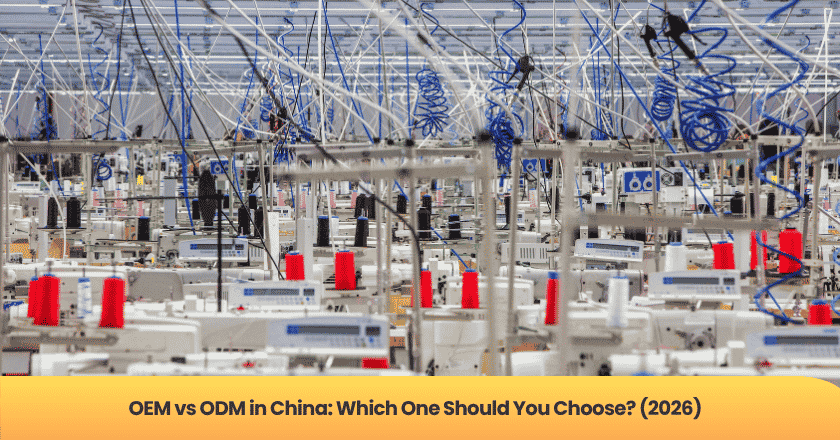
What Is OEM/ODM Sourcing in China? And Which One Should You Choose in 2026?
OEM and ODM sound similar and get used interchangeably online. The difference matters — for IP, for margin, for time to market. Here's how to tell them apart and decide which one fits your business right now.
Key Takeaways
- OEM = your design, factory's production. ODM = factory's design, your brand on top. The difference shapes IP ownership, time to market, upfront investment, and long-term differentiation.
- ODM gets you to market in 6–10 weeks with USD 100–1,000 upfront. OEM takes 4–8 months and USD 2,000–100,000+ in tooling and engineering. The choice depends on your stage, not on which model sounds more sophisticated.
- ODM is usually cheaper per unit below 5,000 units annually. OEM is usually cheaper above 25,000 units annually. Between those numbers, the math depends on tooling complexity.
- The single most important consideration for brands building moats is IP. ODM products are not your IP — the factory can sell them to anyone. If your design is your moat, OEM is the only model that protects it.
- A commission-free sourcing agent makes the OEM cost stack legible. Tooling invoices, engineering hours, prototype rounds, and the production invoice are all visible separately rather than buried in a single delivered price — which matters most on the high-investment OEM side.
- Most successful brands run hybrid: OEM on hero SKUs that drive moat-defending margin, ODM on adjacent products that benefit from broad assortment. Pure-OEM and pure-ODM strategies usually leave value on the table.
- The 2026 environment — AI-assisted design tools cutting OEM development time, tariff pressure pushing OEM tooling toward Vietnam and India, and rising IP enforcement quality in China — has shifted both the cost and the strategic logic of the OEM/ODM choice.
OEM and ODM are the two most common manufacturing models for brands sourcing from China, and they get used so loosely in marketing that buyers often arrive at their first project without a clear sense of which one they want. This is not a small distinction. The two models have different cost structures, different IP implications, different lead times, and different long-term competitive dynamics. Choosing the wrong one for your stage costs money in the short term and brand differentiation in the long term.
This guide explains what each term actually means in operational practice, walks through the trade-offs across six dimensions, and gives you a decision framework based on your stage as a brand. If you're early-stage, OEM might be premature — ODM gets you to market faster. If you're scaling, ODM might be holding back your differentiation. The right answer depends on where you are.
Part 1: What Each Term Actually Means
OEM (Original Equipment Manufacturer)
In OEM manufacturing, the buyer provides the design and the factory produces it. The buyer owns the design, the specifications, the brand, and (usually) the tooling. The factory is a production partner — they bring manufacturing expertise, but the product itself is the buyer's intellectual property. The buyer's brand goes on the finished product; in many cases the factory's identity is invisible to end consumers.
Classic OEM examples: Apple's manufacturing relationship with Foxconn, Nike's relationship with its Vietnamese and Indonesian shoe factories, any brand that hires a contract manufacturer to produce a product the brand designed and specified.
ODM (Original Design Manufacturer)
In ODM manufacturing, the factory provides both the design and the production. The buyer selects from existing designs in the factory's catalog, may request modifications (color, packaging, branding, minor feature changes), and applies their brand to the finished product. The factory typically retains ownership of the underlying design, which means they can — and often do — sell the same or similar products to other buyers.
ODM is enormously common in categories where most products are based on shared platforms: phone accessories, kitchen gadgets, beauty tools, many fitness products. The brands competing on Amazon often source the same ODM products from the same factories, applying different branding and marketing to differentiate.
OBM (Original Brand Manufacturer)
Less commonly discussed but worth knowing: OBM is when a manufacturer designs, produces, AND brands the product themselves. Many large Chinese factories have moved into OBM in recent years — Anker, DJI, and Xiaomi started life as OEM/ODM manufacturers and now sell their own brands directly to global consumers. OBM is not directly relevant to most foreign buyers but provides useful context: many of the factories you might consider for OEM/ODM also have OBM ambitions, and that affects how they prioritize your account.
The simplest distinction: OEM = your design, factory's production capability. ODM = factory's design, your brand on top. OBM = factory's design, factory's brand.
Part 2: OEM vs ODM Across Six Dimensions
Six dimensions where the two models diverge in practice. We'll go through each one in operational detail.
Dimension 1: Time to market
ODM is dramatically faster. The product already exists; the buyer's work is selection, branding, and packaging. From sourcing to first shipment can be 6–10 weeks. OEM requires design finalization, prototype iteration, tooling fabrication, and pilot production. The same shipment milestone takes 4–8 months for a moderately complex product.
For brands chasing a market window — viral product trends, seasonal launches, time-sensitive opportunities — ODM is usually the only viable choice. By the time OEM development is complete, the window may have closed.
Dimension 2: Upfront investment
ODM upfront costs are minimal: sample fees (USD 50–500), branding setup (USD 100–500), and the goods themselves. Most ODM products require zero tooling investment from the buyer. OEM upfront costs depend on the product but typically range from USD 2,000 to 50,000 in tooling, prototype iterations, and engineering work. For complex hardware, USD 100,000+ is normal.
This investment gap matters most for early-stage brands with limited capital. ODM lets you launch a product line for a few thousand dollars; OEM ties up working capital that might be better deployed in marketing or operations.
Expert Tip: When you commit OEM tooling and engineering money, demand line-level visibility. A commission-free sourcing agent (flat service fee, factory and tooling vendor invoices passed through unchanged) shows you the actual tooling vendor invoice, the engineering hours by task, and the prototype iteration costs as separate line items. A commission-based agent quoting "USD 18,000 all-in to develop tooling and first samples" is bundling cost layers that you cannot benchmark or audit. On a USD 2,000 ODM order, opacity is annoying. On a USD 50,000 OEM tooling investment, opacity is expensive — sometimes USD 3,000–8,000 in hidden margin you didn't know you paid.
Dimension 3: Differentiation
OEM produces unique products. ODM produces products that competitors can also source. Walk through Amazon for almost any consumer category and you'll see the same product photographed from slightly different angles, sold under five different brand names, at slightly different price points. These are ODM products, sourced from the same factory, with the differentiation entirely on the brand and marketing side.
For brands competing on something other than product (price, marketing, customer service, distribution), ODM differentiation may be enough. For brands competing on product superiority, OEM is the only way to credibly claim it.
Dimension 4: IP protection
OEM products that you've designed are your IP. They can be protected with NNN agreements, design patents, and trademark registration in China. These protections are not absolute — Chinese IP enforcement has improved but is still uneven — but they create legal recourse if a factory copies and sells your design.
ODM products are not your IP. The factory designed them, the factory owns them, the factory can sell them to anyone. Your branding on top of the product is yours, but the underlying product can show up in your competitor's catalog the next month with no recourse.
This is the single most important consideration for brands building defensible positioning. If your product's design is core to your competitive moat, OEM is the only model that protects it. ODM treats the design as a commodity input.
Dimension 5: Per-unit cost
ODM is usually cheaper per unit at small to medium volumes. The factory has already amortized design and tooling costs across many other ODM customers; you benefit from that shared cost base. OEM is usually cheaper per unit at large volumes (10,000+ units annually), because at scale the buyer's amortization of their own tooling becomes more efficient than paying a share of the factory's amortized ODM costs.
Approximate breakpoint: under 5,000 units annually, ODM almost always wins on landed cost per unit. Above 25,000 units annually, OEM almost always wins. Between 5,000 and 25,000, the math depends on product complexity and the specific tooling required.
Dimension 6: Quality control complexity
ODM products have stable, well-understood production processes. The factory has run the same product hundreds of times. Quality variability is low and predictable. OEM products, especially in early production runs, have higher quality variability because the production process is new to the factory. First-run defect rates of 5–15% are common; these typically improve to 1–3% by the third or fourth production run as the factory dials in the process.
OEM buyers should plan for rework costs and quality buffer in their first 1–3 orders, and budget for additional QC investment (more frequent inspection, sometimes a dedicated quality engineer hired by the buyer to embed at the factory).
Part 3: Side-by-Side
| Dimension | OEM | ODM |
|---|---|---|
| Who designs | Buyer | Factory |
| Who owns the design IP | Buyer | Factory |
| Time to first shipment | 4–8 months | 6–10 weeks |
| Upfront investment | $2K–100K+ | $100–1K |
| Per-unit cost (low volume) | Higher | Lower |
| Per-unit cost (high volume) | Lower | Higher |
| Differentiation potential | High | Low (others sell same product) |
| IP protection viability | Strong (with NNN + patents) | Limited (design isn't yours) |
| First-run quality risk | Higher | Lower (mature process) |
| Best for… | Established brands building moats | Early-stage brands or commodity categories |
Part 4: Decision Framework — Which Model Fits Your Stage?
Most brands move through stages, and the right model changes as the brand evolves. Four stages, four typical answers.
Stage 1: Pre-validation (no proven product-market fit)
You have a hypothesis about what will sell. You don't have order data confirming it. You need to test cheaply and fast.
Default: ODM. The upfront investment is low, the time to market is fast, and if the hypothesis fails, you've absorbed a small loss instead of a tooling write-off. Validate first; differentiate later.
Stage 2: Early growth (validated product, scaling sales)
Sales are growing. The product is working. Competitors are starting to notice.
Default: hybrid. Keep core SKUs on ODM if competition isn't yet copying you; start exploring OEM for any product feature you want to defend long-term. This is also the stage to start filing trademark and design patent protection in China — even if you stay on ODM, your brand assets can be protected separately from the product itself.
Stage 3: Establishing moats (mature product, defending position)
You're a recognized brand in your category. Margin is under pressure from competitors selling lookalike products.
Default: OEM for hero SKUs. The differentiation that defends your margin lives in the product itself, and that requires owning the design. Plan for the upfront tooling investment and the longer development cycles. The payback is in defensible margin over years.
Stage 4: Platform brand (multiple product lines, strong distribution)
Your brand stands for something specific in customers' minds. New product launches benefit from existing brand equity.
Default: OEM for anything strategic, ODM for fill-the-shelf adjacencies that benefit from broader assortment. At this stage you have the resources to invest in OEM development, the team to manage it, and the market position to monetize the differentiation.
A common mistake at each stage
Stage 1: trying to do OEM before validation, locking in tooling cost on an unproven product.
Stage 2: staying on pure ODM after validation, watching competitors flood the market with lookalike products.
Stage 3: not investing in IP protection alongside the OEM transition, leaving the new design exposed.
Stage 4: defaulting to OEM for everything, including products that don't justify the investment.
Part 5: How a Sourcing Agent Helps Differently for OEM vs ODM
The agent's role differs significantly between the two models. Choosing an agent who specializes in the wrong one is a common cause of underwhelming engagements.
For ODM sourcing
The agent's main work is curation and consolidation. They access the factory's existing catalog, present the buyer with a curated shortlist matching the buyer's criteria, negotiate pricing and minor customization (branding, packaging, color variants), and manage production and quality.
Skill set the agent needs: deep familiarity with factory catalogs across categories, ability to spot which ODM products are likely to perform well, negotiation experience for the relatively standard customizations ODM allows. Most generalist sourcing agents handle ODM well.
For OEM sourcing
The agent's role expands significantly. They translate the buyer's design specs into Mandarin technical documentation, manage tooling fabrication, coordinate prototype iterations, run engineering reviews, manage IP protection setup (NNN agreements, design patent filings), supervise the more complex production process, and run higher-frequency QC during pilot and early-volume runs.
Skill set the agent needs: technical understanding of manufacturing processes in your category, project management capability for multi-month development cycles, IP awareness, ability to manage tooling vendors separately from production factories. Not every agent is equipped for this — choose carefully.
Common Mistake: Buyers ask whether an agent "does OEM" and accept yes as a real answer. "Doing OEM" can mean anything from full engineering-led development to "we forward your CAD file to a factory and they figure it out." Ask specifically: how many engineering staff, what tooling vendors they manage independently of production factories, and what their average OEM development timeline is. Vague answers mean they coordinate ODM with extra branding and call it OEM. That's a different service than what you need if you're investing real tooling money.
Part 6: Common Mistakes When Transitioning from ODM to OEM
Brands that grow successfully on ODM eventually need to move some products to OEM. Five mistakes we see most often during this transition.
Mistake 1: Underestimating tooling investment
ODM has zero tooling cost; the buyer's mental model assumes that translates to OEM. It doesn't. Plan for USD 5,000–50,000 in tooling for moderate complexity, USD 50,000+ for complex hardware. Brands that arrive at their first OEM project without budgeting for this scramble for capital and often compromise on tooling quality, which catches up with them in production defect rates.
Mistake 2: Underestimating timeline
ODM lead time is 6–10 weeks. OEM lead time is 4–8 months. Brands that haven't lived through this gap often plan launches assuming ODM speed, then miss launch windows when OEM development takes longer.
Mistake 3: Trying to OEM the entire product line at once
Move one or two SKUs to OEM first — your hero products where differentiation matters most. Keep the rest on ODM until the OEM transition has stabilized. Brands that try to convert everything simultaneously overwhelm their team and their cash flow, often delaying every product.
Mistake 4: Not securing IP before disclosing design
File for design patents and register trademarks in China BEFORE sharing detailed designs with factories. Once your design is in factory hands, you've lost the option to file a patent application that's enforceable on the factory.
Mistake 5: Switching factories for OEM without thinking through the relationship
Your ODM factory may not be the right OEM partner. ODM factories are good at running their existing catalog; OEM requires engineering capability the same factory may not have. Be willing to switch factories for OEM work, even at the cost of restarting a relationship from scratch.
Part 7: How to Evaluate an OEM Factory Specifically
Standard supplier verification (business license, references, audit) covers the basics. OEM-specific evaluation goes further, because the factory's role is more involved than for ODM.
Engineering capability
Ask to meet the engineering team during your factory visit. Real OEM-capable factories have dedicated mechanical engineers, electrical engineers (if relevant), and tooling engineers. Pure ODM factories often have one or two engineers handling everything, or rely on external consultants for design work. Watch how the engineering team engages with your spec — do they ask probing questions about manufacturability? Do they suggest alternative approaches for difficult features? Engineers who treat your spec as gospel rather than a starting point are usually less capable than engineers who push back constructively.
Tooling vendor relationships
Most OEM factories don't make their own tooling — they work with specialized tooling vendors. Ask which tooling vendors they typically use, and ask to inspect samples of recent tooling work. Quality tooling matters enormously: cheap tooling produces cheap parts. A USD 8,000 mold that needs replacement after 50,000 cycles is more expensive in total than a USD 15,000 mold that lasts 500,000 cycles.
Pilot run capacity
OEM development typically requires pilot runs of 50–500 units to validate the production process before committing to full-volume production. Some factories handle pilot runs gracefully; others treat them as a nuisance. Ask about pilot run pricing, lead time, and what changes between pilot and full production. A factory that doesn't distinguish between pilot and production runs is a factory that hasn't thought through the OEM development process — which usually catches up later.
IP track record
Ask the factory directly: have you ever been involved in an IP dispute with a buyer? Have you ever produced a product based on a buyer's design and then sold it to other buyers? The answer is sometimes yes, and the explanations may be reasonable (the buyer didn't pay for exclusivity, the design wasn't patented). What you're testing is the factory's awareness of these issues and their willingness to discuss them honestly.
NNN agreement willingness
Reputable OEM-capable factories sign NNN (non-disclosure, non-use, non-circumvention) agreements without resistance. They understand that OEM buyers need this protection. Factories that resist signing NNN agreements, or insist on heavily watered-down versions, are signaling that they want flexibility to use your design with other buyers. This is disqualifying for genuine OEM work.
Quality system maturity
OEM production is more variable than ODM, especially in early runs. The factory's quality system has to be capable of catching and correcting issues during the run. Look for: documented incoming inspection processes, in-process quality checks at multiple points, statistical process control on critical dimensions, dedicated QC staff (not production workers double-hatted as inspectors), and a calibration program for measurement equipment. Factories without these systems can run ODM products acceptably but struggle with OEM.
A diagnostic conversation to have
Ask the factory: "What was the most challenging OEM development project you completed in the past year? What went wrong, and how did you fix it?" Real OEM-capable factories will have specific stories with concrete problems and concrete solutions. Vague answers ("we always meet specifications") usually mean limited OEM experience.
Part 8: What's Different About the OEM/ODM Choice in 2026
Three forces have changed the calculus on this decision compared to 2023, and buyers who haven't updated their thinking are making decisions on outdated assumptions.
First, AI-assisted design tools have meaningfully reduced OEM development time and cost. Generative CAD tools, AI-driven manufacturability analysis, and automated technical translation between English and Mandarin engineering specs have cut typical OEM development timelines by 20–35% in our experience. The implication: OEM has become accessible to smaller brands than it was three years ago. Stage 2 brands (validated, scaling) can now consider OEM at smaller annual volumes than the historical 10,000+ unit threshold.
Second, US tariff restructuring through 2025–2026 has made country-of-origin part of the OEM decision. Tooling in China for export to the US now carries different landed-cost implications than tooling in Vietnam, Mexico, or India. Some brands moving to OEM in 2026 are simultaneously moving production country, which adds complexity but can save 15–25% in landed cost on tariffed product categories. Sourcing agents with multi-country networks are uniquely valuable here; pure China-only agents force you to make this decision blind to alternatives.
Third, China's IP enforcement environment has continued to mature, particularly for design patents and trademarks. The 2024 amendments to China's design patent law extended protection from 10 to 15 years and clarified enforcement procedures for foreign IP holders. Practical result: filing a Chinese design patent before disclosing your design to factories has become more meaningful as a defensive tool than it was even two years ago. Brands moving to OEM in 2026 should treat IP filing as a critical-path item, not an optional add-on.
The Bottom Line
OEM and ODM are tools for different stages of brand development. ODM gets you to market quickly with low upfront investment, at the cost of differentiation and long-term IP. OEM builds defensible products at higher upfront cost and longer lead times. Most brands need both at different stages — and the most successful brands run them in parallel, with OEM on hero SKUs and ODM on adjacent products.
Choose the model that fits your stage, not the model that sounds more sophisticated in the pitch deck. An early-stage brand doing OEM before validation is wasting capital. A mature brand doing pure ODM is leaving margin on the table. The right answer evolves; the strategy should evolve with it.
FAQ
Can a single factory do both OEM and ODM?
Some can, many cannot. Factories with their own design teams (typically larger, more established) can run both models. Smaller factories often specialize — they're either an ODM player with their own catalog, or a pure contract manufacturer doing OEM. Ask explicitly during supplier evaluation; the answer affects what they can deliver.
What does it cost to file a Chinese design patent?
Approximately USD 800–1,500 for filing, plus translation costs. Annual maintenance fees are modest. Total cost over the patent's 15-year life is typically USD 3,000–5,000. Compared to the cost of a competitor copying your design and undercutting your margin, this is one of the cheapest forms of business protection available.
Can I take an ODM product and modify it enough to call it OEM?
Marginal modifications (color, packaging, minor cosmetic changes) don't convert ODM to OEM — the underlying design is still the factory's. To genuinely move to OEM, you need to own the design at a structural level: form factor, mechanism, key features. This usually means hiring a design firm or doing the design work in-house, then commissioning the factory to produce your design.
Are OEM products always better quality than ODM?
Not necessarily. ODM products benefit from being mature designs running on stable production processes; quality is often very consistent. OEM products in early production runs typically have higher defect rates than mature ODM products in the same category. The quality advantage of OEM is in product capability and differentiation, not necessarily in unit-level quality consistency.
How do I find OEM-capable factories vs ODM-only factories?
Three signals. First, ask for a portfolio of recent OEM projects — factories without OEM capability won't have one. Second, ask about their engineering team — OEM-capable factories have dedicated mechanical and electrical engineers; ODM-only factories often don't. Third, look at the factory's own product catalog. ODM-heavy factories have extensive catalogs of their own designs; OEM-focused factories have minimal own catalogs and emphasize their production capabilities instead.
How long does it take to develop a custom OEM product from scratch?
Simple products (housewares, accessories without electronics): 3–5 months from initial design to first production order. Moderate complexity (small electronics, mechanical products with moving parts): 5–8 months. Complex hardware (consumer electronics with custom PCBs, mechanical assemblies): 8–14 months. Plan timelines realistically; OEM development almost always takes longer than first-time buyers expect.
NewBuyingAgent
Related Resources
Get Started Today
Let's Turn Your Sourcing Goals into RealityWeChat:+86 15157124615
WhatsApp:+86 15157124615
Address:Building 10 #39 Xiangyuan Road, Hangzhou, China
