

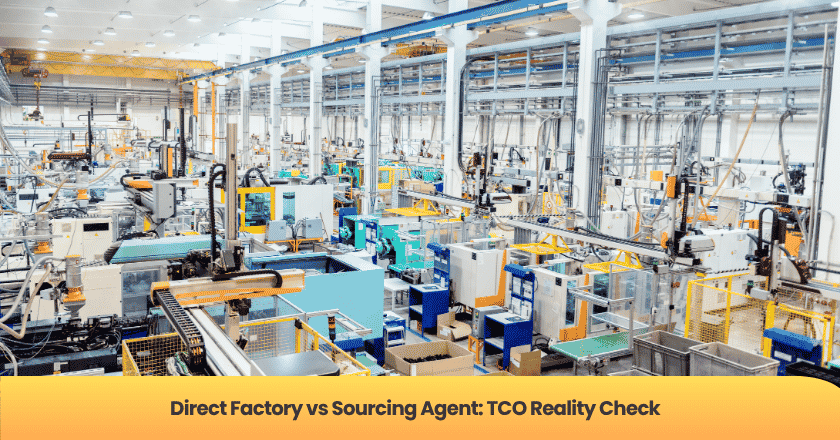
Buying direct from a factory looks 5–10% cheaper on the invoice. The problem is everything not on the invoice — and most buyers don't see the full bill until they're a year in.
Key Takeaways
- The 5–10% saving from going direct is real on the invoice but rarely real on total cost — most buyers absorb 8–15% in operational costs the agent would have absorbed for them.
- "Direct factory" actually covers three different operational models. The one promoted online (find a factory on Alibaba and contact them yourself) has the worst cost-benefit ratio of the three.
- Buyer time is the most underestimated cost line. A typical OEM order direct consumes 30–60 buyer-hours; the same order under an agent consumes 5–15.
- Direct buyers without in-line inspection commonly run defect rates 2–3× higher than agent-managed orders — and most do not realize it because they have nothing to compare against.
- A commission-free agent (flat service fee, no hidden invoice markup) gives buyers the cost transparency that makes the TCO comparison meaningful in the first place.
- The hybrid model — top SKUs direct, long tail under agent management — is what most mature buyers actually run after 2–3 years.
- The 2026 environment (AI-driven QC tools, faster RFQ cycles via Alibaba's GenAI features, and tariff-driven supplier reshuffling) tilts the math further toward whichever model gives you faster decision throughput.
Every importer hears the same advice eventually: "cut out the middleman, go direct to the factory, save the agent's fee." It is intuitive. It feels obviously correct. And for some buyers in some situations it is correct. For most buyers in most situations, it is not. The agent's fee is the most visible cost in a sourcing relationship, but it is rarely the largest. What we are going to do in this article is walk through the full cost of going direct — including the costs that don't show up on any invoice — and compare them honestly against the agent model.
If you come away thinking direct factory is right for you, that is a legitimate conclusion. We will tell you the cases where it usually works. If you come away realizing the agent model is cheaper than going direct, that is also a legitimate conclusion. Most buyers who do this analysis end up there. The math is consistent.
Part 1: What "Direct Factory" Actually Means
Going direct sounds simple but covers several different operational models. Before comparing costs, we need to be clear about which model you mean.
Model A: Find a factory at a trade show
Buyer attends Canton Fair, Yiwu Fair, or an industry-specific show, meets factory representatives in person, exchanges WeChat, and starts a relationship. Communication continues by email and WeChat with the factory's English-speaking sales staff. The buyer flies in for periodic visits.
This is the cleanest version of "direct factory" sourcing. Trade show factories are usually export-oriented, have at least basic English capability, and are accustomed to working with foreign buyers. The model works well for ongoing relationships in mature categories.
Model B: Find a factory online and contact directly
Buyer finds the factory through Alibaba.com, 1688, ImportYeti, or referrals, and contacts them directly without an intermediary. This is the model most online advice promotes. It is also the one that fails most often, for reasons we will get to.
Model C: Hire in-house procurement based in China
Larger brands set up an in-house procurement team in Shenzhen, Hong Kong, or Shanghai. Staff are usually Mandarin-speaking, often Chinese nationals or expat sourcing professionals. This is direct factory sourcing with a permanent on-the-ground team.
It is the most operationally robust direct model and also the most expensive. Setup costs (incorporation, office, hiring) typically run USD 30,000–80,000 in year one, with annual operating costs of USD 100,000+ for even a small team. It only makes economic sense for buyers with sustained China procurement spend above USD 1–2 million annually.
Common Mistake: Buyers read "go direct" advice online and assume it means Model B (find on Alibaba, contact yourself). They then judge "direct factory sourcing" by Model B's failure rate — which is the highest of the three — and either give up on the idea entirely or persist past the point where switching models would have saved them. When direct factory sourcing succeeds, it is usually Model A (trade show relationships) or Model C (in-house team). Model B's success rate is much lower than the internet suggests.
Part 2: The Visible Cost Gap
When buyers compare direct factory to a sourcing agent, they usually compare the obvious numbers.
| Cost | Direct factory | With sourcing agent |
|---|---|---|
| Factory FOB price | USD 100 (assumed baseline) | USD 100 |
| Sourcing agent service fee | — | USD 5–10 |
| Visible cost per unit | USD 100 | USD 105–110 |
On this view, direct factory wins by 5–10%. This is the comparison most buyers run in their heads. It is also incomplete in important ways.
Expert Tip: Before you accept this 5–10% gap as real, ask the agent how their fee is structured. A commission-based agent who quietly marks up the factory's invoice gives you a "service fee" that is actually two fees — the visible one and the hidden margin baked into your unit price. A commission-free agent charging a flat service fee against a transparent factory invoice is the only structure where this 5–10% comparison even means what you think it means. If you cannot see the factory's actual invoice, you cannot run this analysis.
Part 3: The Costs Direct Buyers Forget to Count
Eight categories of hidden cost that disappear under the surface of a direct factory model. We have ordered them by how often they catch buyers off-guard.
1. Buyer time
Direct factory sourcing requires significant buyer time at every stage. Sample iteration over email with factory sales staff who reply in non-native English. Spec clarification through Google Translate. Production follow-up by WeChat in time zones 12+ hours away from US/EU buyers. Inspection coordination. Logistics handoff.
A typical OEM order direct from a factory consumes 30–60 buyer-hours from spec to shipment. With a sourcing agent, the same order consumes 5–15 buyer-hours — the agent absorbs the rest. If your time is worth USD 100/hour, that is USD 2,500–4,500 in time value per order. On a USD 30,000 order, the agent's fee is usually less than this.
2. Travel
Direct factory relationships work best with periodic in-person visits. For US/EU buyers, a one-week China trip costs USD 4,000–8,000 (flights, hotels, meals, ground transport, occasional translator hire). Most direct buyers we see make 1–3 trips per year — USD 5,000–24,000 annually.
Sourcing agent buyers do not need to travel for routine production. The agent visits the factory in your place. Travel becomes optional, reserved for relationship-building or major projects, not operational necessity.
3. Spec misunderstanding losses
Direct factory communication, even with English-speaking sales staff, has a misunderstanding rate. Buyers commonly discover that "matte black" meant a different shade, "food-grade" meant a different certification, or that a packaging tweak was lost in translation. These misunderstandings do not always cost the buyer the full order — sometimes a partial rework, sometimes a price adjustment, sometimes acceptance of imperfect goods. Whatever form it takes, it is a real cost.
Industry data on this is hard to come by, but our internal data across hundreds of OEM orders suggests spec-related rework or partial loss runs around 3–7% of order value on direct relationships, vs 0–2% on agent-managed orders. On a USD 50,000 order, the difference is USD 1,500–3,500.
4. Pricing without a benchmark
Direct buyers usually negotiate prices without a clear sense of where the factory's actual cost floor is. The factory's first quote is rarely their best price, but distinguishing between "we quoted 8% above our floor" and "we quoted 30% above our floor" requires market knowledge most foreign buyers do not have.
Sourcing agents who handle dozens of orders in a category build that knowledge. They know roughly what a 100,000-unit run of plastic injection in Foshan costs, and they push toward that number. Direct buyers often pay 5–15% above what a knowledgeable buyer would pay, simply because they do not know the floor exists.
5. Quality control gaps
Direct buyers can hire third-party inspection firms (SGS, QIMA, AsiaInspection). This costs USD 200–500 per inspection day and produces a reasonable check. What it misses: in-line inspection during the run, where defects can still be corrected without scrapping output.
Most direct buyers run pre-shipment inspection only, because in-line is too logistically complex without an on-the-ground partner. When defects are caught at pre-shipment, the cost is rework, delay, or partial scrap. When the same defects are caught in-line at hour 18 of a 72-hour run, the cost is a 30-minute conversation with the production manager.
This difference is not abstract. We have seen orders where a USD 3,000 in-line catch saved USD 25,000 in rework cost. The cost of in-line inspection is usually included in a sourcing agent's service fee.
Expert Tip: what's new in 2026: AI-assisted visual inspection is now in production at a meaningful share of mid-tier Chinese factories. Some factories will share AI inspection output with buyers as part of the QC report; others gate it behind agent relationships. If you are going direct in 2026, ask explicitly whether the factory uses any AI/computer-vision inspection on their line and whether you can receive that data. Buyers who ask get the data; buyers who don't ask usually don't even know it exists.
6. Dispute resolution leverage
When a defect dispute arises, direct buyers negotiate alone. Their leverage is one order, one buyer, no Mandarin, no relationship history. Factory responses range from cooperative to dismissive depending on how the factory weighs the future business potential of the buyer relationship.
Sourcing agents negotiate from a position of repeat business. The factory is not just losing one buyer's order if they handle a dispute badly — they are risking ten orders a year from the agent's other clients. This shifts dispute outcomes meaningfully. The buyer is paying the agent's fee partly to rent that leverage.
7. Currency and payment friction
Direct factory payments require international wire transfers from the buyer's bank to the factory's bank, often through correspondent banking. Wire fees run USD 30–50 per transaction. Foreign exchange margins on bank-rate USD-to-CNY conversion typically run 1–3%. On a USD 30,000 payment, that is USD 300–900 in FX cost.
Sourcing agents who run their own payment infrastructure (escrow, batched transfers) often absorb some of this friction or pass through better FX rates. The savings are not huge — usually USD 100–500 per order — but they offset a portion of the agent's fee.
8. Compliance documentation
Customs in importing countries require documentation: certificates of origin, commercial invoices, packing lists, sometimes certificates of conformity for regulated categories (CE for EU electronics, FDA for US food contact, EN 71 for EU children's products). Direct buyers manage this themselves — usually through their customs broker, but they need to know what documentation to ask the factory for and how to verify it.
Sourcing agents arrange documentation as standard practice. They know what each export market requires, and they catch missing or incorrect paperwork before it becomes a customs hold problem at destination port. A single customs hold can cost USD 1,000–5,000 in storage, demurrage, and broker fees.
Part 4: Full TCO Side by Side
Putting it all together on a representative USD 30,000 OEM order, with a buyer whose time is worth USD 100/hour. Numbers are typical, not extreme.
| Cost line | Direct factory | Sourcing agent |
|---|---|---|
| Factory FOB | USD 30,000 | USD 28,500 (5% better negotiated price) |
| Service fee | USD 0 | USD 2,280 (8% of factory price) |
| Buyer time (40 vs 10 hrs @ $100) | USD 4,000 | USD 1,000 |
| Travel (allocated) | USD 1,500 | USD 0 |
| Spec misunderstanding loss (5% × 30K) | USD 1,500 | USD 300 (1% × 30K) |
| In-line inspection | USD 0 (skipped) | Included in fee |
| Pre-shipment inspection | USD 350 (third-party) | Included or arranged |
| FX/wire friction | USD 600 | USD 300 |
| Documentation gap risk | USD 500 (probability-weighted) | USD 0 |
| TOTAL | USD 38,450 | USD 32,380 |
| Direct vs agent gap | +USD 6,070 | — |
On this representative order, the agent route costs about 16% less than direct, despite the agent's visible service fee. The gap closes for very small orders (where the agent's fixed costs eat the savings) and widens for larger or more complex orders. We will sketch the breakpoints next.
Common Mistake: Buyers run a TCO comparison once, at decision time, and then never run it again. Two years in, their order mix has shifted, their time value has gone up, the factory's pricing power has changed, and the comparison no longer reflects their actual situation. Re-run the math annually. The model that wins for you in year one is not always the model that wins in year three.
Part 5: When Direct Factory Actually Wins on TCO
Direct factory sourcing wins the TCO comparison in specific situations. The most common ones:
- Single SKU, very large volume (annual orders above USD 500,000 to one factory). The buyer's leverage rivals what a sourcing agent would have, and the agent fee on this volume becomes substantial in absolute terms.
- Established trade-show relationship, mature category, ongoing repeat business. The factory's English-speaking team has years of context with the buyer; communication friction is low.
- Buyer has Mandarin-speaking staff or contractors in their own organization. The biggest cost driver — communication friction — disappears.
- Standard product, no IP concerns, no regulatory complexity, no spec changes order to order. A sourcing agent's value is partly insurance; if the risk is genuinely low, insurance is overkill.
- Buyer is geographically based in a Chinese-friendly time zone (Australia, Singapore) or has flexibility for early-morning calls.
When all five conditions hold, direct factory typically wins TCO by 5–10%. When even two of these conditions fail, the agent model usually wins.
When direct factory wins on the visible cost but loses on TCO
Most cases. The pattern is consistent: the buyer sees the agent's fee on the invoice and the savings of going direct. They do not see the time, travel, error rates, and missed negotiations. Two years in, the buyer has either accepted the higher operational cost as the price of cutting out the middleman, or they have quietly hired a sourcing agent and stopped talking about going direct.
Part 6: The Hybrid Model Most Mature Buyers Use
Buyers who have been sourcing from China for several years rarely run a pure direct or pure agent model. They run a hybrid.
The hero SKU model
The buyer's top one to three SKUs — the products that drive most of their revenue — go direct. The buyer has visited those factories, knows the production manager's name, and has a years-long relationship that makes communication low-friction. Everything else stays under sourcing agent management, where the per-SKU coordination cost is too high to justify direct attention.
This model captures the price advantage of direct sourcing on the products that matter most, while keeping the operational efficiency of agent management on the long tail. It is the model we recommend to most buyers as their China procurement spend passes USD 500,000 annually.
The agent-supervised direct model
Some buyers go direct on certain SKUs but pay their sourcing agent a reduced fee (1–3%) to provide oversight: occasional factory visits, dispute escalation if needed, payment escrow. This is the cheapest viable model for buyers who want direct factory benefits without giving up the operational backstop. It works only with a long-term agent relationship the buyer trusts.
Part 7: Signals That Direct Factory Is Not Working
Buyers who go direct often do not realize the model is failing them — they normalize the friction. Five signals that suggest a switch to an agent or hybrid model is overdue:
Signal 1: You spend more time on email than on product
If your weekly hours on factory communication exceed your weekly hours on product strategy, marketing, or customer-facing work, your time allocation is upside down. The agent's fee buys back the hours you should be spending on the parts of your business only you can do.
Signal 2: Defect rates are higher than your peers
Compare your reported defect rates against industry benchmarks for your category. If your rate is consistently 50–100% above the median, your QC process is leaking. Direct buyers without in-line inspection often run defect rates 2–3x what agent-managed orders run, and many do not realize it because they have nothing to compare against.
Signal 3: You are losing negotiations you should be winning
If your annual price reviews with your factory are producing 2–3% discounts when the underlying input costs have dropped 5–8%, the factory is keeping the difference. This is the classic outcome of a buyer who lacks market visibility. Either get a benchmark or hire someone who has one.
Signal 4: Disputes drag on for months
If your last quality dispute took 8+ weeks to resolve, your dispute leverage is too low. Resolution time on agent-managed disputes typically runs 2–4 weeks because the agent has the relationship and the language to push the conversation forward. Direct buyers wait through long silences while the factory's English-speaking sales staff escalate internally.
Signal 5: Your spouse knows the WeChat ringtone
Half a joke. The serious version: if your factory's communication has bled into your evenings, weekends, or vacations because the time zone gap requires it, that is a real cost the agent's fee makes go away. It is the cost most buyers refuse to count, because counting it forces a difficult honesty about why they took on the work in the first place.
An honest framing: Going direct often appeals to buyers because it feels like control. The agent model trades some of that control for someone else doing the work. If you genuinely enjoy the operational details of factory management — and some buyers do — direct can be the right answer regardless of the math. If you are running direct because you think it is cheaper but are quietly miserable doing it, the math is telling you something.
Part 8: What's Different About This Decision in 2026
Three shifts in the 2026 sourcing environment change how this decision plays out compared to two or three years ago.
First, AI tooling has cut the friction of direct sourcing in real ways. Alibaba's GenAI-assisted RFQ tools now generate first-pass spec documents in Chinese and English, summarize factory replies, and flag inconsistencies between quotes. Translation quality on technical specs has improved sharply. A buyer going direct in 2026 spends meaningfully less time on the lowest-skill parts of communication than they did in 2023. This narrows — but does not close — the time-cost gap with agents.
Second, the tariff and reshuffling environment has made factory selection more consequential. With US tariffs on Chinese goods restructured through 2025–2026 and reshoring to Vietnam, Mexico, and India accelerating, the factory you pick today carries duty implications that a sourcing agent — who tracks supplier moves across borders — will see before a direct buyer does. Buyers who locked in direct relationships in 2022 with single-country factories have spent 2025 scrambling to evaluate alternatives. Agents with multi-country networks absorbed that scramble for their clients.
Third, commission-free agent models have become more visible. The traditional agent model relied on opaque margins baked into factory invoices, which made the TCO comparison hostile to buyers — you could never tell what you were actually paying the agent. Modern commission-free agents charge a flat service fee and pass through factory invoices unmodified. This is the structure that makes the TCO comparison in this article actually possible to run. If you are evaluating agents in 2026 and they cannot tell you exactly what factory invoice you would receive and what flat fee they would charge on top, you are evaluating the wrong agents.
The Bottom Line
Direct factory sourcing wins on the line item buyers see — the unit price minus the agent's fee. It loses on most line items buyers do not see — time, travel, error rates, and dispute leverage. On the full TCO, the agent model wins for most buyers most of the time.
There are exceptions. Very large orders to a single factory, mature trade-show relationships, in-house Mandarin capability, and standard products with low compliance complexity all push the math toward direct. If your situation matches several of these conditions, going direct can be the right answer.
If your situation does not — and most situations do not — the agent model's higher visible cost is more than offset by the operational costs it absorbs. The fee is the most visible part of the bill. The other costs are larger and harder to see. Add them all up before deciding.
FAQ
Won't going direct save me 5-10% guaranteed?
On the visible invoice, yes. On total cost, often no. The agent's fee is offset by a better factory price (the agent negotiates from a position the buyer typically cannot match), reduced buyer time, lower error rates, and avoided travel costs. The 5–10% visible saving usually evaporates against 8–15% in operational costs the direct buyer absorbs themselves.
Can I start direct, then add an agent if it doesn't work?
You can, but the transition costs more than starting with an agent. Once you have an established direct relationship and a year or two of habits, switching to an agent model means reintroducing an intermediary the factory may resist (because their margin gets squeezed) and rebuilding workflows. Buyers who try direct first and switch typically lose 6–12 months of progress.
How can I tell if I'm cut out for direct factory sourcing?
Five questions. Do you have Mandarin capability in your team? Do you have time for 30–60 hours per order on factory follow-up? Are you comfortable traveling to China 1–3 times per year? Is your category mature with low IP and compliance complexity? Are your orders large enough that agent fees would represent meaningful absolute dollars? If you answer yes to four or five, direct can work. If two or three, hybrid. If one or zero, hire an agent.
Don't agents have an incentive to keep me from going direct?
Reputable agents will tell you when direct is the better fit, even though it costs them business. The math doesn't lie, and lying about it would cost the agent their reputation faster than they would gain from holding onto a marginal client. If your agent refuses to discuss whether you should consider direct, that itself is a signal. Reputable agents will run the analysis with you and give you an honest answer. This bias toward honesty is also why commission-free agents are easier to trust on this question than commission-based ones — the commission-free agent has no hidden margin to defend.
Can I have a direct relationship with the factory my sourcing agent uses?
Sometimes. Some agents work openly enough that the buyer can develop a parallel relationship with the factory over time. Others treat the factory list as proprietary. Discuss this upfront before signing with an agent — if you might want to take certain SKUs direct in the future, the agent should agree in writing not to block it.
How do trade shows fit into this?
Trade shows are how most buyers discover the factories they eventually go direct with. Canton Fair, Yiwu Fair, and category-specific shows in Shenzhen, Guangzhou, and Shanghai are where serious direct relationships start. If you are considering direct, plan to attend at least one major show in your category. The relationship-building done in person in a week is worth a year of email back-and-forth.
What's the typical timeline before a buyer is ready to take a SKU direct?
Usually 12 to 24 months of consistent ordering with the same factory under agent management. The buyer needs to have visited the factory at least once, built a personal relationship with the production manager, and established a year of clean orders without major issues. Going direct earlier is possible but tends to introduce friction the agent was previously absorbing. Once the relationship is mature, the transition to direct (or hybrid) is usually smooth.
NewBuyingAgent
Related Resources

Get Started Today
Let's Turn Your Sourcing Goals into RealityWeChat:+86 15157124615
WhatsApp:+86 15157124615
Address:Building 10 #39 Xiangyuan Road, Hangzhou, China
