

Your product idea is solid, you've found a Chinese factory that says it can build exactly what you want, and the quoted price makes your margins sing. The deposit is the only thing standing between you and a shelf full of inventory. This is the precise moment where first-time buyers lose the most money — not because the factory is a scam, but because they checked the price and skipped everything else.
An OEM factory (Original Equipment Manufacturer — a factory that builds products to your design and specifications, which you then sell under your own brand) hands you enormous leverage and equal risk. They can make your product better than you could yourself, or they can quietly cut a corner you only discover after 5,000 units have shipped. Knowing what to verify before the deposit is the difference.
Key Takeaways
• Confirm the factory is a true OEM manufacturer, not a trading company reselling another plant's capacity, before you discuss anything else.
• Verify real production capability and capacity against your volume, since a factory that handles 500 units may collapse on an order of 50,000.
• Clarify tooling ownership and costs in writing, as tooling disputes are the most common first-order surprise with OEM factories.
• Lock in IP protection with an NNN agreement before sharing your design, given that your spec is the asset most worth protecting.
• Insist on a signed sample and independent inspection, because the gap between an OEM's sample and bulk run is where quality quietly slips.
Confirm It's a Real OEM Factory First
Before any conversation about price or tooling, settle one question: are you talking to the factory that will actually make your product? A large share of "OEM factories" online are trading companies subcontracting to a plant you'll never see. That hidden layer adds cost and breaks accountability the moment quality slips.
Check the business license
Request the business license and read the registered scope. A genuine OEM manufacturer's scope includes production of your product category, not just "wholesale and import-export." Cross-check the company name on the license against the name on the bank account you're asked to pay. Mismatches here are an early warning worth taking seriously.
Tour the floor, even remotely
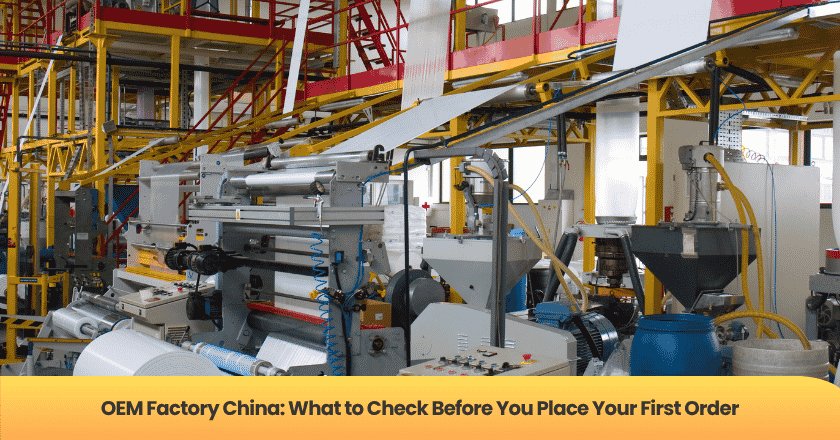
Ask for a live video walkthrough of the production line, not a polished marketing video. A real OEM will show machines, work-in-progress, and staff without much fuss. Hesitation, or footage that never quite shows the line making your kind of product, usually means the capacity belongs to someone else.
OEM versus ODM
Clarify whether you need OEM or ODM (Original Design Manufacturer — a factory that designs and makes a product you then brand, rather than building to your own design). OEM suits buyers with their own design; ODM suits those who want to brand an existing product. Many factories do both, so state which model your order is from the start.
Expert Tip: When a factory quotes a price that's notably below every other OEM you've contacted, ask specifically which materials and grade they’ve quoted. In my experience the low number almost always rests on a cheaper resin, a thinner gauge of metal, or a lower component spec than the others assumed. Get the bill of materials in writing before you celebrate the price, because the gap usually reappears as a quality problem later.
Verify Production Capability and Capacity
Saying yes is free; delivering 50,000 compliant units is not. The factory’s real test is whether it can hold your spec at your volume, on your timeline — not whether it can produce one flawless sample. This is the check that separates a workshop from a manufacturer.
Match capacity to your volume'
Ask about monthly output, current order load, and how many lines could run your product. A factory operating near full capacity may push your order to the back of the queue or rush it past quality. You want headroom, not a plant that has to strain to fit you in.
Assess the quality system
Look for documented QC (Quality Control — the inspection processes a factory uses to catch defects during and after production) procedures, not just a promise. Certifications like ISO 9001 signal a real system, though you should still verify them by number. A factory that can describe its in-line inspection steps is usually one that runs them.
Confirm relevant experience
A factory skilled in one product is not automatically competent in yours. Ask for examples of similar products they’ve made and, where possible, references from buyers in your market. Specific, checkable experience beats a broad claim of "we can make anything." A partner such as NewBuyingAgent confirms this capacity for you, its 20,000+ QC experts checking real output across a 50,000+ factory network before you order.
Common Mistake to Avoid: Judging an OEM factory's capacity by the quality of its single sample. A workshop with a handful of skilled staff can hand-build one perfect unit and then fail completely at 10,000. The sample proves the factory understands your design; it says nothing about whether it can repeat that quality across a full production run. Always confirm output capacity and ongoing order load separately from sample quality.
Nail Down Tooling, Molds, and Costs
Tooling is where OEM relationships most often turn sour, because the money and the ownership are easy to leave vague. A mold can cost thousands and is essential to your product, yet first-time buyers routinely fail to ask who owns it. Settle this before, not after, the deposit.
Who pays and who owns
Clarify the tooling cost, who pays it, and crucially who owns the mold once it’s made. If you paid for the tooling, the contract should state that you own it and can move it to another factory. Without that clause, a factory can hold your mold hostage to keep your business.
Understand the full cost stack
Beyond the unit price, account for tooling, sampling, packaging, inspection, and freight. A low FOB price (Free On Board — the cost of goods loaded onto the vessel at the Chinese port, before freight and insurance) means little until you've added everything else into a landed cost. The cheapest unit price often carries the highest total.
Mind the MOQ
OEM factories set a MOQ (Minimum Order Quantity — the smallest batch they’ll produce) tied to material runs and line setup. A MOQ that’s far above your first-order need ties up cash in inventory. Negotiate it, or find a factory whose minimum fits a realistic launch volume rather than overbuying to win a price.
Expert Tip: Put a line in your contract that the tooling you paid for is your property and must be released or shipped to you on request. Even if you never plan to move factories, that single clause changes the power balance. A factory that knows you can take your mold elsewhere negotiates and performs differently than one that holds your production hostage by default. It costs nothing to add and protects you for years.
Protect Your Design and Intellectual Property
The moment you share a design with an OEM factory, you've handed over the asset your business is built on. Most factories are honest, but the cost of the rare one who isn’t can be your entire product line appearing under a competitor's name. Protection is cheap relative to that risk.
Use an NNN agreement
A Western NDA often doesn't hold up well in China. An NNN agreement (Non-disclosure, Non-use, Non-circumvention — a contract drafted under Chinese law to stop a factory from copying, using, or going around you with your design) is the standard tool. Have it drafted to be enforceable in China, and sign it before sharing detailed specs.
Register what you can
Where it fits, register your trademark in China and consider a design patent. China operates a first-to-file system, so a local competitor can register your unprotected mark before you do. Early registration is far cheaper than fighting to reclaim a name later.
Share on a need-to-know basis
Give the factory the specifications required to build, not your full business plan, margins, or customer list. Limiting what you disclose limits what can leak. The factory needs to make the product well; it doesn't need to understand your entire go-to-market strategy.
Common Mistake to Avoid: Sending a full technical design package to a factory before any protective agreement is signed, just to "get an accurate quote." Once the design is out, you can't recall it, and an unprotected spec can be reproduced or shared. Provide enough for a ballpark quote, sign an enforceable NNN agreement, and only then hand over the detailed files. The few days this adds are trivial against the risk of a leaked design.
Lock In Samples, Quality Control, and Terms
With the factory verified and your design protected, the last gate before bulk production is proving the product and pinning down the terms. This is your final cheap opportunity to catch a problem. Skipping it means discovering issues when a full container is already at sea.
Sign a golden sample
Approve a pre-production sample made from your actual materials and line, then sign and seal one unit as the reference standard. Keep an identical one yourself. When a dispute arises later, you’re comparing the bulk goods against a physical agreed standard rather than an emailed description.
Arrange independent inspection
Book a during-production and a pre-shipment inspection against your spec, run by a third party or your sourcing agent. Catching a defect at 20% completion lets you fix the run; catching it at the port forces a bad choice. The inspection cost is minor against a rejected shipment. A partner such as NewBuyingAgent can run these inspections and manage door-to-door logistics so a failed batch never quietly ships.
Structure safe payment terms
A 30% deposit with the balance on inspection or against shipping documents keeps real money tied to acceptable goods. Resist full prepayment on a first OEM order regardless of the discount. Settle inspection rights and payment milestones in the same agreement, before the deposit leaves your account.
Expert Tip: On a first OEM order, schedule your during-production inspection to coincide with roughly the first 10 to 20% of units completed. That timing is early enough to halt and correct a systemic defect — wrong material, off tolerance, bad finish — before the factory commits the full run, yet late enough that real production conditions are visible. Inspecting only at pre-shipment leaves you discovering problems when it's far too late to fix them cheaply.
Frequently Asked Questions
How do I know if a Chinese OEM factory is legitimate?
Start with the business license: confirm the registered name, production scope, and that the payment account matches. Add a live video walkthrough of the line and verification of any certifications by number. A factory that passes all three is far more likely to be the real producer rather than a trading company reselling another plant’s output.
What's the difference between OEM and ODM?
With OEM, you supply the design and the factory builds it to your spec under your brand. With ODM, the factory designs the product and you brand an existing or lightly modified item. OEM gives you more control and a more distinctive product; ODM is faster and cheaper to launch. Many factories offer both, so state which you want.
Who owns the tooling if I pay for it?
Only if your contract says so. Paying for a mold does not automatically give you ownership in practice unless the agreement states you own it and can move it. Without that clause, factories often retain physical control of the tooling, which can lock you into the relationship. Put ownership and release terms in writing before paying.
Do I need an NNN agreement, or is an NDA enough?
For manufacturing in China, an NNN agreement drafted under Chinese law is generally stronger than a standard Western NDA. It covers non-use and non-circumvention, not just disclosure, and is built to be enforceable locally. Sign it before sharing detailed designs. A reputable factory will sign without resistance.
What's a reasonable MOQ for a first OEM order?
It varies widely by product and materials, since the MOQ reflects the factory's setup and material-run costs. The practical test is whether the minimum matches a realistic launch volume rather than forcing you to overbuy. If a factory's MOQ is far above your need, negotiate it or find one whose minimum fits your first order.
Conclusion
The price is the easy part of an OEM deal; the protection is what separates a clean launch from an expensive lesson. Verify the factory is real, confirm it can hold quality at volume, settle tooling and IP in writing, and insist on a signed sample and inspection — all before the deposit. Do that and your first order becomes a foundation rather than a gamble. If you'd rather have specialists run these checks for you on the ground in China, that's exactly the work NewBuyingAgent does. Its 20,000+ development and QC specialists run these on-site checks across a network of 50,000+ partner factories, so first-order surprises are caught before you commit.
NewBuyingAgent
Related Resources
Get Started Today
Let's Turn Your Sourcing Goals into RealityWeChat:+86 15157124615
WhatsApp:+86 15157124615
Address:Building 10 #39 Xiangyuan Road, Hangzhou, China
