

An NNN agreement is a commercial agreement that addresses non-disclosure, non-use, and non-circumvention. For a buyer preparing to source from China, it is most useful as a disclosure boundary: it says who may receive specified information, why they may use it, and which commercial relationships they must not bypass. It is not a complete IP strategy, a substitute for registrations, or a prediction of what a court will do.
That distinction matters before a quote request becomes a chain of forwarded emails. A factory may need dimensions, materials, target cost, packaging direction, and timing to make a meaningful offer. It may not need every CAD layer, retailer list, launch plan, formula, pricing model, or relationship record on day one. The practical question is therefore not “Do we have a template?” It is whether the legal recipient, the information set, the permitted purpose, and the evidence record all describe the same sharing event. This is general sourcing-risk information; obtain qualified China legal advice before choosing contract language, governing law, remedies, or a dispute path.
The Disclosure Boundary Buyers Need Before a China Quote
An NNN is a disclosure gate, not a complete IP strategy. In sourcing terms, the agreement should sit beside confidentiality controls rather than replace them.
WIPO's China overview lists non-public status, commercial value, and proper confidentiality measures in its trade-secret definition. Read the WIPO overview of China’s trade-secret system as legal context, not as a substitute for transaction-specific advice.
- Party: identify the legal entity that will receive or control the information, not only a contact name, chat account, or English trading name.
- Information: separate a shareable quotation brief from designs, tooling files, customer data, non-public pricing, launch plans, and other controlled material.
- Purpose: state whether the recipient may evaluate, quote, sample, manufacture, or perform another defined activity—and what is outside that permission.
- Record: retain the signed agreement, versioned file list, authorized recipients, transmission record, and any return or deletion confirmation.
These four points also create a better internal decision. If the team cannot identify the recipient or explain which version of a drawing was sent, it is too early to send the most sensitive package. A buyer can still move the project forward with a minimum-necessary brief: product category, broad material direction, anticipated quantity, destination, target timing, and approved commercial requirements. Counsel can then help decide when more detailed information is appropriate.
What an NNN Adds to an NDA in a China Sourcing Relationship
The official law text distinguishes disclosure and use conduct. NNN is a widely used commercial shorthand, not the name of one universal statutory form. Its value is that it forces three separate risks into the conversation. The English text of China’s Anti-Unfair Competition Law on WIPO Lex distinguishes conduct involving the obtaining, disclosure, use, and permitted use of trade secrets. That legal context is a reminder to ask a more precise sourcing question than “Will you keep this confidential?”
A conventional NDA may focus mainly on keeping information from being disclosed to outsiders. A carefully reviewed NNN-style arrangement can also make the intended use explicit and address defined commercial relationships. The three labels overlap in real drafting, and their effect depends on the actual text, parties, law, evidence, and facts. Buyers should avoid assuming that an acronym answers those questions. Use the acronym to organize a counsel-led review, not to avoid one.
Non-Disclosure: Identify What Must Stay Confidential
Define confidential information by the files and business information the buyer actually plans to share. Non-disclosure starts with an information map. “All project information” is usually too vague to help an operating team decide what it may forward, store, or show to a subcontractor. Create a schedule or controlled list that names categories and versions: a CAD file, artwork, bill of materials, sample photograph, test method, retailer launch date, price architecture, customer contact, or manufacturing process. Mark what is already public and what is not.
The scope should identify actual files and business information rather than a vague label. The need for specificity is practical as well as legal. A buyer does not need to mimic a court case to gain the lesson: preserve a dated list of the actual material sent. It gives the recipient a clearer boundary and gives the buyer a traceable record if the project changes hands.
An SPC guiding case describes identifiable drawings, process documents, confidentiality agreements, and internal procedures. The SPC guiding case on technical secrets provides that factual context; it does not determine the outcome of another dispute.
Non-Use: Limit the Purpose of the Evaluation
State the exact evaluation or production purpose for any approved use. A permitted purpose is the specific evaluation or production activity for which information may be used. Non-use is about purpose, not simply possession. A permitted purpose should say what the recipient may do with the approved information—for example, evaluate feasibility, prepare a quotation, build an authorized sample, or perform an approved production task. It should also make clear that use outside that purpose requires authorization. This distinction matters when a factory asks for a drawing to quote one project and then wants to reuse it for a different customer, product, channel, or production arrangement.
Keep the permitted purpose narrow enough to guide behavior and broad enough to allow the work the buyer actually wants. The buyer may authorize a feasibility review but not a production run; a sample build but not marketing use; or a factory evaluation but not onward sharing across an affiliated group. Counsel should determine the appropriate exceptions, duration, and remedy language. The sourcing team’s job is to document the commercial purpose in plain terms before it distributes the files.
Non-Circumvention: Define the Relationship Boundary
The case summary treats special client information as potentially protected business information. Non-circumvention is the most easily overbroad part of the discussion. The buyer needs to identify the commercial relationship that requires protection and any sensible exclusions, rather than write a blanket restriction with no defined connection. In an SPC-published client-list case summary, the court discussion distinguishes ordinary names from deeper information such as trading habits, needs, and price tolerance, while also noting the role of reasonable confidentiality measures.
For a sourcing project, the relationship map may include a named customer opportunity, retailer contact, exclusive launch channel, distributor, design partner, or selected factory relationship. It may also need exceptions for public information, prior relationships, independently developed information, or conduct already authorized by the buyer. These details are drafting and enforceability questions for counsel. The buyer can make that review more useful by writing down who introduced whom, what information is non-public, and which relationship creates the real commercial concern.
Make the Agreement Match the Actual Parties and Information
A useful agreement must match actual parties and information. Start by confirming the legal entity that will sign and the entity that will receive the drawings, samples, or data. A sales office, trading company, related factory, tooling supplier, and production facility may be different entities. If more than one organization needs access, the buyer should not assume one signature covers the entire group. Ask qualified counsel to assess the relevant entity structure and authority.
The Civil Code provides context on lawful contracts, multiple authentic language versions, and confidentiality and ownership clauses in technology contracts. The English publication of China’s Civil Code is useful background; it does not select contract terms for a particular transaction.
Those points do not tell a buyer what to sign. They do explain why a copied English-only form, an unspecified recipient, and an unclear ownership clause deserve careful legal review before a sensitive sourcing handoff.
| Review Item | Buyer Question | Practical Record | Hold Signal |
|---|---|---|---|
| Legal recipient | Which entity receives the information? | Entity name, registration details, signatory authority | Sales contact and factory are not matched |
| Information scope | What exact files and data are controlled? | Versioned disclosure schedule | Full files are attached without a list |
| Permitted purpose | What work is authorized? | Quote, evaluation, sample, or production description | Use is open-ended |
| Ownership and records | Who owns what, and what proves the handoff? | Ownership review, access log, acknowledgments | No approved version or recipient record |
The table is a sourcing control, not a contract template. It helps the buyer collect the facts a lawyer needs to assess: entity identity, scope, ownership, duration, applicable law, dispute-resolution choices, and remedies. It also stops a familiar but weak practice—sending the full product package first and trying to reconstruct the boundary after a supplier has circulated it.
Build a Protection Stack Around the Agreement
Proper confidentiality measures matter to trade-secret protection. A signed agreement is stronger in practice when the buyer treats it as one layer in a protection stack. The WIPO overview identifies proper confidentiality measures as part of the trade-secret definition in its China summary. Start with the contract, then add an information classification, minimum-necessary access, version control, ownership records, and a disclosure log. The objective is not to create bureaucracy. It is to make a later question answerable: which entity and people received which file, for which authorized purpose, under which agreed boundary?
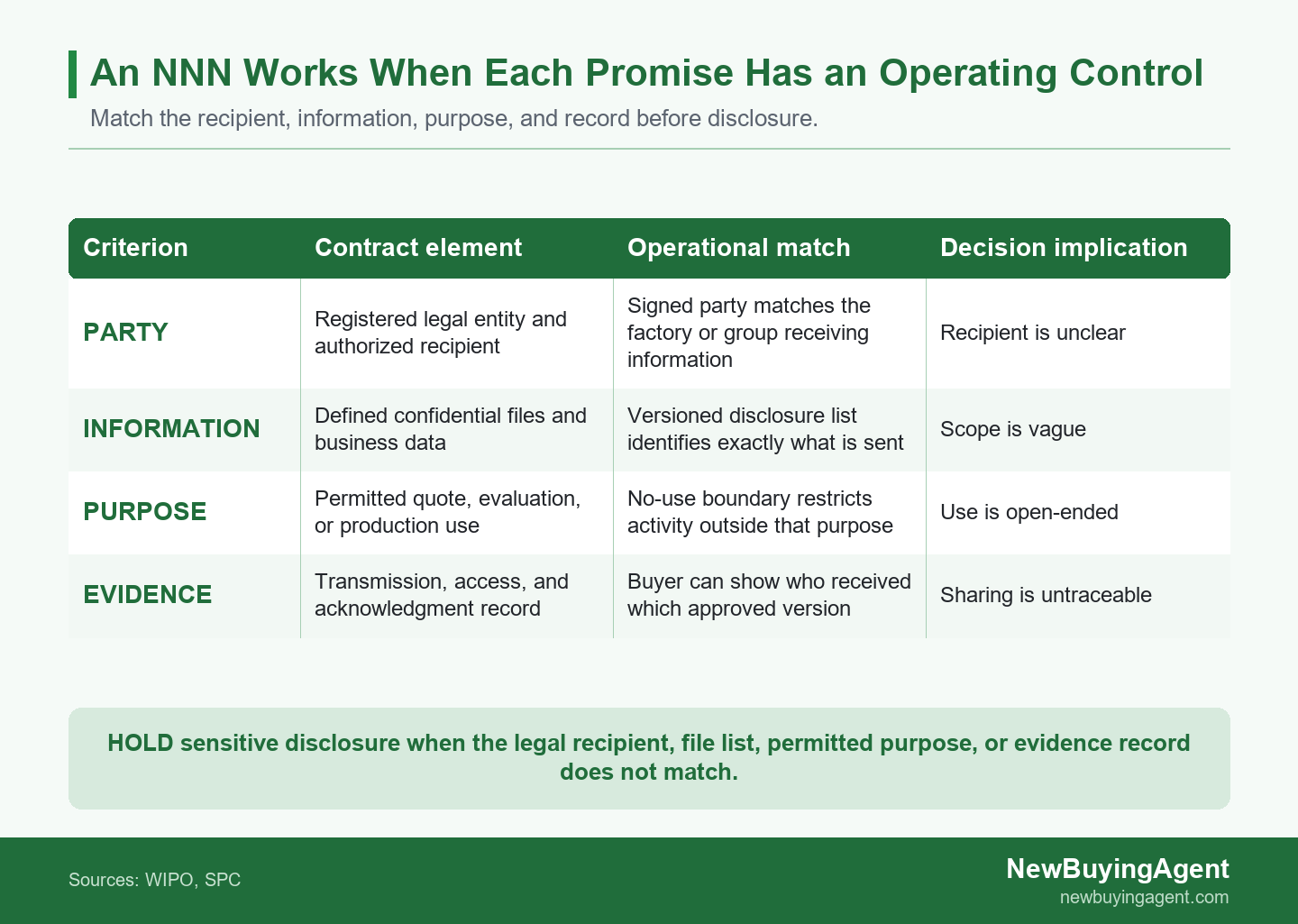
An NNN protection map linking the legal party, defined information, permitted purpose, and evidence record.
Use a simple release sequence. First, give an internal owner authority to approve sharing. Second, issue only the version needed for the next decision. Third, transmit it to named recipients through a traceable channel. Fourth, keep the recipient acknowledgment with the versioned file list. Fifth, when the evaluation ends or the relationship changes, follow the counsel-approved return, deletion, or continuing-confidentiality process. The evidence does not guarantee an outcome, but it is far more useful than a verbal assurance that “the factory has the files.”
Trade-secret remedies are fact-specific. An SPC-published trade-secret case summary describes an interim measure in the context of identified documents, supporting evidence, and a court’s assessment of the situation. A separate 2025 SPC/SPP release discusses judicial benchmarks for criminal trade-secret cases. Neither source makes a result automatic for a sourcing dispute. They reinforce the need for a prompt, fact-specific legal response if a serious issue arises.
An Illustrative Sourcing Scenario: A Kitchen-Tool Design
Release Only the Minimum Necessary, Logged Package
A global buyer is evaluating a China manufacturer for a custom kitchen-tool set with a non-public retailer launch plan. The illustrative evaluation covers 2 custom SKUs, 3 CAD files, 1 packaging artwork set, and 1 retailer launch list. An NDA is signed with a sales contact, but the full package would be forwarded to an affiliated factory not named in the document.
The buyer's draft email names a sales contact while the proposed recipient is an affiliated manufacturing entity. The attachment includes 3 CAD files and a customer launch list without a versioned disclosure schedule or recipient acknowledgment. The intended recipient, permitted purpose, document versions, and relationship information are broader than the signed paper identifies. That mismatch is a reason to pause the disclosure, not a conclusion about the factory’s intentions.
Hold until entity, recipient, files, and purpose match. The buyer asks counsel to confirm the appropriate contracting entity and scope, then prepares a minimum-necessary, versioned disclosure package with recipient acknowledgment. Separate basic quote inputs from controlled CAD, customer, and launch data; record the legal entity, files, purpose, and authorized recipients. The authorized commercial brief can still describe the product category, material direction, anticipated quantity, target timing, destination, and approved performance needs.
The court summary describes identified documents and supporting evidence. The SPC case summary explains an interim-measure request in the context of named documents and evidentiary material. Before release, reconcile four points: the legal party and authority, the 3-file disclosure list, the authorized factory recipients, and the acknowledgment record. Then retain the outgoing transmission record and any later return or deletion confirmation. This is an illustrative procurement control, not legal advice or a guarantee of a remedy; legal obligations, remedies, and the appropriate disclosure process depend on the parties, files, and applicable law.
The scenario also preserves commercial momentum. The buyer does not have to abandon the quotation. It can authorize the information needed for the current decision while keeping sensitive files and relationship data behind a clearer gate. If a supplier cannot work from the authorized brief, that is useful information for the buyer and counsel before more valuable material is disclosed.
When an Existing Supplier Needs a Different Contract Check
An existing-factory relationship needs its own recipient and access review. The buyer may be sharing production schedules, inspection photos, quality records, tooling updates, packing details, customer delivery information, or corrective-action discussions with a factory already in production. Those records can involve different people and different access needs than a new-factory quotation. Do not assume that an old NDA, purchase order, or email chain automatically answers today’s scope question.
Existing-supplier management needs its own recipient and access review. Where the buyer has already chosen a China supplier but needs local coordination, it can review factory-management support for an existing China supplier. NewBuyingAgent’s relevant role is China-side communication, production follow-up, quality management, and logistics coordination after the buyer has established the appropriate commercial and legal boundaries. It is not a law firm and does not determine IP ownership, contract enforceability, or litigation strategy.
What to Prepare Before a Sourcing Conversation
Once counsel has reviewed the disclosure boundary, prepare an authorized sourcing brief. For a new product, include the product category, approved specifications, expected quantity, target price, destination, timing, and the material or quality requirements that are safe to share. Keep separate the confidential package that needs a more limited recipient and purpose. This lets a sourcing discussion begin without sending every sensitive asset at once.
The sourcing brief should contain only approved, shareable information. NewBuyingAgent is a one-stop China sourcing agent service provider for global buyers. Where the buyer needs a new product supplied from China, its local factory resources and product-development and quality-control capability can turn an authorized brief into a practical quote-to-supply path. Buyers can see how NewBuyingAgent supplies products from China, while retaining legal decisions with qualified counsel and final commercial approvals with the buyer.
For context on the kinds of product and sourcing situations the team supports, readers can review NewBuyingAgent sourcing stories. When the authorized brief is ready, the useful next step is to submit an authorized product brief to NewBuyingAgent. Include only information cleared for that conversation, plus the product, destination, timing, and decision the buyer wants to advance.
Frequently Asked Questions
Is an NNN Agreement Enforceable in China?
An NNN agreement can be part of an enforceable commercial arrangement, but enforceability depends on the actual parties, clauses, governing-law and dispute-resolution choices, evidence, and applicable law. A buyer should not rely on the NNN label alone. Before disclosure, qualified counsel should review the proposed counterparty, its authority, the information definition, language versions, ownership terms, duration, remedies, and the relevant facts. The sourcing team should preserve the signed version and the records that show how information was shared under it.
Does an NNN Agreement Replace Patent or Trademark Filing?
No, an NNN agreement controls defined confidential information and commercial conduct; it does not replace registrations, ownership documentation, or other IP steps that fit the product and markets. Different assets can require different protection paths. A buyer with a custom design, brand, invention, artwork, or manufacturing process should ask qualified IP counsel which protections and timing are appropriate. The agreement is most useful when it is coordinated with—not substituted for—the buyer’s wider ownership and registration plan.
Who Should Sign an NNN Agreement With a China Supplier?
The agreement should identify the legal entity that will receive or control the information, and counsel should confirm whether related factories, trading companies, tooling suppliers, or individuals need their own obligations. A contact person’s signature, chat identity, or business card may not answer the entity question. Give counsel the supplier’s legal details, the proposed information recipients, and a clear description of the work each party will do. Then keep the final recipient list aligned with the actual sharing process.
What Should Buyers Keep After Sharing a Product Design?
Keep the signed agreement, versioned disclosure list, files sent, authorized recipients, transmission records, supplier acknowledgments, and any return-or-deletion confirmations. Also retain the internal approval that allowed the disclosure and the commercial purpose for it. These records do not guarantee a legal result, but they reduce ambiguity about what was shared and why. If a concern emerges, seek qualified legal advice promptly and preserve the original files, messages, documents, and access records.
NewBuyingAgent
Related Resources


Get Started Today
Let's Turn Your Sourcing Goals into RealityWeChat:+86 15157124615
WhatsApp:+86 15157124615
Address:Building 10 #39 Xiangyuan Road, Hangzhou, China
