

Introduction
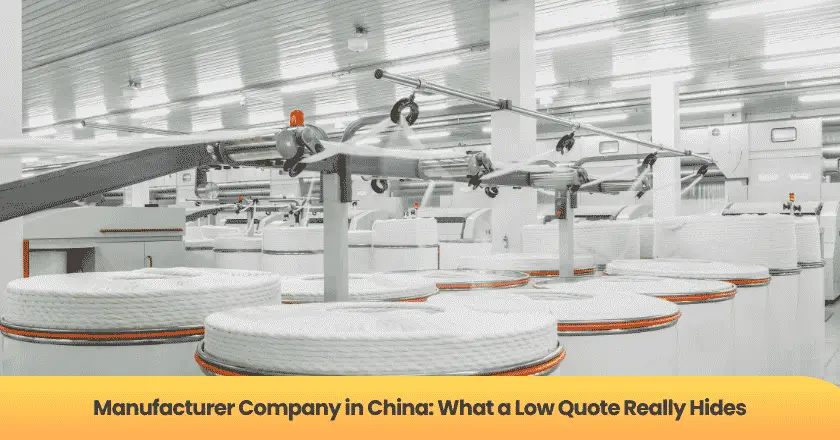
Four quotes on the same drawing. Three cluster around $4.10 and one comes in at $2.85. The cheap one is a real company with a real factory and a salesperson who answers quickly. You have not been lied to, and the number in front of you is not the number you will pay.
A quotation is a short document carrying a great many unstated assumptions. Which quantity it applies to, where the goods stop being the seller's problem, what the carton looks like, whether tooling is included, how long the price holds. A low quote is usually one of those assumptions rather than a discount, and the way to find out is to read what the document does not say.
Key Takeaways
• A low quote is often a different set of assumptions rather than a cheaper factory.
• Confirm the quantity, the trade term, the packaging and the validity period before comparing any two numbers.
• Tooling, samples, testing and freight volume are the four costs most likely to arrive after the quote.
• Normalise everything to landed cost per unit at one quantity, then compare.
• Factories quote low for good reasons as well as bad ones, so ask rather than assume either.
Why a Factory Would Quote Low on Purpose
Buyers treat a low number as suspicious or as a win, and it is frequently neither. Several entirely rational reasons produce one.
The legitimate reasons
A plant with idle capacity prices to fill a line, because a machine running below cost still beats one standing still. A factory wanting into your market or your category will price an entry order deliberately thin. Material already sitting in stock from a cancelled order costs less than material to be purchased. None of these are tricks and all of them are temporary.
The reasons that cost you later
A misread drawing. A quantity assumption far above what you intend to order. A specification the factory has quietly simplified in its own head. An intention to recover the difference through packaging, freight or a substitution nobody discussed. These look identical to the legitimate reasons on the quotation itself, which is why the follow-up question matters more than the number.
Timing tells you something as well. A quote arriving within an hour of a detailed enquiry has rarely been costed, because nobody checked material prices or line availability in that window. A considered reply the next working day, with two clarifying questions attached, usually reflects an actual calculation rather than a figure from a similar job last year.
Expert Tip: Ask the cheapest supplier directly why its price sits below the others, and say so plainly. The answers separate quickly. A factory citing spare capacity this quarter, existing material stock or a wish to enter your market is telling you something real and time-limited. A supplier that cannot explain the gap has either misunderstood the job or has a plan it would rather not describe.
What the Quotation Does Not Say
Most Chinese factory quotations are two or three lines long. The omissions are standardised enough that you can check for them in a minute.
Six things that belong on every quote
Ask for any of these that are missing before treating the document as a price at all.
• The quantity the price applies to, since the same product carries different prices at different volumes.
• The trade term, because an FOB price (free on board — goods delivered onto the vessel at a Chinese port) and a factory-gate price are different numbers.
• The packaging included, down to inner cartons, master carton and units per carton.
• Whether tooling, moulds or setup charges are inside the unit price or invoiced separately.
• The lead time and, separately, what that lead time is counted from.
• The validity period, since material prices move and a quote from March may not survive June.
None of these requests are unusual and none of them require a difficult conversation. A factory used to export customers produces all six without comment, often in a standard format it already has. A supplier that treats the request as unreasonable is telling you about its experience level rather than about your expectations.
Common Mistake to Avoid: Comparing two quotes that use different trade terms without converting them. A factory-gate price will always look better than an FOB price from a competitor, and the gap is simply inland transport, export handling and documentation that somebody still has to pay for. Ask every supplier to quote on the same term before laying the numbers side by side, and the ranking often changes.
The Quantity Assumption Underneath the Number
Of all the hidden variables, quantity moves the price most and is stated least often.
Why the same product has several correct prices
Setup cost, material purchasing lots and machine changeover are spread across whatever quantity the factory imagined while quoting. Optimistic sales staff quote against a hopeful volume, then rebuild the number once a real purchase order arrives at a third of it. The MOQ (minimum order quantity — the smallest run a factory will accept) sitting beside the price is the clue most buyers skim past.
Getting the curve rather than a point
Ask for pricing at three or four quantities including one above your intended order. The shape tells you where the fixed costs stop mattering and gives you a target worth negotiating toward. It also exposes a quote built on an assumption you never shared, because the number for your actual quantity appears immediately.
Watch where the curve flattens. Below that point you are paying mostly for setup, and above it almost entirely for material. Knowing which side of the bend your order sits on tells you whether to negotiate on quantity or on material grade, and those are completely different conversations with completely different outcomes.
Expert Tip: Put your realistic first-order quantity in the enquiry rather than an ambitious annual figure. Buyers inflate volumes hoping for a better price and receive one that evaporates at purchase order stage, which costs a week and some goodwill. Stating a modest first order with a credible annual projection gets you a usable number now and a better one later, and it starts the relationship with an accurate picture.
The Costs That Arrive After the Quote
A quotation prices manufacturing. Several other things have to be paid for before goods reach you, and their absence from the document does not make them optional.
The usual four
Tooling or setup on anything custom, sometimes offered as amortised across early orders and quietly making the tool the factory's. Sample rounds, each with its own fee and courier cost. Testing and certification where your market requires it. Freight, which is priced on volume, so a carton designed without you in mind lands directly in your shipping bill.
Asking about them at the right moment
Raise all four during quotation rather than after selecting a supplier. Let's be honest: a supplier that knows it has won is less generous about tooling and packaging than one still competing. Through 2026 most factories quote these items readily when asked upfront, because buyers comparing total cost have become common enough that it no longer surprises anyone.
Payment terms belong in the same conversation. A supplier funding sixty days of production has priced that into the unit, and one demanding full payment before shipment has not. Two quotes a few cents apart can differ meaningfully once the cost of your own tied-up cash is counted alongside them.
Expert Tip: Ask for carton dimensions and units per carton with the quotation, then work out how many units fit a container before choosing. Two suppliers quoting within cents of each other can differ by a meaningful amount per unit once freight volume is counted. It is the least glamorous line in the comparison and regularly the one that decides it.
Turning Quotes Into Comparable Numbers
Comparison only works once every quote describes the same transaction. Normalising takes half an hour and changes the ranking more often than not.
One quantity, one term, one carton
Fix a single quantity and ask everyone to quote it. Fix one trade term. Specify the packaging yourself rather than letting each factory choose. Then add tooling divided over a realistic first-year volume, sample costs, testing, freight per unit at actual carton dimensions, and inspection. The resulting figure is the only one worth putting in a spreadsheet.
Keep the working rather than only the answer. Recording which assumptions you fixed makes the next comparison faster and lets you requote the same product in a year without rebuilding the model. It also makes the number defensible when somebody asks why the cheapest bidder did not win.
What to do with a persistent outlier
If a supplier remains substantially cheaper after normalising, the difference is real and has a source. It is usually material purchasing power, a faster cycle time or genuine spare capacity. Ask which, and ask whether it holds for a repeat order in six months, because capacity-driven pricing does not.
Common Mistake to Avoid: Awarding the order on the normalised number alone. A factory two percent cheaper on landed cost but unwilling to discuss its process, slow to answer technical questions or vague about who actually manufactures has told you something the spreadsheet cannot hold. Price differences of a few percent disappear inside one quality problem, and the quality signals were all visible during quotation.
The Conversation Worth Having With the Cheapest Bidder
A low quote is an opening for a useful conversation rather than a reason to disqualify anyone. Three questions do most of the work.
Three questions and what the answers mean
Ask what material grade is quoted and what the nearest alternative would cost, which surfaces any substitution already assumed. Ask what the expected scrap rate is on this part, since a plant with an unstable process is pricing optimistically. Ask what the price becomes at half the quantity, which exposes a volume assumption instantly.
Buying a low quote safely
If the answers hold up, place a small first order rather than declining the saving out of caution. Tie part of the payment to a passed inspection, specify the material grade in writing on the purchase order, and inspect against the specification rather than against the approved sample. A genuinely cheap supplier will pass all three without complaint. Resistance to any one of them is the answer you were looking for, arriving cheaply.
Expert Tip: Keep the second-cheapest supplier warm while you trial the cheapest. One quotation request a quarter costs nothing and keeps the relationship alive. If the low bidder turns out to be pricing on temporary capacity, you already have an alternative that knows your product, rather than starting a supplier search at the point your price has just moved.
Comparing Quotes From a Wider Field With NewBuyingAgent
Normalising four quotations only helps if those four suppliers are genuinely suitable alternatives. A wider and more relevant supplier pool can make the comparison itself more useful.
NewBuyingAgent works with 50,000+ partner factories across China, giving buyers access to a broader range of sourcing options than the suppliers they may be able to identify independently. Suppliers can be considered against the buyer's product requirements, order quantities and target costs rather than simply comparing the first few quotations received.
A broader field can also create more room to identify competitive purchasing options. Depending on the product and order, NewBuyingAgent can help reduce purchasing costs by around 5%–10%, including its margin.
But a lower quotation only creates value if the delivered product matches what was agreed. NewBuyingAgent's 20,000+ product development and QC experts provide product and quality support during the sourcing and production process, helping connect the approved requirements with the finished goods.
The useful comparison is therefore not simply four prices versus one price. It is the right suppliers, comparable quotations and the product that ultimately arrives. → Learn more.
Frequently Asked Questions
Why is one quote from a manufacturer company in china so much cheaper?
Most often a different assumption rather than a different cost base: another quantity, another trade term, packaging excluded or tooling left out. Where the gap survives normalising, it usually comes from material purchasing power, cycle time or spare capacity. Ask which one, because capacity-driven pricing does not survive to your second order.
How long should a factory quote stay valid?
Thirty to sixty days is common, and shorter where the main material is volatile. Ask for the validity in writing, since a quote with no stated period is an invitation to requote later. If your decision will take longer, say so and ask what would need to be fixed in advance to hold the price.
Should I tell suppliers what the other quotes are?
Sharing a target price tends to work better than sharing competitors' numbers. Naming a rival's figure invites a match on paper that gets recovered elsewhere in production. Asking what would have to change to reach a target keeps the conversation on specification and quantity, where the answers are verifiable. It also avoids teaching a supplier what it needs to beat rather than what you actually need.
How does NewBuyingAgent price against a direct factory quote?
The comparison is against what you could obtain yourself rather than against a fee line in isolation. Uncompetitive Pricing: The 95% of factories you can't reach offer far better prices. The scope of what the arrangement covers is the other half of the comparison. NewBuyingAgent handles all factory communication—perfect for multi-category buyers.
Conclusion
Treat every quote as incomplete until quantity, trade term, packaging, tooling, lead time basis and validity are written down. Normalise to landed cost per unit at one quantity, add the four costs that arrive later, then ask the cheapest bidder to explain itself. Low quotes are frequently real and almost never mean what the document appears to say. If collecting the right four quotes is the part you would rather hand over, NewBuyingAgent is worth a conversation.
Partial Sources
1. Incoterms 2020 – International Chamber of Commerce — https://iccwbo.org/business-solutions/incoterms-rules/incoterms-2020/
2. Basic Importing and Exporting – U.S. Customs and Border Protection — https://www.cbp.gov/trade/basic-import-export
NewBuyingAgent
Related Resources
Get Started Today
Let's Turn Your Sourcing Goals into RealityWeChat:+86 15157124615
WhatsApp:+86 15157124615
Address:Building 10 #39 Xiangyuan Road, Hangzhou, China
