


Consolidate only when avoided duplicate shipment charges exceed added consolidation and waiting costs, and included cargo meets one readiness cutoff. Here, a readiness cutoff is the last agreed point by which each included lot is received and verified at the warehouse. The next sections separate transport context from the buyer’s own cost-and-readiness decision.
That rule is more useful than a generic “LCL is cheaper” answer. A buyer with several China suppliers is not deciding whether a single carton can move by less-than-container load. The real choice is whether completed lots should share an origin handoff, a forwarding file, and a sailing. The answer changes when fixed charges repeat, when a supplier misses the agreed receipt date, or when a lot arrives without the information needed to release it safely.
The calculation below is deliberately simple: it shows how the comparison changes when one lot misses the cutoff. Current route, destination, customs, insurance, and carrier terms still need confirmation from the selected forwarder before booking.
The Decision Is Not Just LCL Versus FCL
Less-than-container load (LCL) is a shared-container arrangement: cargo from several shippers can share space. FCL is different: one shipper uses the full container under the booking. That distinction does not tell a buyer whether three supplier lots should be combined. This is an origin-control and cost-comparison question before the cargo reaches the port.
It helps to separate the terms. “LCL” describes the freight mode. “Consolidation” describes the act of bringing multiple lots together, checking them, and releasing them as a combined shipment. You can have separate LCL shipments from several suppliers, or a consolidated LCL shipment from several suppliers. The second option may reduce duplicated shipment-level charges and handoffs, but it also makes the combined booking depend on the slowest included lot.
That is why a total CBM number is only an input, not a decision. A 6.4-CBM total is economically meaningless until you know how many quote files it replaces, which line items repeat, who pays to move each lot to the warehouse, and what happens if one lot misses the cutoff.
The Four Inputs That Decide Consolidation
A usable consolidation sheet has four decision inputs: volume, shipment-level charges, consolidation-only charges, and cargo readiness. Put every input beside the same shipment scope and timing assumption so that a low-looking figure cannot depend on an omitted line item.
- Volume: record the measured CBM for every ready lot, not just the order total. A small lot can still carry a full set of shipment charges when it moves alone.
- Shipment-level charges: identify the charges that occur once per separate shipment, such as booking, documentation, origin handling, or destination processing where applicable.
- Consolidation-only charges: include domestic transfer, warehouse receipt, counting, labeling, pallet work, storage, rehandling, and any inspection work that is actually requested.
- Readiness: define a deadline and an evidence standard. A supplier saying “almost ready” is not the same as cartons received, counted, labeled, and matched to the packing list.
Put these four inputs in the same worksheet before asking for a recommendation. This avoids a familiar problem: one quote looks lower because it excludes a transfer or warehouse line that appears elsewhere in the process. The comparison should not reward a missing line item.
Build the Comparison from Quote Lines, Not a Single Rate
LCL cargo space is commonly measured in cubic metres, or CBM. Maersk’s LCL guidance explains the volume basis; measure every lot consistently before placing it into either option.
The measurement is physical, not a promise about the final total. Use the same volume basis in every option, then keep per-CBM and fixed lines separate.
Separate and consolidated options should be compared with like-for-like volume and shipment-level quote lines. Request a complete breakdown, including the quote validity period, currency, origin, destination, commodity description, and exclusions.
For NewBuyingAgent, this type of China-side comparison is most useful when every supplier, carton record, and ready date is visible before the booking instructions are issued.
If carton dimensions or weights are provisional, mark the whole comparison provisional. Buyers who need to make a product and shipment record easier to review can review the China manufacturing and product guide rather than reconnecting fragmented messages during booking.
Separate Volume, Shipment, and Consolidation Charges
LCL services consolidate smaller shipments, creating a distinct origin handling step that should be visible in the comparison. DHL Global Forwarding’s LCL overview describes the service context. In a buyer’s cost sheet, receiving, checking, short-distance transfer, and warehouse handling should never disappear inside a single “all in” figure.
Keep the per-CBM line, shipment-level line, transfer line, warehouse line, and delay line separate before calculating a saving. This reveals whether a difference comes from avoided duplicate work or from a cost that has simply moved to another party.
| Quote line | Separate LCL | Consolidated LCL |
|---|---|---|
| Per-CBM freight basis | Use each lot's volume | Use the measured combined volume |
| Shipment-level charges | Repeated for each shipment | Usually reduced to one booking file |
| Domestic transfer | May be supplier-to-port or local delivery | Supplier-to-warehouse transfer |
| Warehouse work | Usually limited by separate handling | Receipt, count, labels, staging, and rehandling |
| Delay exposure | A late lot affects its own booking | A late lot can affect the shared plan |
Carrier LCL terms can include a broad range of local, documentation, storage, and exceptional handling charges. Read the applicable LCL terms and charge definitions, then ask the forwarder which lines are confirmed for your origin and destination. A generic sample rate cannot settle that question.
Set a Readiness Cutoff Before Treating Cargo as Combinable
LCL transit can take longer than FCL because consolidation and deconsolidation take place. Deconsolidation means separating shared-container cargo after arrival. Review the service explanation alongside the route-specific schedule, not in place of it.
For a combined booking, ready means received, count-matched, packed, labeled, and accompanied by the agreed shipment information before the cutoff. It is a release standard rather than a verbal production estimate, so missing receipt evidence keeps a lot outside the shared plan.
Make that rule written and measurable. The receiving record should identify the supplier, carton count, marks, gross and net weight where relevant, dimensions, packing-list version, and any approved handling instructions. Cargo subject to special stowage, securing, or safety requirements needs an earlier technical review; the IMO Code of Safe Practice for Cargo Stowage and Securing is a useful boundary for understanding why safe loading conditions cannot be assumed from a spreadsheet alone.
NewBuyingAgent offers China supply-chain management for buyers working with existing factories. A written cutoff and receipt checklist can be part of the China-side handoff, turning “ready next week” into a release decision with evidence. Buyers can review China factory-management support for existing suppliers before treating a consolidation estimate as a final booking decision.
A Worked LCL Consolidation Calculation for Three Suppliers
This illustrative three-supplier example uses transparent inputs to show the comparison method, not current freight rates. Its value is in testing a controlled decision rule, not in predicting a carrier’s price.
Assume the buyer has a 2.0-CBM home-goods lot, a 2.2-CBM fixture lot, and a 2.2-CBM accessories lot. All are intended for the same destination window. The buyer has no reason to fill a full container, so the live choice is three independent LCL files or one warehouse consolidation. The figures below deliberately use simple values so the decision logic is visible.
The $160 Saving That Becomes a $25 Loss
In the illustrative 6.4-CBM, three-supplier example, consolidation produces a nominal $160 saving before delay exposure. The calculation below shows each assumed component so that the result can be rebuilt when a quote or receipt date changes.
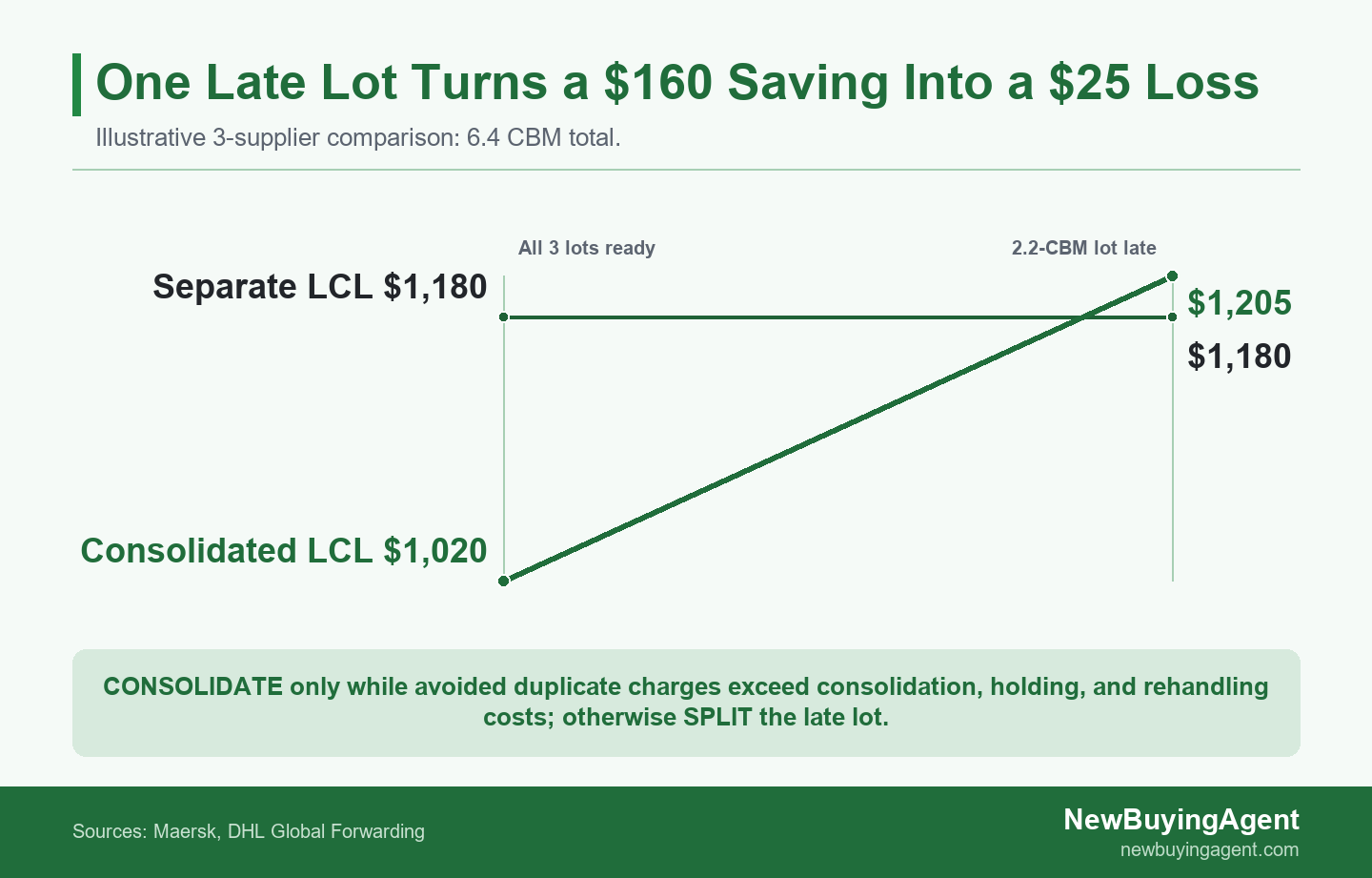
Illustrative LCL consolidation decision curve showing a $160 nominal saving becoming a $25 loss when a late supplier adds cost
Here is the transparent comparison. Three separate shipments create three $180 shipment-level charge sets, or $540. Their combined per-CBM freight component is $640. The separate baseline is therefore $1,180 before any destination-specific or exceptional charges. The combined option uses the same $640 volume component, one $180 shipment-level charge set, and $200 for transfer and warehouse handling. Its planned total is $1,020. The difference is the nominal $160 saving.
That $160 is not a reward for reaching 6.4 CBM. It comes from avoiding two repeated shipment-level charge sets after paying for the new warehouse step. If the per-CBM basis changes, the result changes. If the warehouse has extra pallet, storage, inspection, or relabeling work, the result changes. A calculation should therefore name its assumptions directly rather than presenting the saving as a rate-market fact.
When the 2.2-CBM late lot adds $185 of holding and rehandling in the illustration, the nominal $160 saving becomes a $25 loss. The comparison must therefore be recalculated at the cutoff, not copied forward from the first estimate.
The buyer is coordinating 3 suppliers totaling 6.4 CBM. Two lots have been received and checked at the warehouse: 4.2 CBM in total. The third 2.2-CBM lot is not received by the agreed cutoff. Its supplier has sent a production update but cannot provide a warehouse receipt, final carton count, or matching packing-list evidence. The physical volume has not disappeared; what has changed is the confidence that the combined shipment can still move on the planned sequence.
The direct option repeats shipment-level charges three times. The $160 saving assumed that all three lots would share one handling cycle and one release. Holding the ready cargo and preparing the late lot for another handling cycle adds an illustrative $185. This is a decision-useful cost because it is tied to the missed cutoff, rather than being folded invisibly into the original quote.
The apparent saving is now negative. The buyer should compare a ready-cargo booking and a late-lot booking against the new combined option, then choose the version that meets the destination need with the lowest confirmed total and least avoidable schedule exposure. If the late supplier can prove receipt before a revised cutoff without extra cost, reprice the combined option; do not merely assume the original $160 remains valid.
Move the ready 4.2-CBM cargo and calculate the late 2.2-CBM lot separately when its receipt evidence is missing. Before release, match warehouse receipts, carton counts, labels, packing lists, and the forwarder’s final quote lines to the selected booking. The example does not determine current rates, customs duties, insurance, dangerous-goods acceptance, or carrier booking terms.
When the Ready Cargo Should Move Without the Late Lot
If a supplier misses the cutoff, price the ready cargo and late cargo as two active alternatives instead of carrying forward an assumed consolidation saving. The buyer can then choose based on an updated total and delivery need, not an outdated headline figure.
Splitting is not automatically a logistics failure. It can be the controlled decision when the ready goods are tied to a launch window, a replenishment need, a customer commitment, or a carrier cutoff that is already credible. The key is to decide from current evidence. Ask for a fresh comparison with the ready cargo’s actual CBM, the late lot’s expected receipt date, and a clear statement of what charges have already become unavoidable.
Use an escalation rule before the problem occurs. For example: a lot without receipt evidence by the cutoff becomes a separate option; a lot received but not count-matched is held for resolution; a lot with a material label discrepancy is not released until the documents and carton marks agree. This preserves control without treating every delay as a reason to cancel the combined plan.
There are cases where waiting still makes sense: the late lot may be critical to sell a finished set, the revised sailing may preserve the customer deadline, or the added holding cost may remain lower than the separate-shipment charge. State the reason in the booking brief. A deliberate wait is different from an accidental wait caused by an undefined readiness standard.
Check the Operational Value Beyond the Freight Invoice
A consolidation is operationally useful when it reduces handoffs without making one weak supplier the schedule owner for every lot. The receiving process must therefore expose exceptions early enough for the buyer to keep the ready cargo moving if needed.
The operational benefit can be real even when the cost difference is modest. One controlled receiving point can create a common carton-count record, make label exceptions visible before export, and give the buyer one final packing-list reconciliation. It can also reduce the number of forwarder handoffs that need to be traced after departure.
But do not mistake one warehouse for automatic quality assurance. The scope should say whether the warehouse only receives cargo, or also counts cartons, checks markings, photographs pallets, reconciles documentation, or arranges inspection. A vague “consolidation fee” can conceal a mismatch between the buyer’s expected controls and the work actually included.
A concise booking brief should list supplier names, planned CBM, receipt cutoff, warehouse address, carton-mark format, packing-list owner, quote validity, release authority, and the fallback plan for a late lot. That document is often more valuable than an extra decimal point in the CBM total because it assigns who makes the next decision.
Turn the China-Side Handoff into a Booking Brief
Where factories are already selected, the useful work is often coordination: confirm what is ready, make the receipt evidence comparable, and ensure the forwarder receives one complete release instruction. The booking brief should make the handoff and fallback decision clear to every party.
NewBuyingAgent can supply products from China when a buyer needs a product brief and sourcing path. When the supplier set still needs to be developed, buyers can see how NewBuyingAgent supplies products from China and include packing and shipment-readiness requirements from the start.
A buyer can contact NewBuyingAgent with a multi-supplier shipment brief. To start with a controlled comparison, contact NewBuyingAgent with the multi-supplier shipment brief and include the destination, shipment timing, supplier locations, estimated CBM, and known readiness risks.
Frequently Asked Questions
How do you calculate LCL consolidation savings?
Calculate the separate and consolidated options from the same measured volume and comparable quote scope, then subtract all added transfer, warehouse, storage, and delay costs from the avoided repeated shipment-level charges. The result is useful only while its assumptions remain true. List each charge line, state the quote validity, and rerun the comparison when a lot changes volume, misses the receipt cutoff, or requires extra handling.
Is total CBM enough to decide on consolidation?
No, total CBM alone is not enough to decide consolidation. DHL’s LCL guide supports the shared-shipment context, but it cannot show how many fixed charge sets you avoid, what warehouse work costs, or whether every supplier lot is ready by the same cutoff. Use total CBM with individual lot volumes, complete quote lines, and confirmed receipt evidence.
When should a late supplier ship separately?
A late supplier should ship separately when the added holding, rehandling, and schedule exposure of waiting are greater than the remaining consolidation saving, or when the ready cargo has a meaningful delivery deadline. Reprice the ready and late lots as active alternatives using the latest evidence. If a revised receipt date preserves the booking without material extra cost, the combined shipment may still be viable, but it must be recalculated.
What should a comparable LCL quote include?
A comparable LCL quote should state the volume basis, shipment-level charges, origin and destination handling, domestic transfer, warehouse work, storage assumptions, documentation requirements, route, currency, validity period, and exclusions. It should also distinguish confirmed charges from estimates. If a line is unknown, leave it visible as an open assumption instead of treating the quote as fully comparable to another option.
Can one warehouse consolidation reduce supply-chain risk?
It can reduce handoff complexity by creating one receiving record and one coordinated release point, provided the warehouse scope and cutoff are clear. It also creates a shared delay point when one supplier misses the agreed standard. The practical control is a documented fallback: define what evidence makes cargo ready, who can approve a wait, and when ready cargo should move without the late lot.
NewBuyingAgent
Related Resources



Get Started Today
Let's Turn Your Sourcing Goals into RealityWeChat:+86 15157124615
WhatsApp:+86 15157124615
Address:Building 10 #39 Xiangyuan Road, Hangzhou, China
