

A multi-SKU consumer product can pass a sample review and still fail at launch. Between an approved sample and the first shipment, a brand has to confirm that every variant is ready: the product and its specification, the factory's ability to produce the volume, the pack, label and identity the market will see, and the price, order quantity and reorder assumptions behind the range. When those checks are compressed into one product approval, a gap on a single SKU travels into the launch. A launch readiness review separates the range into per-SKU release decisions.
A launch readiness review is the final cross-SKU check before a multi-SKU consumer product goes to market. It confirms that each SKU is ready across product and specification, supply and production, packaging and compliance, and commercial readiness, so the first order is released on evidence rather than on one approved sample.
The practical question is not whether the sample passed, but which SKUs are ready and which should wait.
What a Multi-SKU Launch Readiness Review Must Decide
A multi-SKU launch is only as ready as its least-ready SKU, so the buyer should review every SKU against the same readiness dimensions and decide to launch all, launch part of the range, or hold before the first order ships. The goal is not a longer approval meeting; it is a small number of decisions, each with a record that shows what was checked and who accepted it. The four dimensions below are the ones a buyer can write into a launch release checklist.
- Best for: brands and importers launching a multi-SKU consumer product from China who need a per-SKU release decision rather than one product approval.
- How it works: each SKU is checked against product and specification, supply and production, packaging and compliance, and commercial readiness.
- Key advantage: every dimension names its evidence and owner, so a SKU cannot be released on a verbal assurance.
- Decision: launch all, launch part, or hold, and name the condition that releases the held SKUs.
- Risk: a shared carton, insert or identity can spread one SKU's gap to the rest of the range.
What a Launch Readiness Review Means for a Multi-SKU Product
A launch readiness review is the final, cross-SKU check that confirms a multi-SKU consumer product is ready to go to market, by testing each SKU against product, supply, packaging and compliance, and commercial readiness before the first order is released. For a China-sourced range, those checks connect the buyer's product decisions to factory capability: what the market needs, what the design allows, what the pack and label state, and what the factory can repeat. It is wider than a sample approval and narrower than the whole development program, because its job is to release each SKU on evidence rather than to invent the product.
Quality discipline sits inside the review rather than beside it. ISO 9001:2015 is the quality management system standard published by ISO/TC 176, Quality management and quality assurance, and the logic of planning, verifying and approving before release is the same logic a buyer applies to a launch. The buyer's own specification, contract and destination-market rules set the content of the checks; the standard supplies the discipline of deciding on evidence. The transferable lesson is to plan verification and control changes, not to claim that a certification applies to a China order.
Because a multi-SKU range sits inside China manufacturing, it helps to see how requirements, tooling and production stages connect before writing the readiness checks; the China manufacturing and product guide explains how those stages relate.
Two limits matter from the start. A review can only confirm a decision that has been written down, so a brand that has not defined a SKU's specification cannot mark it ready. And a review records a decision; it does not guarantee the quality of every later unit.
The Readiness Dimensions to Review Before Launch
A launch readiness review covers four dimensions — product and specification, supply and production, packaging and compliance, and commercial readiness — because a multi-SKU range can be strong in one dimension and fail in another. A range with a perfect pack and an unproven volume is not ready, and a range that can be produced but cannot be labeled for its market is not ready either. Using the same four dimensions for every SKU is what makes the review comparable, and it is what lets a buyer hold one SKU without re-opening the whole range.
A range that shares a tool, a carton or a component still has four separate readiness questions, and the answers can differ by SKU.
The four dimensions are not a checklist of tasks; they are four decisions. Each one asks whether a specific piece of evidence exists and who accepts it, so a SKU that passes one dimension is not assumed to pass the next.
Product and Specification Readiness by SKU
Product readiness is confirmed SKU by SKU, because each variant has its own specification, tolerance and trade-item identity even when variants share components. Each sellable variant is a stock keeping unit, or SKU: a single variant defined by its own size, color, pack or configuration. A shared housing, a shared carton or a shared insert can make two SKUs look identical on the line, but each sellable variant still needs its own approved specification and its own identity. Product readiness is where a shared component stops being a reason to skip a per-SKU check.
Variant identity is standardized on the trade side. GS1 states that a Global Trade Item Number (GTIN) supports the unique identification of trade items, so a GTIN can be used by a company to uniquely identify all of its trade items, defined as products or services that are priced, ordered or invoiced at any point in the supply chain. A GTIN, or Global Trade Item Number, is the identifier that gives each sellable variant its own unique identity. When a size or a color can be ordered separately, it is a separate trade item, so the product check should confirm that each variant carries the right identifier before the launch.
For a range entering China sourcing, NewBuyingAgent's product-supply service sources the products against the readiness checks written into the brief, using local China factory resources and product-development/QC capability to connect each check to the factory that has to satisfy it.
Supply and Production Readiness
Supply readiness confirms that the factory can produce every SKU at the planned volume and hold the approved specification across a first run and a reorder. A verified sample is not yet a verified process; the question is whether the same factory can repeat the range across a run and then again on the next order. Supply readiness is where a shared tool, a shared carton or a shared line is checked for the whole range rather than one SKU at a time.
Scale-up is treated as a readiness decision rather than a formality. The NIST Manufacturing Extension Partnership is a program administered by the U.S. Department of Commerce's National Institute of Standards and Technology to strengthen small and medium-sized U.S. manufacturers through MEP Centers. The program supports U.S. manufacturers, so the transferable lesson is narrower: moving from a sample to volume is a decision supported by documented process evidence and named ownership, wherever the factory is.
Supply readiness also asks how the range will be followed once it is running. The evidence that matters is the same per SKU: production status, the pack that was actually used, and the check that confirms the run matches the approved baseline.
Packaging, Labeling, and Compliance Readiness
Packaging and compliance readiness confirms that each SKU's retail pack, label, claim and certificate match the approved product and the destination market before the range reaches the market. This is the dimension most often treated as artwork, but the pack carries the identity, quantity and origin statements that a market checks. A label that disagrees with the approved product makes the SKU unready even when the product itself is fine.
Packaging is a design and testing discipline. ISTA is a member-based nonprofit that empowers organizations and their people to minimize product damage throughout distribution and optimize resource usage through effective package design. A range that shares one carton or one insert should confirm that the shared pack still protects and presents each SKU, rather than assuming one SKU's pack result covers the others.
Compliance adds a mandatory step for covered products. Under 16 CFR Part 1110, finished products subject to a consumer product safety rule under the Consumer Product Safety Act must be accompanied by a finished product certificate, and the certificate must identify the finished product by a unique identifier such as a GTIN, model number, or SKU. That is why the identity check and the compliance check belong in the same review: the certificate and the pack both depend on the SKU's identity.
Labeling is regulated as well. The FTC's Fair Packaging and Labeling Act resource explains the federal law that requires consumer commodities to be labeled with the identity of the commodity and its net quantity of contents, so each covered SKU's retail label must carry a net-quantity statement that matches the packed product. A label with the wrong quantity is not a cosmetic error; it is a mismatch between the document and the product.
Commercial Readiness: Pricing, Inventory, and Repeat Orders
Commercial readiness confirms that the price, minimum order, inventory and reorder assumptions hold for the whole range before the first order is committed. A range can be technically ready and still fail commercially if the minimum order quantity (MOQ) is only workable for the largest SKU, if the price assumed one color, or if the first order leaves no room for a reorder. Commercial readiness is where the range is tested against the money and the next order.
Pricing across a range is rarely uniform. A shared component can make two SKUs cost the same, while a second color, a larger size or a different pack can change the price without changing the product. The review should confirm the price per SKU against the approved specification and pack, not against an average that no single SKU actually costs.
Repeat-order readiness belongs here too. The files, approvals and controls that released the first order should be reusable, so the second order starts from the same approved baseline instead of a memory. A range that cannot be reordered from a record is only ready for one launch, which is the opposite of what a multi-SKU line is for.
Read together, the four dimensions explain why a single product approval is not enough: the product can be right while the pack, the identity, the volume or the economics are not, and each of those lives on a specific SKU.
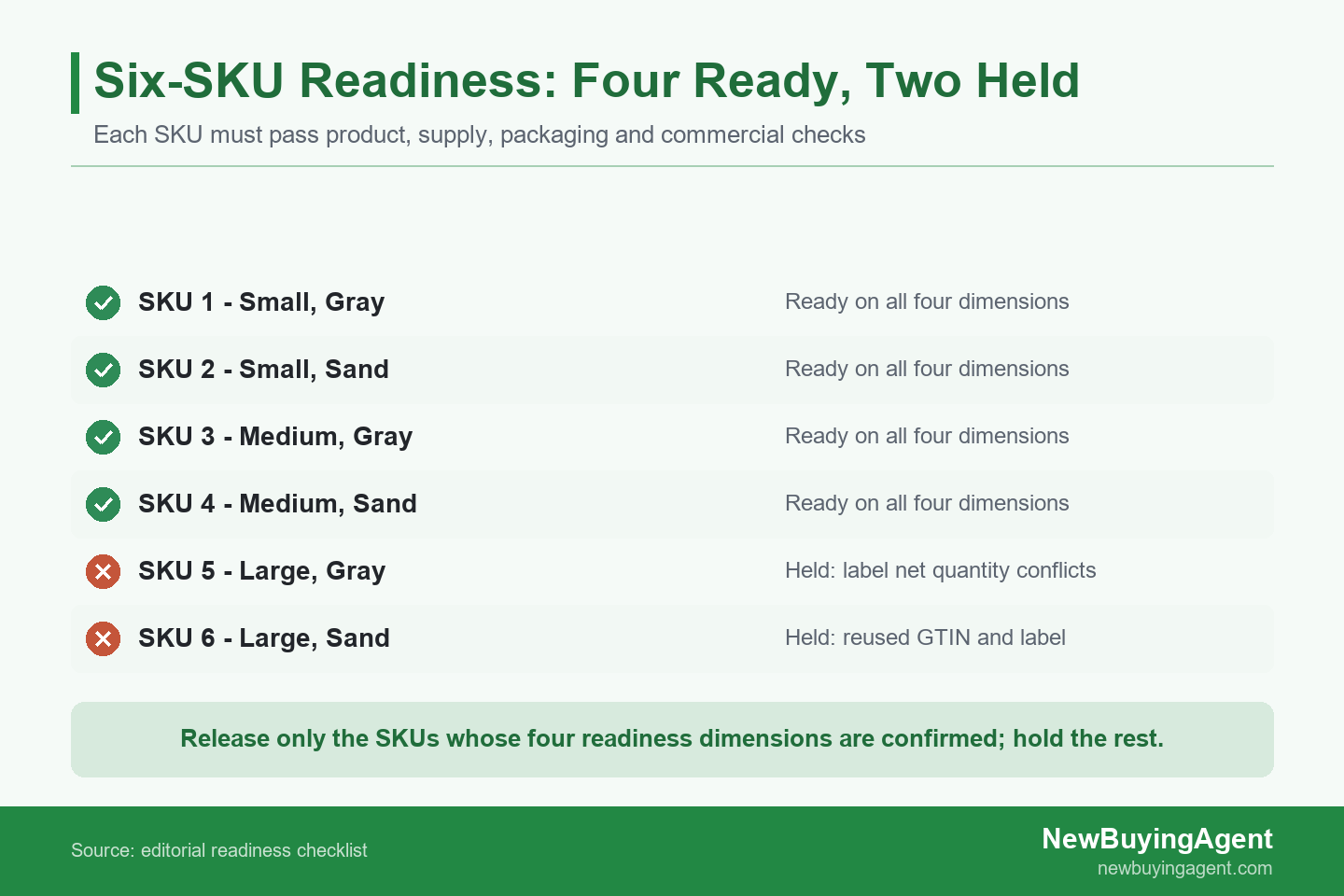
Per-SKU launch readiness checklist showing four SKUs ready on all four dimensions and two SKUs held for a label and barcode conflict
For a range already running at an existing factory, the practical work behind commercial readiness is follow-up rather than sourcing. NewBuyingAgent's existing-factory management service connects local China follow-up and quality-control capability to the per-SKU production and packaging evidence, so a volume, pack or reorder issue is caught before the launch rather than at the port.
The Multi-SKU Readiness Scorecard
A per-SKU scorecard records the readiness status, the evidence and the owner for each dimension, so a SKU cannot be released on a verbal assurance. A readiness scorecard is a per-SKU record that marks each readiness dimension as ready, held, or not applicable before launch. It is deliberately short: it names the evidence that changes the release decision at each dimension and the owner who accepts it. It is the part of the review a buyer can copy into a launch release checklist.
| SKU | Product | Supply | Packaging and compliance | Commercial | Release |
|---|---|---|---|---|---|
| 1. Small, Gray | Ready | Ready | Ready | Ready | Launch |
| 2. Small, Sand | Ready | Ready | Ready | Ready | Launch |
| 3. Medium, Gray | Ready | Ready | Ready | Ready | Launch |
| 4. Medium, Sand | Ready | Ready | Ready | Ready | Launch |
| 5. Large, Gray | Ready | Ready | Held: label net quantity | Ready | Hold |
| 6. Large, Sand | Ready | Ready | Held: reused identity | Ready | Hold |
Read the table as a release rule: a SKU is released only when its evidence exists and its owner has accepted it, and a held cell keeps that SKU out of the launch while the rest of the range moves.
Some evidence is set by law rather than by the buyer. Under 19 CFR Part 134, every article of foreign origin imported into the United States must be marked to indicate the English name of its country of origin, unless an exception applies. That marking is part of the pack and identity evidence the scorecard records, so it is checked before release rather than discovered at the port.
Launch Decision Rules and Boundary Cases
A readiness review has to define when to launch all, launch part, hold or stop, and it cannot replace a mandatory control for the destination market. Without a decision rule, the review becomes a delay rather than a decision, and a product inside a regulated category carries controls that an internal review does not remove. The rule should say which outcome applies and what evidence changes it.
Claims are part of that boundary. The FTC's Made in USA standard explains the requirements a product must meet before a company can claim that it is made in the United States, so a China-made SKU cannot carry an unqualified U.S.-origin claim. When a claim and a product disagree, the SKU is held until the claim is corrected, not launched with a footnote.
When to Launch Only Some SKUs
A partial launch should release only the SKUs whose readiness dimensions are confirmed, and it should name the condition that releases the held SKUs. A partial launch is the decision to release the ready SKUs while holding the SKUs that do not pass the review. The condition should be specific — for example, hold until the second color's net quantity is corrected and its identity is reassigned — so the hold has an exit rather than a hope.
The test for a partial launch is whether a held SKU can be separated from the released ones. If the held SKU shares a pack, a component or an identity with a released SKU, releasing part of the range can spread the gap, and the separation is not real. A partial launch works when the held SKU's problem lives inside that SKU and its own pack.
When the Whole Range Is Not Ready
A range is not ready when a shared pack, component or identity can spread one SKU's gap to the others, or when a mandatory control is unmet. In those cases a partial launch is not enough, because the released SKUs depend on the same corrected item as the held ones. The right decision is to hold the whole range, fix the shared item once, and re-check before release.
The distinction is between a gap that lives in one SKU and a gap that lives in the range. A single SKU's missing measurement can be fixed while the rest launch; a shared insert, carton or identity that is wrong keeps the whole range open until it is corrected. Deciding which case applies is the difference between a controlled partial launch and a launch that quietly carries the same defect into every SKU.
When One SKU Fails Readiness After the Range Is Approved
Separate reversible preparation from the release that depends on missing readiness evidence, and state the condition for release. In a real range the release is rarely all-or-nothing: some SKUs may be ready while others wait on a label or an identity correction. The point of the review is to make that split explicit instead of allowing an incomplete range to start production.
Illustrative Example: A Label and Barcode Conflict That Split the Launch
In this illustrative example, a consumer brand is preparing to launch a home-goods range of 6 SKUs, 3 sizes and 2 colors, with several SKUs sharing a carton and a component. It plans 12,000 units for the first production run at a China factory, and the range shares one carton size and one printed insert. The approved sample passed, production dates are set, and four SKUs have complete packs, labels and identifiers; the two largest sizes are still being finalized.
Four SKUs match the approved specification, pack, label and trade-item identity, so they look ready. Two gaps sit under the range. The retail pack for the two largest sizes carries a net-quantity statement that disagrees with the approved fill, and one of those SKUs reuses the trade-item identity of a smaller size. Because the printed insert is shared, a corrected net-quantity statement on the held packs also changes the insert copy that the ready SKUs use, so the two held SKUs are not fully isolated from the rest of the range.
The buyer's decision is to launch the four ready SKUs, hold the two affected SKUs, and pause the shared insert print run until the corrected copy is approved. The factory is asked to correct the net-quantity statement on the two held packs, assign a unique trade-item identity to the reused SKU, and re-check the pack and label against the approved product before the held SKUs are released.
Before releasing the held SKUs, the buyer reviews the corrected label and identity records against the approved product and confirms the shared insert matches; after release, the same records are kept for the reorder. This illustrative example invents no measured value and no passed test, and a ready SKU is not a guarantee for every later unit; the product's own critical characteristics and destination market govern the real scope.
Turn the Review Into a Launch Release Checklist
Put the readiness dimensions into the launch release checklist: the SKU list, the evidence and owner for each dimension, the held SKUs, the correction path and the import documentation. Written this way, the range is released against a record rather than a memory, and "the same as the sample" is replaced by a set of checks each SKU has to satisfy. The checklist also tells the factory what it shows before a SKU may launch.
Import and standards documentation belongs in that checklist rather than at the end of the process. The U.S. International Trade Administration's China Country Commercial Guide covers customs, regulations and standards, including tariff and non-tariff barriers, import requirements and documentation, and product standards. Naming the applicable documentation in the checklist keeps compliance evidence attached to the release decision instead of surfacing at the port.
For a range about to launch from China, prepare the SKU list, the specification and approved sample records, the target quantity and price, the destination market, and the delivery timing. NewBuyingAgent can use its local China factory resources and product-development/QC capability to develop a product quotation around those requirements, including the per-SKU readiness evidence and the release conditions. With that brief ready, send your product requirements to NewBuyingAgent.
Frequently Asked Questions
How is a launch readiness review different from a product approval?
A product approval confirms one item meets its specification, while a launch readiness review confirms that every SKU in the range has passed the same product, supply, packaging and compliance, and commercial checks before the first order ships. Approval answers whether the product is right; readiness answers whether the range, its pack, its identity and its economics are right. A range can have an approved product and still be held because one SKU's label or identity does not match it.
How many SKUs should be reviewed before a launch?
Every sellable variant in the launch should be reviewed, because each SKU carries its own specification, pack, label and identity, even when variants share a component or a carton. A range of six SKUs is six release decisions, not one. If a variant is held from the launch, the review should still record why, so the hold can be closed on evidence rather than reopened from memory.
Can a brand launch some SKUs before the rest are ready?
Yes, a partial launch is often the better decision, provided the held SKUs do not share a pack, component or identity that would spread the gap to the released SKUs, and the condition that releases them is named in advance. The test is separation: if the held SKU's problem lives inside that SKU, the rest can launch; if it lives in a shared item, the whole range waits.
What should a buyer prepare before a launch readiness review?
Before the review, a buyer should prepare the SKU list, the specification and approved sample records, the target quantity and price, the destination market, and the delivery timing, because those inputs decide whether the range can launch as planned. They also become the reference each readiness dimension is checked against, so a vague brief at the start usually produces a held SKU later. Prepare them in writing before requesting a quote.
NewBuyingAgent
Related Resources



Get Started Today
Let's Turn Your Sourcing Goals into RealityWeChat:+86 15157124615
WhatsApp:+86 15157124615
Address:Building 10 #39 Xiangyuan Road, Hangzhou, China
